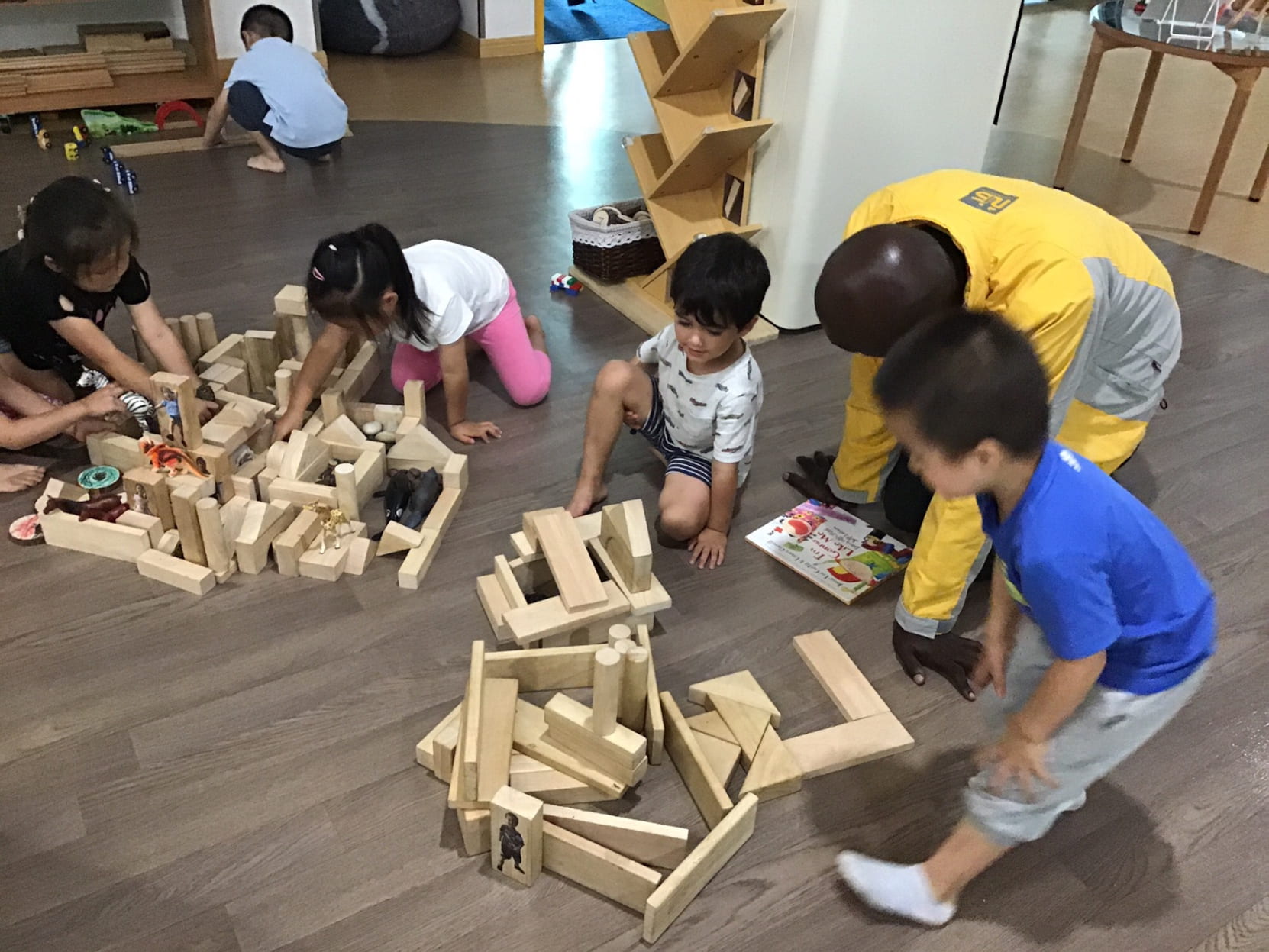
The Birthday Cupcakes – Final Steps

The Field Trip to the Skyways Kitchen!

After months of research, problem-solving, and collaborative inquiry, the children were ready for their field trip to the Skyways Kitchen. We gathered all the materials we needed: the cartons of milk, the lunch cards, and the first aid kit that the children had planned to take. We stepped onto the school bus, excited to visit Skyways Kitchen to make birthday cupcakes. The children spoke about the map they had created, which now directed their journey to the kitchen.

Mr. Patrick had prepared spaces for the children to make chocolate chip cookies and decorate the cupcakes. The children enjoyed both making and decorating the cupcakes, adding frosting and topping the cakes with Smarties, sprinkles, and wafer biscuits. As they worked to decorate over 75 cupcakes, the children in K2B made chocolate chip cookies for both classes.

Next, we went on a tour of the kitchen, looking at all the different areas used to prepare breads, ice creams, chocolate treats, and pastries. Mr. Patrick explained the various sections of the kitchen, showing the children all the tools and materials used, as well as discussing safety and hygiene when preparing food.

Finally, the children enjoyed a treat of hot chocolate. We were pleased that the milk had not gone to waste but was instead used to make hot chocolate for everyone on the trip.


The Cupcake Distribution

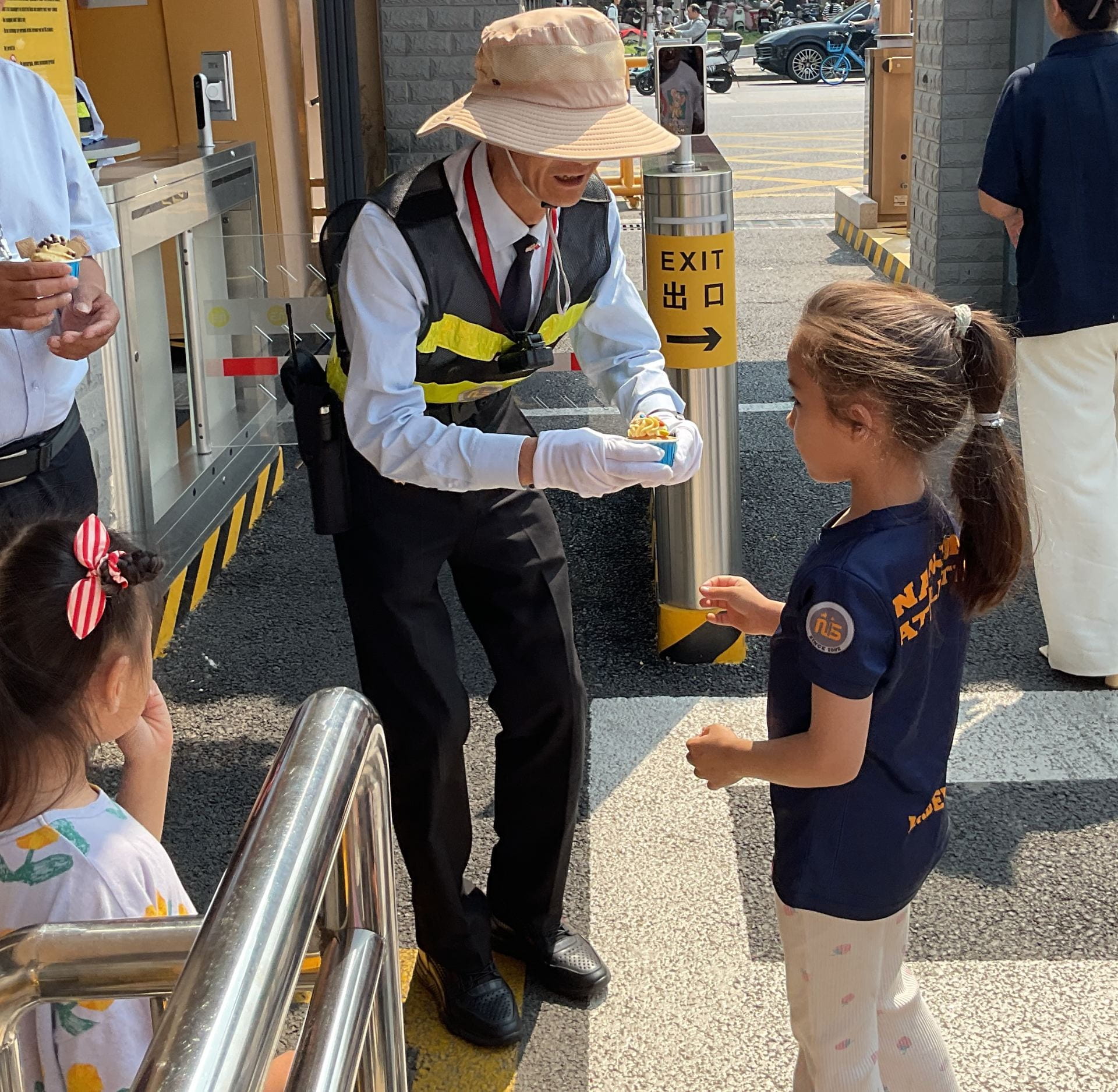
The cleaning staff and gardeners were excited to come into the Early Years Centre to meet the children. They were eager to learn about the project the children had been working on and delighted by the thoughtful gesture.

K2A visited all the different spaces with their teachers and their birthday cupcake trolley to distribute cupcakes to all the staff who had not received a cupcake for their birthday. They visited Aiden Kitchen, Homecaught, and the security guards.The children’s inquiry created opportunities for authentic learning experiences, allowing them to understand and appreciate the work that various members of the community engage in to make the school a positive and joyful environment. The children’s dedication to the project helped them learn more about themselves and the connections they share with those around them. This thoughtful gesture helped everyone feel included and appreciated
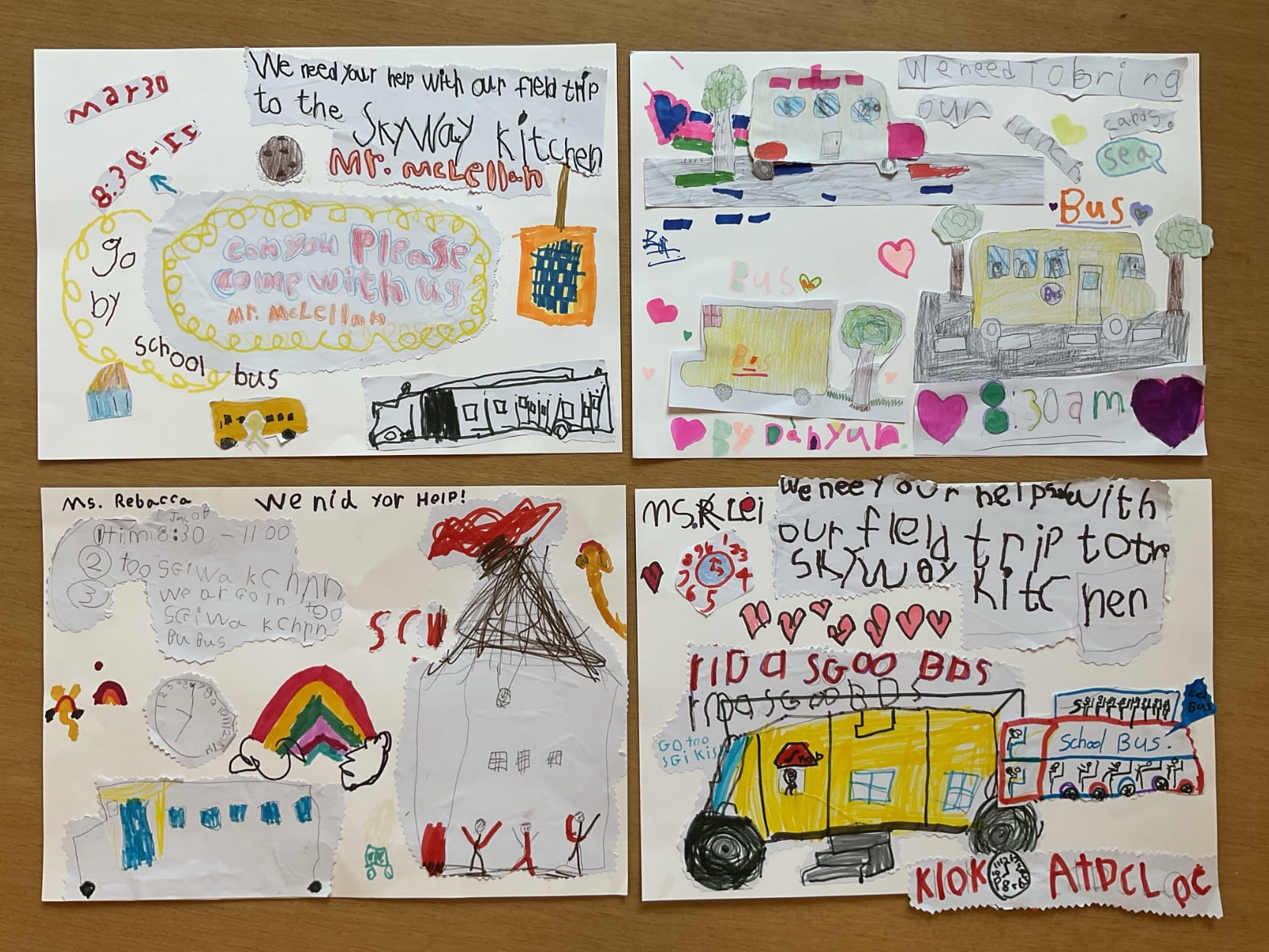
The Invitations

The children were ready to plan the rest of their trip to the Skyways kitchen. There were several activities they wanted to engage in during the trip, therefore, they had to think about additional support they needed. The children decided to invite some of their teachers to join the field trip to ensure some adults could support them. They sat with Ms. Hannah to decide on the important information they needed to include in the invitations, brainstorming and then designing the cards.

We are excited to finally visit the Skyways Kitchen to make the cupcakes for the community!

Celebrating Everyone in the Community

The Birthday Cupcake team met with Ms. Hannah to plan their next steps. One of the first steps was to find out how many people at NIS don’t get the PTA cupcakes. 

Ms. Hannah showed the children the list of the outside contracted workers at NIS, which was shared by the Human Resources department at NIS> Collectively, there are 18 security guards, 17 cleaners,  9 gardeners,  8 Homecaught workers, and 14 Aden workers at NIS.

These members do not receive a Birthday cupcake from the NIS PTA, as they are outsourced contracted staff. However, they get different types of birthday celebrations. The children thought it would be great for them also to get the PTA cupcakes and wondered how they could make this happen.  

  • Isabella “Where did PTA order the birthday? Maybe We can go to the place where the PTA orders and make the birthday cupcakes?”
  • Suzy “Maybe we can learn how they make the PTA cupcakes?”
  • Adalyn “I like to learn how to make the PTA cupcakes.”
  • Isabella “We can make cupcakes for our families.”
  • Evan “We can give cupcakes to those at NIS who don’t get the PTA cupcakes.”
  • Jacob “We need the map.”
  • Isabella “We need to find out where this bakery is. We will need a car, and if everyone goes, we will need a school bus.”
  • Suzy “Can we do it during Atelier time? Maybe we can ask everyone if they want to go at the end of the Atelier time.”
  • Adalyn “We will need transportation because we are all going. We can’t just go there.”

The team wondered who they could ask.

  • Suzy “We can ask the school bus driver. Maybe he will know.

They wondered how much money they needed for a cupcake.

  • Isabella “Maybe we can ask Ms. Rebacca about the cupcake cost?”
  • Jacob “We can then use the calculator to figure out how much in total.”
  • Isabelle “School bag and student ID card.”

The children presented their proposals to the rest of the K2A. They had some questions to solve before the field trip to the Skyways Bakery:

  • Can we visit the Skyways Bakery? Who can we ask?
  • Where do you get the map to the Skyways Bakery, where they make the PTA cupcakes?
  • How many cupcakes do we need to order?
  • Can we also make cupcakes for our families as well?
  • How much is the cupcake?
  • How much money do we need to pay for all the cupcakes

The PTA Birthday cupcakes project invites the children to explore a range of different concepts through the process of research. Their inquiry has focused on the concepts of ‘inclusion’ and ‘community’, as the children have been learning about the people in their community to look for authentic ways to connect with them. As they dive deeper into this project, they will need to apply a range of skills to answer the questions and wonderings they have noted, plan their field trip and organise a special treat for those who do not receive one for their birthday. They will need to find more information about the location of the bakery, and explore maps signs and symbols to make decisions about the journey. They will need to contact relevant members of the community to organise the transportation and plan the field trip. They will need to contact the bakery to find out important information about the visit and plan for the necessary items and the money that would be required for the trip. We look forward to observing how the children apply their knowledge and skills to take responsibility for the preparation and organization of the field trip.

Presenting to the NIS Staff

The Cupcake Team and Ms. Hannah shared their presentation and poster with the children in K2A to seek feedback before presenting to the NIS faculty team during the ‘Monday Briefing’ in the Staff Room. Overall, the children thought they presented well because:

  • the voice was loud and clear
  • they took turns to share
  • everyone knew what to say!

The team worked together to prepare for their presentation to the NIS staff. They gathered all the items they needed for the display in the staff room.

  • Where should we keep the poster in the staff room?
  • Where should we stand when we present to the teachers so they can see all of us and the poster?

They made the decisions together. They presented the poster and the information to the teachers.

We wonder what their next steps would be!

Designing the Bike Park Signs

We revisited the bike park project to discuss our next steps. The children were invited to create new signage for the bike park.

A team of volunteers sketched their first ideas on paper. We noticed that some of the children wanted to include drawings, and some of them were keen to use words.

These ideas will be presented to the class to gather feedback.

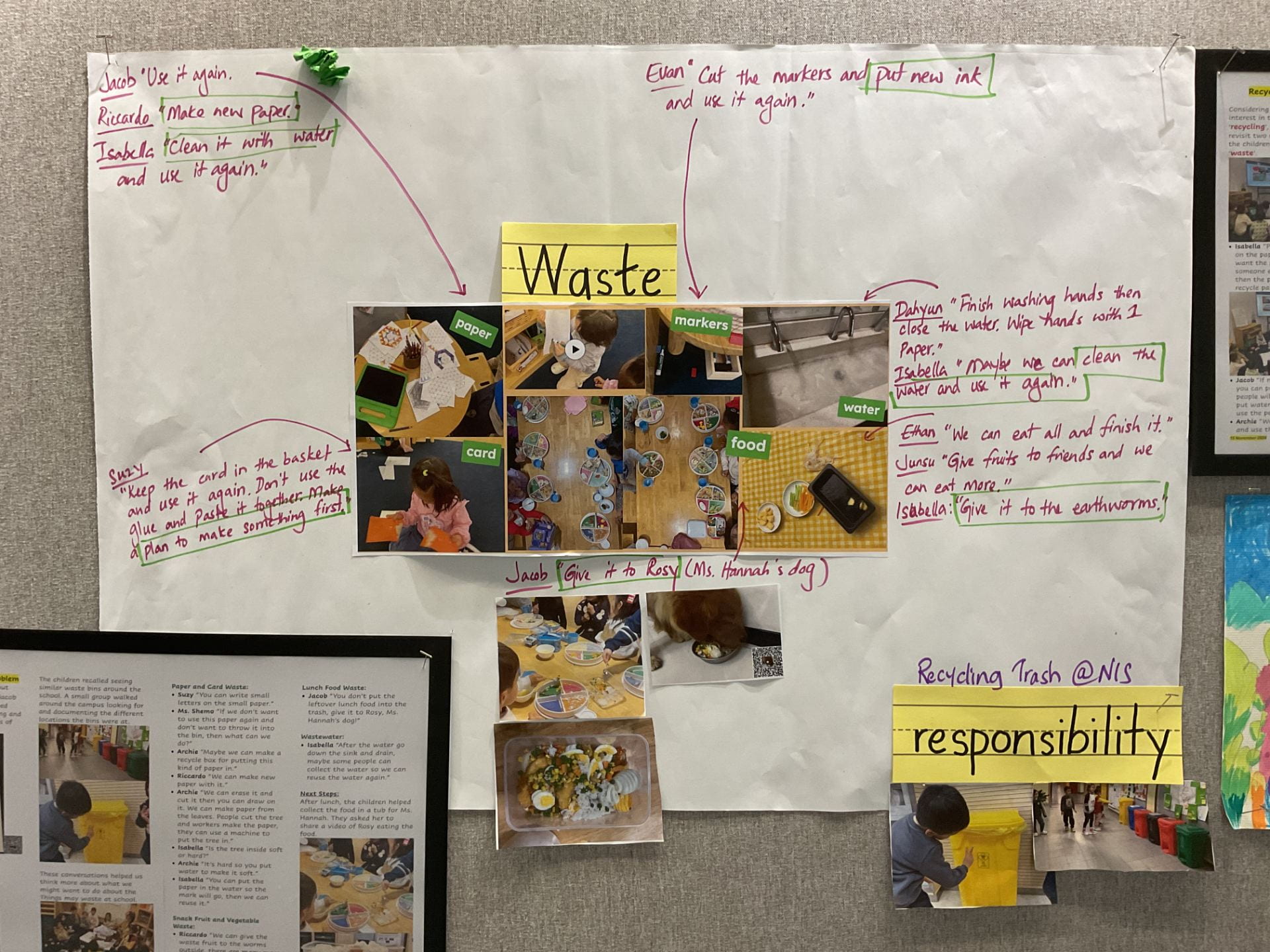
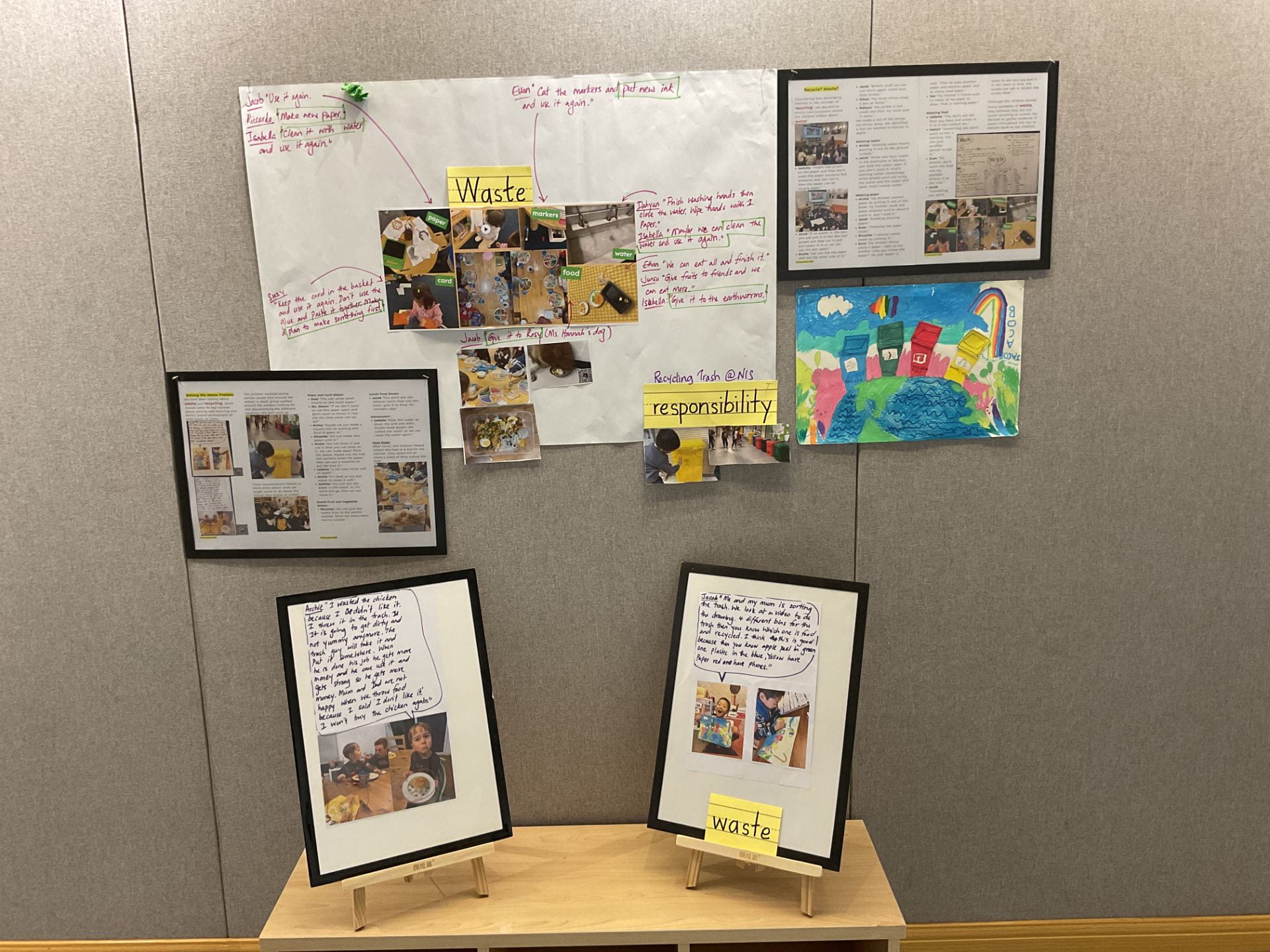
Solving the Waste Problem

We have been talking about waste and recycling.

Jacob shared what he had learned about sorting and recycling and Archie shared photographs of food waste at home.

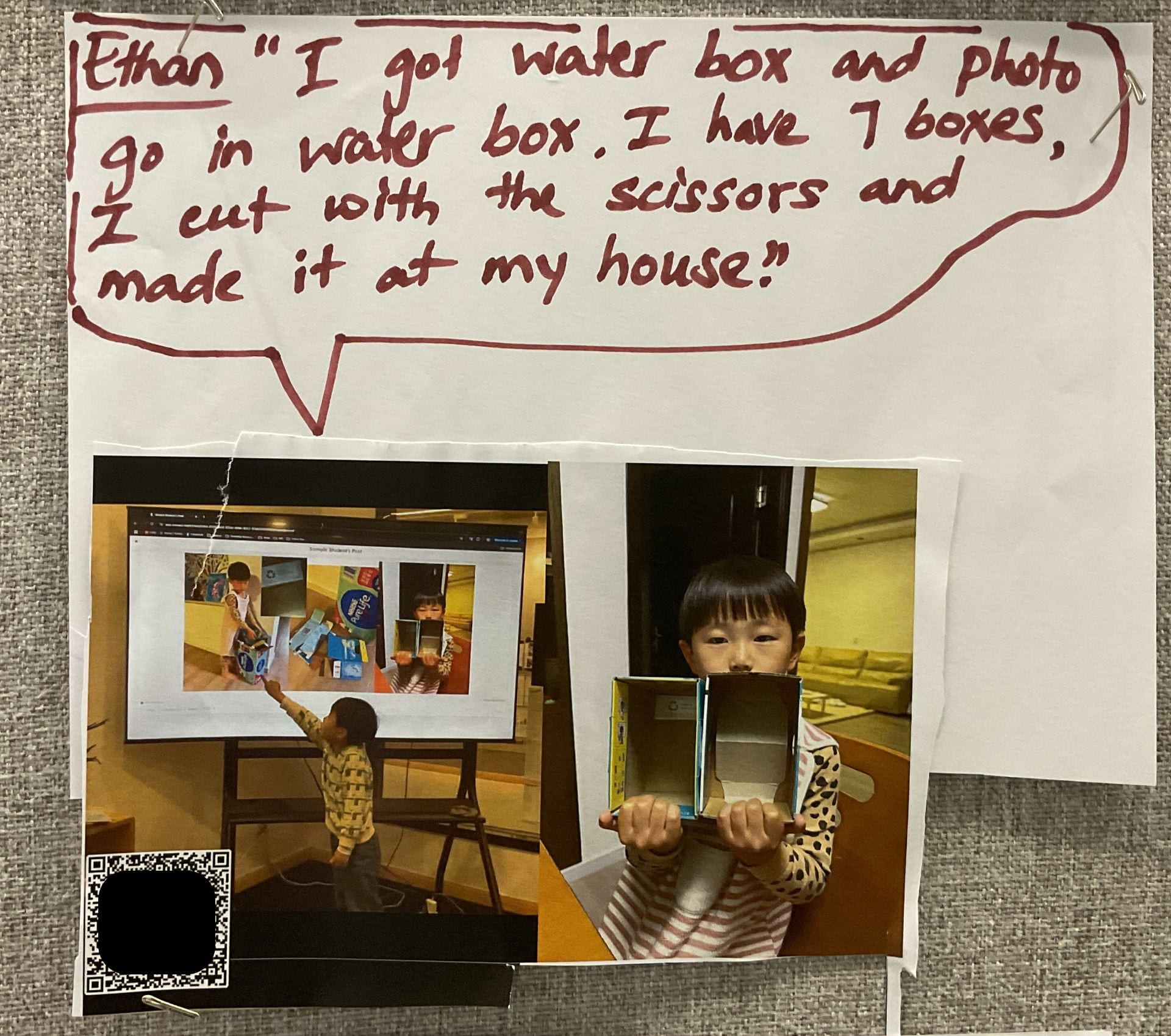
Isabella and Ethan had decided to repurpose the boxes they had at home. Isabella used the boxes to make a home for the cats in her compound to keep them warm during the winter. Ethan used his boxes to store objects.

The children recalled seeing similar waste bins around the school. A small group walked around the campus looking for and documenting the different locations the bins were at.

These conversations helped us think more about what ‘WE’ might want to do about the things we waste at school. 

Paper and Card Waste:

  • Suzy “You can write small letters on the small paper.”
  • Shemo “If we don’t want to use this paper again and don’t want to throw it into the bin, then what can we do?”
  • Archie “Maybe we can make a recycle box for putting this kind of paper in.”
  • Riccardo “We can make new paper with it.”
  • Archie “We can erase it and cut it then you can draw on it. We can make paper from the leaves. People cut the tree and workers make the paper, they can use a machine to put the tree in.”
  • Isabella “Is the tree inside soft or hard?”
  • Archie “It’s hard so you put water to make it soft.”
  • Isabella “You can put the paper in the water so the mark will go, then we can reuse it.”

Snack Fruit and Vegetable Waste:

  • Riccardo “We can give the waste fruit to the worms outside, there are many more worms outside.”

Lunch Food Waste:

  • Jacob “You don’t put the leftover lunch food into the trash, give it to Rosy, Ms. Hannah’s dog!”

(We asked the children to consider other possible solutions to the problem.)

Wastewater:

  • Isabella “After the water go down the sink and drain, maybe some people can collect the water so we can reuse the water again.”

Next Steps:

Our brainstorm highlighted many different ways we can take action to solve some of the issues we found with waste.

  • Riccardo “I have a shop and they can come and buy my toys and I get money.”
  • Archie “When I was in India my mum said I have too many toys and I gave some away.”
  • Euno “I eat all of my rice. When there is too much my mum throw in the bin.”
  • Riccardo “Or you can keep it and then eat it later.”
  • Shemo “What can we do with the fruits and vegetables we remain at school?”

Ms. Shemo “What can we do with the fruits and vegetables we remain at school?

The children decided to take the fruit and vegetable snacks to Ms. Hannah to ask her for some advice.

Over the next few days, the children will work in small groups to explore some of their theories about paper and seek more information about wastewater and composting at school.

PTA Birthday Cupcakes – Next Steps…

Nest steps…

The team gathered to analyse the data they had collected through the survey. They noticed that many people received cupcakes from the NIS PTA, but a few didn’t. We made a list of all the people (or groups) who didn’t receive cupcakes. Then, the class took the information they had gathered to Ms. Hannah to plan their next steps.


Considering the children’s ongoing questions about the cupcakes, we suggested that the team speak to the PTA President to learn more about NIS Birthday cupcakes. The children brainstormed the specific wonderings they wanted to take to her.
  • Isabella “Why do somebody have cupcakes, but somebody doesn’t have cupcakes? How to decide on who has birthday cupcakes?” 
  • Jacob “Why does the PTA want to give cupcakes?”
  • Suzy “How did you make cupcakes?”
  • Evan “How many ingredients do you need to make cupcakes?”
  • Adalyn “Who made the birthday cupcakes? Did you make it by yourself?”
  • Sea “How many cupcakes did you need to make?” 

The PTA President came in to speak to the children about the cupcakes. The children gathered their notes to ask her the questions they had brainstormed. 

  • Isabella “Why do somebody have cupcakes, but somebody doesn’t have cupcakes?

We learned that the PTA had to think hard to plan and organise the cupcake distribution. At first, they wondered if they could deliver cupcakes every week or every month. They decided that it was better to share the cupcakes once a month with children, teachers and staff who had a birthday in that particular month.

  • Rebeca “When it is your birthday then you get a cupcake. Next week we will go to November so you need to check when it’s your month and then you remember and go to pick the cupcake.

  • How to decide on who has birthday cupcakes?” 

Rebeca “Every teacher and student receives a birthday cupcake. Not parents. All the children get the cupcake. We give to all NIS employees on the list, some of them belong to the facilities department like the bus drivers, so they receive their birthday cupcakes. The guards are not NlS employees so they don’t get a cupcake.”

Noticing that Ms. Hannah was on the list of people who didn’t get a birthday cupcake, Ms. Rebecca explained that perhaps Ms. Hannah was sick on that day or was not in school for some reason.

Rebeca “Some people don’t pick their cupcakes, and then we keep the leftovers in case they ask for them.”

  • Jacob “Why does the PTA want to give cupcakes?”

Rebeca “Do you like to get a treat when it’s your birthday? We thought that every child in the school liked to have a treat so we decided to give the children a cupcake.”

  • Suzy “How did you make cupcakes?”
  • Evan “How many ingredients do you need to make cupcakes?”

Rebeca “There are many ways to make cupcakes. You can use a recipe book. If you never made it before you can use this list of ingredients to make it. Egg, oil, milk, flour, baking powder, a tiny bit of salt. All together.

Then, you beat your eggs for 3 minutes, add oil and keep beating. If you don’t eat egg then tell us so we can make you a special cupcake. Then put the flour and baking powder and salt. And then you keep the dough for 3 hours and you put it in the oven, you make the tiny cakes and you wait for 20 minutes and that’s it. You can decorate the cupcakes as you wish. With cream, chocolate and candy.”

The children wondered if they could put gummy bears on their cake.

  • Adalyn “Who made the birthday cupcakes? Did you make it by yourself?”

Rebeca “Skyways are the ones that bake the cupcakes. They have a special place where they have a very big kitchen for professional cooks, chefs and bakers.”

Ms. Rebeca shared photographs of the kitchen. “Can you see how many things they have there? This is the place they prepare the dough. At the end of the year, we make 700-800 cupcakes. And then there are special tables where they make the dough and when they finish they need to put the cupcakes in a place where they can cool. There is an oven. There are 4 units as tall as the room. When they open the oven and take out all the cupcakes they put it in the tray. Then they decorate them.”

  • Sea “How many cupcakes did you need to make?” 

I think we make 800 or 900 cupcakes.

  • Hannah shared her wondering “If they forget to pick up their cupcake what do they do?

Rebeca “At the end of the day we send it to the teacher’s room so you can go to the teacher’s room you can pick it up.”

We learned that some people on the list did not receive a cupcake for their birthday.

We wonder how the children will use what they have learned to strengthen their relationships with the community

We look forward to hearing about their next steps…

The Bike Park – Safety and Functionality

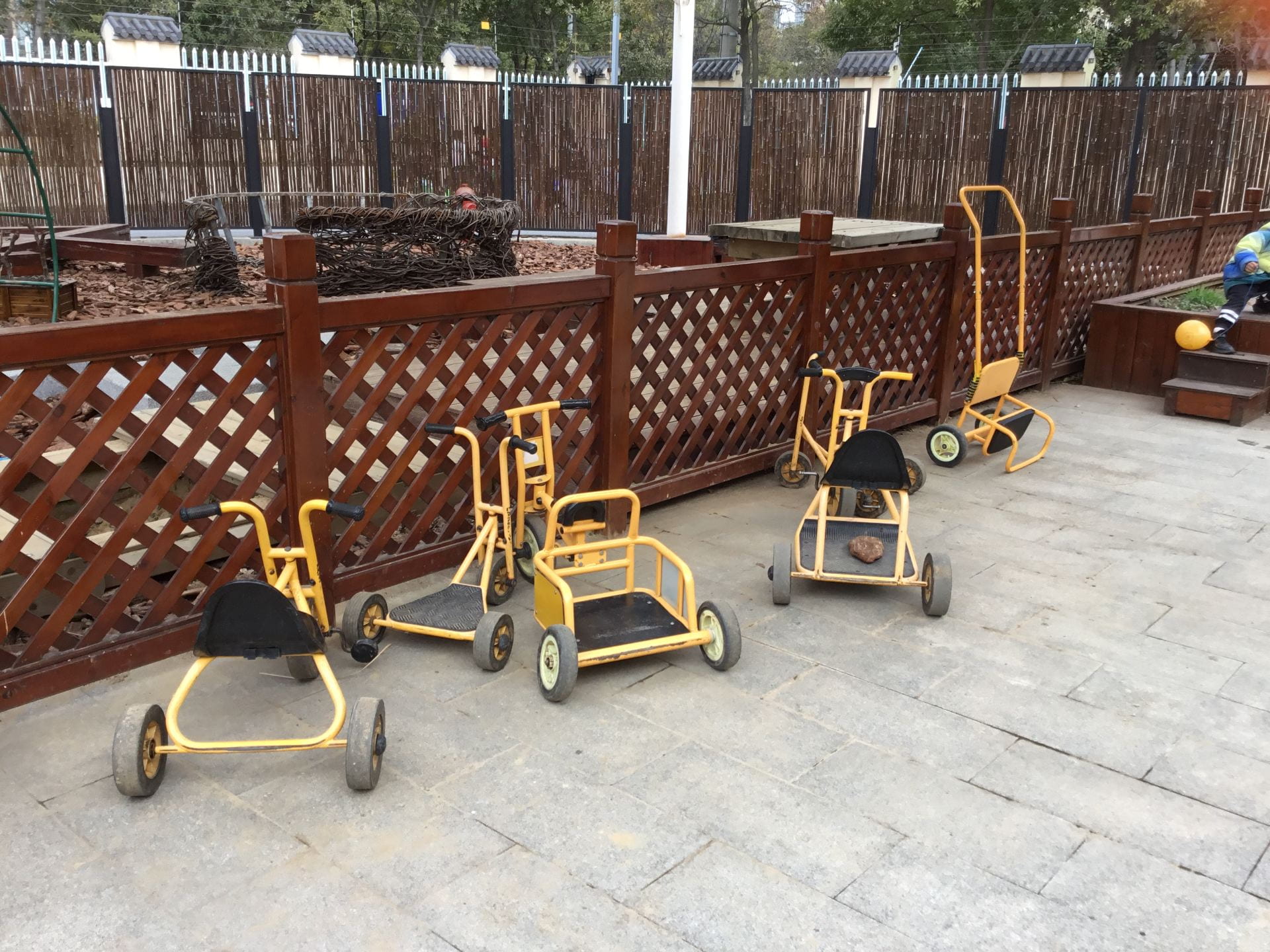
Over the last few years, different groups of children have worked on projects connected to bikes and trikes in the Early Years playground. We decided to share some photographs of the Bike Park to see what the children might notice about the bikes and signs in the play area.

The children quickly noticed that toys and gardening tools were not cleared away after playtime.

They noted that the bikes were blocking the walking path, and emergency exits, and that overgrown plants and bushes were making it challenging to park the bikes in the allocated spaces. Some suggestions for improvement:

  • toys need to be stored away in the correct places
  • bikes could be parked facing forward making it easier to write them away
  • store the sand toys on the sand table
  • clear the overgrown plants
  • Park the bikes along the fence
  • make new signs for the bike park

As they took a closer look at the signs that were made for the bike park, they realised that the wet and hot-dry weather had caused the signs to fade and get mouldy.

The children’s keen observations sparked conversations about the changes they could make to the bike park and play areas safer and more functional.

We decided to share documentation about the bike park from the previous years with the children, to help them understand and appreciate student-led projects that positively impacted the EY.

The children were excited to see some of the work past students had undertaken to make the play areas safer and more exciting for others.  

The children decided that they wanted to create new signs for the bike park. They wondered what materials would be most suitable for the purpose, considering the challenges with the weather and temperature outdoors.

They discussed the properties of different materials such as plastic and wood, providing interesting improvements to ensure the signs would last longer.  

We wonder what elements the children would consider as they move forward in planning, designing and creating new signs for the bike park.

The Trolley Project – Parts and Instructions

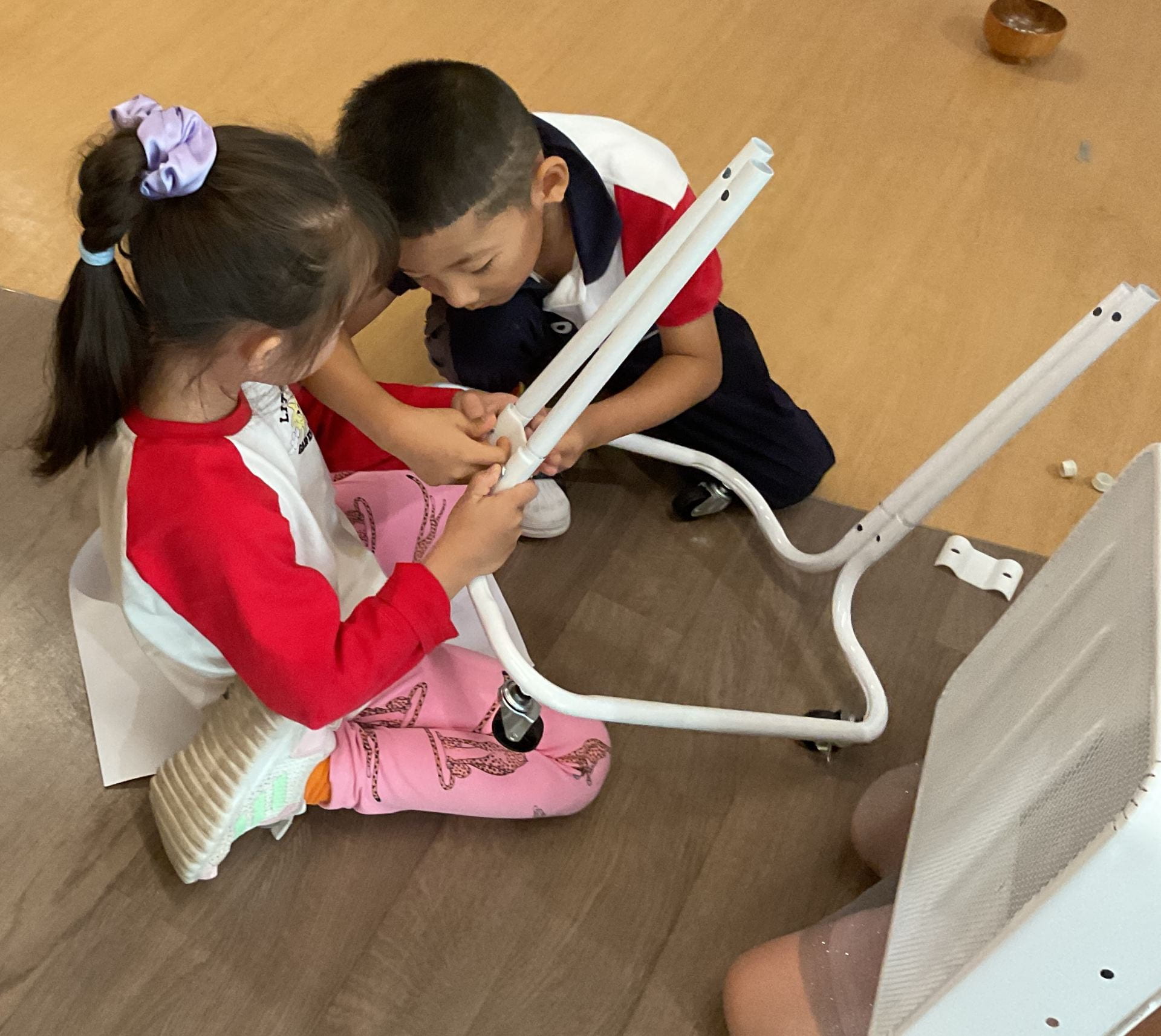
Over the last few days, the team of assemblers have continued to work on the trolley. They felt it was very challenging to put the parts together. They gathered to discuss the problem before they began their task.

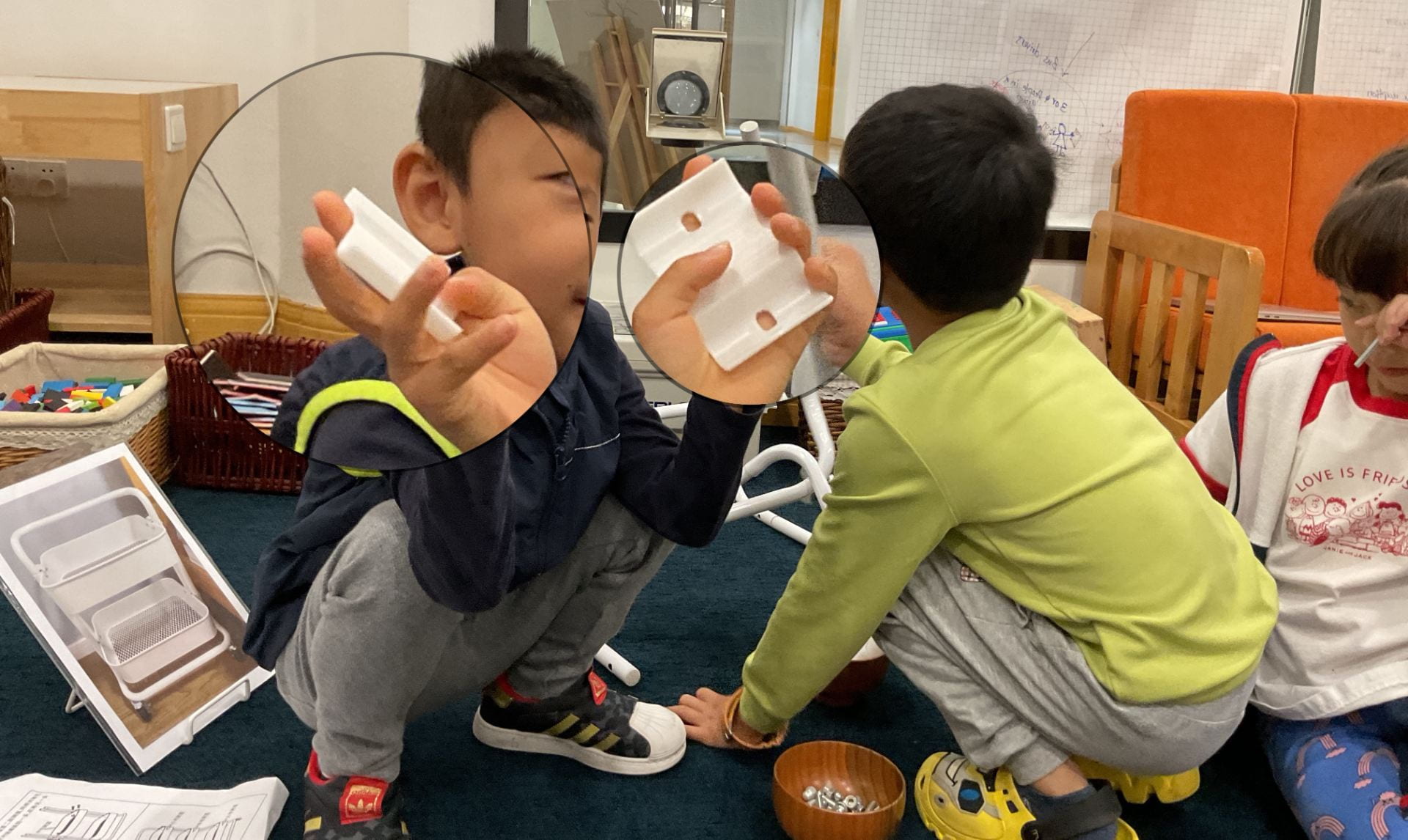
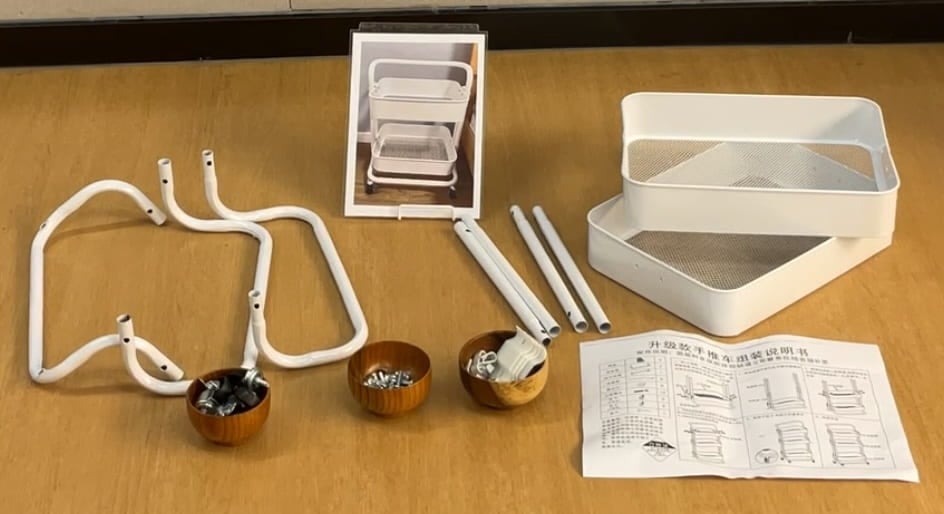
They began by looking carefully at all the different parts of the trolley.

  • Isabella “We have the small parts such as screws and wheels.”
  • Adalyn “We have the nuts.”

  • Jacob “We have the holders for holding the sticks.”
  • Isabella “We have the tools for assembling the trolley.”
  • Evan “We have the words.”
  • Adalyn “那个叫说明书。”(that’s called the instruction) A picture of the trolley.”
  • Jacob “The big parts of the trolley, like the baskets and sticks to connect them.”

Now that we have all the different parts of the trolley and the tools to assemble it, where do we start?Adalyn suggested that they read the instructions carefully. Isabella emphasised the importance of the pictures in the instructions. However, as they tried to assemble it, Evan could see that it was very wobbly. Isabella suggested taking the wheels off. Jacob agreed, explaining that this could come right at the end.

  • Isabella “There are some numbers that show us the steps.”
  • Jacob “Some parts such as the long sticks are too hard for us to insert”
  • Evan “We don’t have enough muscle.”
  • Jacob “We need an adult to help.”
  • Isabella disagreed and said, “We children can work together”.

The team continued their work together, assembling and dismantling parts of the trolley as they tried to complete the task. During the week, a clean-up in the Early Years centre posed a new problem!  

One morning, when the team went back to continue with their project, they found some of the parts were missing. How can we assemble the trolly without the parts?

Yet again, the team sat down together to work out which parts were missing. And how they might solve the problem. Isabella suggested that they look at the paper instructions to figure it out.

The instructions provided information on all the different parts that were required to assemble the trolley. They needed screws, nuts, black rings on the wheels, hooks and the holders. Together the team tried to calculate how many of each they needed in total. The problem invited the children to use their understanding of calculations to find the number of missing parts.

  • The nuts: Adalyn “We need 12 in total and we used 4, so 8 of them are missing.”
  • Hooks: Jacob “We had two before and now we only have one.”
  • The holders for the screws: Evan “There are 6 in total on the instructions, but there are three levels in the instructions, and we only need 2 levels for our trolley so we need two more.”

They continued to work on creating a list of items they needed. Then, the team plan their next steps to solve the problem. 

Jacob suggested asking the facilities department for the missing parts because they have the staff who come and fix items that are broken in the classroom. Isabella suggested reaching out to Mr. Matt as he helped fix the table. Jacob recalled Mr. Arek helping to fix ‘The Nest’ in the playground. Adalyn thought Ms. Jo might be able to help as well as she has lots of different materials for making things.

  • Adalyn “If none of the people that we mentioned above has the parts we need, we can buy another set of the small losing parts we need.”
  • Jacob disagreed, “if we buy only a set of the small parts, the other trolley is going to miss some parts.”
  • Evan disagreed with Jacob, “I think the shop must have some extra small parts.”

Everyone agreed with Evan’s suggestion, and they decided to ask the school purchasing office to help them source the missing parts. To do this they decided they had to:

  • take a photo of the parts they need
  • make a list of the parts that need to be purchased
  • measure the size of the different parts to give accurate information.

They worked together to gather all this information to take to the school’s purchasing officer. We look forward to their next steps as they solve the problem of ordering and purchasing the missing pieces in the trolley.


The Water Bottle Trolley (Part 1)

At the beginning of the year, a trolley for the water bottles was ordered for the class. We were excited to see the box with all the components needed for the trolley. But who will assemble the trolley?

The teachers decided to Present the idea to the children as a provocation. 

The next morning, some of the children noticed the provocation and discussed the idea.

They wondered what the different parts were and how they might be used.

  • Isabella “I know, they are parts of a trolley. We used to assemble a trolley when I was in Ms. Pat’s class last year.”
  • Suzy “Maybe we can help assemble this one.”

They began to take a closer look at the pieces. Noticing this interest, other children gathered to see what was happening.

  • Jacob “我来负责看说明书。” I can be in charge of reading the instructions.”
  • Evan “早知道我带个电钻来了。” I should have brought an electric screwdriver if I knew it before.”
  • Finn “看,这是这个!”(he pointed at the something on the instruction, ‘look, it is this’)
  • Evan “乔治,你装反拉,这个需要把它转过来。”(“George, you did it the opposite way. You should turn it around to the other side.”)

Isabella “Evan and George, do you still remember we assembled one trolley like this last year?”

Isabella “以前Ms.Pat 是不是像这样把推车给推走的?” (Did Ms. Pat hold it like this to push the trolley before, Evan?) Ms. Karen 以前带你们做过这个吗?(Did Ms. Karen do this with you in K1A, Adalyn?)

Evan tapped into his prior knowledge and tried to assemble the trolley.

George realised the significance of the picture of the assembled trolley and pushed it closer to the group. The assemblers began their work.

They continued to work on the trolley for a while, and then Evan realised that they needed to revisit the instructions. “这是说明书,你能看懂字吗Jacob?” (this is the instruction, can you read the Chinese characters, Jacob?)

Through trial and error, they continued to explore the complicated instructions, trying to figure out which parts went together. Some children slipped away to explore other spaces, but Jacob, Evan, Isabella and Adalyn continued to stay interested in assembling the trolley. They continued to persevere, finally deciding that it was important to develop a plan of action.

Jacob “Since the trolley has two parts, we can have two groups working on assembling it. Isabella and I will be in a group, and we are going to be in charge of the bottom layer. Evan and Adalyn, you two can be a team and work on the top layer.”

The group assembling the lower shelf began their work. They decided that when they were finished, the top group would take over. As they were working, they referred to the picture and the instructions when needed.

As we observed the children at work, we noticed how they used their communication skills to express their thoughts and ideas with each other to solve a common problem. They understood the significance of the instructions and their connection to the different components of the trolley. They used what they knew about pictures, Chinese characters, numbers and words to read the instructions and explain their understanding to each other.

Their idea of ‘making a plan’ to help with the process of assembling the trolley, and their decision-making demonstrates their understanding of the process, and teamwork and show their developing understanding that people work together for different purposes.    

Creating a Plan for Data Collection

Creating a Plan for Data Collection

The children have been thinking about the people in the community that they would like to speak to, to find out if they receive a PTA birthday cupcake.

They have been making lists and taking photographs of people in the NIS community to collect and organise their research.

As we thought about the task, we wondered about the ‘process of research’.

  • Jacob suggested that the children should spread out and speak to different people in the community, to make the process faster.
  • Isabella thought it would be better if three or four children went as a small group to speak to different people in the community.
  • Adalyn suggested that each group should have a teacher for safety and support.

The conversation went back and forth as the children shared many different perspectives and suggestions. The teachers decided to ask the children …  

  • How can we remember all the things we talk about?
  • How can we share or make our thoughts more visible?

A teaching Moment:

The children suggested writing down the ideas that were shared, to help us plan the next steps. The teachers scribed, drew and wrote as the children shared and discussed the details.

The teachers modelled adding details to illustrations to share information with others. We discussed the way illustrators choose colours and show action and key details through drawings. These are important techniques the children will be invited to practise and use when creating illustrations for different purposes. 


Creating a Survey

The children’s initial belief that everyone at NIS receives a birthday cupcake has been challenged!

A deep dive into our wonderings about the PTA birthday cupcakes at NIS has resulted in the children wanting to find out more about the cupcakes. They decided to speak to the community, to find out if this belief was true.

We discussed the next steps in our research. Perhaps a survey was required to gather the information the children were seeking. When this was suggested to the children, they recalled gathering data in a similar way, the previous year. They explained how they had done it, writing sentences down and seeking out people to find out what they thought. They recall recording their information on paper.

Isabella explained that a good question to ask the community would be, “Do you get a PTA cupcake?” The children agreed with Isabella’s idea. Next, a small group gathered to prepare the survey.

We began to plan our writing. Saying and stretching the words helped the children isolate the sounds and look for the letters they needed in an alphabet chart. Sight Word cards were used to help the children write the words that were harder to sound out.  We talked about leaving spaces between words and punctuation at the end of the sentence.  

The surveys were photocopied and clipped onto boards as they needed to ask many people in the community.

The researchers practiced conducting their survey by asking their friends and teachers in K2A.

Next, they will visit different people in the community to see what more they can learn from their research.

The team of researchers will bring their data to the rest of the class to share their findings.

We wonder what they might uncover through their research!

Do you get a birthday cupcake?

Euno and Ms. Shemo received a birthday cupcake from the NIS PTA. They were both excited to have their cupcakes at the end of the day! 

Jacob “But why do YOU get a cupcake?”

Ms. Shemo explained that she also received a birthday cupcake as her birthday was in August. However, Jacob’s wondering got us all thinking. Do ALL teachers get a cupcake?  

– Does everyone at NIS get a birthday cupcake from the PTA?

This led to a discussion about the community at NIS. The children tapped into their experiences at school to share what they knew about the different people who work around them. Some people we knew a lot about and others we didn’t. They decided to speak to people to ask them if they received a cupcake from the PTA for their birthday. We documented the children’s ideas on large chart paper to gather all our thoughts and observations in one place.

During the next few weeks, we will seek out opportunities to engage with the people the children identified in their brainstorm, as well as others in the school community, to get to know them and their roles at the school.

– We wonder how the children will document their thinking.

– We wonder what they might uncover through their inquiry into their community.

Approaches to Learning (ATL’s)

  • Use discussion and play to generate new ideas and investigations.
  • Engage in conversations.
  • Listen actively and respectfully to others’ ideas.

Earth Week

Does trash last forever?

We began our day by talking about Earth Week and the different activities that we might be engaged in to bring awareness to our role in keeping the environment safe and clean.

During snack time, the children noticed the amount of garbage we were producing. The children shared their observations and began to suggest how we could solve some of the problems we have with trash. 

One suggestion was to reduce the amount of packaged food we purchase and bring to school. Another way is to avoid using plastic or disposable cutlery.

To learn more about trash, we watched a Mystery Science video on the question ‘Does trash last forever?’.

The children were surprised to see the mountains of trash that humans had collected.

They were sad to see what plastic in the ocean can do to the different creatures and plants that live in the water.

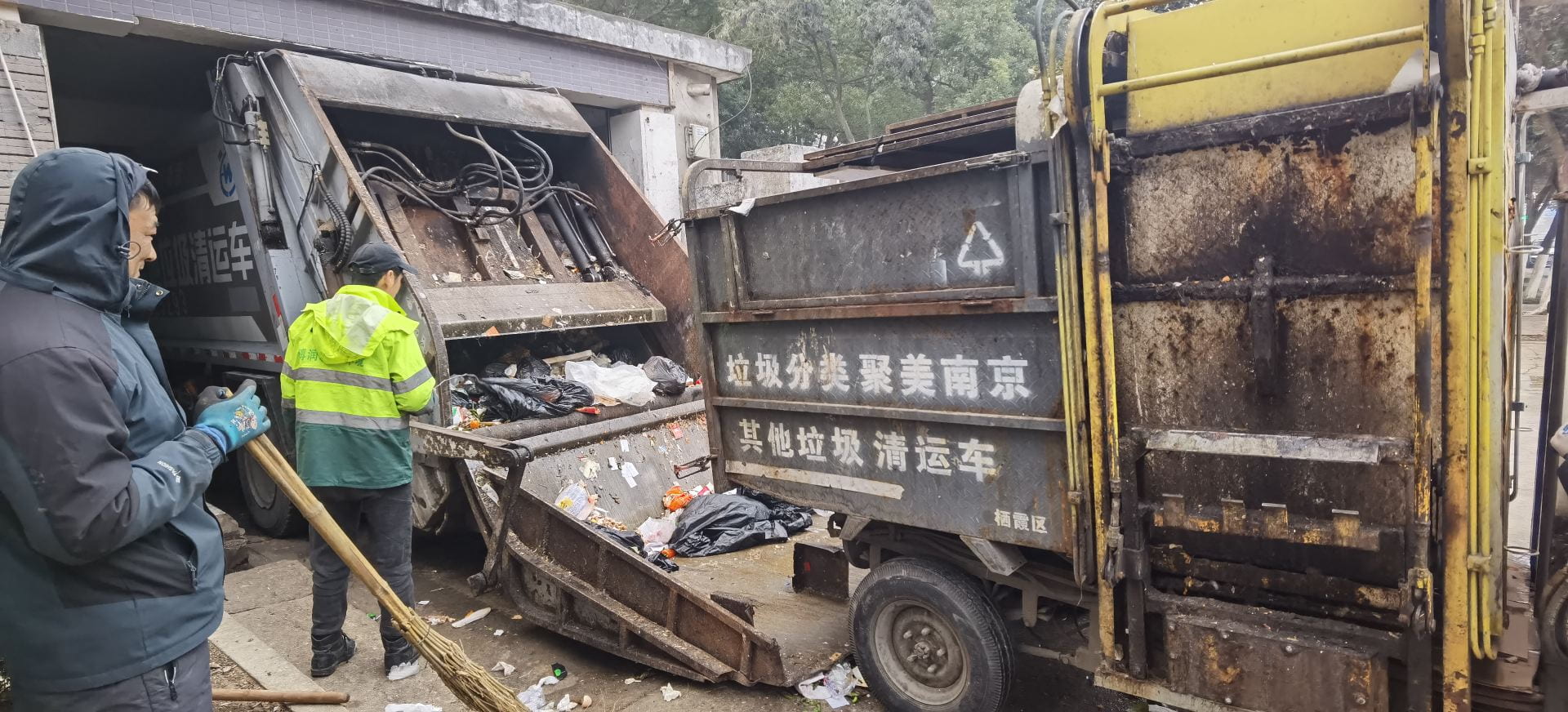
As part of our ongoing research into what happens to the trash and garbage we collect at NIS and Nanjing,  Ms. Nicole gathered some videos and photographs of garbage being collected around the city in Nanjing.

The children quickly recognised the workers in orange uniforms. We talked about the important service they provide to keep the city clean, safe and beautiful. How could we be more mindful of the waste we generate each day and how this affects our environment? 

Finally, we invited the children to bring in all the recycled materials they could find at home to see how we can sort, organise, re-purpose or create with these materials.

The children brought in recycled materials and then thought about the different ways they could recycle, create or re-use the items.

  • Wyatt “I am making an airplane fighting robot.”
  • Oxford “I am making a robot.”
  • Oliver “I am making a new flowerpot for new flowers.”
  • Motong “I am making trash boxes.”
  • Lydia “I am making a unicorn.”
  • Eli “I am making a rocket with a fire engine at the end.”
  • Liz “I made a bird and a bird’s nest.”
  • Beomjun “This is a little home.”
  • Jeongyoon “I am making a drum with a big cup.” 
  • Yui “I made a person with blue hair.”
  • Hana “I made a turtle.”


 ACTION: Taking Responsibility

SEE

  • Eli “I see Oxford cleaning up so many of the toys.”
  • Liz “I see some of the other children are not cleaning up.”
  • Lydia “I see some children are playing with the water and Oxford is cleaning up so many things.”
  • Motong “Oxford is NOT counting things.”
  • Jeongyoon “I see some people drink water when its tidy up time.”
  • Eli “I see the people are not cleaning up the shovels and Oxford had to clean all of the shovels up.”
  • Morning “I see people throwing toys in the Shed when its clean-up time and it’s very messy.”

THINK

  • Liz “I think other children are not cleaning up and are running around. I think play the things and not clean up.”
  • Oliver “I think some people just don’t want to clean up, they just count and clean up only 3.”
  • Lydia “I think them is play together and teacher ring the bell and them not clean up, just play.”
  • Eunbyul “I think some people do not clean up and drink water.”
  • Motong “I think Oxford did not play.”
  • Wyatt “When the bell gone, just play and not clean up it’s not ok.

You don’t get the toys and you don’t play.

  • Jeongyoon “I think only some are cleaning up.”
  • Liz “I think the teacher is done and the people are looking and Oxford just cleaned up. The playground is not clean up its not nice because its then so messy.”
  • Lydia “I think play is over and them play and go to drink water and teacher say take 2 gongs and then they go to class and not clean up, Oxford is cleaning up.”

WHAT CAN WE DO?  

  • MotongClean up all the toys and don’t count the toys. We hear one bell we need to clean up, and we hear two bells we can drink water.”
  • Lydia “We can tell people. We can take a paper writing and use the glue stick and tell everybody play and everybody needs to clean up.” Make a poster.
  • Eunbyul “We can drink water after we clean up.”
  • Eli “We can say to people ‘You HAVE to clean up even if you don’t play anything because this is everyone’s playground’.”
  • Wyatt “You hear the gong, you need to clean up.”
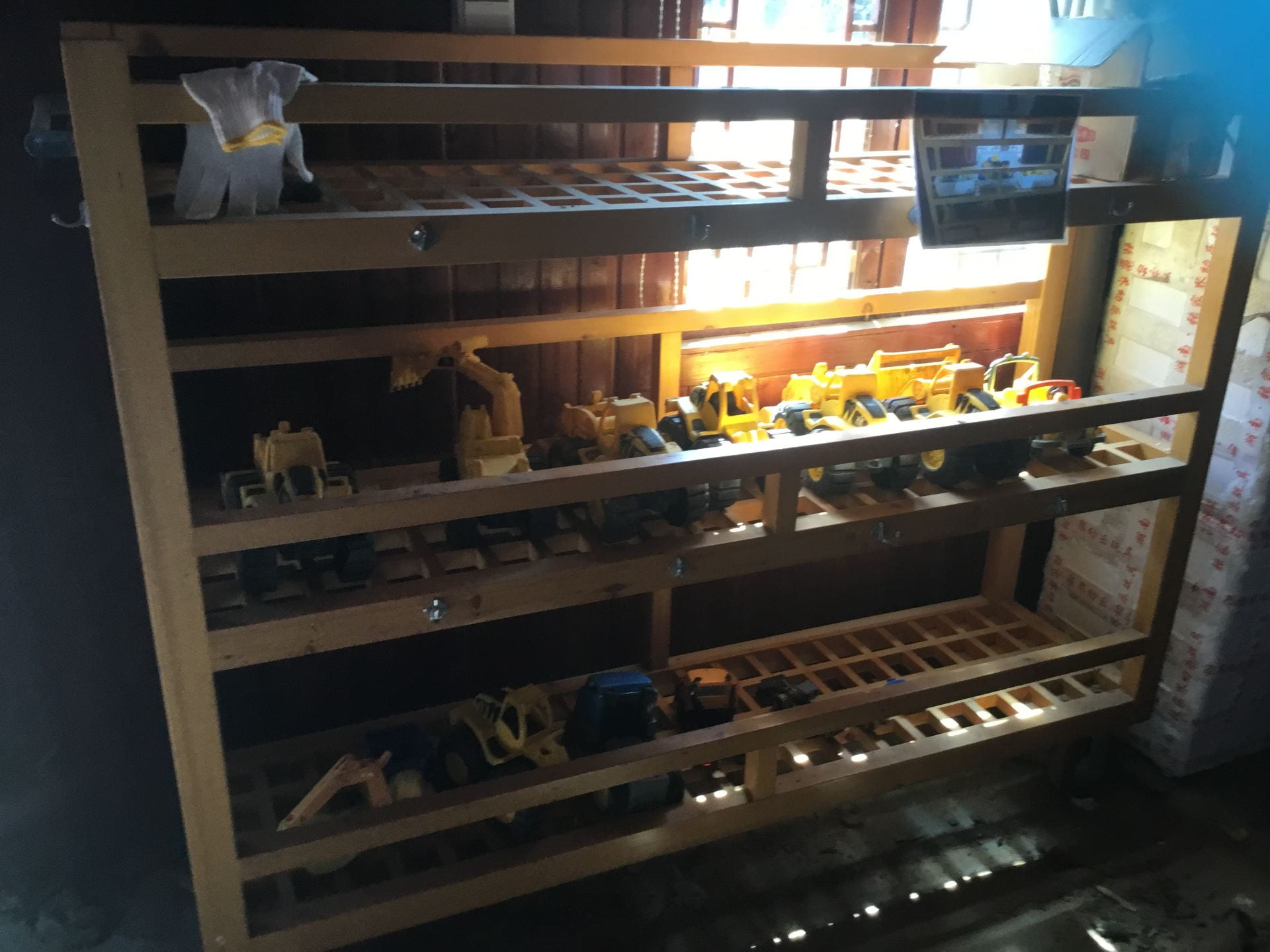
  • Morning “Put the trucks on the shelf and the shovels on the hooks.”


Caring for Living Things

We have noticed the child’s continued interest in living things in the Early Years playground. We decided to share some of the documentation the teachers have collected of the children’s play.

  • Liz “We found worms and roly-polys in the soil.”
  • Lydia “We are in the outside and we used the shovel to find the worms and the roly-polys and put them in the water. They were swimming. It looked like people swimming. We gave them to Eli and they are making a house for them.”

  • Eli “I hide them where the wood things are and I put the cap on so the roly-poly won’t come out and I can play with it next time. I put some leaves so they can eat.”
  • Oliver “It’s a baby beetle. They dig in the wood.”

  • Eli “They live in the wood.”
  • Oliver “They love the playground, they want to live there every day. They have lots of fun things to do. They are playing hide and seek under the soil.”
  • Liz “We put worms in the water. It was like water on my hand.”
  • Eli “I think you can’t keep them forever or they will die because you keep them every day in that pot and he eats all of the fruits and then they will have nothing to eat and they will die.
  • Oxford “There we have so much creatures.”
  • Oliver “You can just take a picture of anything you want to keep or the creatures you keep them for many days they won’t have anything to live.”
  • Wyatt “I and Eli play with the roly-poly and then put it in a cup and we just play there. And then finish playing.”
  • Liz “When we look at the worm they are moving, she wants to go to the soil because worm don’t like you holding it. Put it in the soil quickly.”
  • Motong “When we hold the insects we need to put some wet wood because they like it.”
  • Morning “I am looking at the roly-poly because it’s coming in the cup and then we put it back because they like the wood.”

We noticed that the children have a deep appreciation for the living creatures in nature. Their theories about the different insects reveal how they observe, form generalizations and develop understandings of nature. The children’s discussion about their play outdoors shows their sensitivity and growing awareness of how to care for living things and what they need to survive in their natural habitats.

  • We wonder how the children might document what they see, hear and know about the world around them.
  • We wonder how we might continue to develop their curiosities about the different creatures in our environment.  


Important messages to our community…

The Garden Project

@O and @L were our classroom representatives, working with Ms. Hannah and Ms. Eileen on the ‘Garden Project’.

On their return to class, they presented their ideas to K2A.

They explained the ideas they had discussed, sharing their drawings where they had documented their suggestions for improvement.

The Gardening Team have decided to:

  • cut and prune the overgrown bushes
  • add the cut pieces to the compost bin
  • use the compost to help the new plants grow
  • replant the seeds to make new plants
  • use the lemongrass and mint to make tea
  • and make space to grow other new plants for the season.

The children were excited to be part of the Garden Project.

We look forward to their next steps!     

Organising the Shed

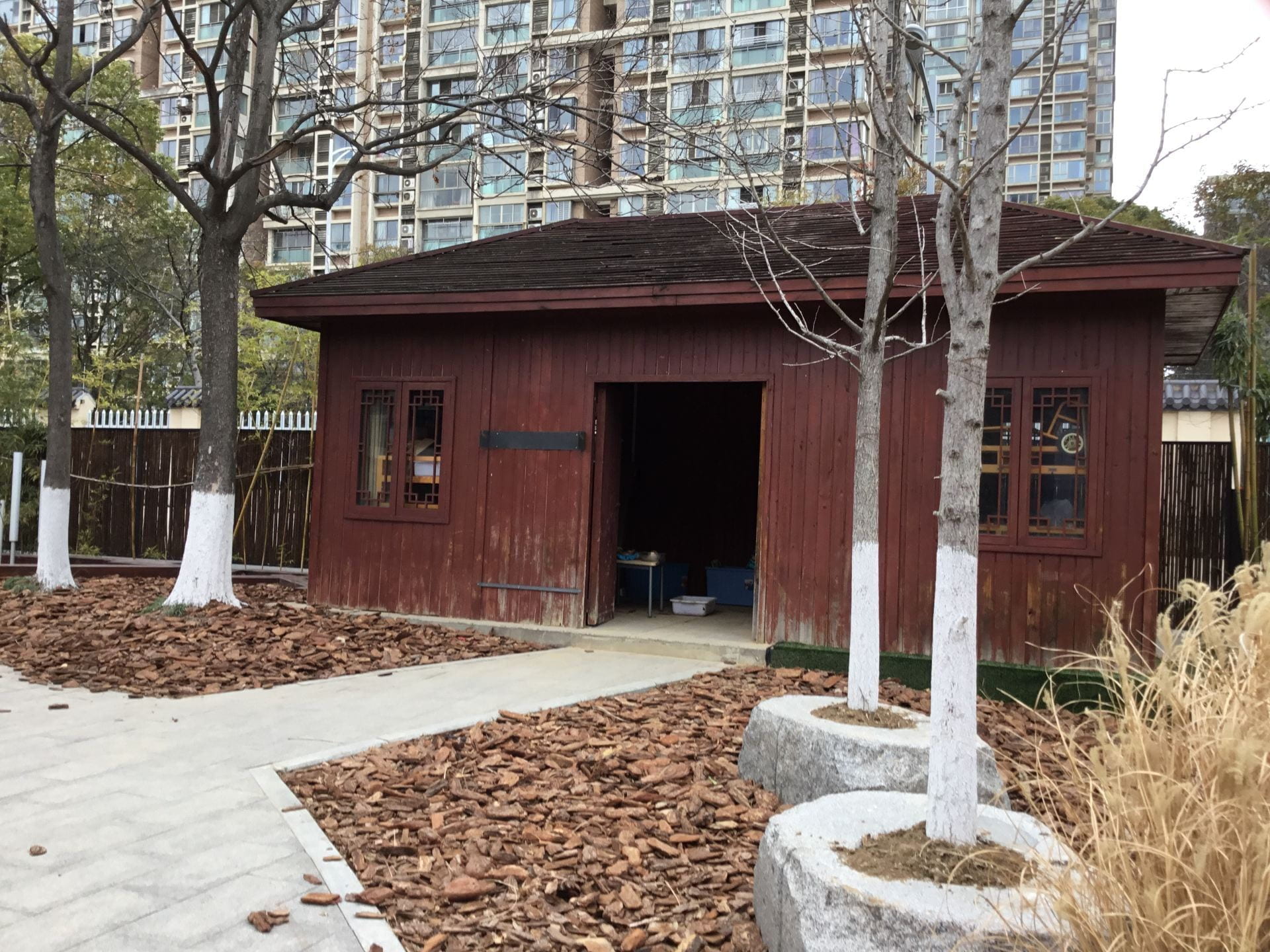
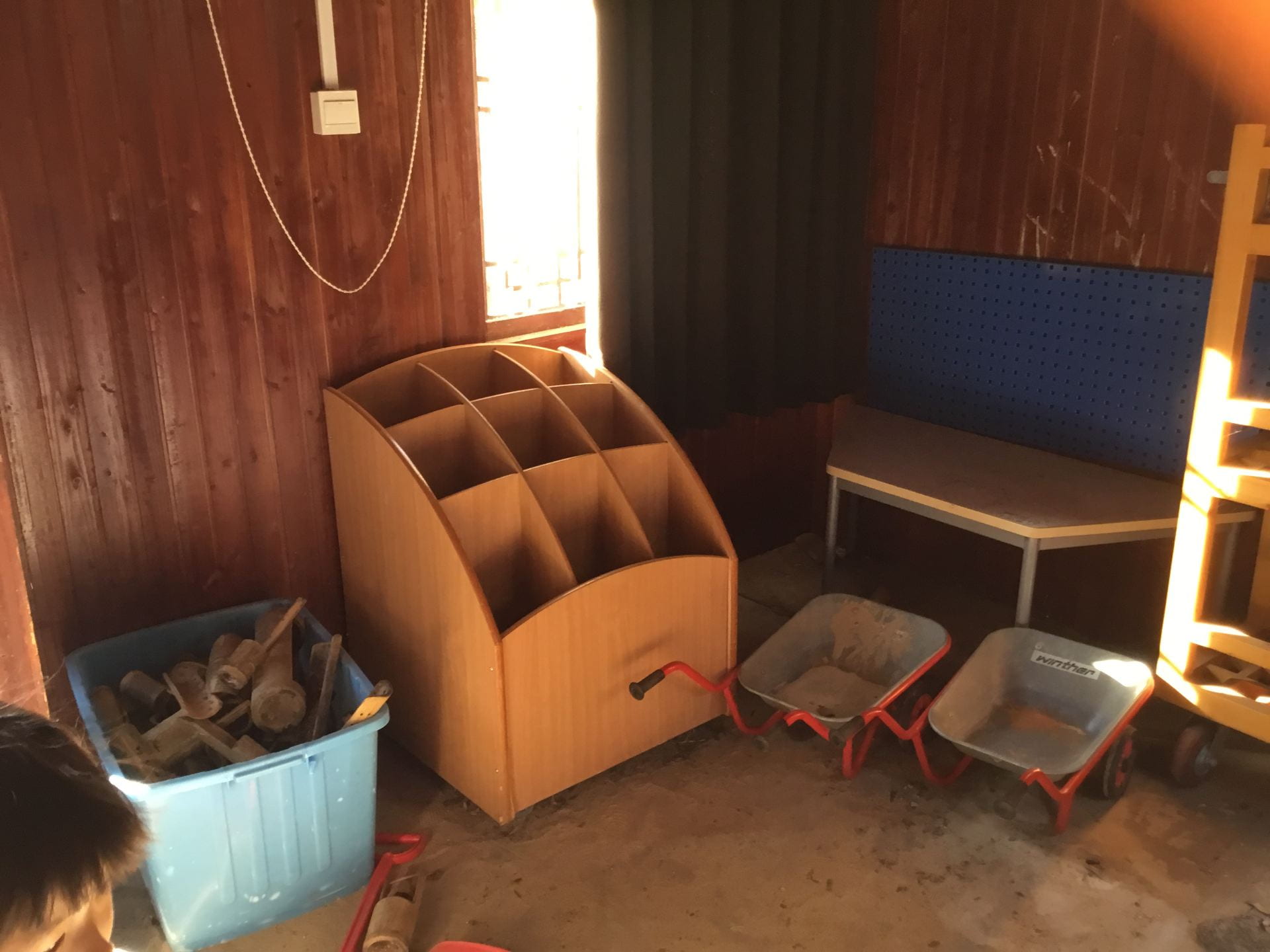
We observed the children at the end of outdoor recess as we noticed that they were having some challenges with putting the toys away in the designated spaces. We were particularly interested in learning more about the storage system in the ‘shed’, a storage space where all the water toys, cooking utensils and trucks are housed.

We decided to start by revisiting past documentation on ‘The Shed Project’, to learn more about the space. The previous K2 class had organised the space, ordered pegboards and hooks for the toys, and posted signs to help the children know where to store the toys.

A group of children went into the Shed to think about their next steps.

  • Liz “It is dirty and messy”
  • Lydia “We can clean it up!”

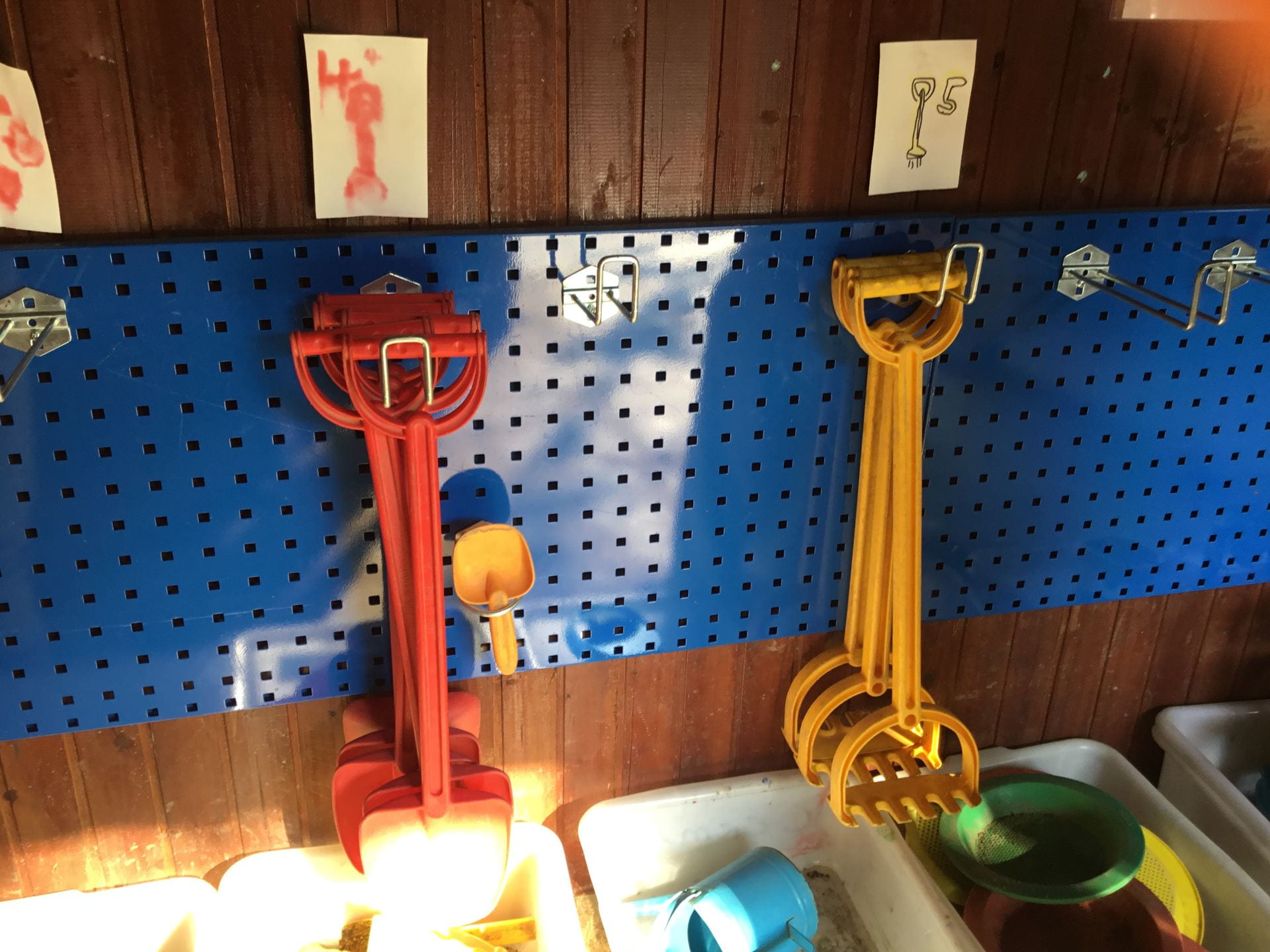
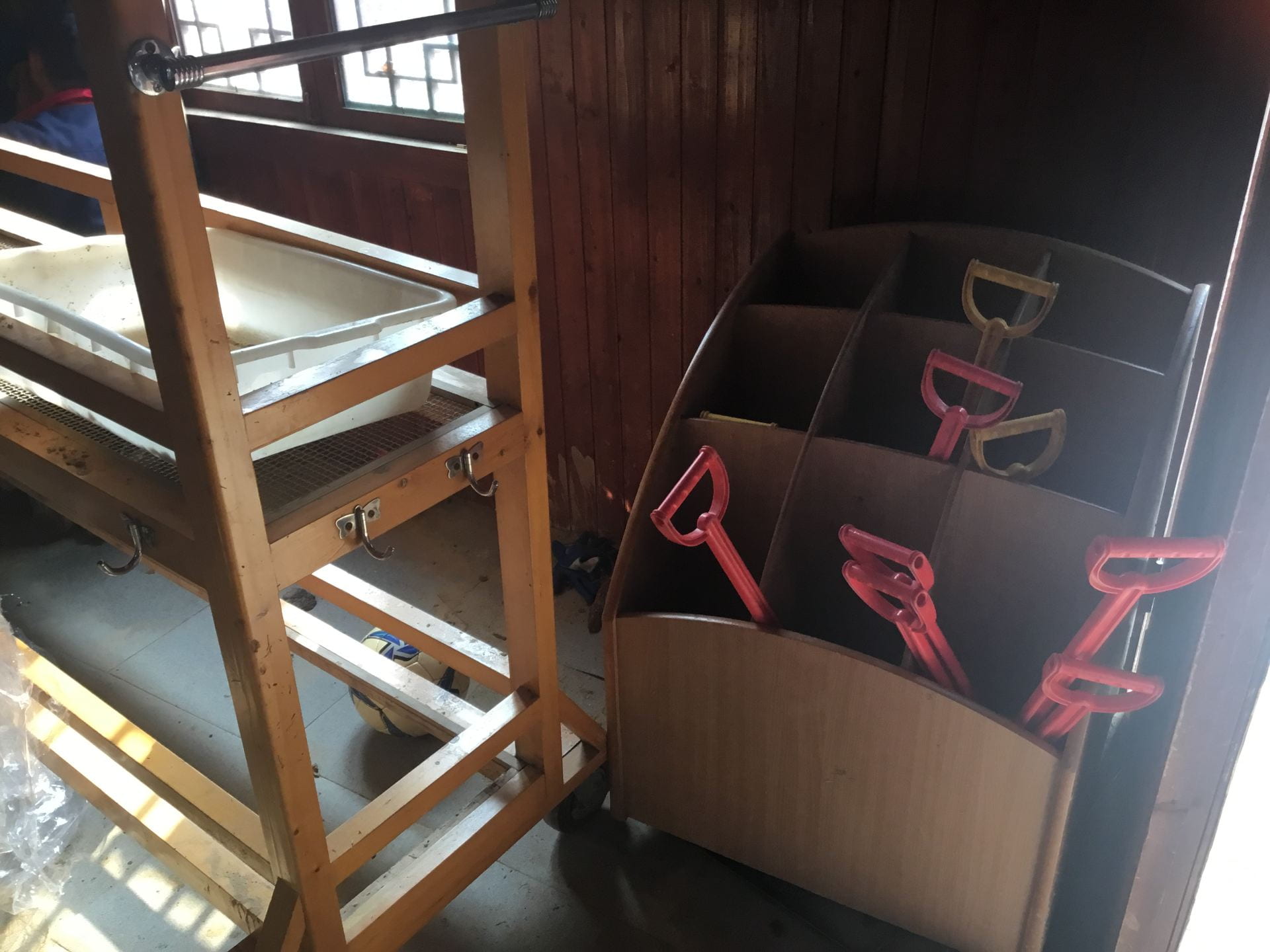
The team worked together to clean up the shed. They gathered all the rakes and spades and hung them up on the pegboards. They sorted the water and sand toys, and placed the bamboo waterplay toys, in separate tubs.

We noticed that the signs and labels were wet, and the messages were smudged.

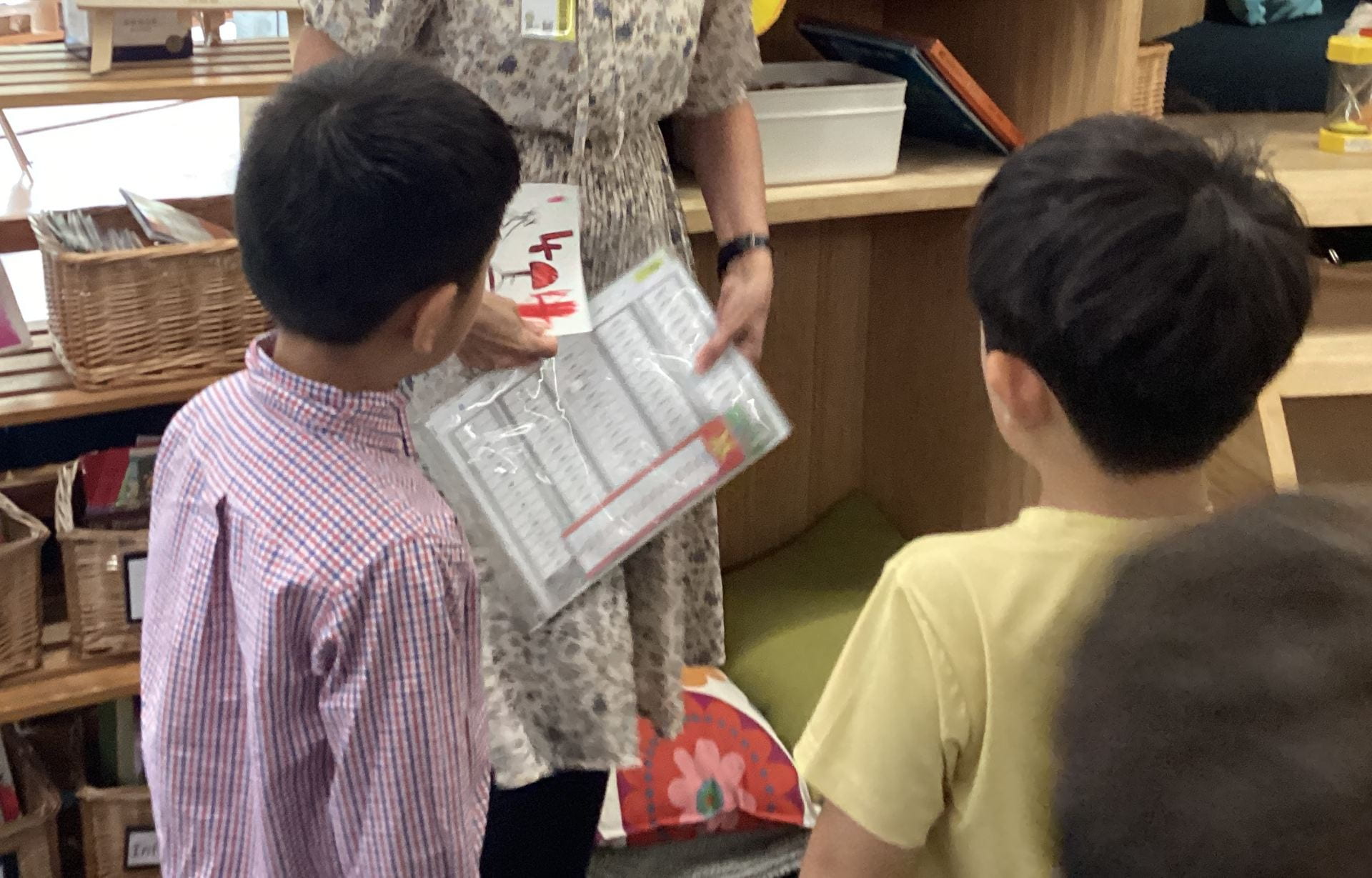
When we returned to the classroom, the team created new labels for the shovels and rakes.  

We compared a label that was in the shed with a new one.

Teacher “What do you think happened to the label?”

  • Oliver “Melting. The colour has almost go off from the water. Someone came with a bucket of water and put it and it melted the colours.”
  • Howie “It will come off.”

The children decided that a piece of plastic would protect the paper. We looked around the classroom for the type of plastic we could use and discussed each option.

The plastic like the drawer…

Oliver “That is too hard and too heavy.”

The plastic that is used to cover the food container…

  • Oxford and Howie “It breaks easily.”

The plastic pouch…

  • Eli “It is too small”

The plastic folder…

 “It’s too big.”

The different ideas presented by the children moved us to offer a suggestion, a plastic film that is used on the overhead projector screen. The children quickly made the connection.

  • Oliver “Ms. Eileen has a transformer to turn this card save, then no water can melt the colour and smudge it.”

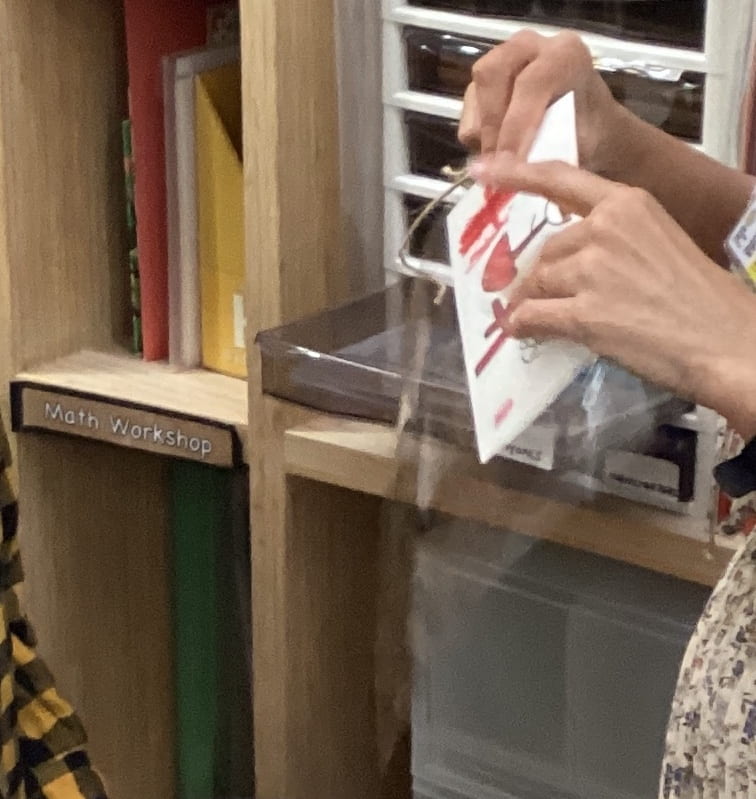
The team went with Ms. Eileen to prepare the cards for the machine.

  • Morning “Put the paper in.”
  • Wyatt “Put the paper in the plastic.”
  • Liz “Then no water in the paper.”
  • Liz “Plastic in the machine.”
  • Morning “It is going on the side and the paper will not fall out of the plastic.”

  • Liz “It is so hot.”
  • Eli “It has power. If you don’t have the power it can’t move out and in.”
  • Oliver “And it can not stick the plastic together. Because it’ hot it sticks.”
  • Oxford “Because this has a yellow sign says no touching.”
  • Eunbyul “It says ‘NO Finger In’.”
  • Howie “If you put your finger it will get hot and stick together.”
  • Liz “Cutting paper because no cutting paper, these is so big. Plastic in and cut into two.”

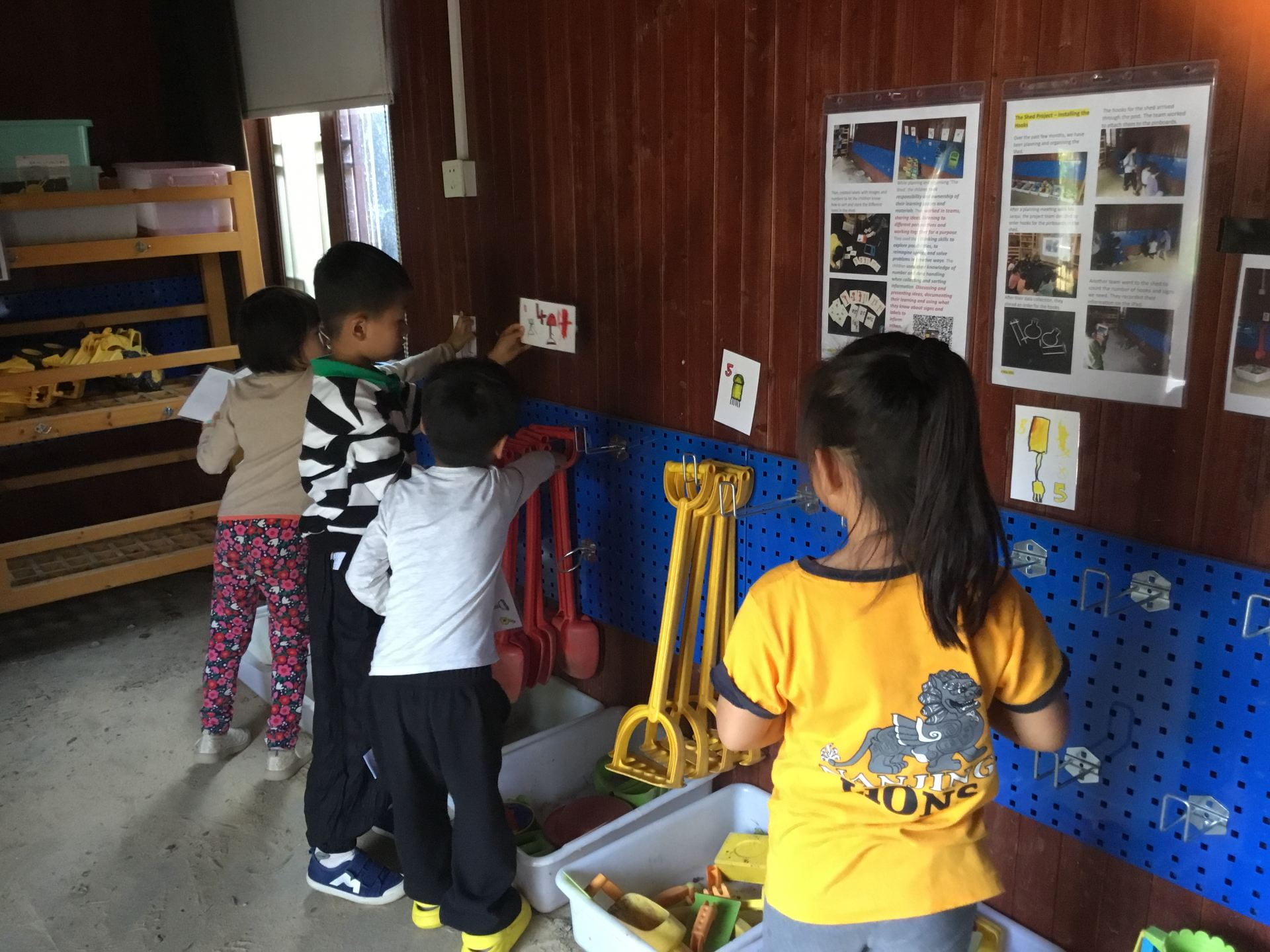
After presenting their process to the rest of the class, the team went to the shed to put the new signs on the wall.

  • Morning “Put the paper on the wall people will know the yellow one does not go to the red one.”
  • Oliver “The blu tack behind the picture will get smudged.”

Next, the team will visit the rest of the classes in the Early Years to share their video with the children, to tell them about the new labels. They hope this will help the children think more about the way we store and care for the toys in the Shed.

This project was connected to the unit of inquiry ‘How We Organise Ourselves’ as it encouraged the children to look at community spaces around them and to consider how they might take responsibility for the care and maintenance of these spaces.

Revisiting a Project: The Bike Park Signs

Revisiting a Project

We looked at the bikes outside our playground.

  • Liz “It’s messy people will get fall down.”
  • Morning “If we run around and we didn’t know the bike is on the way we will trip over the bike.”
  • Wyatt “If you put them like this people won’t see them clearly, we won’t know if we lost one.”

Ms. Eileen “Is there another way to park the bikes?”

The children started to organise the bikes. We noticed a picture on the wall showing how the children parked the bikes the previous year.

Ms Eileen “Did they park the bikes the same way? Why did they park like this?”

  • Lydia “The bike is opposite from ours, it is easier for children to ride it away.”
  • Liz “If we put them properly when the fire comes, we can go through the door quickly and we are safe.”
  • Wyatt “If we park the bike in a wrong place when the fire comes the bike will burn.”

We went back to reorganise the bikes.

Ms Eileen “Do you think this is the best way to park the bikes?”

  • Morning “We can ride the bike out easily.”
  • Jeongyoon “Everyone played with the bike we can tell them.”
  • Lydia “We need to tell everyone.”

We looked at the parking signs the K2 made together last year.

The children decided to put the signs up to let the other children in the Early Years know how to park the bikes.

The group presented their learning to the rest of the class.

  • Jeongyoon “Outside.”
  • Liz “Bikes clean up.”
  • Lydia “Cars. Me see the bikes are in a mess. (in Mandarin) If a fire comes then we can’t get to the escape door.”
  • Morning agreed with Liz’s statement adding “Clean the bikes.”
  • Wyatt “When people park the bikes in front of each other then its easy for the children to bump into the bikes. (in Mandarin)”
  • Morning explained that the team had an important task so they needed to “park the bikes together”
  • Eli “Park the bikes nicely on the road and the other side. People will step on the wheel and fall down.”
  • Oliver “If you don’t park the bikes nicely, someone will be running where you park the bikes then someone will hurt yourself.”
  • Oxford “I will tidy up and put them back.”
  • Howie “Put them nicely because when someone comes, the people can quickly run outside.”
  • Motong “Clean up the car because the car cannot come in.”
  • Eunbyul “Everybody bikes play and everybody children play and finish then tidy up. Bikes and children and me friend together tidy up.”

The class thanked the team for their work and presentation. Next, the team will need to think about sharing this important message with the rest of the Early Years Community.

Creating Essential Agreements

Over the last few weeks, we have been taking photographs and videos of the children engaging in different spaces around the Early Years. These images have helped us highlight and make observations visible.

At times, the images focused on celebrating learning, community and engagement. On other occasions, the images helped us hone in on challenges and problems that require attention.

Over the last few days, we have discussed these ideas in small and whole group situations, talking about what we see, think and wonder.

See, Think, Wonder is a ‘thinking routine’ that places emphasis on the importance of observation as the basis for thinking and interpretation, through looking closely at an image, object or video.

After many discussions, we gathered to create our ‘Essential Agreements’. We noticed that the conversations often focused on the idea of feeling ‘safe’ in a ‘caring’ and ‘respectful’ environment.

Some of the key points were:

  • Expressing and communicating emotions in respectful ways and asking for an adult’s help when needed.
  • Being aware of how we touch others when speaking or playing with them.
  • Using manipulatives and resources in a safe and respectful way.
  • Moving our bodies safely in and around the different spaces.
  • Cleaning up after playtime to ensure we respect people, materials and spaces.
  • Using kind and thoughtful words to express ourselves.
  • Being inclusive by collaborating sharing and inviting others to play.

The key ideas by the children highlight the concepts of well-being, interaction, participation, belonging and inclusion.

As a learning community, we will continue to revisit our essential agreements to help us make appropriate choices that help us work and learn together as a community.

We are learning that by following agreements and sharing space we can participate safely in our community.

The Bike Park Signs

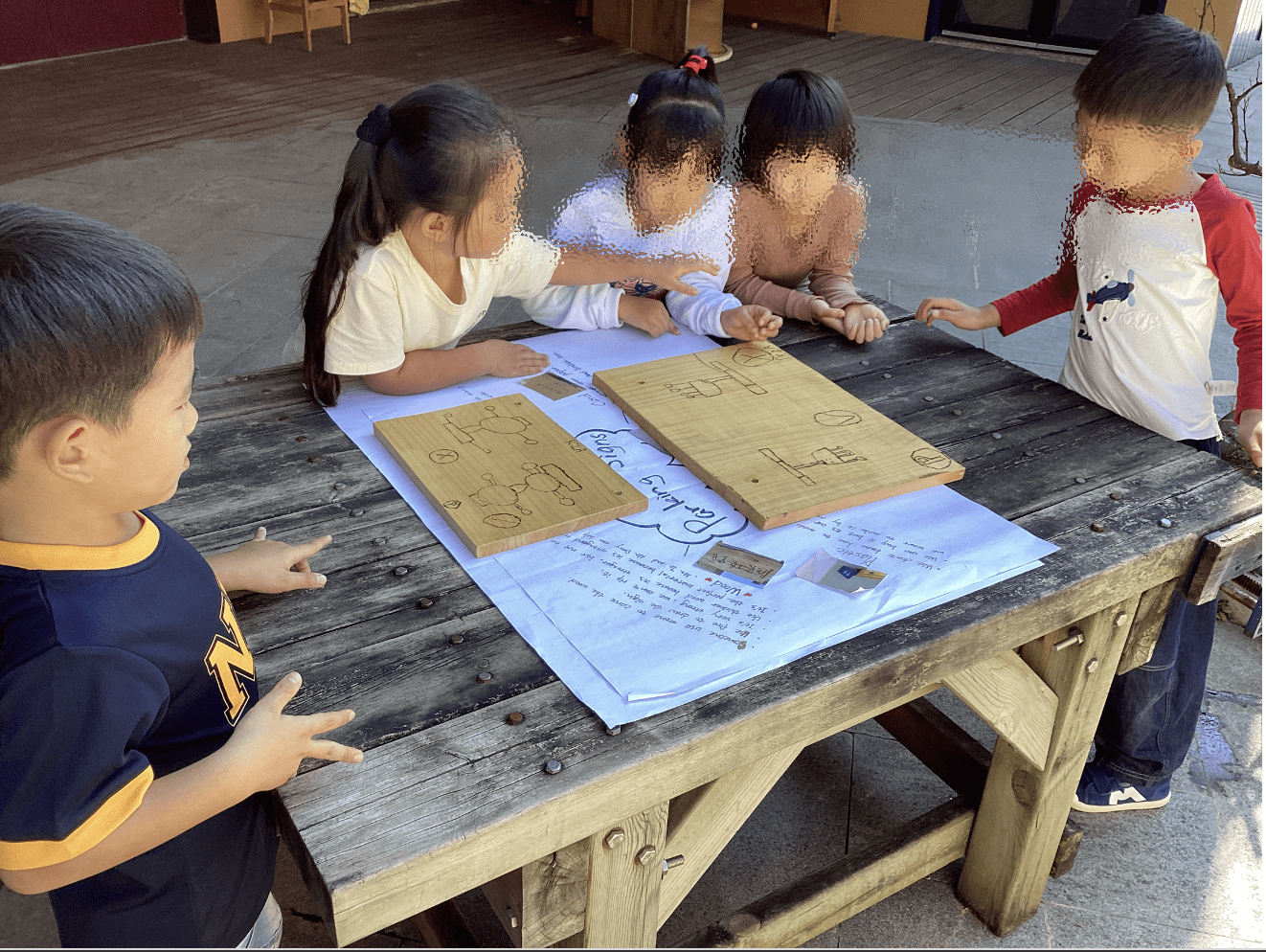
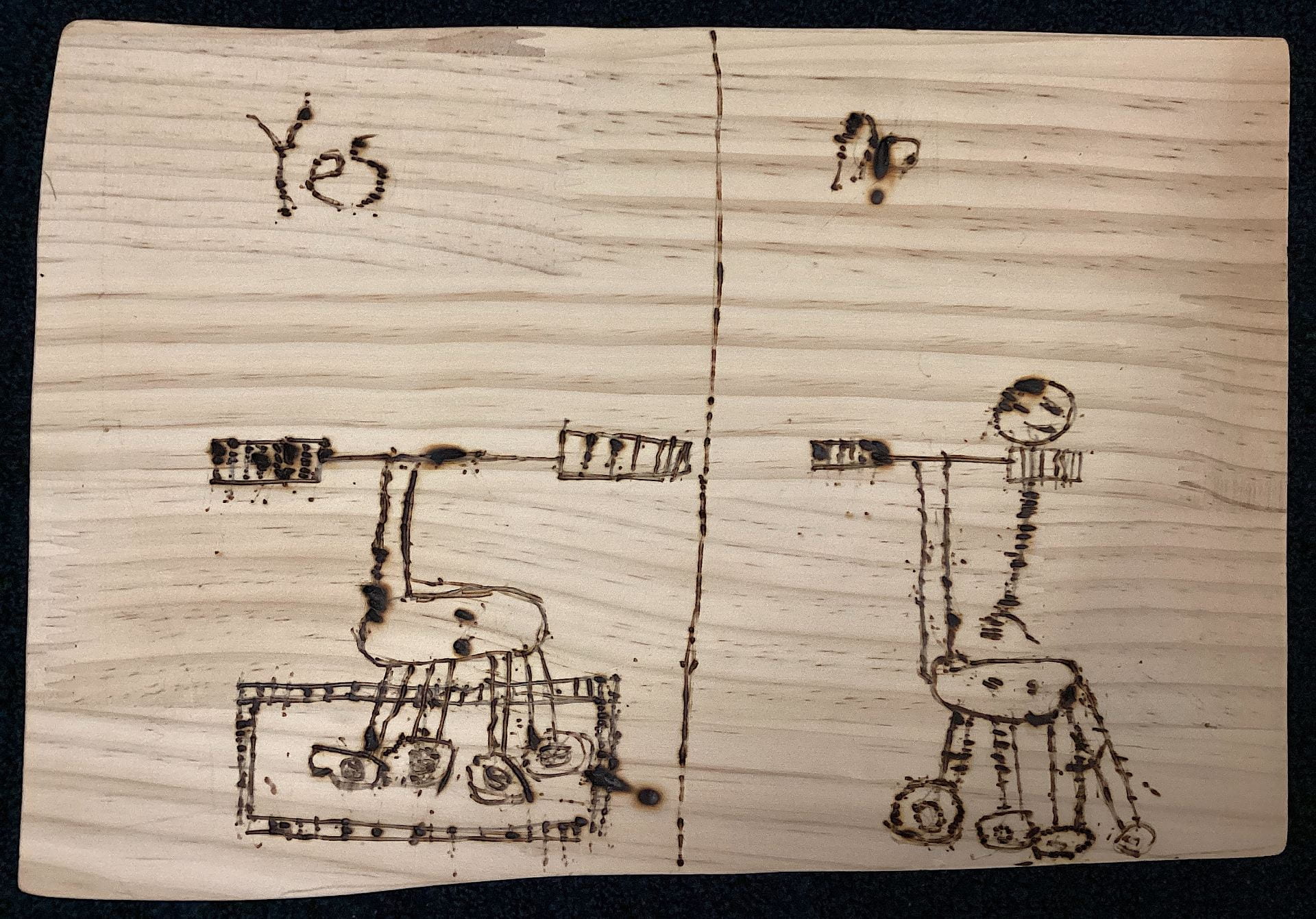
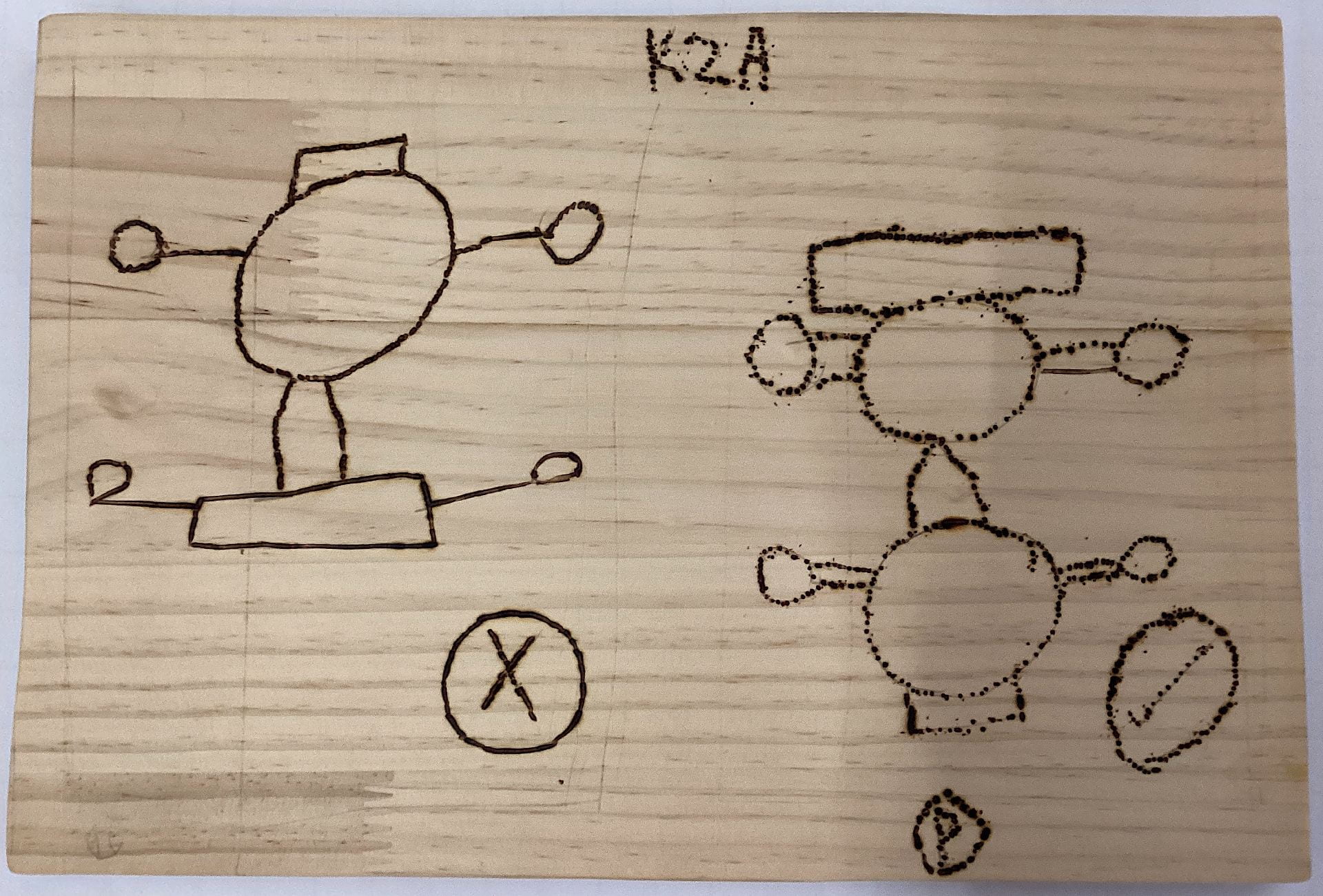
Over the last few weeks, a team of young designers worked together with Ms. Eileen and Ms. Jo, to create signs for the bike park. After conducting their research, they decided to create the signs using wood, as this was a material that could be used outdoors in all types of weather. After considering many options for the message, the team decided to use the wood-burning tool to burn the message onto the wood instead of using paint, markers or other writing tools. 

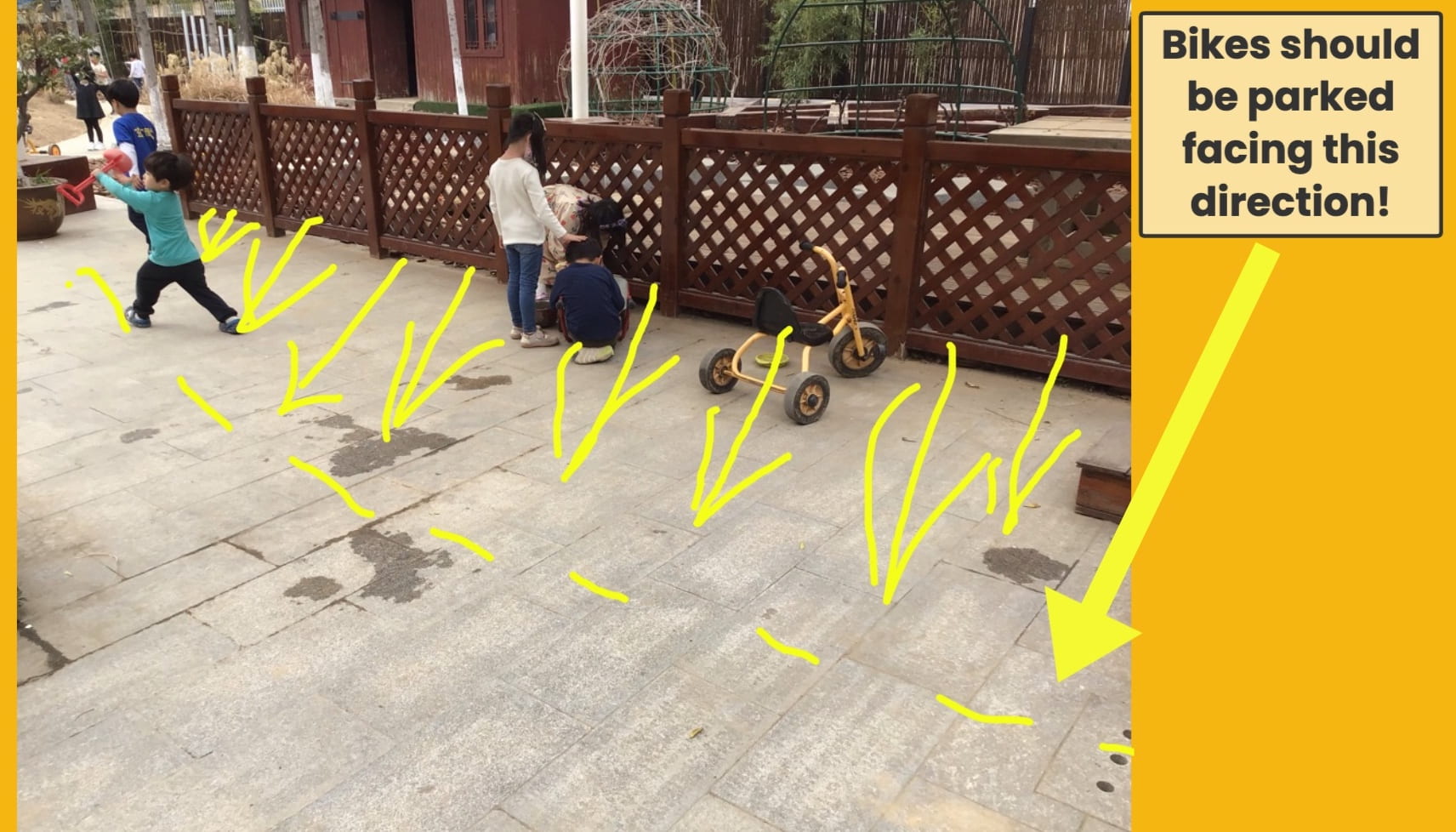
They began by planning their message out using pictures and words, to inform the early years community how to park the bikes safely in the bike park area. Their pictures served to remind the children where to park and in which direction the bikes needed to be stored at the end of playtime.

The team considered the type of wood and the size of the sign. Then, they used sandpaper to make sure the edges of the wood were smooth. 

They learned how to use the wood-burning tool to burn the messages on the pieces of wood. They had to think about staying safe and focused throughout the task.

Finally, their signs were ready to be mounted in the bike park area. They talked to each other about the best place to put up the signs and what materials they would use to attach the signs in the different spaces. Noah decided that his sign should be placed standing upright in the bike park. Mason, Sean and Eunice decided that their signs should be attached to the wooden fence dividing the play area. The team were proud of their hard work, and were excited to see that the Early Years community were now well informed about safe parking in the playground.

K2 students are aware of the impact they can have on the community. They understand how they can actively engage in various stages of learning: including thinking about, planning, modifying and creating for a purpose. Through active discussion and questioning, they were able to direct their own learning. The ‘Bike Park’ project helped them make connections to the real world. Through a range of experiences, they could consider perspectives, possibilities and outcomes that would benefit the community. They considered their own responsibility in shared spaces, and were able to use their voice and actions to bring a sense of purpose and belonging to these community spaces.

The Shed Project – Installing the Hooks

Over the past few months, we have been planning and organising the Shed.

After a planning meeting with Ms. Jacqui, the project team decided to order hooks for the pinboards in the shed. After their data collection, they placed an order for the hooks.

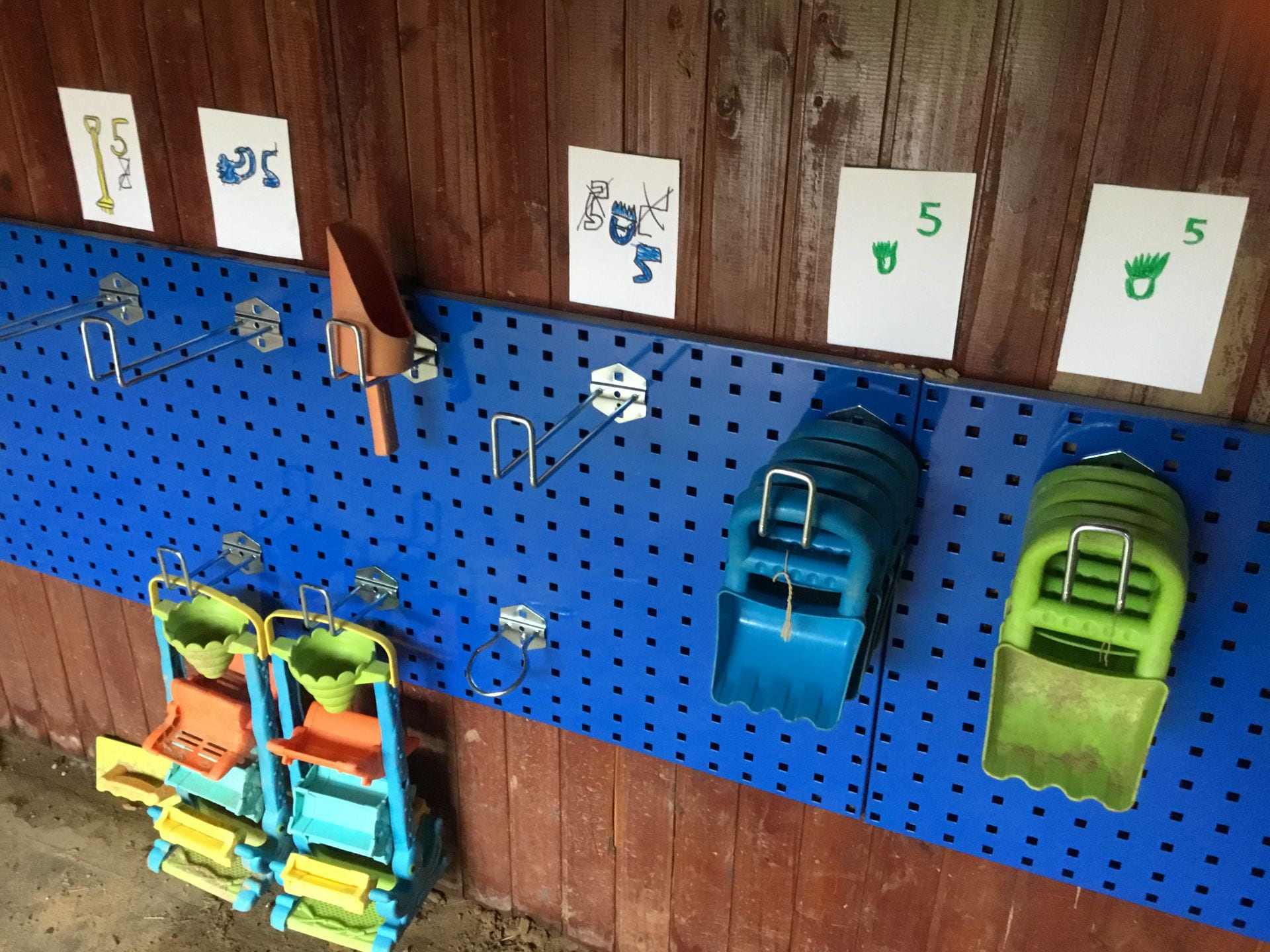
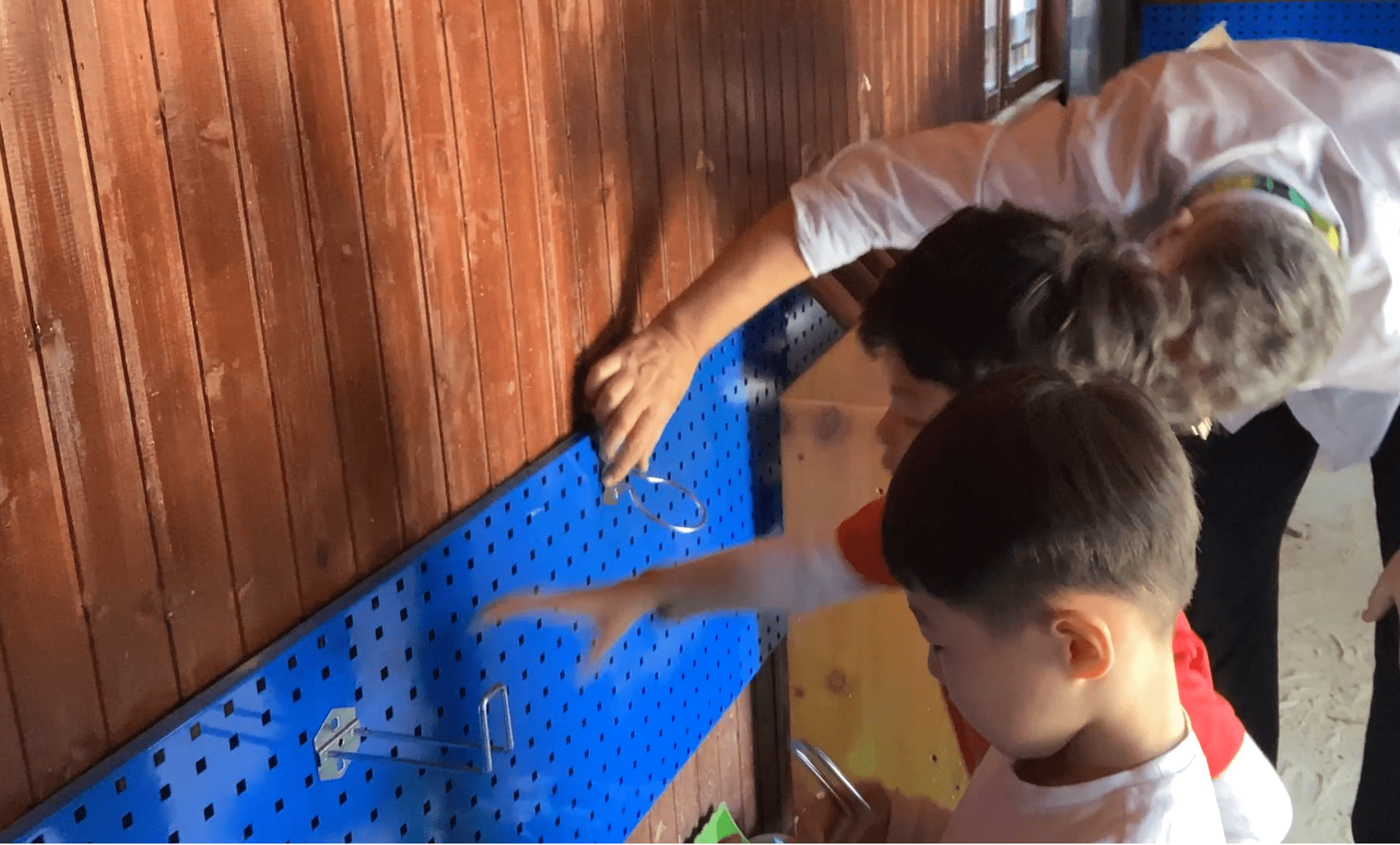
The hooks for the shed arrived through the post. The team worked to attach them to the pinboards.

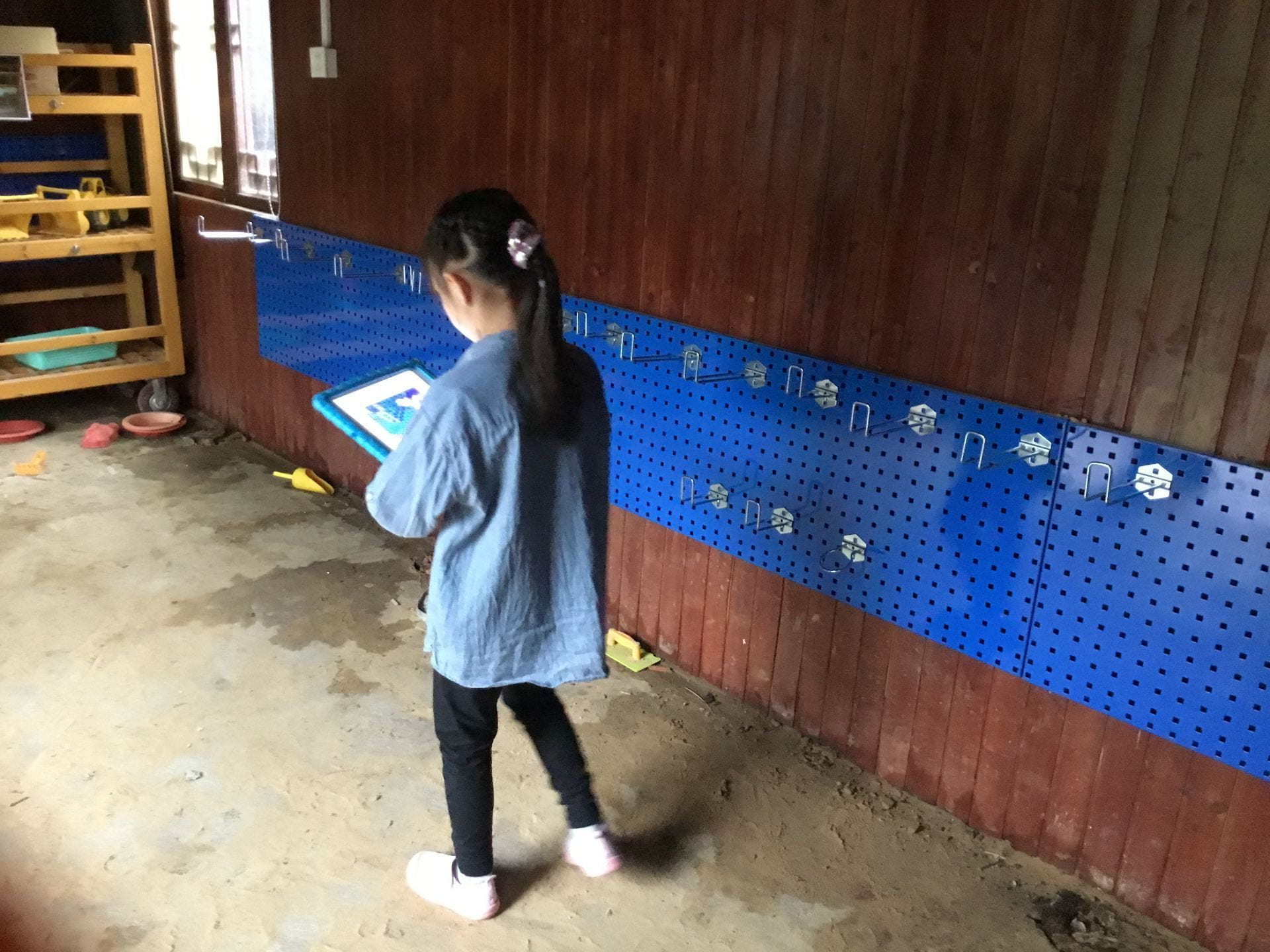
Another team went to the shed to count the number of hooks and signs we need. They recorded their information on the iPad.

Then, created labels with images and numbers to let the children know how to sort and store the different items in the shed.

While planning and organising ‘The Shed’, the children took responsibility and ownership of their learning spaces and materials.

They worked in teams, sharing ideas, listening to different perspectives and working together for a purpose. They used their thinking skills to explore possibilities, to reimagine spaces and solve problems in creative ways.

The children used their knowledge of number and data handling when collecting and sorting information. Discussing and presenting ideas, documenting their learning and using what they know about signs and labels to inform others, developed their literacy skills.

Organising the Shed: Sorting and Data Collection  

A team of children went to the shed to begin sorting the toys. They placed tubs for the sand toys, put the kitchen and cooking items on one rack and all the trucks and diggers on the shelves.

Next, Doho and Sean went to look for Mr. Jamie, to ask him if he could help the team mount the hooks on the pegboards.

Sean and Doho explained the problems they had, and then they went out to the shed with Mr. Jamie. Together, they were able to problem-solve and make a plan to mount the hooks.

A team of K2 mathematicians went to the shed to gather more information to plan the next step of the project. We needed to find out how many hooks, tubs and racks we will need to sort and organise the different toys in the shed.


The team began to think about the different ways we can record data. We decided to divide the paper into four to record the number of kitchen items wheelbarrows trucks and sand toys.

Then, the data collectors used pictures, words and numbers to record their information. 

We observed the children:

·     gathering, recording and organizing information

·     listening actively and respectfully to others’ ideas and listening to information

·     using mark-marking to convey meaning

·     taking responsibility with tasks

·     using strategies to problem-solve

Proposals to Ms. Jacqui

Different teams have been working together to make changes to the Early Years Playground. They have been conducting their research to look for ways to organise the play areas to make them safe and functional.

The ‘Shed Project’ team had received samples of the hooks for the pegboards.

They checked the height of the pegboards and tested the hooks to see which ones were most suitable.

Doho, Sean, Kenan and Eunice were ready to share what they leaned. They presented their ideas to the class and Ms. Jacqui.

Kenan liked all the hooks but decided that the circular ones were the least useful as they were too big and the tools fell through them.

Doho, Sean and Eunice also preferred the long straight hooks as you could hang more tools on them.

Ms. Jacqui was very happy to see the curved edges on the hooks as they were safer for the children.

We noticed that the children used a range of mathematical vocabulary; bigger, longer, shorter, to express their ideas about measurement.

The class gave them some feedback on the different ways the toys could be hung up.

Ms. JacquiHow many tools do we have and how many hooks will we need? We don’t want to buy too many, we just want to get what we need.

  • Tracey “We can count them!”

Tracey explained that the pegboards could not be mounted higher as the younger children have to be able to reach the tools.

Next, the team will work together to decide how many hooks we need to order for the shed. Then, they will need to put in a purchase order to buy the hooks. Ms. Jacqui suggested that they ask Mr. Jamie, the Grade 4 teacher to help them attach the hooks as he has a drill.


Next, we presented the proposal for the ‘Bike Park’. The children explained the reason for the yellow lines on the floor. We asked Ms. Jacqui if we can paint the floor. Ms. Jacqui agreed that the emergency exits, and walkway should always be clear.

Ms. Jacqui thought about the idea of painting the ground. She wondered if there were other ways to let people know that it was a ‘NO PARKING’ area.

  • Kenan “We can put a ‘NO Parking’ sign!”.
  • Mason “Put and red X on the floor!”

These were all great suggestions.

Next, the children explained the arrows in the parking area. They worked hard to convince Ms. Jacqui that their proposals will help the riders park and ride the bikes safely and quickly.

Ms. Jacqui “Instead of just painting it right away, what else can we try first?”

  • Tracey “We can put a sticker!, We can test it first!”

The children had many different ideas to communicate the message. We will begin to ‘test’ some of the suggestions to see how they work before asking for the floor to be painted.

We noticed how the children shared their thinking, providing examples to convince others of their ideas. We noticed the children listening to each other, building on each other’s ideas to find ways to solve problems and look for the best solutions. We look forward to our next steps in making the Early Years Playground more exciting, organised and safe.  

The Shed Project – Organising the Space

Sean, Kenan, Eunice and Doho have been leading in the ‘Shed Project’. They sat down to decide their next steps.

  • Teacher “The maintenance staff have fixed the pinboards. What do we need to do next?”
  • Kenan “We need to put a thing like a peg on the pinboard.”
  • Sean “What is a hook?”

We looked at some different types of pegboard hooks.

  • Kenan “We need to put the hooks because there are too many things.”
  • Sean “So dirty. Floor is sand. Some people play with sand and throw the sand.”
  • Eunice explained that the sand needs to be “outside in the sandbox.”
  • Doho “Some children put the sand inside. And some children mess it together.”
  • Eunice “Making the things dirty.”
  • Kenan “We need to put the sand back in the boxes. The sand needs to be in the EY Playground.”
  • Doho “Don’t put the sand inside the shed. Play in the sandbox. We need to clean the floor and put the sand back into the box.”
  • Kenan “We need to put the shovels on the pegboards.”
  • Sean “Pans and play cooking things, hang them up on the pegboards.”
  • Doho “NO putting things on the floor!”
  • Kenan “We need to put a sign.”
  • Eunice “Some person is making messy cooking. Don’t make a mess. Go to the sandpit and play.”
  • Doho “Some children making cooking and throw the sand inside.”
  • Sean “Put the trucks on the racks.”

The team drew pictures to share their thinking.

The team presented their ideas to the class and asked for other suggestions to make the space better.

Kenan “We need to put the spades on the pegboard.”

Questions and Answers:

Patrick “Why are the shovels on the pinboard.”

Kenan “Because there are so many shovels. We can use the pinboards.

Patrick “But I did not see the shovels on the floor. Can we put 2 shovels in one hole.”

We might think about the different ways we can organise the shovels.

Sean “Put the trucks on the racks.”

Questions and Answers:

Tracey “Why do not have new toys? Why are there racks on two sides?”

Sean “There are many cars.”

We might need to think about purchasing some new toys.

Eunice “We need to put the sand toys on the rack.”

Questions and Answers:

Tracey “Why is the sand on the floor?”

Eunice “She gets it and puts it on the floor.”

Tracey “Why did she throw the sand out and put it on the floor and the clothes?”

Eunice “She did not throw, she is playing.”

Doho “We need to cleanup inside the shed.”

Doho explained his drawing and answered questions about the shed, the sand on the floor and the shelves on the side wall that will be used to store more toys.

The team will consider the ideas suggested by the class. They would like to propose their suggestions for improvement to Ms. Jacqui to plan their next steps. 

The Bike Park Plan

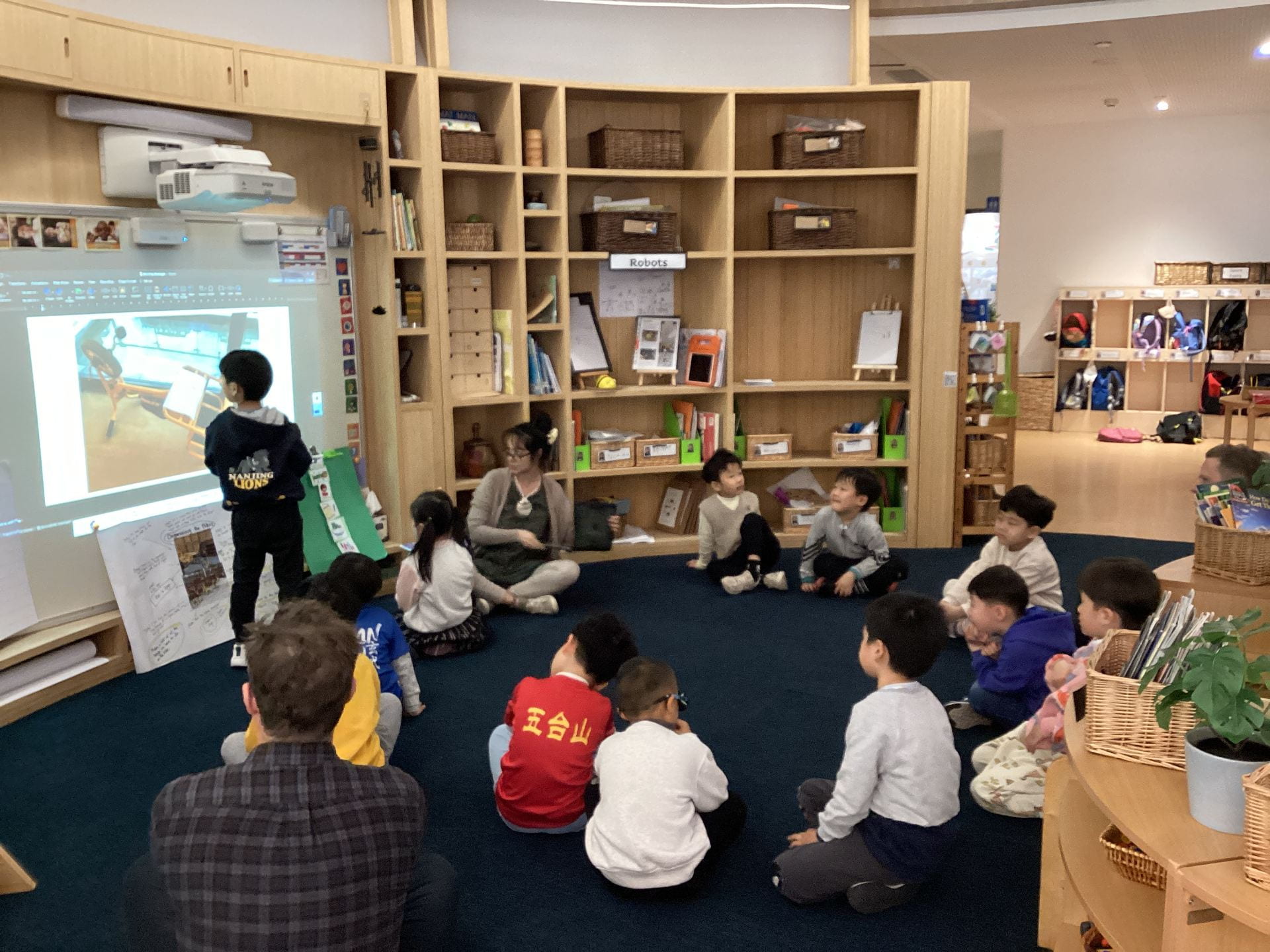
The teachers set up a time lapse video after playtime to provoke the children’s thinking. We watched the video during our class meeting and discussed what we noticed.
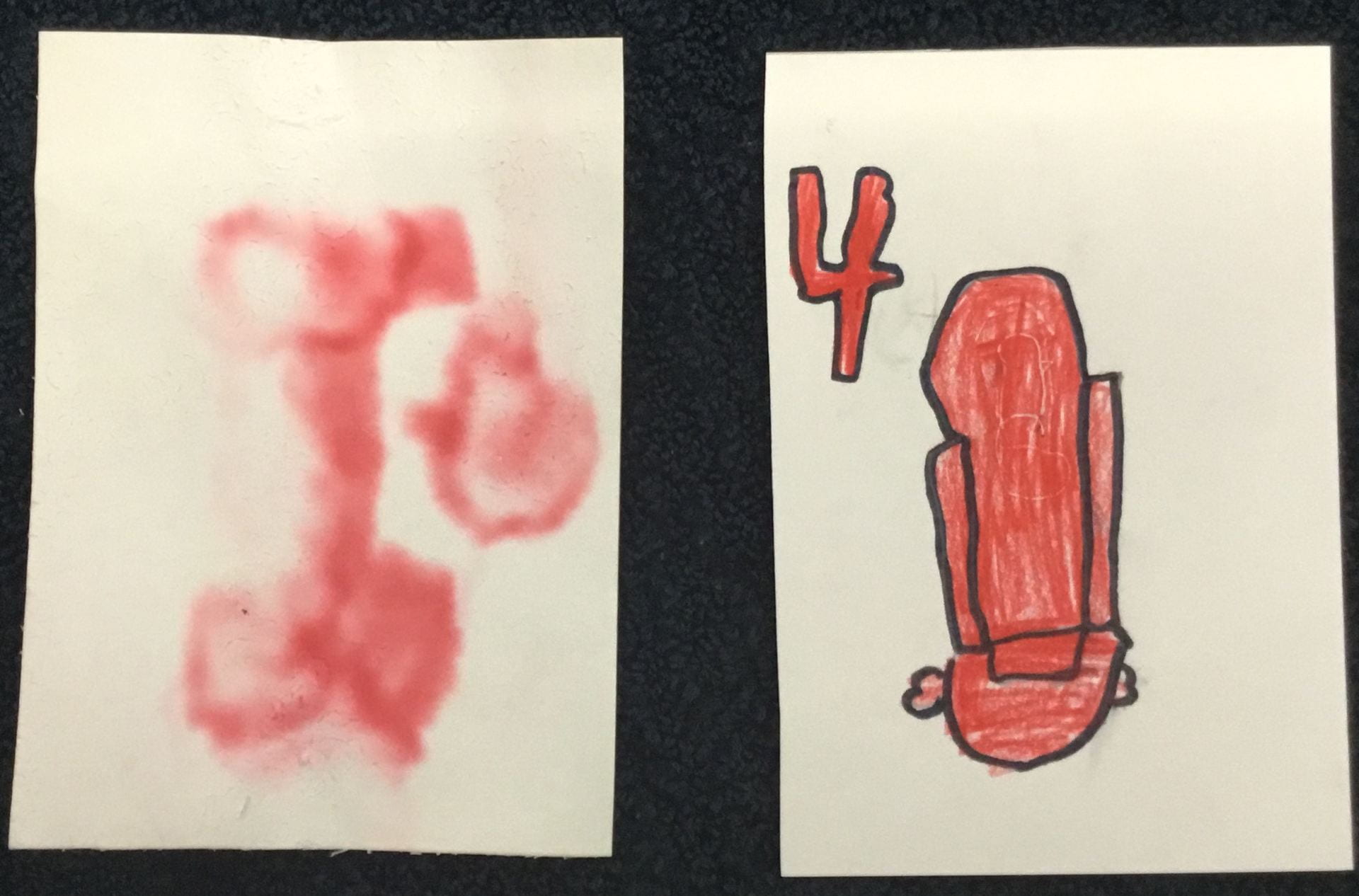
We reflected on what Noah had said about blocking the emergency entrance. We also noticed how Kenan and Noah parked the bikes, making sure they are parked in reverse.
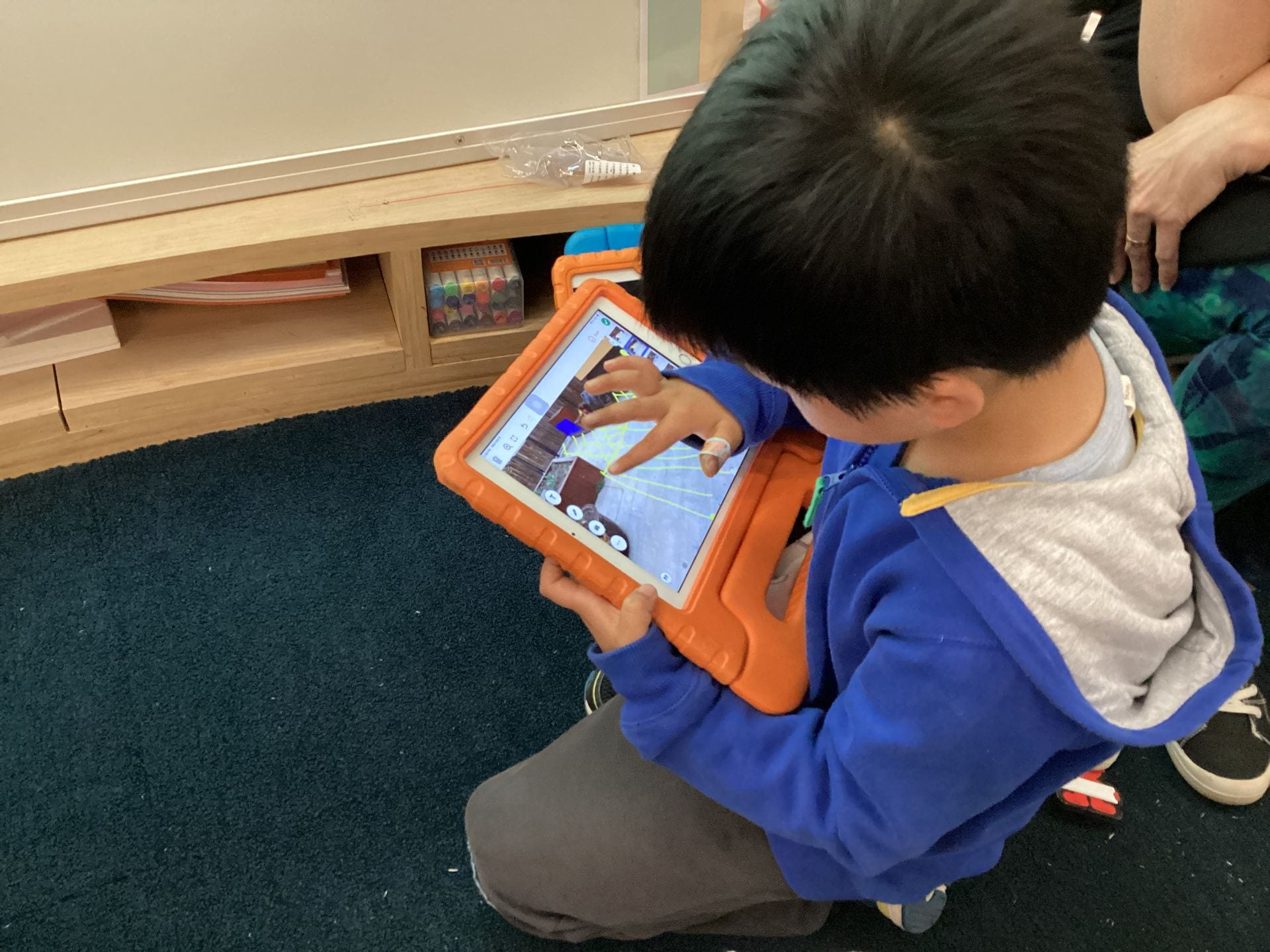
Noah used the iPad to show the class how we could keep the walkways in the playground clear of tricycles.

He thought about what he had learned through his research about the school parking lots, and then used the iPad to show how the lines could be marked on the floor. The yellow lines would be a ‘NO PARKING’ area. The class gave him feedback as he made the plan.


The messages and signs team are ready to begin their work on the signs to help the EY community know how to park the bikes.

Another team will present their ideas to the facilities department and relevant personnel in school, to help them make the changes they need. They will need to convince the facilities team that their suggestions will ensure we have a safe and organised playground.

The Bike Project – Research Groups

Our Bike project continues, with children leading research projects to help them make the best decisions for their outdoor space.


Name for the Parking Spot: Conducting a Survey

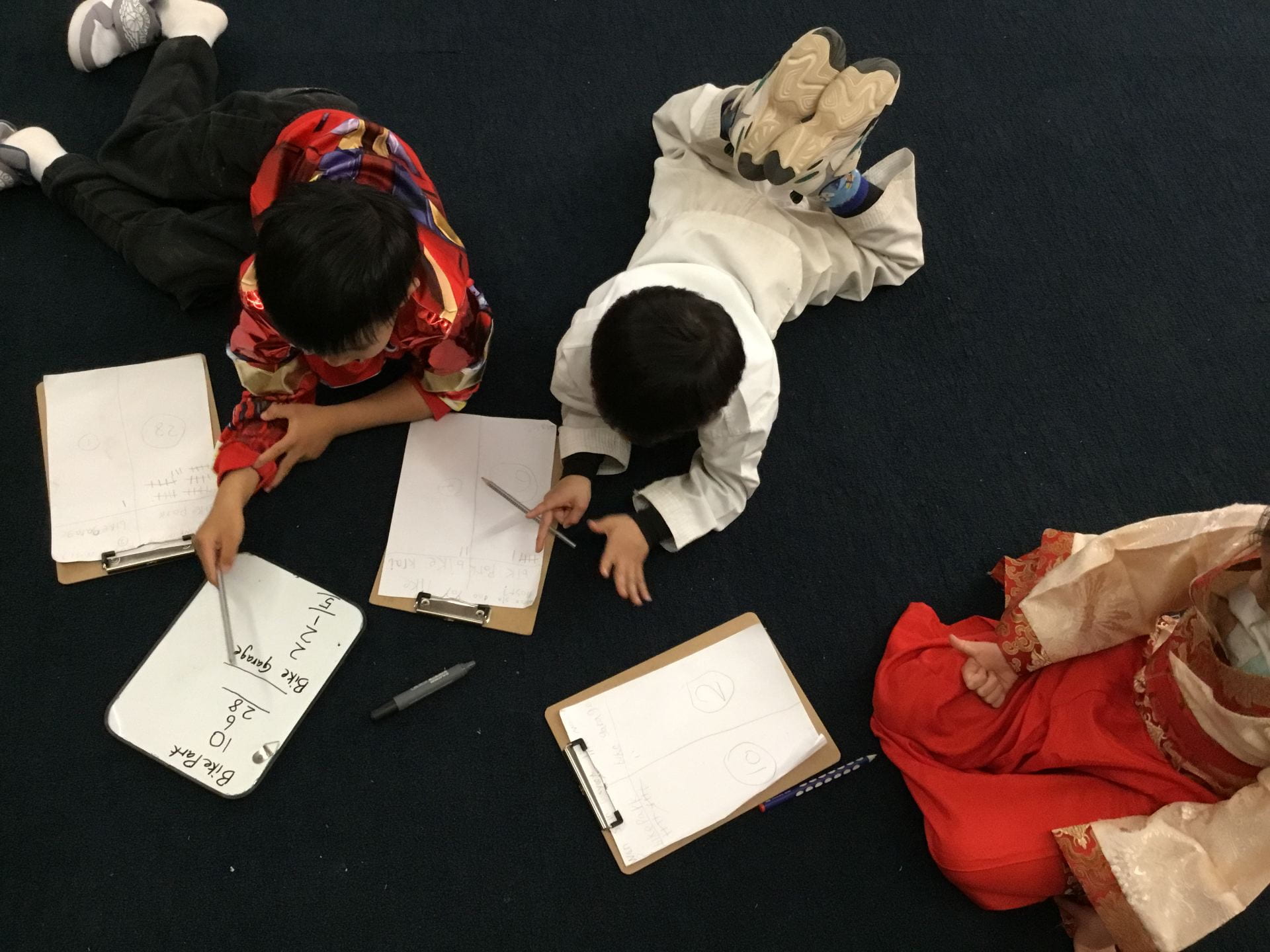
from our brainstorm on the different A group of mathematicians interviewed the Early Years community to find out their preference for the name of the parking spot. The two choices were BIKE PARK or BIKE GARAGE.

The team used tally marks to record the data on the survey.  

Then they worked together to calculate the total for each choice.

Through their research they learned that more people preferred the nameBIKE PARK!


NO PARKING area: Field Visit

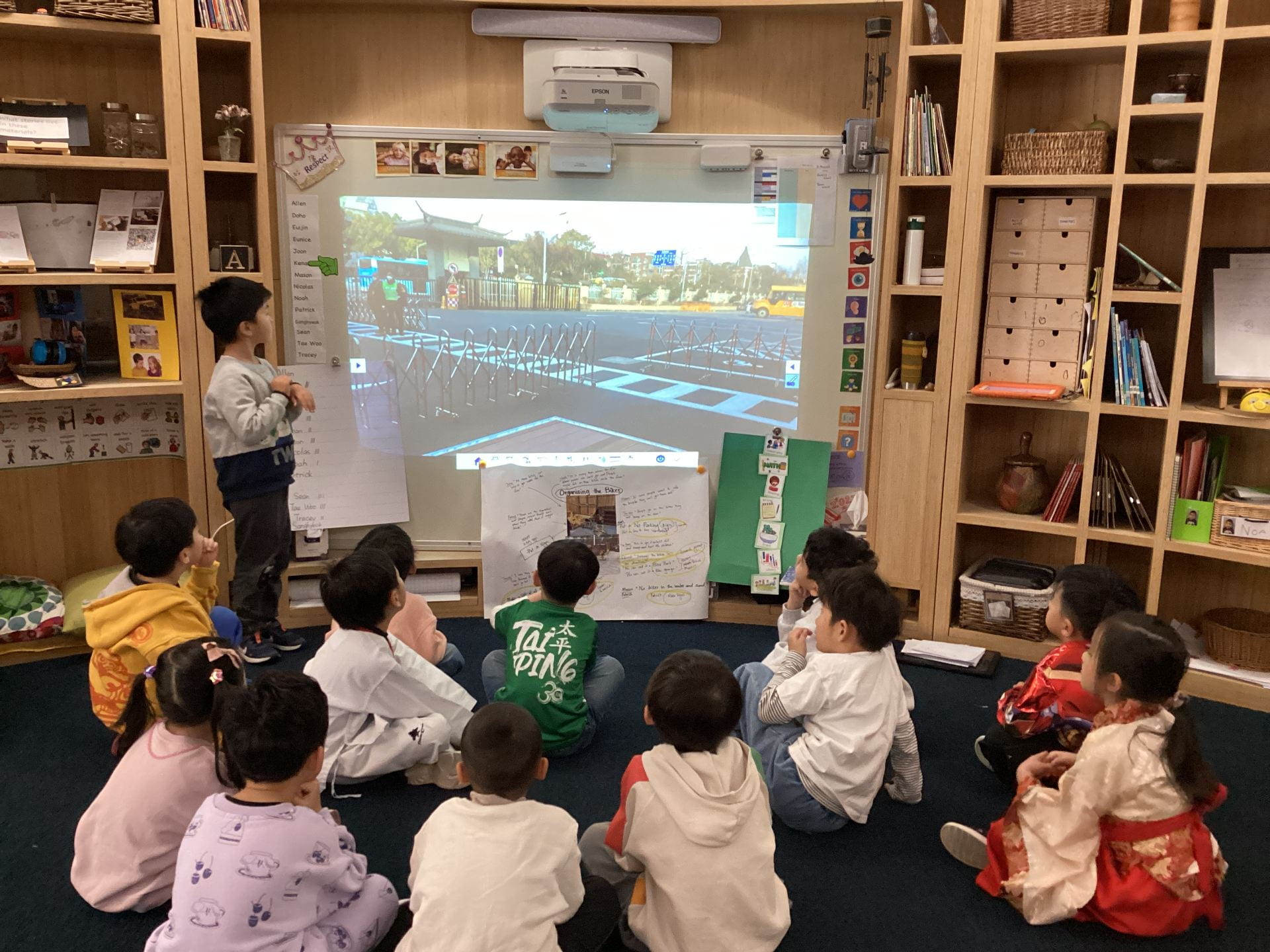
The children wanted to find a way to create a ‘No Parking’ area near the emergency exit. We know the school has many NO PARKING areas and areas where you can park. Noah went on a field visit to learn more.

  • What do we notice in the parking spaces?
  • How is the space organised?

Noah created a video to share what he learned from his research. We wonder how we might use these ideas to help us organise the tricycle park.


Signs and Messages:

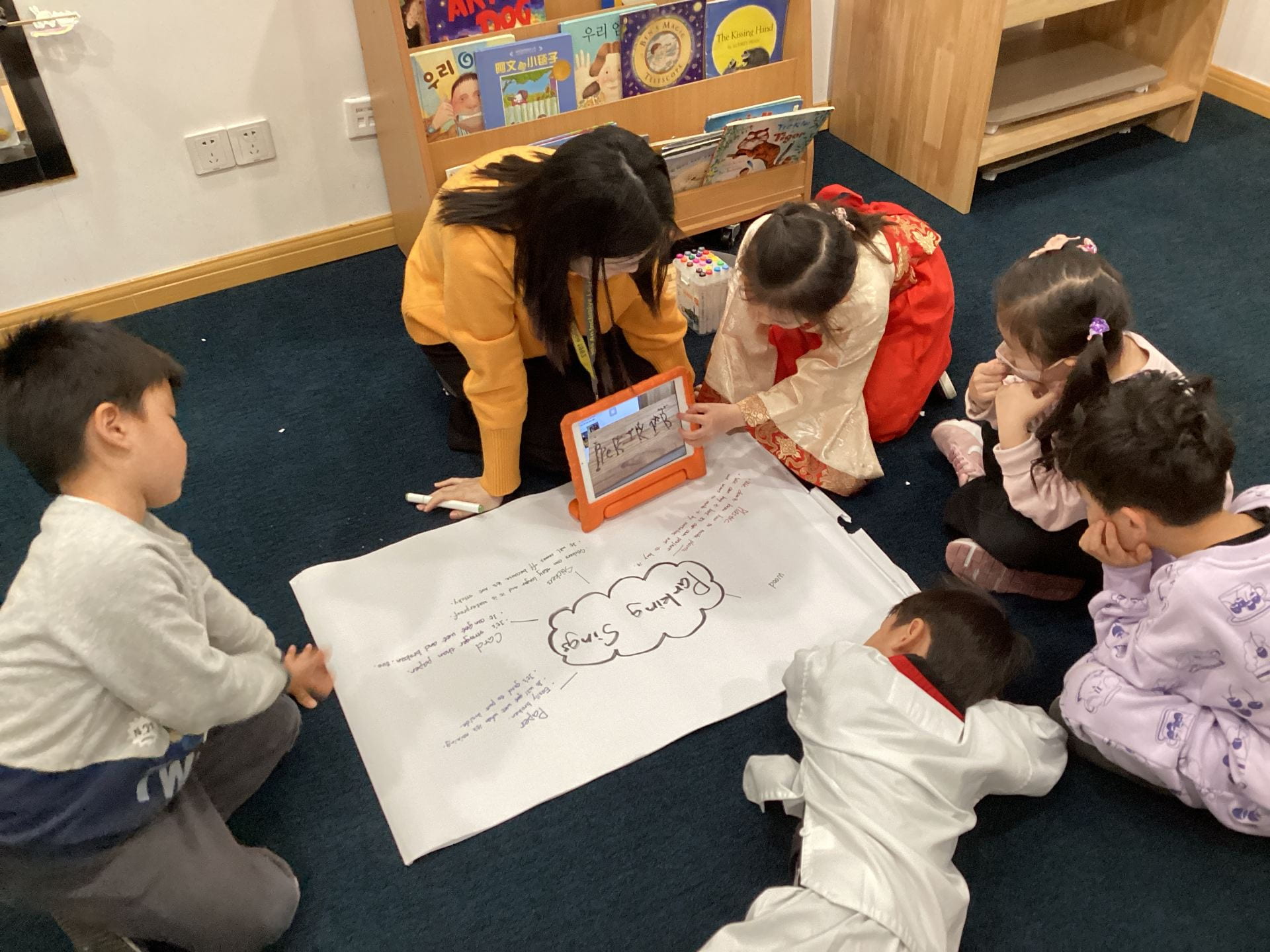
Another team of researchers brainstormed ideas for the signs. They began by looking for signs around the Early Years Centre.

  • What materials are signs made of?
  • How are colours, shapes and words used to share messages?
  • What messages and actions do they communicate to people?

They used the iPads to record their observations and brought photographs back to the team.

The researchers discussed their observations while Ms. Eileen documented key points on chart paper. 

The team decided that ‘plastic’ would not be an appropriate material to use as they didn’t know how to make plastic.

They didn’t want to buy plastic from the shop as it was their own project. They wanted to make the sign all by themselves.


Paper’ and ‘card’ were not the best materials for the signs as it breaks and tears easily.

Although card is stronger, it will get wet when it rains as the signs will be outdoors.


Yet another choice were ‘stickers’. They may last longer and are waterproof, but they might come off after a while.

The team decided that stickers were not a suitable choice either.


They noticed that the ‘wood’ was very strong and wouldn’t rip. If they used thicker wood, it would make the sign stronger.

The team decided that wood would be the perfect material for the signs.

They wondered if someone used stone to carve the wood, or fire to draw the sign. They decided that their next step would be to meet Ms. Jo and Mr. Danny to ask them more about the sign. Other ideas the team would consider:

  • How big does the sign need to be?
  • Where will the sign be placed?
  • How will it be fitted safely?

The team wondered how they might use what they have learned about traffic rules, signs and important messages in their own planning.

We look forward to our next steps as we begin to use what we have learned to organise the ‘BIKE PARK’.

The Bike Project: Fixing the Tricycles

We held a class meeting to talk about our nest steps with the Bike Project.

Mr. Danny and Mr. B joined our meeting and took note of the problems the children shared about the older bikes in the playground.

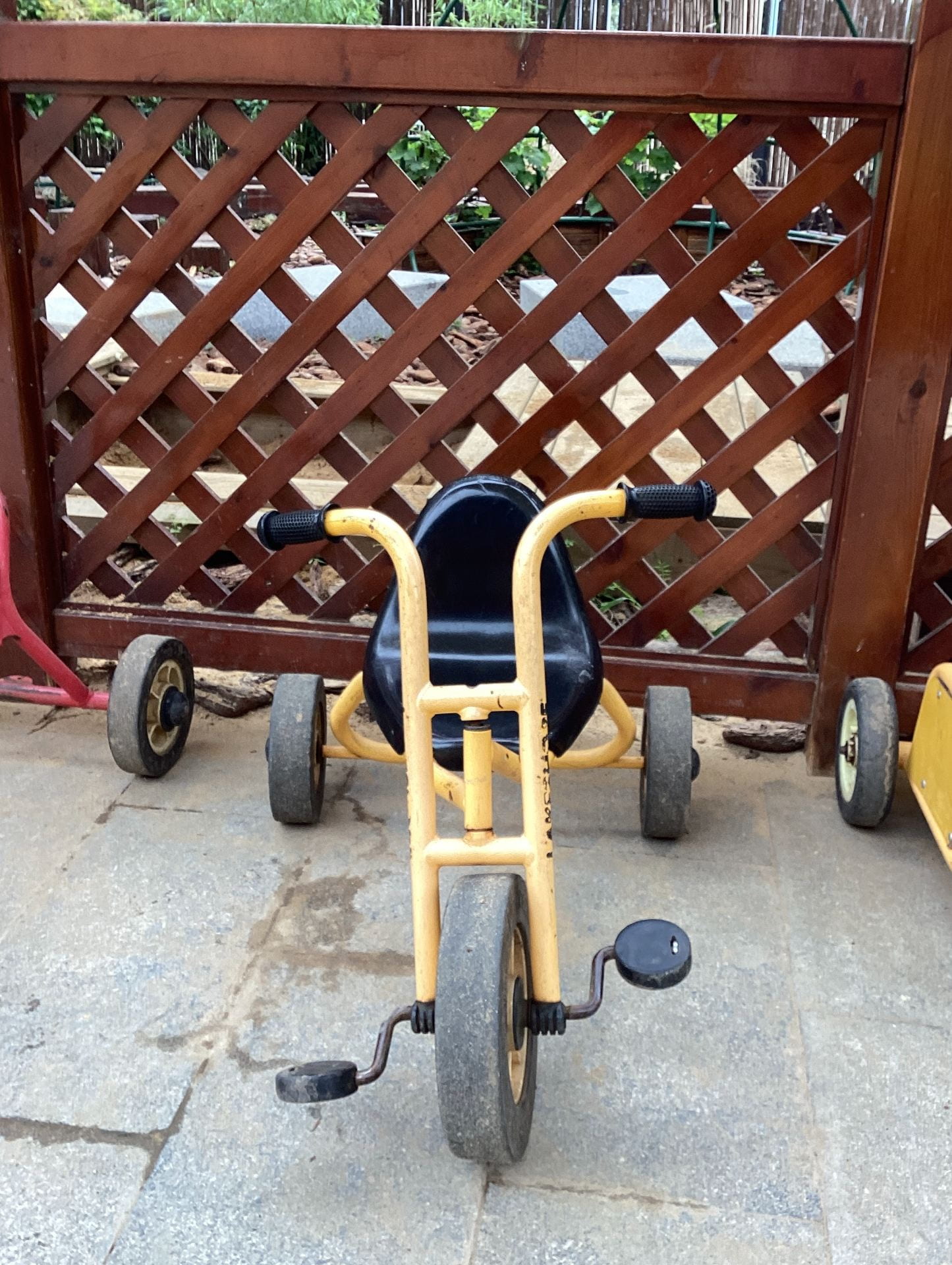
  • The front wheels are wobbly.
  • Some bikes don’t have the pedals.
  • Some bikes don’t have the rubber sleeves on the handles.
  • The seats are moving around.
  • The back tyres are wobbly.
  • Some of the screws at the bottom of the trikes are not tight enough.

A team went back to the design room to bring the tools they needed. They were HEAVY!

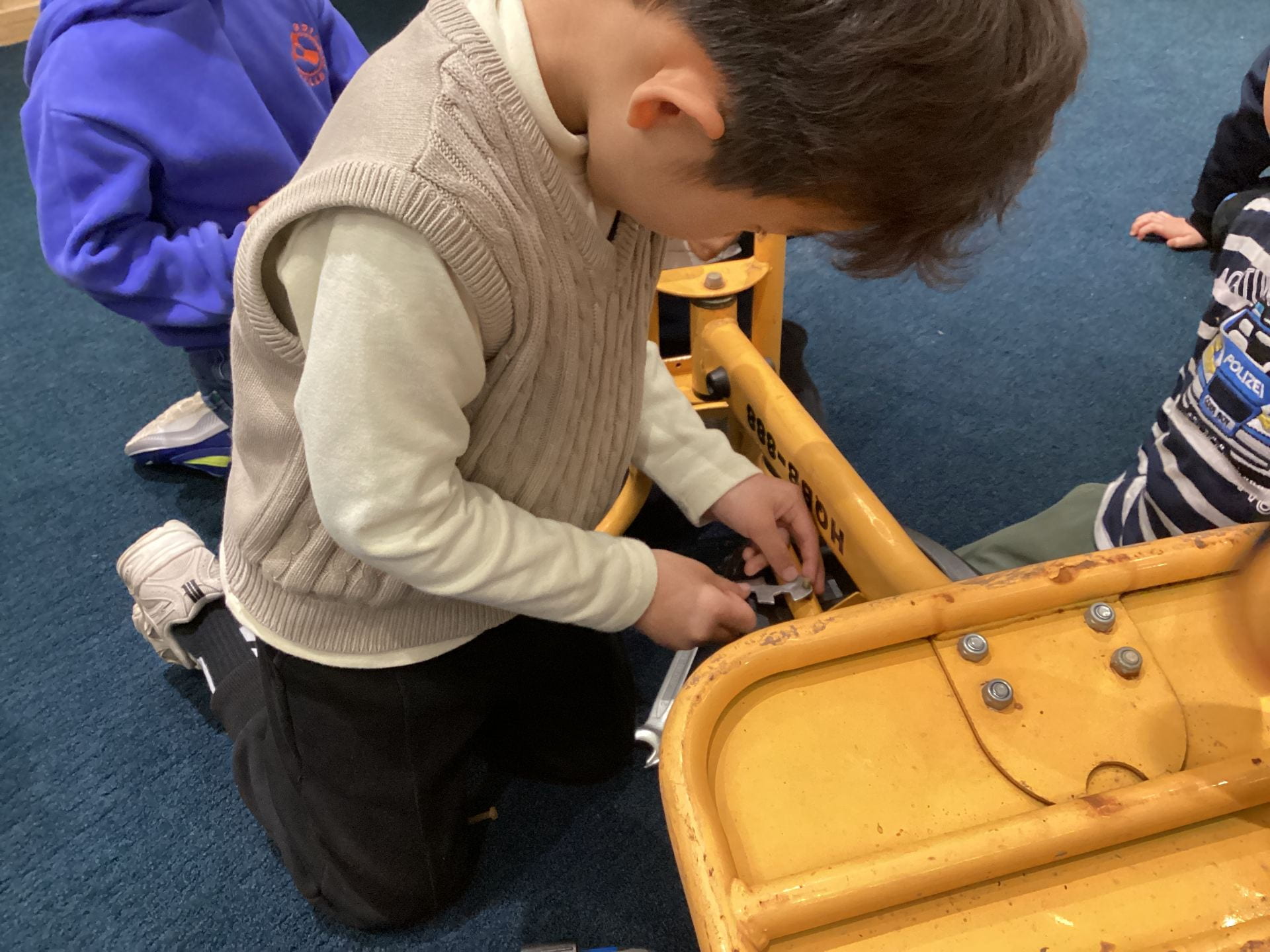
Then, the expert mechanics got to work with their eager assistants, tightening nuts and bolts, fixing the wobbly seats and adjusting the wobbly wheels. 

The mechanics took the bike for a test run to see if there were any more problems that needed their attention. The ride was smooth!

Pinboards for the Shed

(Organization, function, systems)

A few weeks ago, a group of children went into the shed to try and organise the space. They noticed that the spades, sand toys and kitchen items were left all over the shed. We decided to try and organise it.

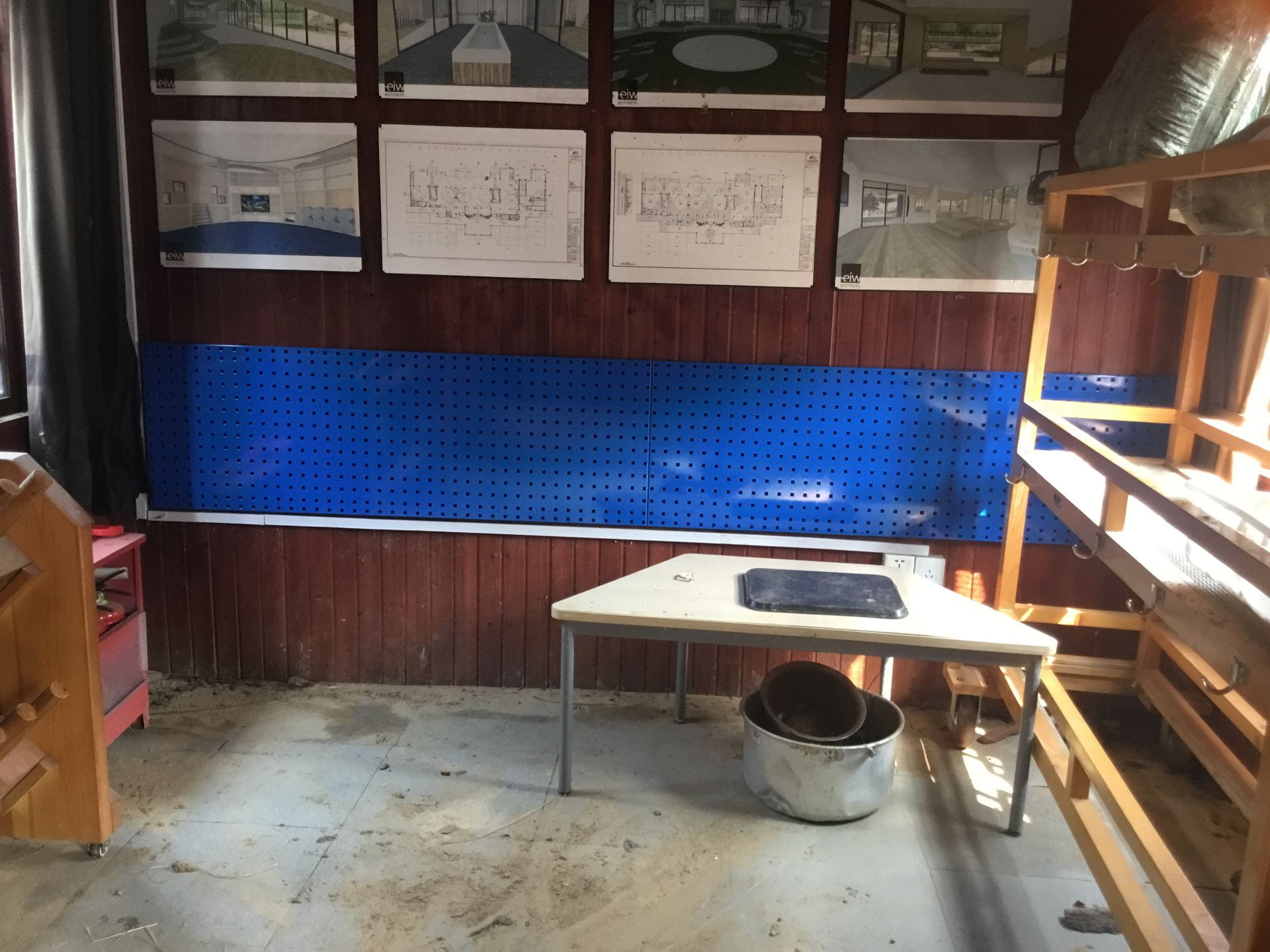
We ordered some pinboards but they needed to be mounted on the walls.  

The children decided where the pinboards should be mounted.

Ms. Hannah sent the information to the maintenance staff department.


When the maintenance staff arrived, they opened the boxes. The pinboards were blue! We saw some screws in the box.

The maintenance staff thought about the children’s request. There were more pinboards than we had planned to have but the team shared some good suggestions. They began to mount the boards in the shed.

Now we have new pinboards to organize the tools and toys.

Our next step is ‘to discuss and agree on how we might organize the space so that people can use the different items safely’.

We continue to see the children taking ownership over their spaces, observing, discussing and creating functional spaces that meet their needs. The children know they have a voice, and that their ideas and creative thinking can lead to positive changes that support the community. Through these experiences they explore how community spaces can bring a sense of purpose and belonging.

The Sandpit

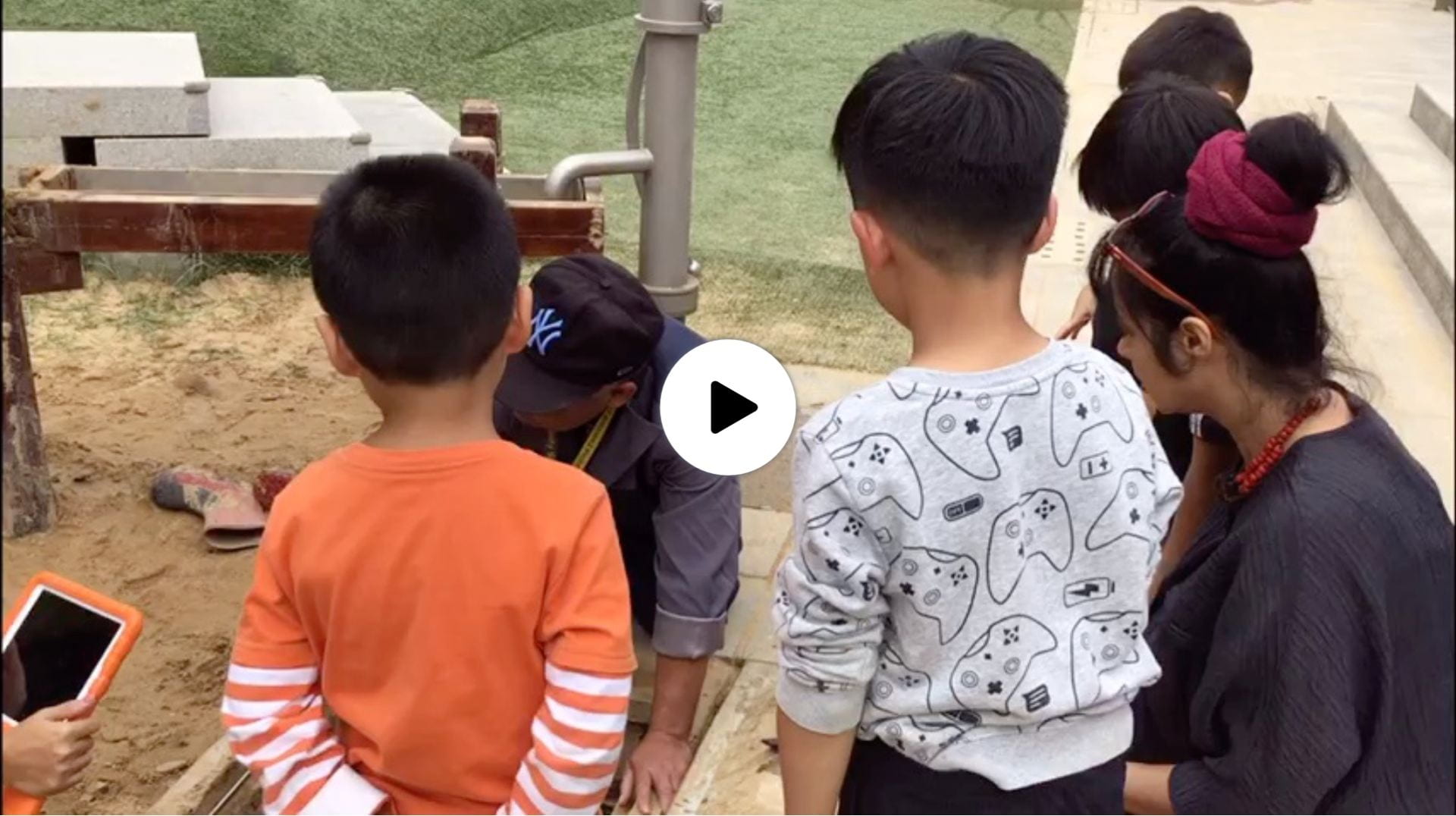
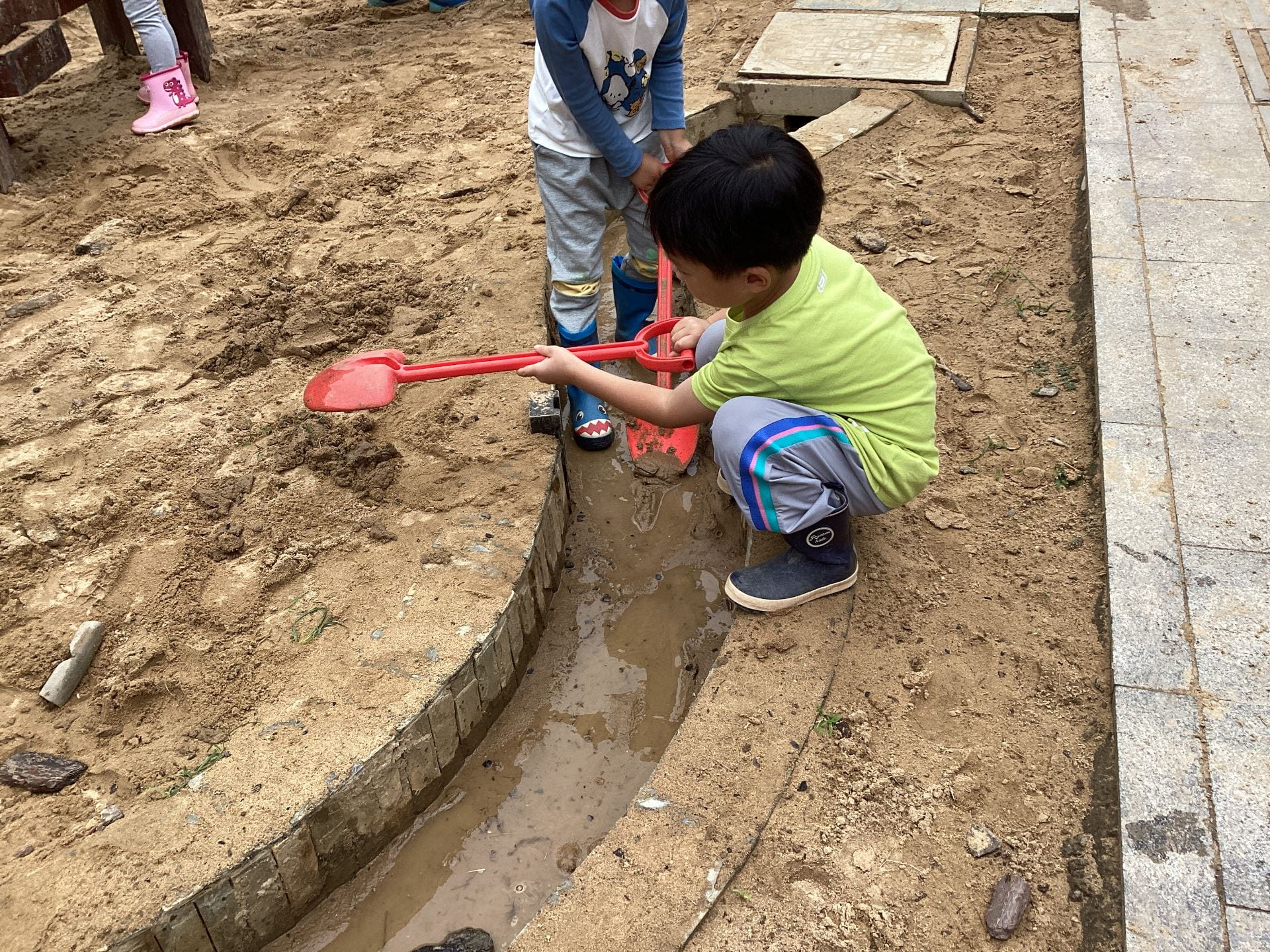
We noticed the Support staff clearing out the sandpit. We were curious and decided to investigate. A few of the children who frequently play in the area, building dams and waterways, went out to speak to the staff to inquire about the work being done. 

Later, Patrick and Noah shared the photographs with the class and explained the situation to everyone.

  • Patrick “We want to make a river and we need water so we put the sand on the waterway. Then there were rocks in the river. They are cleaning the water way and put the rocks on the sand. There is big trouble because the waterway has sand.” 
  • Noah “Everyone put the sand in the drain because we wanted to make a big river. He (the workers) are cleaning the sand. We are watching how they take out the rocks.”

  • Noah “The workers are taking out the rocks. The water is stuck. Don’t put the sand in the pipes because the water cannot go. They were telling not to block the way.”
  • Patrick “Ms. Shemo said, this waterway is not clean.”

When it was outdoor playtime, Patrick ran out to the waterway and began to clear out the drain and waterway.

Noah quickly joined in to help. Olivia and Kenan joined in.

When the water started running down the waterway, they all cheered and squealed with joy!

When children have agency they reflect on their actions and take ‘action’. They understand that they have an active voice and stake in their classroom and community.

Kindness

Online Learning

Focus: Social and Emotional Learning

What does it mean to be kind? How might acts of kindness bring us together as a community?

Author Todd Parr explores this concept through his picture book ‘The Kindness Book‘.  

https://www.youtube.com/watch?v=SFzmydgwgwc

  • How were ‘you‘ KIND today?

-Approaches to Learning (ATL’s)

  • express oneself using words and sentences
  • practise empathy and care for others
  • be respectful to others
  • be aware of own and others’ feelings
  • use strategies to problem-solve

Helpers in the Community

We had a second step ladder in the classroom. But again, we had to assemble it!

This time we decided to ask our community to support us. We placed all the pieces of wood, screws and tools in the corridor, along with the instructions. We included a ‘message’ to the community.

A week went by. Nothing happened. The step ladder was still in the box. A few days later, we saw a student working on the project. He was assembling the step ladder during his lunch break.

The next day, a few other children joined in to help. A week later, the step ladder was completed. The community helpers posted their own ‘message’.

We decided to send them another ‘message’. We thought that they may like to paint the step ladder they have assembled. The quickly joined in to help.

The step ladder was beautiful.

The children in PreK-K1C were excited to see the green, white and silver step ladder.

What other ‘messages’ can we send them?

The students began to share their ideas. Can we ask them to help us again?

  • Felix “Can you please build a tree house? We can bring trees. We can bring small trees (sticks). Put something sticky.”

  • Michelle “Could you please build a garden? Put leaves and flowers. And keep garden books. Chairs here. People can make lion in garden.”

  • Tyson “大椅子。很多木头。” [a big chair. Many pieces of wood]
  • Teacher “How will the Grade 4 students know what type of chairs we want them to make for us?”

The children used paper to draw their designs.

They collected the material the community may need to use to create the different items. Craft sticks, twine and scissors for the tree houses.

Play dough for the garden.

Pieces of wood, a hammer and nails for the chairs.

  • Felix decided to move his tree house close to the bulletin board. “They can see what my tree house looks like.”

Will the community see our messages?

We wonder what will happen next…

https://twitter.com/shemogani/status/1174867793679773696

Approaches to Learning (ATL’s) 

  • Observe carefully.
  • Use discussion and play to generate new ideas and investigations.
  • Present information in a variety of modalities.
  • Listen actively and respectfully to others’ ideas and listen to information.
  • Interpret visual, audio and oral communication: recognizing and creating signs, interpreting and using symbols and sounds.
  • Express oneself using words and sentences.
  • Participate in conversations.
  • Negotiate ideas and knowledge with peers and teachers.
  • Understand that mark-making carries meaning.
  • Use mark-marking to convey meaning.
  • Share responsibility for decision-making.

Developing a Sense of Community

We gather as a group each morning to welcome the day, to greet each other, to share news and to talk about the projects that we might want to follow or complete.

Our Morning Meetings are a time to learn about each other. A time to share our individuality, diversity and common aspirations. We sit in a circle, where there is no hierarchy. We are all the same in this space. Together we find ways to create a democratic environment where we respect, care and learn about each other’s perspectives.

During this time, a member of the community checks in with others to place the lunch order. While completing this task, we learn each other’s names. We learn how to listen to others, respond to questions and collect data.

One member of the community then goes over to the cafeteria to deliver the cards to the staff, placing the order for lunch. They bring back the fruit snacks, which we eat together at the snack table. 

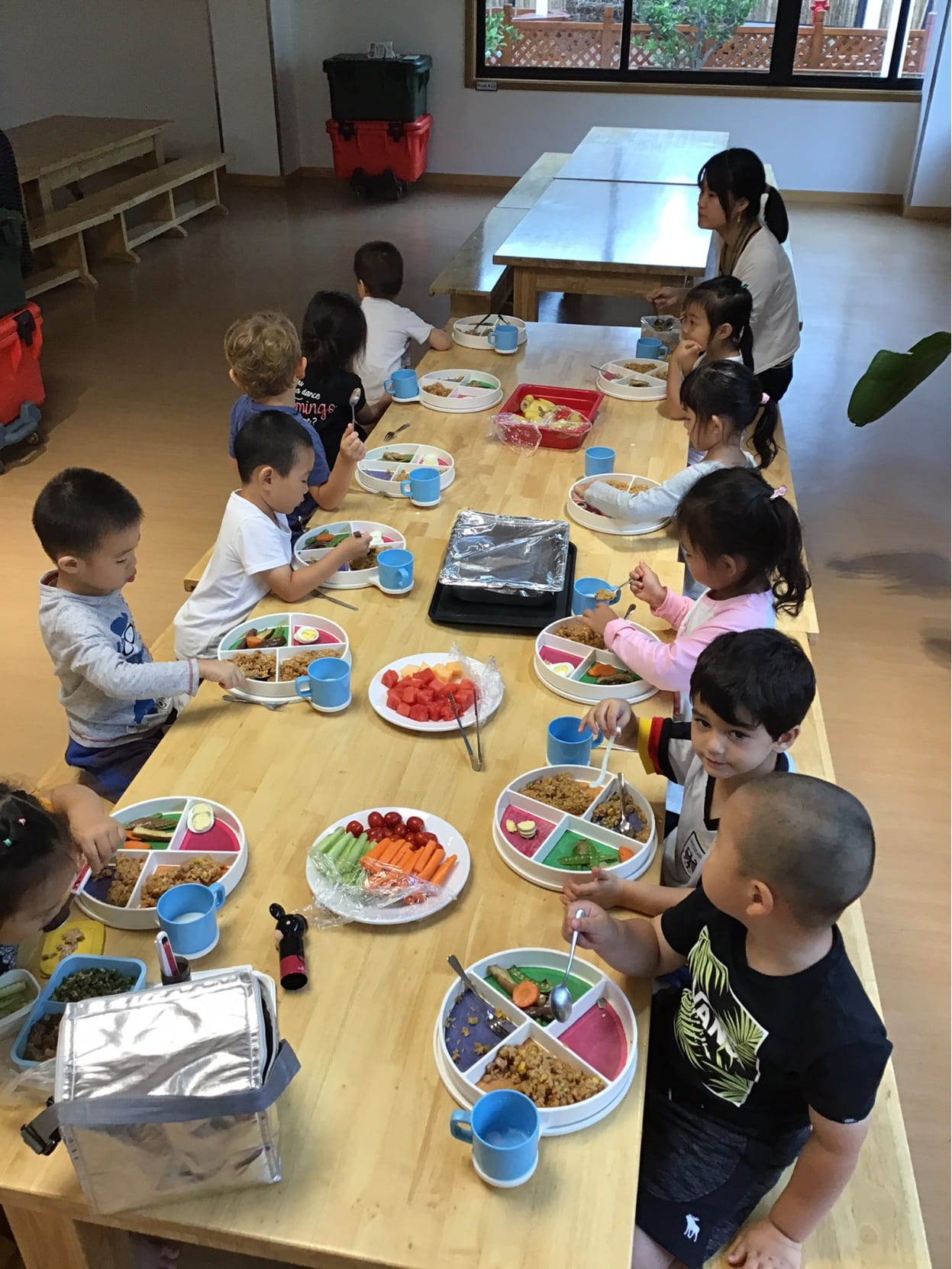
At lunch time, a few children go over to the kitchen to set the table, to prepare for our meal together. We all sit together to eat our ‘school’ and ‘home’ lunches. We focus on independence, encouraging and learning good table manners.  We pass the food platters around, serving only what we can eat, talking about balanced diets and good hygiene. We discuss waste and care for the environment. After lunch, we pack up all the cutlery, crockery and clear away the dirty dishes. Taking responsibility for the spaces we use is an important part of our learning together.

Being caring and accepting others is one of our Essential Agreements. We seek out and celebrate instances when these agreements come to life in the community.

The teachers frequently sit together with the children, sharing what they have noticed.

Making invisible actions public and celebrating instances when the community have been able to solve problems together through dialogue and collaboration. These are great opportunities to highlight the role of kindness, empathy and care in communities.

The children frequently create with blocks, loose parts and other materials in the classrooms. Sharing the materials as we create can be a challenge for some of us. It is important to be able to capture instances when we act as a community. 

In the picture below, the students noticed that there were many people crowding around the library check out counter.

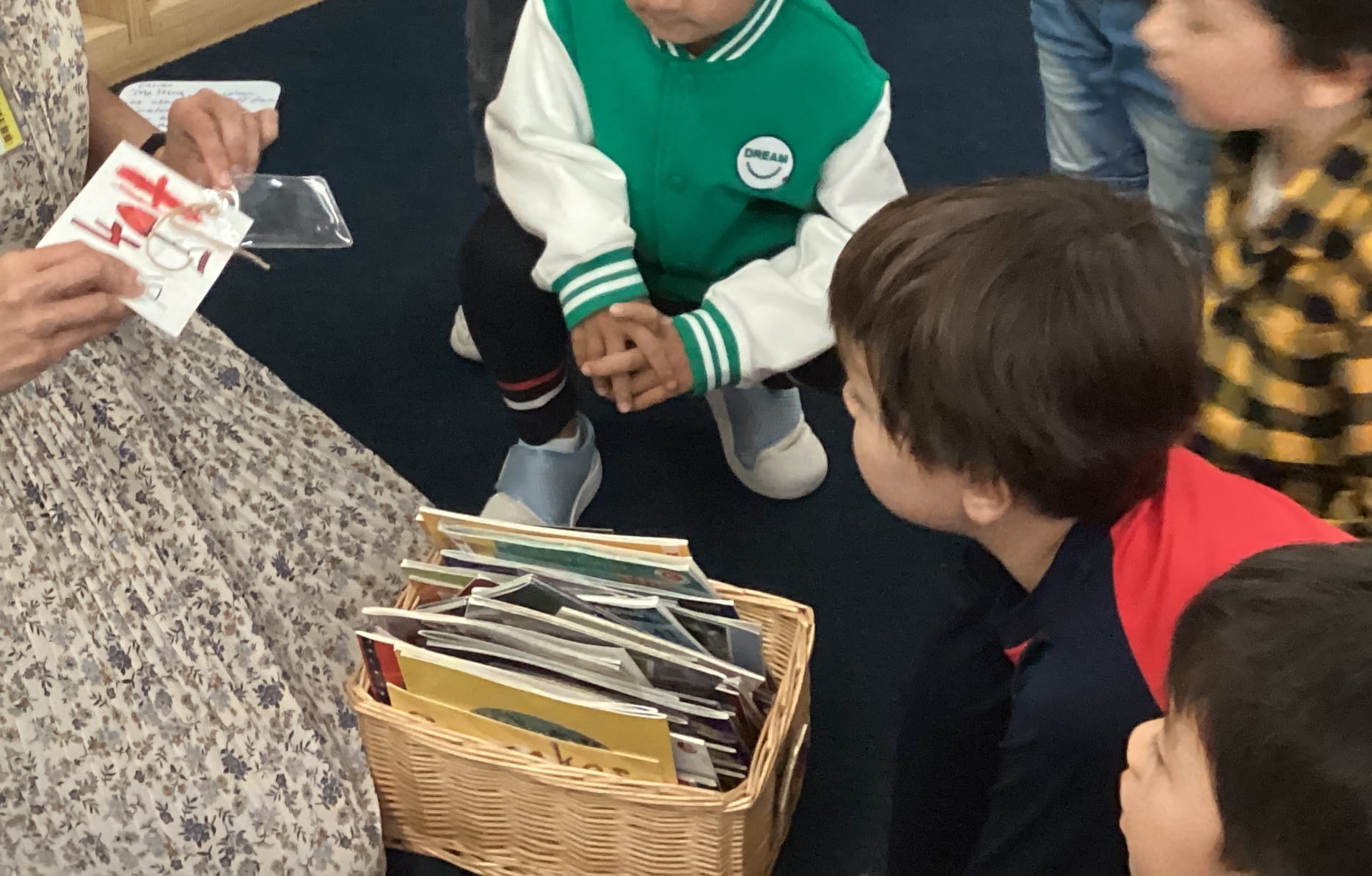
When the teacher shared her observations, the children quickly lined up behind one another, waiting patiently for their turn to check out their books. Being mindful and respectful of different behaviours in different places helps us create a calm and positive learning environment.

In order to make this happen we spend a lot of time, learning about ourselves; our actions and behaviours, how they affect us and the others around us, how we can manage these emotions.

The Zones of Regulation help us visualise and verbalise emotions. We refer back to this language to help us learn how to manage our feelings, emotions and actions.

Here are some examples of kindness in the Early Years.

We aim to seek out opportunities that bring us together as a community. In order to celebrate our PreK-K1 community, we worked together to bake muffins that we then shared with our friends.

Our community is more than just our PreK-K1 friends. The children frequently visit the other campfires in our Early Years space, to play with the other children and explore the different centres. In the picture below, a K2 student reached out to a K1 student, when he could see that she was unhappy in the playground.

Caring for others helps us develop a safe, kind and positive environment where everyone feels valued and empowered to learn.

Central Idea: What we do matters to others.

Lines of Inquiry:

  • how we behave towards others (perspective)
  • appropriate behaviour in a variety of settings (connection)
  • the impact of our behaviour on others (responsibility)

Key Concepts: connection, perspective, responsibility

Related Concepts: acceptance, relationships, attitudes, behaviours

The Step Ladder

Our new campfire has tall curved shelves. They are great for storing our resources and creations. However, we realised that we cannot always reach the top of the shelves. Even the teachers were not tall enough!  

We decided to order a step ladder from IKEA. It came in a box. It was in pieces! We had to fix it ourselves.

A few of the children took up the challenge. @S stated that she knows how to do it as her grandpa and grandma always fix the furniture in the house. She knows how it’s done.

@S wanted to be in charge of the screws. @F wanted to read the pictures in the instruction manual. It was decided that he would be the person telling the team where the screws fit, and which wooden pieces were needed.

The children wanted to know the name of the tools we were using. We invited @MrZachG the Design teacher, to come over to the Early Yeas space to help us. He told us the tool was a type of wrench!

The children talked about the pictures they saw in the booklet. They noticed the sequence of steps and the need to follow them.  

@F noticed that there are different kinds of screws. He looked closely at the different pieces of wood to see where the screws needed to be inserted. This was a challenge. There were so many different pieces!

He wondered in which direction the screws needed to be turned. After many attempts, @F said…

“Because it’s harder and harder, so I know I’m right.”

Others joined in to see how they can help. The project allowed for opportunities to learn through trial and error.

Conversations revolved around size, measurement, purpose and safety. We wonder what other tools people use to create different objects…

Through this project we had opportunities to …

  • Observe carefully.
  • Seek information.
  • Ask or express through play questions that can be researched.
  • Analyse and interpret information.
  • Listen actively and respectfully to others’ ideas and listen to information.
  • Express oneself using words and sentences.
  • Negotiate ideas and knowledge with peers and teachers.
  • Understand symbols.
  • Understand that mark-making carries meaning.
  • Be respectful to others.
  • Play cooperatively in a group: sharing, taking turns, helping.
  • Choose and complete tasks independently.
  • Follow the directions of others.
  • Share responsibility for decision-making.
  • Demonstrate persistence in tasks.
  • Use strategies to problem-solve.

Approaches to Learning (ATL’s)

Routines That Build Independence

Each morning we gather in a circle to greet each other using our words and gestures. It is a time to be part of a community, sharing our feelings, cultures and stories. It is a time to celebrate our diversity while being respectful and inclusive.

Each morning one student checks in with each member of the class to place the lunch order. Student ID’s are assembled in a graph to help sort the information collected.

The cards are then taken to the cafeteria by the student helper. The lunch order is placed, and snacks are brought back to the Early Years kitchen.

After we wash our hands, we line up to get our snack boxes.

We are now ready to have our healthy snacks!

Approaches to Learning (ATL’s)

  • Seek information.
  • Gather information from a variety of sources (people, places, materials, literature).
  • Sort and categorise information and materials; arrange into forms or order, for example, with graphs, marks or symbols using emergent writing skills.
  • Analyse and interpret information.
  • Listen actively and respectfully to others’ ideas and listen to information.
  • Express oneself using words and sentences.
  • Follow the directions of others.
  • Follow classroom routines.

A New Baby

Michelle has a new baby brother. She took some pictures of her brother to share with us. We had a very interesting discussion about what we know about babies, what a baby needs and what can we do to help a baby.

What do you KNOW about babies?

  • Felix “Sleeping on the bed.”
  • Seungbin “Baby.”
  • Si Hyun “Me house baby, so small.”
  • Freida “The baby is sleeping in the big bed.”
  • Nicolas “This picture looks funny. Because he is sleeping and eyes closed in the bed.”
  • Charlotte “Baby sleeping is very funny.”
  • Amber “我看到Michelle和弟弟。” [I see Michelle and her brother.]
  • Lawrence “我觉得baby哭了是因为他不想喝奶,刚生下来不习惯喝奶,我小时候也是这样的。” [I think the baby cries because he doesn’t want to drink the milk. When the baby is just born, he is not used to drink milk. I was like that when I was a baby.]
  • Freida “The baby is crying.”
  • Ethan “Michelle坐在沙发上,抱着宝宝。” [Michelle is sitting on the sofa and cuddling the baby.]
  • Jiwoo “Baby, here, eating milk.”
  • Alejandra “Michelle 在帮弟弟喂奶。” [Michelle is helping feed her brother the milk.]
  • Michelle “在医院的时候我帮助喂奶。” [When I was in hospital, I help feed the baby the milk.]

What do babies NEED?

  • Jooeon “Eat and rice.”
  • Lawrence “He need milk.”
  • Felix “My brother likes chocolate, he (referring to Michelle’s baby) doesn’t.
  • Jasmine “He needs eat the rice.”
  • Alejandra “他没有牙齿,所以他不能吃饭,只能喝奶。然后像我们一样长很多牙齿,然后可以上学。” [He doesn’t have teeth, only drinks milk. He will have many teeth just like us, then he can go to school.]
  • Ruby “Only milk because he hasn’t had teeth to eat food.”
  • Michelle “Baby 没有牙齿,他就可以喝奶,不可以吃饭。” [Baby doesn’t have teeth, he can only drink milk, he can’t eat rice.]

What can we do to HELP the baby?

  • Jasmine “我帮助George换衣服,我和弟弟玩车车,我还帮弟弟洗浴缸,我还帮弟弟推推车,我还帮弟弟抱着玩。Me and George play card.我们还玩芭比娃娃。Me and George, we play Jiwoo. Jiwoo with the car, Jiwoo together, he plays my home with me.” [I help George change clothes, I play cars with him. I help him by cleaning the crib. I help him push the pram, I cuddle him. Me and George play cards. We play with the dolls.]
  • Felix “I like broccoli from mummy, Simon like broccoli from Ayi. I play cars, building with Simon. When Simon don’t know where the folder, I show him.”
  • Alejandra “我们可以帮助换尿布,到台湾的时候,我就有两个妹妹,然后我就要帮她换尿布,喂奶,换衣服。” [We can help to change the diapers. When I go to Taiwan, I will have two sisters, then I will help them change the diapers, feed the milk and change the clothes.]
  • Jiwoo “Baby sleeping the house. Baby sad, mummy coming in.”
  • Charlotte “可以喂奶,就像我们一样长得很高。也可以帮助他做一个玩具,然后Michelle的弟弟可以长得高高的,像爸爸一样。等我们长大,我们就会变成妈妈。” [We can help feed the milk, and he will grow as tall as us. We can make a toy for him. Michelle’s brother will be as tall as daddy. When we grow up, we will be mothers.]
  • Lawrence “我们可以帮助baby换衣服,还有也可以给baby喂奶。” [We can help baby change clothes and feed the baby milk.]
  • Nicolas “I have a baby and actually in Germany. When he wants to eat, I show him how to be responsible. I help him to be responsible.”
  • Michelle “如果他哭了,我可以给他唱歌,他就好了。” [If he cries, I can sing a song for him and he will be fine.]
  • Si Hyun “My baby like milk. Me and baby play car. And me house so many cars. Baby milk finish, sleeping. Me go to zoo and baby sleeping and me do it, push the car.”
  • Sarah “我和妹妹在围栏里玩得很开心。有一天妹妹不小心掉下来,我帮助告诉爷爷。阿姨一个人搞不动那么多东西,是我阿姨喂妹妹,因为我抱不动,她一岁了。” [My sister and me paly nicely inside the fence. One day my sister fell down by accident, I help by telling my grandpa. Ayi is too busy to handle so many things by herself. Ayi feeds my sister because she is 1 year old and I can’t hold her.]
  • Michelle “我长大的时候帮他换尿不湿。” [When I grow up, I will help him change his diapers.]

Student Learning Outcomes (SLO’s):

  • their roles and responsibilities within the family and class
  • who their caretakers are and turn to them when needed
  • that everybody has a family
  • that not all families are the same
  • that a sequence events from their routines, life and personal histories can be put in chronological order
  • the importance of people in their lives
  • the ability to take care of things – animate and inanimate
  • their thought for others
  • a sense of wonder and curiosity 

Approaches to Learning (ATL’s):

Communication Skills

Listening

  • Listen to information.
  • Listen actively and respectfully to others’ ideas.

Speaking

  • Express oneself using words and sentences.
  • Participate in conversations.

Social Skills

Interpersonal relationships

  • Practise empathy and care for others.
  • Listen closely to others.
  • Help others.

The Accident

  • Felix “What is it? Ms. Cherry, she is in the room.”
  • Nicolas “Did she break her leg?”
  • Alejandra “Ms. Cherry!”

Alejandra shows Freida the picture.

  • Jasmine “That’s Ms. Cherry.”
  • Ruby “Ms. Charry has a broken leg because she has something on her foot.”
  • Amber “Because he hurt his leg.”
  • Alejandra “It’s because Ms. Cherry looking for some people for the window. Someone broke the window and Ms. Cherry go to say something and some pieces fall from the window and fall on her foot and all the foot.”

A few days before we had spoken to the students about a broken window in Ms. Cherry’s class. It had broken when a student threw a stone.

  • Felix “I think when the window come then its broken then the foot.”
  • Nicolas “She is smiling and her foot is broken!”
  • Charlotte “Its broken.” In Mandarin “Ms. Cherry bones are broken.”
  • Alejandra “We can give to Ms. Cherry some flowers and chocolates.”
  • Teacher “How do you know she will like to have flowers and chocolates?”
  • Alejandra “Flowers. Because I love!”
  • Felix “In the house then it is broken and then it came this. She fell in house.”
  • Poli “Ms. Cherry and doctor and here and here and doctor.

  • Nicolas “Maybe she go to the house upstairs and lies down and then she fall down from the bed and then she went out and looked to the window and then she falled down to the ground.”
  • Freida “Ms. Cherry will sit on…”
  • Ruby “Wheelchair.”
  • Frieda “Ms. Cherry go on a wheel chair and then she goes to a doctor on the wheelchair.”

  • Ethan “Ms. Cherry is hurt, and her legs are in some straps. I don’t know what happened.” 9in Mandarin)
  • Ruby “Its bandages.”

The teacher explained that she had no money. How can we earn some money to buy some flowers and chocolates. The children suggested we ask Ms. Angie because she had money. She used money to buy things from the supermarket when we went to buy things.

  • Nicolas “We can make our own chocolates. We can pick flowers from the garden. From the playground where there is a spider web.”
  • Alejandra “Ms. Cherry comes to the nurse and see its broken and she sits down to the doctor and she can push her and the chair in the office. He can call her doctor to help to push.” (the nurse will help to push the wheelchair)
  • Lawrence agrees that she needs some chocolates and flowers.
  • Felix Ms. “Cherry comes a doctor.”
  • Poli “Ms. Cherry and doctor and pillow and house and put on floor.”
  • Alejandra “My mum and me go shopping I can first say to mum, ‘Can I buy some flowers for Ms. Cherry’. Because I like. My mum has some money to buy.”
  • Lawrence “Girls like Chocolates and flowers. Boys no.”
  • Nicolas “I like flowers.”
  • Ruby “Maybe in the window, someone threw the rock in her window and I saw the crack and then maybe it fell and hurt her foot. Also she go to the doctor and go get a plaster, and also why did someone crack her window?
  • Alejandra “It’s because in her house, so many bad guys go to her house, it’s a fire and then she hurt her leg.”
  • Poli “Ms. Cherry and doctor and house and home and flower and chocolate.”
  • Lawrence “It’s boys no like flowers. Girls thinking, boys is boys thinking.
  • Ruby “Boys like chocolates and girls like flowers. Boys don’t like smelling things. I know because you know Ms. Cherry has flowers, it will make her feel better.”
  • Freida “I wasn’t to bring chocolates and flowers. I have money for buying fruits and vegetables.” 
  • Nicolas “Wait!!! I have money in my bank! Remember my small money!”

We wonder what action students will take…

The next day we discussed our ideas. We checked with Ms. Angie about getting flowers from the garden, but we have not seen any. We know that there are flowers growing in the garden plots, but those do not belong to us. The students explained that, “We can’t take things that do not belong to us.” 

We then wondered if we can make our own flowers. Ms. Angie offered to help us create our own flowers. We could use paper, card, tissue paper, pipe-cleaners and glitter. Nicolas was concerned that the flowers won’t smell like flowers. He suggested that we spray perfume on our flowers. 

https://twitter.com/NISPreKK1/status/1064459094642180096

What would you like to say to Ms. Cherry?

The students went to see Ms. Cherry with their flowers and notes. 

Ethan wanted to know how Ms. Cherry broke her leg. 

Jasmine wanted to know why Ms. Cherry was not getting better. 

The children wished Ms. Cherry a quick recovery and then went back to class to have snack.  

https://twitter.com/NISPreKK1/status/1065870247196950528

Approaches to Learning (ATL’s)

Social Skills 

Interpersonal relationships

  • Practise empathy and care for others.
  • Listen closely to others.
  • Be respectful to others.

Social and emotional intelligence

  • Be aware of own and others’ feelings.
  • Be self- and socially aware.

A Muddy Mess!

A new space opened up to the students. The space was shaded by the young trees and the ground cleared out so that it can take on a new life in the playground. A week of rain contributed to new opportunities for learning. The ground was soft, muddy, slippery and ready to be explored. The playground was full of muddy puddles. The students ran around in their wet boots, jumping in the mud shouting with excitement. It was so much fun!

At the end of the second day, the challenges were apparent. The children’s boots were covered in mud. Their clothes were muddy and clay blobs lined their faces. 

The class gathered for a walk outdoors. The students quickly observed how fun play had also resulted in disrespect for the environment. They noticed and commented on their observations.

There were mud balls on the walls.

Mud on the wooden pillars.

Trucks in the pond.

Mud in the sand pit and on the fire truck.

Mud on the windows and on the carpets.

And Ms. Cherry’s window was broken by a travelling stone!

A plan was needed!

The students gathered to discuss what they had noticed.

How might we have fun and still be respectful of our environment?

  • Alejandra “We need to remember to stay ‘STOP’ because I think that we can’t clean the muddy puddle off the window.”
  • Ruby “No throwing mud on the wall because the wall will crack.”
  • Nicolas “If somebody throws the mud on the wall then you can’t clean it.”
  • Felix “Not running and pushing because it’s not ok.”
  • Ruby “When someone pushes you two times then you have to tell the teacher. Play with the trucks in the sandpit. But now the sand pit is covered in mud because someone threw the mud in the sandpit. When you are being rude to your mummy and daddy, then they will be sad. When someone is not your friend then find an English other person and I play with other friends in Chinese.”
  • Felix “The fire truck is not in fire (there is no real fire)”.
  • Freida “Don’t put the mud on the wall and not on the fridge. Because it will break. You cannot wipe it.”
  • Lawrence “我们不能把泥巴扔在窗户上。我们不能把泥巴放在脸上,也不能把泥巴放在自己和别人的身上。” “We can’t throw the mud on the window. We can’t put the mud on the face, on our body or others’ body.”
  • Alejandra “我们不能把泥土仍在别人的脸上。如果有人扔泥巴的话,我们可以告诉老师。” “We can’t throw the mud on people’s face. We can tell teachers if somebody throws the mud.”
  • Ethan “我们不能把泥巴扔在窗户上。” “We can’t throw the mud on the window.”
  • Charlotte “我们可以用泥土来做城堡。而且我们要洗手。”“We can use the mud to make castle. And we should wash our hands.”
  • Lawrence “我们不能把泥巴带到教室里面来。我们要在玩泥巴的地方玩。” “We can’t bring the mud into the classroom. We have to leave the mud in the muddy space.”
  • Alejandra “我们可以用泥巴来做公主。” “We can use the mud to make princess.”
  • Lawrence “ 不能把玩具弄坏。”“We can’t break the toys.”

We continue to talk about how we can make playtime a great experience, while reflecting on how we can respect our environment. 

SLO’s

  • the impact of simple actions on their immediate environment
  • how to take care of things
  • enthusiasm and respect for nature and Earth

Morning Meeting – Leader of the Day

Morning Meeting is a special time for the students. It is a time when students greet their peers and adults by name, and prepare to settle in to play, explore and learn together. Morning Meeting activities help build a strong sense of community and sets the students up for success. Students are encouraged to listen, look at the person who is talking, and manage their bodies, which sets the tone for a respectful and trusting learning environment.

This morning, one student was in charge of the lunch order.

I asked Nicolas, “School lunch or home lunch?” Because he needs to eat. 

Letter ‘s‘ is for school lunch and letter ‘h‘ is for home lunch. 

Alejandra “We put it into the packet and then we put it on the door.” 

Each morning, the students will be responsible to place the order. 

We wonder, how many students will eat lunch tomorrow?

Self-management

• Complete tasks independently.

• Follow the directions of others.

• Follow classroom routines.

• Share responsibility for decision-making.

Responsibility

What agreements do we have as a community when playing outdoors?

What is our responsibility?

How do we show care and respect towards the ‘things’ we have around us?

We used these photographs to learn more about our outdoor learning space.

The students discussed different ways of playing with mud. Alejandra explained that some children like to make mud pies and mix muddy water in containers. These are fun ways of exploring natural materials. But how could we use the spaces we have around us respectfully?

Freida “Mud and water get it to mud. We should clean it.” [referring to the the mud on the wall]

Alejandra “Clean it up!” [Referring to the mud on the playhouse toys]

Amber “Sand is for playing.” Amber explained that putting sand in our mouth was not a good choice. It can make us sick. [in Mandarin]

Ruby “We keep the sand toys in the sand pit. NO GUNS! If we hit the sand toys they will break.”

A small corner of the playground has seen a lot of activity during the last few days. The students explained that they have seen many little frogs in this area.

Ethan explained that the frogs were tadpoles first and then they became frogs, just like the caterpillar becomes a butterfly.

Michelle “Maybe put the frog in a tank? It will be sad without mummy. Give him some water. If we touch the frog he will jump.” Michelle went on to suggest that if the frog was lost he could use a map to find his way home.

Amber “The frog can live in the water. Be gentle with the frog.” [in Mandarin]

Nicolas “He is not a people. He cannot find a place with a map. If you put him in the water he will go to the sea. Be kind. Touch him gently.”

Ruby “Keep him safe in the home in the forest.”

We will continue to explore how we can show respect and care towards the toys and learning spaces we have around us. 

SLO’s

  • how to take care of things
  • resources are necessary to meet the needs of living things
  • the ability to take care of things – animate and inanimate
  • appreciation of own environment and all living things in it
  • a sense of wonder and curiosity

Agreements in Communities (continued)

How do we treat each other?

What are our responsibilities?

The students share their thinking:

  • Amber “No hitting.”
  • Ethan “No running” [in Mandarin]
  • Ruby “No shouting. Everyone needs some quiet time and some peace. We be nice and some friends be nice.”

Jasmine explained that it is not nice to grab friends by their clothes.

Alejandra explained that if we play nicely then friends then they will play with us.

  • Ethan “We keep our clothes on or people will laugh at us.”
  • Amber “No hitting anybody.”
  • Charlotte “No crying.”
  • Ruby “We have to help each other. We have to be in the green zone.”
  • Ethan “When we walk on the stairs, if someone pushes, we will fall down and get really hurt.” [in Mandarin]

Charlotte agreed saying, ‘No running.”

  • Alejandra “If everyone is running in the class then we will be in the red zone.”
  • Ethan “Don’t play in the dangerous places like the drain or near the electric wires.”
  • Freida “If someone pushes someone, then we will fall down.”

Kindergarten Gardening Project

The students have been involved in many projects in the classroom over the past few weeks. Some of these projects have led to mini inquiries and excursions in and around the school. For authentic learning to happen, some of these projects (money) require a trip outside of the school premises.

As a part of a ‘prototype’ and an ongoing mini inquiry into ‘plants’, 15 students from K1 went on a field trip to The Kindergarten affiliated to Nanjing Foreign Language School. The Prototype aims to connect with the local community through a gardening project.

https://twitter.com/NISPreKK1/status/934302180370137088

Service Learning Objectives:

  • To create a relationship between the NIS and local kindergarten

SLO’s

  • positive acceptance of diversity
  • open mindedness
  • observe changes in their physical environment at different times of the year
  • enthusiasm and respect for nature and Earth
  • how to take care of things
  • the ability to take care of things – animate and inanimate
  • their thought for others
  • appreciation of own environment and all living things in it
  • a sense of wonder and curiosity

Block Play – Cleaning Up

The students found large cardboard blocks in some of the cupboards. They took them out and began to construct small individual houses using just a few blocks each. After a while they wondered how they can create one large tower together. They worked together to build the tallest tower, negotiating roles, the placement of blocks and problem-solving when the tower collapsed.The excitement did not end there.

  • Teacher “Why do we need to clean up?”
  • Cornelis “Because it is so much mess, because it is too much mess. We are cleaning it on the shelf.”
  • Ruby (singing) “Clean up, clean up.” 
  • Ruby “Shall we make a party?”
  • Cornelis “Let’s make a tower, because this is the really cool castle.”
  • Ruby “Wow!”
  • Cornelis “Thats where everyone lives in the castle.”
  • Ruby “Make it high up!”
  • Cornelis “So we can climb up. So we can climb up to the castle with these stairs.”
  • Ruby “It is a really cool building.”
  • Cornelis “This is going to be the coolest building ever!”
  • Faye “Look!”
  • Cornelis “YAY!”
  • Ruby “Let’s dance.”
  • Cornelis “We want to leave it because it is so cool.”

At the end of their play they had to clean up the blocks, partly because the tower they created was blocking access to some of the student lockers.

These collaborative experiences provide students with an opportunity to practice appropriate social langue while solving problems through play. They persevere through challenges and are not afraid to explore possibilities. This experience helped them explore mathematical concepts such as measure, space and number through real life experiences.

https://twitter.com/NISPreKK1/status/906126015331680256

SLO’s

  • listen to others
  • co-operate and share in mixed groups
  • learn to take turns
  • participate in communal classroom activities
  • develop age appropriate skills for different social occasions
  • understand that shapes can be described and organised according to their properties
  • explore how objects can be sorted by their attributes

Essential Agreements

Conversations about safety and care have been at the forefront during the last few weeks of school. These conversations are driven by the concepts acceptance, relationships, attitudes, responsibilities and behaviours.

Literature and daily situations often provide opportunities for discussions about our care for others and the environment. In order to ensure that everyone works collaboratively, the students together with their teachers created ‘Essential Agreements‘.

Photographs of students creating this culture and climate for learning and play were shared with students to help them better understand these agreements.

Care and Empathy 

As the weeks progress many examples of how students grow as a community become more visible. Helping each other navigate through tasks, showing concern and empathy for those who are hurt and supporting each other emotionally helps create a safe, caring and thoughtful learning environment.

One student holds an ice pack for another who is hurt, while another helps to tie up an apron.

Students help rebuild a broken wooden tower.

https://twitter.com/NISPreKK1/status/900297029338906625

SLO’s

  • communicate with others in order to experience relationships and make friends
  • reach out for help when it is needed for themselves or others
  • identify when their actions have impacted on others

Baking for Others

We were excited to hear that the students in one of the Grade 2 classes will be our reading buddies for the year. We decided to bake cookies for them. Ms. Angie helped us bake the yummy chocolate chip cookies.

  • Reggie “We are making cookies with Ms. Angie.”
  • Ruby “We put the flour in there.”
  • Cornelis “Also we need some butter.”
  • Franz “Ms. Angie showed us the cookies in the book.”
  • Cornelis “She needs ingredients.”
  • Reggie “Butter, sugar.”
  • Ruby “And flour”
  • Cornelis “And brown sugar. And we also need chocolate and butter.”
  • Ruby “Also she needed eggs.”

  • Franz “We are stirring the egg.”
  • Jasmine “I put my hand on the table and the other hand on the shirt. That is egg.”

  • Amber “One hand I hold the bowl and the other hand I am stirring the dough.”
  • Cornelis “I was waiting and my hands were on the chair. Because Jasmine was doing it I had to wait for it. I asked Jasmine can I have it to stir?”
  • Ruby “I said…can I have a turn?”

  • Reggie “That is dough to make cookies. Because we need to roll it into a ball.”
  • Cornelis “And also we need to put some flour in our hands.”
  • Ruby “Because it does not stick.”
  • Abby “I wanted to put it on the tray.”
  • Ruby “She put them in the oven.”
  • Hannah “Because the cookies are still raw.”
  • Reggie “Then they will turn right.”
  • Cornelis “Also you need to bake them until they are all ready.”

  • Cornelis “We went to the Grade 2 class.”
  • Hannah “My sister’s class. I gave it to my sister.”

  • Reggie “They said Thank You!”

  • Hannah “Ms. Linnie and Ms. Nora got cookies too.”
  • Ruby “We gave them because we have to eat them.”
  • Reggie “Because we wanted to share.”

SLO’s

  • develop an inquiring mind
  • ask simple questions
  • make observations
  • follow a template/guide for study
  • make statements that reflect their understandings
  • develop their ability to reflect by describing the sequence of activities undertaken
  • listen to others
  • co-operate and share in mixed groups
  • learn to take turns
  • accept that others might have different opinions and preferences about things
  • participate in communal classroom activities
  • develop age appropriate skills for different social occasions

A Picnic

During the last few days we have been sharing our ideas about appropriate behaviour in a variety of settings (Responsibility). We had a new picnic mat in class and this encouraged a discussion on how we can work together as a community.

  • Cornelis “We are eating.”
  • Ruby “That is me and Cornelis, we are peeling the orange.”
  • Reggie “They are helping.”
  • Ruby “We are eating our snack. We are being in a circle.”
  • Jasmine “We are all sitting together.”
  • Ruby “That is the rule. We have to share the mat.”
  • Cornelis “Also, you don’t step on the picnic mat.”
  • Ruby “Because it will get dirty.”
  • Lawrence “We can’t step on the picnic mat or the food.”
  • Cornelis “You must not touch someone else’s food.”
  • Reggie “We wash our hands because it is dirty.”
  • Amber “We can’t step on the mat. When the picnic gets dirty we dirty our food as well.”
  • Hannah “We are sitting in a circle on the mat because we can put our food on the mat.”

We Are…

During the last few weeks the students have been settling in, getting to know their peers and exploring their new learning environment. How do they demonstrate the attributes of the  Learner Profile? 

They are…

Inquirers

“What will happen to the water bead when I put it into the water?”

  • We ask questions.
  • We like to learn and discover new things about the world.
  • We are curious, we will carry this love of learning throughout life.

Risk Takers

“I can help you get the money out.”

  • We have the courage to try new things.
  • We are not afraid to give it a go even if we feel shy.
  • We try to solve problems in a lot of different ways.

Thinkers

“We are trying to make the marbles travel through the pipes.”

  • We are thoughtful.
  • We try to solve problems and make good decisions.
  • We do this by thinking about things and by learning from our mistakes.

Open-Minded

“We like listening to stories read in different languages.”

  • We know that people are different and may do different things.
  • We know that not everyone will think like us and that’s fine.
  • We listen and try to understand others.

Knowledgeable

“I can create a picture using these shapes.”

  • We have learned many things.
  • We can tell you about these things and we can show you.
  • We can use this information to solve problems in life.

Reflective

“How does this story make you feel?”

  • We think about what we have learned, what we are good at and what we can improve the next time.
  • We take the time to think about our actions and their effects.

Caring

“Can we water the garden?”

  • We care for other people and try to help others.
  • We care about everything around us.
  • We want people around us to be happy and we are sensitive to their needs.

Communicators

“I can draw a picture of ME!”

  • We talk about our ideas.
  • We are able to express ourselves in more than one language.
  • We can also communicate using mathematical language, symbols and drawings.

Principled

“I can share the money with you.”

  • We always try to do what is right.
  • We are fair and follow rules.
  • We are honest with ourselves and with others.

Balanced

“I like to create tall towers.”

  • We eat healthy food and we exercise.
  • We like to learn about different things.
  • We understand it is important to have a balance of work and play.

Nature Creation

The students went for a walk around the school in small groups. They observed nature and collected little treasures to bring back into the classroom. They noticed and discussed information about the flowers and vegetables growing in the school garden plots. They created a piece of art using their nature collections.

“We used pebbles, sticks, leaves, seeds, chillies, tomatoes and moss to create a picture.”

SLO’s

  • the impact of simple actions on their immediate environment
  • how to take care of things
  • the ability to take care of things 
  • appreciation of own environment and all living things in it
  • a sense of wonder and curiosity 

Caring for Others

The rain boots were messy. They lay on a sandy mat in the corner of the classroom. Three students decided that this was not appropriate. They took ‘action’.

Agency: When students have an active voice and stake in the classroom/community.

They first moved the boots, dusted and swept the area and then mopped the floor.

They created name tags and placed them on the floor.

They arranged the rain boots neatly on top of the taped tags.

They decided that mopping was fun. Over the course of the day they mopped the whole classroom. They explained that they wanted to mop the floor because they wanted to be helpful. The mopping gradually moved into the hallway and ended in a second grade classroom.

More students joined in.

Their actions led to a discussion during circle time.

Carolyn “We are walking in the hallway and cleaning the classes.”

Teacher “Why?”

Gabby “Because we want to be caring to our other classmates at NIS.”

Vera “Because the Ayi’s don’t have to clean all the classrooms.”

Gabby “The classrooms are dirty.”

Carolyn “Their shoes are muddy.”

Teacher “So what else can we do to show others that we care about them?”

All the students started to make a list of things that they could do to show how they care.

  • Laugh with people
  • Build with stones together
  • Say good stuff and NO sad words. NO angry words
  • Say “STOP” if people do it the second time
  • Play games together
  • Pat them and say “Excuse me” when people are talking to someone else
  • Don’t roll your eyes
  • Be caring
  • Hugging, cuddling
  • Say “Sorry”
  • Share
  • Be kind
  • Help others do things
  • Help the teachers do jobs
  • Listen
  • Wait for your turn

SLO’s

  • build independence and personal responsibility and a sense of self-worth
  • Identify positive thoughts and attitudes in themselves
  • communicate with others in order to experience relationships and make friends
  • reach out for help when it is needed for themselves or others
  • identify when their actions have impacted on others
  • interact, play and engage with others
  • take turns
  • listen respectfully to others
  • share their own ideas and feelings in an appropriate manner
  • celebrate the accomplishments of others

Stay Safe!

The students noticed that some children were opening the safety gates during playtime. They took action by creating a video about playground safety. They shared their video with their peers.

https://twitter.com/NISPreKK1/status/853163861142196227

Agency: When students have an active voice and stake in the classroom/community. When students reflect on their actions and self-regulate.