
Beautiful

What makes something ‘beautiful’?
The children frequently gather at the writing table to draw, colour, write and create using a range of different materials available at this centre.

Intricate designs, drawings, ideas and props for stories often emerge as a result of their inquiry. As the semester progressed, we noticed that the paper creations were becoming more complex.

The children made computers, puppets with moving parts and 3-dimensional art.

We decided to speak to a group of children to explore some of their wonderings about paper crafts.
- Liz “Make computers is so happy. I like to play with computers.”
- Lydia explains, “I want to make things beautiful.”
- Teacher “What is beautiful? What makes something beautiful?”
- Lydia “Flowers are beautiful because there are so many beautiful things on it.”

- Lydia points to her fingers, she has a sparkling sticker on one fingernail. “Stickers are beautiful. Coloured pencils are beautiful. We ‘like’ things that are beautiful.”
- Yui thought about what Lydia and Liz shared and explained that insects like butterflies are beautiful because they have many colours, and leaves are beautiful because there are many different shapes.


The team continued to wonder what makes something ‘beautiful’. Are they things we ‘like’?
We decided to invite them to take photographs of what they considered beautiful around the EY space. The children spread out across the space, capturing images of beautiful things. Each of them had taken pictures of colourful flowers, fish, pots of markers and glittering fabric.


Two of the photographs the children had taken were different to the others. One was a younger child’s drawing with black tip markers, and another was a ball of twigs that was a neutral colour. We wondered why they chose to capture these images. What made them beautiful?
We printed the photographs to present them to the children to see what they thought about the images they had taken.
Another child in the group was not sure which objects to photograph as she went on her walk around the EY space. She sat down to listen to Lydia and Yui as they sorted through their photographs. As Lydia thought about the photograph she had taken, she began to sort the images into different groups.

Teacher “Why are these photographs together?” To which Lydia replied, “This and this is flowers. Flowers are beautiful.”
Lydia continued her sorting, creating a second group that she labelled as ‘fish’. One of the images was a black and white drawing. Lydia explained, “This fish is ‘cute’, and cute is beautiful.” Lydia’s collection of beautiful included alphabet letters that her friends in K1 had made, a plastic butterfly and a picture of a snowflake.

The final photograph was a picture of a ring with a precious stone on the top. Lydia explained that her mom had many stones at home, and they were ‘beautiful’.
Yui gathered her photographs and thought about the different ways she could sort her photographs.

Her sorts were based on the items having ‘many different colours’. The feather was beautiful because it was ‘soft’. Leaves, flowers and a ball of twigs decoration were in a separate group because they had interesting ‘shapes’.
 Yui also had a group of ‘shiny’ things. Her final image was a paper lantern with a candle. She explained, “When you light the candle it is beautiful at night, ‘light is beautiful’” (in Mandarin).
Liz was ready to explore the space a second time. She returned with her own collection.

Liz decided to sort her photographs into two categories. The first were beautiful because they were ‘flowers’, and the second because the objects had ‘many different colours’.
 Through their research, the children were exploring how objects could be organised in different ways, and that including labels to the sort helps others understand how the information is organised.
The teachers noticed that the children’s collections centred around objects that we ‘see’ and can ‘touch’. We wondered how we might stretch their thinking further.
- Are objects the only beautiful things around us?
- What else could be beautiful?
The Interviews
Through their research, the children were exploring how objects could be organised in different ways, and that including labels to the sort helps others understand how the information is organised.
The teachers noticed that the children’s collections centred around objects that we ‘see’ and can ‘touch’. We wondered how we might stretch their thinking further.
- Are objects the only beautiful things around us?
- What else could be beautiful?
The team gathered to discuss their sorts.
What did they notice in the data?
- “Flowers are beautiful”, said Lydia. “We can see it is beautiful.” She added.
- Teacher “But what if you could not see the flowers? How would you know they are beautiful?”
- Liz “We can touch.”
- Teacher “Some people are blind and can’t see the world like we can. I wonder what they might consider beautiful?”
- Lydia thought about this more. She explained in Mandarin, “When you touch the pollen in the flower, you will know it’s beautiful because the bees like it. Bees help flowers grow.”
The information the group were working with was limited to the inquiry team. To give the children an opportunity to stretch their thinking and research further, we decided to invite them to speak to others in the Early Years.
What do other people think is beautiful?
The team wrote their question in English and Mandarin.


Then, they interviewed the children and teachers in the Early Years and recorded their data.

At first, the team needed encouragement to speak to others. They practised asking the questions and then approached new friends in the group. We noticed that the team gained confidence as they spoke to the community.

The researchers used drawing and writing to document what they heard. They also asked their interviewees to draw or write their answers down if they had trouble recording it.


We wonder what new insights they will have as a result of their research!
How might we capture beauty?
An unexpected observation presented an opportunity for the children to explore ‘beauty’ when Lydia paused while walking across the playground and said, “…a beautiful cherry blossom tree”.

The children collected the soft, shaded flowers that had fallen under the tree. We realised that the flowers would soon wilt and fall from the tree. We wondered how the children might capture the memory of the tree.

Teacher “How can we remember what the tree looks like?”
- Lydia “We can take a photo!”
- Motong “We can draw a picture!”
Having agreed to Motong’s suggestion, the artists went to the atelier to find the mark-making tools they needed.

Then, they positioned themselves in front of the tree to create a memory of the beautiful cherry blossom tree.

The artists captured details in their drawings, sharing their ability to use art to express their creativity.
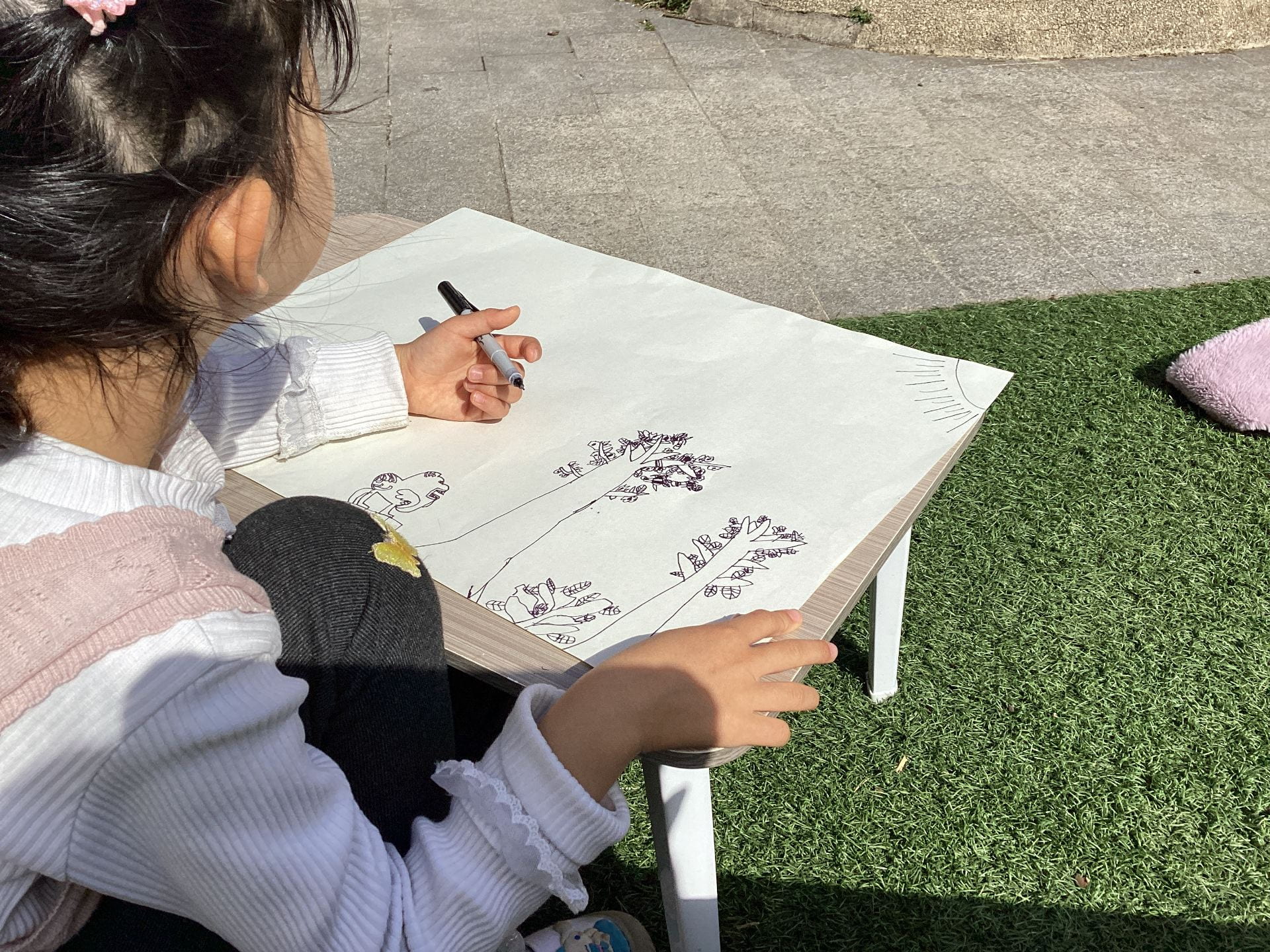
Yui decided to include the resting lions by the side of the tree, Lydia included the artists in her drawing, Liz the elements of nature and Motong’s drawing of the cherry blossom tree showed how he considered, shape, texture and perspective in his artwork.

When Lydia was ready to colour in her tree, she explained that the bark and flowers had “many different colours”, which is why it was ‘beautiful’.
Understanding Data
The team sat with the data they had collected through their survey, to sort and understand what their friends and teachers in the Early Years thought about the concept of ‘beauty’.

Looking at the information before them helped the team decide on a rule for sorting. They began to notice that they each had similar ideas that could be grouped.
They created several different groups based on the criteria they had decided on.

The team decided to include labels to help others understand the groupings they had created.

The team confidently presented their data to the class, naming all the different elements the Early Years community thought were ‘beautiful’.

Creating an Expression of Beauty
A team of children have been conducting their research to learn more about ‘beauty’. They have been interviewing the school community to listen to different perspectives.
During Student-led Conferences, families were invited to share what they thought was beautiful on a white canvas. We wondered how we might create a piece of art including all the different circular canvases that have been painted with ‘expressions of beauty’.

We invited the children to think of creative ways to exhibit the piece. The children quickly decided that they wanted all five circles to be included in one piece of art.

The children used paper and markers to make their thinking visible.


 They used shapes, symbols and words to explain their design to others. While considering the draft designs, it became evident that we needed help to create the structures the children were visualising.

Ideas presented required a strong material that could hold the weight of the different circular canvases.
The ‘Beautiful’ Paintings Display Stand
We wondered how to put the circular canvas paintings themed ‘beautiful’ together. We shared the challenge with the class to see if they had any ideas. We knew we wanted the circles to rotate, but how would we mount them together?
“Put a screw on it in the middle”, suggested Oliver.
Eli was excited to share how his dad does woodworking projects at home, he uses tools and materials to make things. We decided to speak to Eli’s daddy to see if they would take on the project, to help us build the final display stand.
Eli’s Daddy agreed!
Eli and his dad worked to create a prototype.
They began by planning. Then, they used scraps of wood they had at home to make two prototypes.


Eli presented the prototypes and his process to the class. 


The Final Stand!


Where do we go from here?
The team conducted their research, then collected, analysed and presented their findings to the class. Their presentation showed how they have uncovered a broader definition of ‘beauty’. It was time to plan the next steps in their project.
How can we share OUR expressions of ‘Beauty’?
Lydia was excited to find a piece of tinsel paper. The children explained that it was ‘beautiful’. They were attracted to the texture, colour and feel of the paper. They wondered what they could make with coloured tinsel paper. Lydia, Liz and Yui decided to draw pictures to document their ideas. They wanted to create a collaborative piece of art using all of their ideas.


Morning noticed the beautiful pictures and asked to join the team to create the art. She used several colours to draw peacocks.
 Morning explained that peacocks were ‘pretty’ because they had colourful feathers that had diamond shapes. As Morning tapped into her prior experiences, she recalled memories of seeing beautiful peacocks on her travels with her family.
The Display Stand
@Y began to envision her craftwork display where she would showcase her handmade creations. She started by sketching a design.

Ms. Eileen had collected several boxes from the IT office for the children’s project work. @Y decided to use some of them for her structure. @Ybegan to arrange the boxes according to her plan.

While playing with ideas, @Y noticed that the boxes were relatively narrow and not very suitable for placing her items.

She decided to tape two boxes together to crate a wider surface area for her creative display. @Y moved the boxes around and then arranged them in the desired manner.

As her stand was made up of recycled boxes, the print and colour on the boxes were dull and unattractive. Ms. Eileen invited @Y to think of alternatives. @Y experimented with different ideas and coloured fabrics for the base of her display.


After careful consideration, @Y settled for the red fabric.
She was drawn to the softness of the material and the shade of red. She believed that her artwork would be more visible with this background effect.
@Y was actively engaged in all stages of learning including thinking about and planning her display stand, then testing ideas and modifying to construct her final creation. As an artist, @Y’s process shows her developing understanding of how colour, shape and texture interact with each other in unique ways, and that this can have a profound effect on the observer’s experience of art.
The Group’s Expression of Beauty
The group were ready to create their final expression of beauty. They began with a blank canvas. They decided to make a beautiful picture on the large canvas based on their initial plans for their final artwork. First, they discussed the plan together and agreed to divide up the work.
Liz was responsible for making the grass, Lydia was in charge of the large flowers, and Yui handled the small flowers. After completing the initial picture draft, the group returned to the classroom and presented it to the whole class for feedback.

The children Loved the beautiful colours used for the flowers. The green grass and the shiny paper created a fascinating effect. They suggested including the sky, the sun and more flowers.
Incorporating the feedback they received, the group went back to work. They added a rainbow, more big and tall flowers, a sun, clouds, and other elements to beautify their artwork further.

When adding the rainbow, the group meticulously measured the curve and precisely cut it out to achieve the desired shape and proportions. Throughout the creative process, they provided each other with constructive feedback and helpful suggestions to refine the artwork.
The group went back to the class to share their artwork.
The children were excited to see that the team had included a rainbow more flowers and grass, all suggestions they had made to improve the creation. They explained that there was room for more improvement, perhaps including some clouds, birds, unicorns and butterflies would make the artwork even more beautiful.
The team’s final creation shares a collective expression of what is beautiful in the eyes of children. 
Cover Page for the Project Journal

Exhibits


