How are dinosaurs different from one another?

How are dinosaurs different from one another?

Our journey began with a shared curiosity about the ancient world. Before opening any books, we mapped out our existing knowledge with our own words and imagination. We exchanged initial theories, listening closely to one another’s ideas and posing questions to guide our exploration.


Our initial brainstorming session erupted into a vivid exploration of the prehistoric world.

The researcher shared their foundational theories, mapping out their current understanding of what a dinosaur is, how they lived, and how they relate to the world we know today.

  • Reptilian Connections: “They are like crocodiles.” / “They are like dragons.”
  • Biological Needs: “They are animals.” / “They drink water.”
  • Habitats and Movement: “They live in the jungle.” / “They walk on 4 legs.”

“They are big because they eat people.”

A pivotal moment emerged as the child began to grapple with the timeline of coexistence, asking whether people existed when dinosaurs roamed the Earth. Then, the dialogue shifted from abstract concepts to lived, personal memory as the young researcher shared a personal connection to bridge the past with their present reality:

“I saw big dinosaurs in Malaysia!”

In the Reggio tradition, we view this not as a factual error, but as a profound moment of prior knowledge activation. The child is actively filtering the concept of “dinosaur” through a real-world visual memory—a museum exhibit, a theme park, or a large-scale statue. This memory serves as their personal proof that these magnificent creatures are tangible, real, and accessible.


Visualising and Meaning-Making

To deepen our investigation, we introduced the text Many Kinds of Dinosaurs. The book served as a collaborative tool, where detailed illustrations and clear language acted as a springboard for deeper research. As the reader engaged with the pages, we constructed vivid mental pictures—translating words into inner visual landscapes. This process of visualisation allows us to not just read, but truly feel and see the scale, textures, and diversity of the dinosaur world. As the inquiry deepened, the child’s focus shifted from passive observation to the active mechanics of prehistoric life. We began to wonder about how “dinosaurs lived, moved, or roared, [and what] they used” to interact with their environment.


Co-Constructing Relationships: Alike and Different

Driven by our discoveries, we sought ways to make sense of the vast information. We chose to organise our findings by exploring connections, finding patterns of similarity, and celebrating stark differences.

Through this active process of comparing and contrasting, we were learning to categorise the world around us, transforming isolated facts into a deeply understood web of relationships.

Traces of the Past: An Inquiry into the World of Dinosaurs

The Spark of Inquiry (Observation)

Young children are deeply fascinated with what they see around them and naturally curious about the world from the past. A simple conversation about time can spark immense wonder. To honour this curiosity, we decided to take ourselves on a collective adventure back in time to explore and talk about the ancient creatures that roamed the Earth long before us.


The Hundred Languages of Children: Our Initial Theories

Before embarking on our journey, we wanted to uncover the children’s existing knowledge and mental images. We invited the group to share their ideas by asking a foundational question: What do we already know about dinosaurs?

  • Noah “Dinosaurs live in the jungle.”
  • Asel “Dinosaurs are big!”
  • Noah “And it eats people. I love dinosaurs, they are my favourite.”
  • Asel “They eat fried rice.”

By listening to the children’s initial theories, we notice how they use their current understanding of scale, time, and biology to make sense of the prehistoric world. They bridge the gap between the known (aeroplanes, schools) and the unknown (extinct creatures). This initial dialogue serves as our map, revealing the specific threads of curiosity—such as size, diet, habitats, or extinction—that we will co-research next.


Documentation of the Narrative Journey

We read the wonderful picture book ‘Mamasaurus‘ by Stephan Lomp, and followed Babysaurus on an adventure as he enlists his prehistoric friends to seek his Mamasaurus.

The children deeply inhabited the role of palaeontologist, stepping physically and emotionally into the narrative with every turned page.

As the story unfolded, they translated their live interpretations onto paper, weaving their graphic and writing skills into a personalised reinvention of the tale.

Through careful observation, they selected specific colour palettes to reflect the identity of each character. This continuous mark-making serves as a visible artefact of their collective meaning-making and expressive dialogue.

Call me by my name!

This inquiry launched us into an exploration of identity, connection, and self-expression. We began to investigate the invisible threads that connect our personal identity to the wider world.

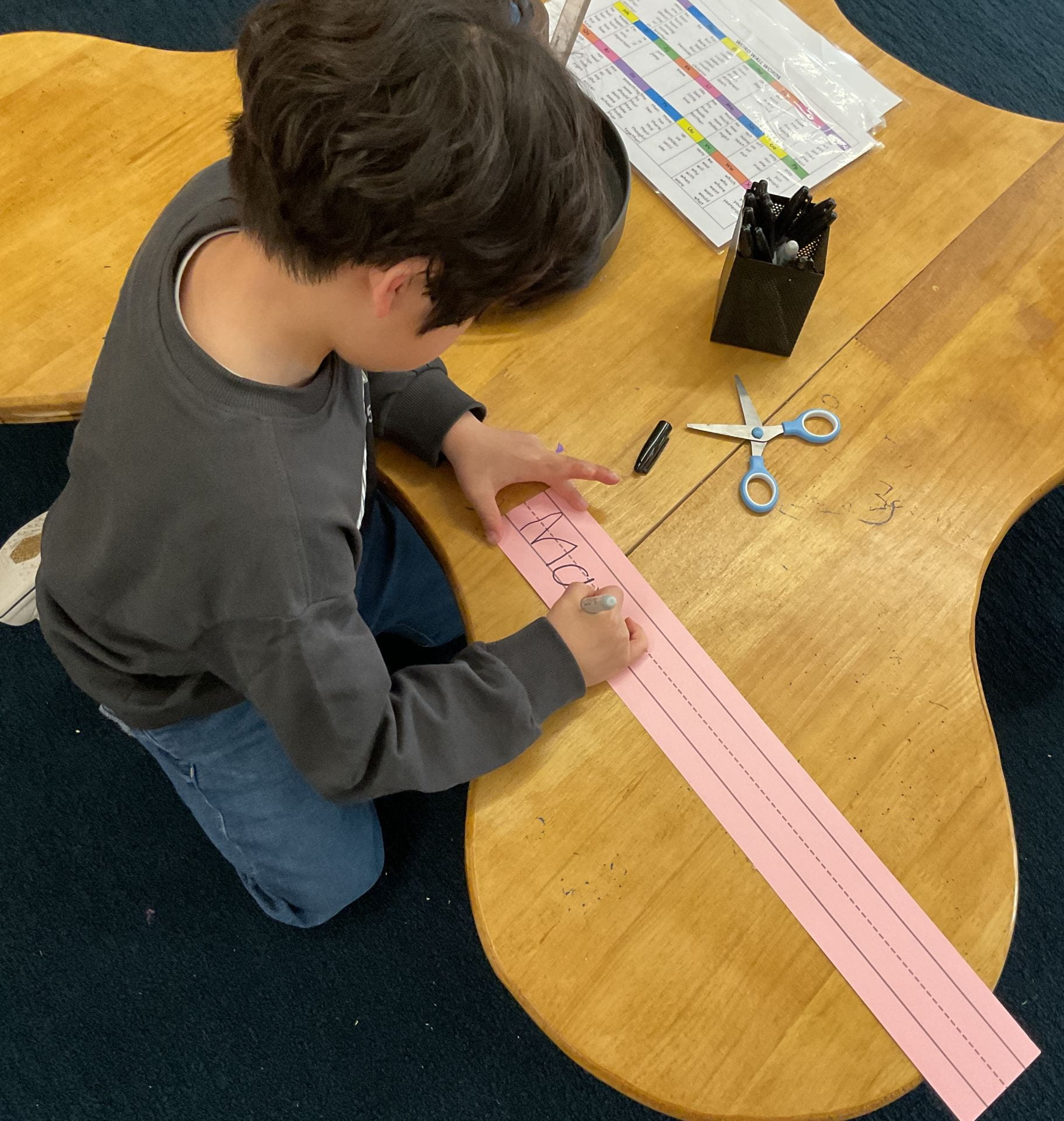
The Sound of Self: When a child hears their name, their body language shifts instantly. Eye contact locks in, posture straightens, and a sense of presence fills the room. It acts as a verbal beacon, calling the child into a relationship with others.

The First Mark: Long before conventional writing emerges, children express ownership through mark-making. A child’s first deliberate scribbles or letter-like forms are almost always attempts to manifest their own name. This acts as their initial declaration to the world: I am here.”

It Affirms Belonging: To learn, pronounce, and honour a peer’s name is an act of deep respect. It constructs a democratic classroom where every individual is visible.

Communities use letters, sounds and characters to communicate this identity in 2-dimensional form. In English, we use the letters of the alphabet to create our names. We decided to explore our names by constructing them in different ways.

We wonder about the significance of your name and how it shapes your identity.

Our Inquiry Into the World of Machines: Connecting Home and Text

Initial Theories and Curiosities

Our exploration began with a question: What is a machine?

We thought about the tools and objects that use energy to help us work at home, activating prior experiences to draw direct links between concepts in our heads and the physical world we navigate daily. This shift transformed the abstract definition of a “machine” into a tangible, shared study of everyday life.


Meeting the Text: Making Thinking Visible

When introduced to an informational book about household tools, the researchers did not just read—they actively constructed meaning. By closely studying the cover and detailed photographs, they practised the art of visual literacy and decoded the visual language. 

“We use many machines at home.”

This central theory became our anchor. By writing this concept down, the writers manifested their comprehension, showcasing how an engaged researcher actively synthesises new data with old memories and rich life experiences.


Investigations and Gathering Data

Researchers know how to collect and document their observations and learning through active investigation. To practice these skills and test their theories, we went on a hunt around the learning space—treating our environment as the third teacher—to learn about, identify, and document the different machines we use each day.


The Educator’s Reflection

This documentation captures more than a reading comprehension lesson. It reveals the children’s deep competence as capable researchers. They effortlessly bridged text, home environments, and personal theories. Moving forward, we wonder:

  • How do the children distinguish between a simple tool and a complex machine?

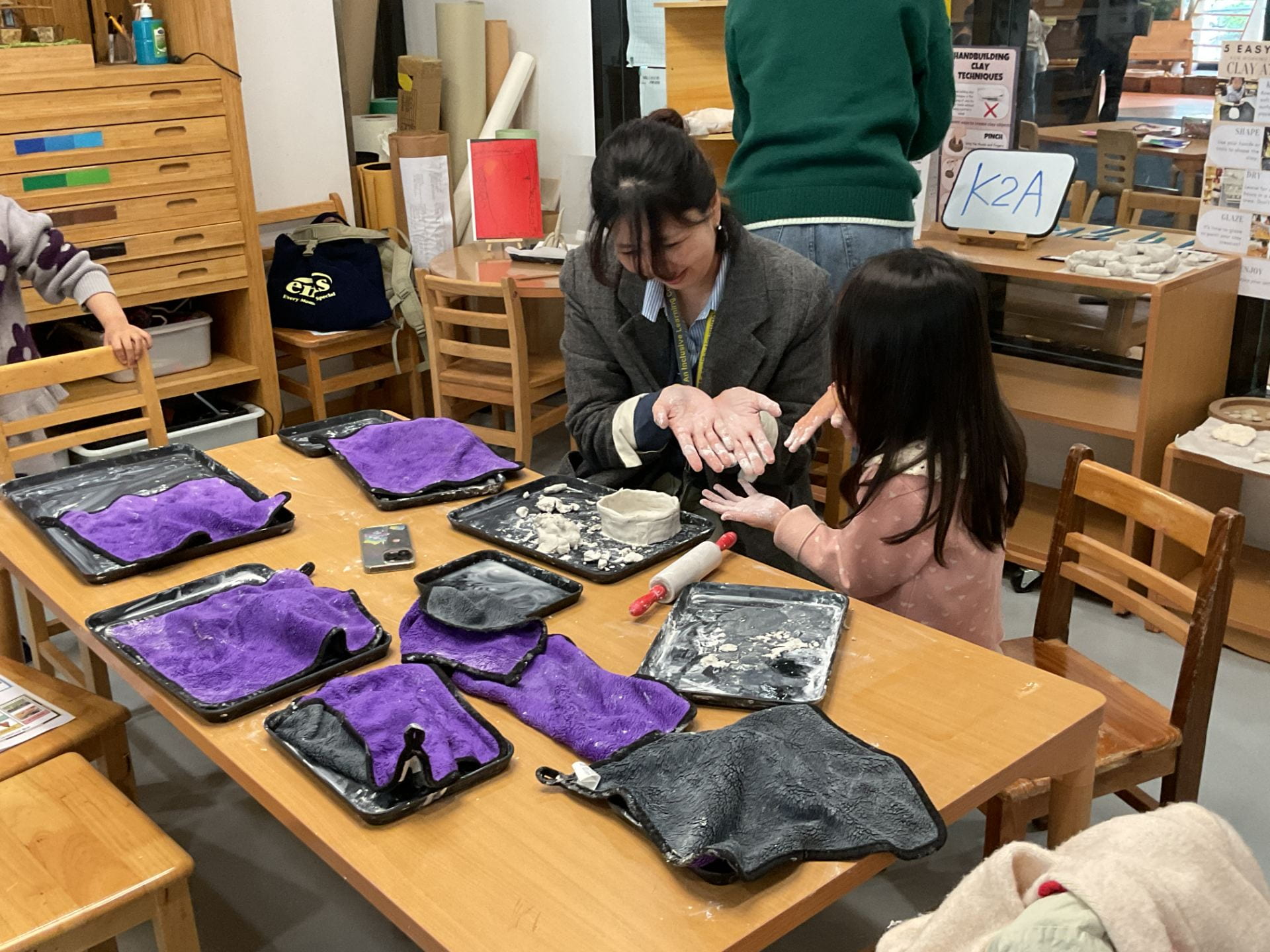
Our Hands, Our Stories: Sculpting Meaning Through Playdough

“An environment that encourages children to play also encourages them to converse, to explore, and to collaborate.”

The Spark of Inquiry

Children are natural storytellers who seek to make sense of their world through multiple languages. In our ‘Writer’s Workshop’, we intentionally move away from the mechanical repetition of writing. Instead, we offer children a joyful, purposeful context. By anchoring their mark-making to a real experience, writing transforms into a meaningful tool for connection, fuelled by a clear sense of purpose and a real audience.


The Alchemy of Making: Step-by-Step Discovery

We invited the children into a sensory-rich, hands-on exploration: the collaborative creation of playdough.

Gathering Our Collective Voice: We began by listening. The children mapped out their existing knowledge, sharing how different colours of dough could be transformed into people, objects, and vehicles.

The Language of Sequence: With focused intentionality, the young authors translated the physical recipe into visual documentation. They illustrated the specific tools, measured the ingredients, and mapped out the procedural steps needed to form the soft, malleable dough.

Blending Literacy with Art: As they drew, the children played with the physical geometry of letters and sounds, weaving text into their illustrations to guide their future readers.

The Sculptor’s Studio and Environmental Responsibility

Once the dough arrived at its perfect consistency, the children instantly transitioned from authors to sculptors. The room was filled with the rhythmic sounds of pounding, rolling, poking, and pinching. Sausages, spheres, and miniature cars emerged from their hands—ideas made visible in three dimensions.

When the creative energy settled, a natural sense of community care took over. The sculptors became caretakers of their space, meticulously clearing their workspaces and showing deep respect for their shared learning materials and environment.

Visible Reflections

The journey culminated in a beautiful moment of sharing. The children eagerly flipped through their self-made booklets, reading their own documentation with care and intention. The learning did not end at the atelier; filled with pride, the children carried their handmade playdough home and shared their stories and discoveries directly with their families.

What can you do at the beach?

We began by discussing the different activities we can do at the beach and our favourite things to do there.  Next, the writers used drawings, words and sentences to share these ideas with others, using inventive spelling as a strategy for writing and spelling.  

Then, we read the title of the nonfiction/informational text using what we know about letters and sounds to break apart unknown words to read new words.

This is a strategy that readers use to decode unknown words. As we began to read the text, we used our imagination to visualise in order to understand the ideas shared in the text. The readers paused to describe the information provided by the photographs and used it as a word-attack strategy. We discussed the questions:

  • What do most people wear at the beach?
  • What do you see at the beach?
  • What are the two kids digging in at the beach?
  • How do you think the kids eating on the beach feel? How do you know?
  • What are the kids using to build a castle?


Throughout the reading process, readers were encouraged to point to the words they were reading to track their reading independently.


The comprehension skill in focus was identifying the main idea and supporting details included in this informational text. Most stories have a main idea, which is the subject of the story. The title of the story, as well as the pictures, can give us clues to the story’s main idea. When a story has a main idea, it also has supporting details, which are descriptions that help the reader better understand the main idea.

The writers used illustrations, words and sentences to share the different activities the characters engaged in during their time at the beach.


They were encouraged to capitalise the beginning of sentences and include punctuation at the end of a sentence. Leaving spaces between the words helps readers read the information with the appropriate pausing and understanding.

As we continue to discuss and read new texts, we will practice using these strategies to grow as readers and writers! 

Story Workshop @TheSeedAtelier

Workshop Focus: 

To develop reading and writing skills through the world of books and storytelling.


The ‘Story Workshop’ is a literacy experience where we:

  • explore strategies to develop strong comprehension skills
  • dive into picture books to learn about reading and writing
  • explore the connection between letters and sounds

This workshop helps young children develop their identities as readers and writers. Through play’ and exploration and a deep dive into the world of books, they learn strategies and techniques that foster strong reading and writing skills. 

We began by observing and noticing the behaviours of the young readers and writers before us. We took note of the skills they used and the strategies they applied when expressing themselves through their pieces of work. 

By analysing the data we gathered, a learning plan began to emerge.

We asked ourselves:

  • What techniques do the children already use to craft their writing?
  • What mentor texts would spark their interests?
  • What ‘play’ materials would support their inquiry?
  • How might their experiences develop their identities as readers and writers?

We noticed the relationship the writers had with their writing tools. A strong yet comfortable pencil grip supports the act of writing. We discussed a range of experiences that would help them develop their large and small muscles: 

  • Manipulating natural materials such as clay to build finger dexterity
  • using small manipulatives such as Lego to pull apart and assemble structures
  • cutting and tearing paper
  • using large wet brushes to draw on the wall or floor.

We noticed that their drawings expressed ideas about transport, home and family. Elements of nature were embedded in their messages. Colours were chosen deliberately to express what they value and treasure. We began inviting the young writers to use what they know about letters and sounds to share these messages with others. 

Young children know the art of ‘playing’ to make sense of the world around them. The small-world materials bring their experiences to life, creating opportunities for them to play with ideas to understand concepts. Through the ‘Writers Workshop‘, we hope to use these materials creatively to help the readers and writers express themselves in many languages. 

As we begin our sessions, we hope to explore these ideas further, offering young writers opportunities to learn and celebrate the world of symbols, shapes, characters and letter shapes. 

Watch this space to follow our learning story… 

Narrative Writing

We wondered how these young readers and writers would apply the knowledge they have gained over the last 10 weeks when creating new pieces of writing. What have they learned about themselves, and how would they use the skills and techniques they have explored in these situations?

Reflections about Writing:

The young writers were presented with their first pieces of writing, which they had produced 10 weeks earlier, and invited to reflect on what they are proud of and what they could do to improve their writing.

Some of the thoughts they shared were:

Stars (What I am PROUD of)

  • my handwriting
  • the drawings
  • spelling in my plan
  • the details and full stops
  • I included lots of actions
  • I reread everything I wrote

Wishes (What I can IMPROVE on)

  • I could add more feelings
  • Put more details in my plan
  • Stretch out small moments so I have more ideas
  • Put more commas near the end of the story
  • Add more feelings
  • Add what the character said

The writers were presented with four different images and invited to create a piece of writing inspired by their imagination or real-life experiences.

They applied what they had learned about story writing to create and share their ideas with others. The writers were challenged to plan, write, and produce this text in 30 minutes!

They remained focused, tapping into their prior knowledge and using new strategies and skills they had learned to create engaging reading material.

Through their short narratives, the young writers remind us that we can be inspired by a variety of situations, memories, or objects to create interesting written pieces.

We continue to develop our writing identities by exploring texts and creating our own at The Seed Atelier! 

Developing Research Skills

Observing, note-taking and describing are important skills that researchers use to explore and explain the world around them.

The young researchers shared their thoughts on what researchers do before they explore nonfiction texts.

We think that researchers:

  • look for and check evidence of something
  • look for the stuff (evidence)
  • solve mysteries
  • double-check everything they do
  • make sure everyone is safe
  • explore to find more cool stuff
  • are careful
  • look for clues
  • follow the clues
  • find something
  • show people the evidence

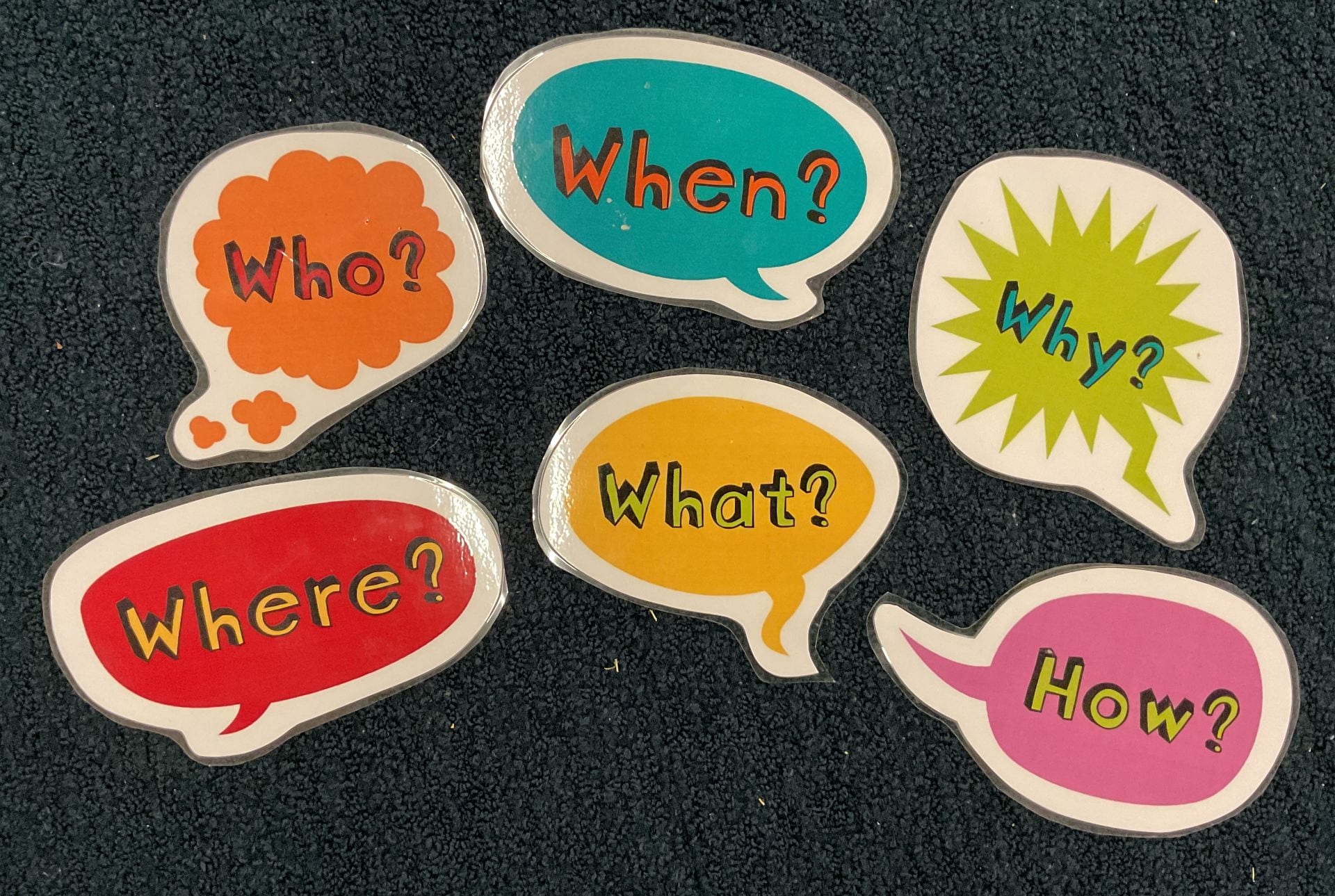
We decided to read the book ‘Cave Dwellers’ by Katherene Follette. The readers began by noting down all that they knew about cave dwellers. They used the question words who, where, what, how, when and why to share their thinking and prior knowledge. Then they shared their ideas:

  • Saveth “I think cave dwellers live in a cave. They are blue colour. Survive by eating food.”
  • Theja “I think cave dwellers are animals that live in caves. There are snakes. Sea snakes, bats and aliens. Animals that live in caves. They live in the deepest part of the cave. Some can see in the dark.”
  • Thenuli “I think cave dwellers live in the sea. They are blue or pink. They are sea creatures. They live in caves. It looks like a lizard.”

Next, we read the nonfiction text to learn more about the various creatures that inhabit the cave ecosystem. As we read the text, the researchers jotted down important ideas, concepts, vocabulary and information that they would like to remember.

Using quick sketches and grouping ideas together were some of the strategies the researchers used to document their work. They were reminded to listen carefully to the read aloud, and pay close attention to the descriptions under images and illustrations as they also provide important information about the different ideas shared under sections.

Finally, the writers were invited to create an informational poster to share all the main ideas and important information about Cave Dwellers. They used their are quick notes to choose the information they wanted to include, using illustrations, fancy writing and colours to grab the attention of their readers.

Literacy Circle Roles

A literature circle is a small-group instructional approach that supports the development of comprehension, independence, and reading enjoyment. The young readers took on different roles in our literacy circle to help them develop their reading skills.

To prompt thinking, we used the following role cards:

Literacy circle (or literature circle) roles provide structure for student-led discussions about a text, with specific roles such as:

  • The Artist
  • The Connector
  • The Passage Picker
  • The Summariser

We read the story ‘The Rabbit Listened by Cori Doerrfeld, which is a wonderful picture book about ‘empathy’. The character Taylor doesn’t know where to turn or what to do when something terrible happens. One by one, the animals try to tell Taylor how to cope with this loss and frustration, and one by one they fail, until the rabbit arrives to simply ‘listen’.

After listening to and discussing the story, the readers used the different roles to share their thinking and perspectives.

The Writing Process

The young writers continued to follow the writing process to create a story that captures their audience’s interest. They began by creating a ‘plan’ and documenting their ideas on a ‘storyboard’.
Then, they drafted their story, narrating all the different events that take place in it.
The writers narrated the sketch of the story using interesting details and events, sharing problems that arise and how these are solved as the story unfolds. Including a powerful ending for the story was a key focus. 
Next, they revised their story to ensure it made sense. They edited their work, using the dictionary and their knowledge. They used the acronym ‘CUPS‘ to help them check their capital letters, usage of language, punctuation and spelling.
We look forward to reading the young writers’ final stories!
 

Details that HOOK the Reader

We wonder how authors and illustrators hook their readers.

What are some of the strategies and techniques they use to capture the attention of their readers? 

The young writers started by revisiting their stories. Their stories were inspired by snakeskin, using this idea to create their own pieces of writing. As authors, they were encouraged to think about the characters, how they feel, what they say, and how they act in their story. We used a mentor text to learn more about stretching a story to expand on small moments. We read ‘Shortcut’ by Donald Crews. 

This is a story about seven children who decide to take the shortcut home along the train tracks. It is an exciting story that keeps the children on the edge of their seats. In this text, the author uses multiple strategies to hook the reader and keep them in suspense.

The details in the words and illustrations help transport the reader into the story, allowing them to see, feel, and imagine the children on their journey through the shortcut. The writers discussed these details, gathering information about the messages and specifics the author shares throughout the text. We wondered how we might use some of these techniques in our own writing.

The writers then started to write their stories, exploring ways to include these techniques. They discussed how to convey ‘time’ and ‘sequence’ by using time words, such as ‘the next day,’ ‘one morning,’ or ‘late in the afternoon.’ They were encouraged to add more details to help readers follow the story effortlessly. Rereading what they had written before helped ensure their stories flow smoothly.

Zooming In!

We have been exploring the different elements of a story through analysing picture books. We have observed that writers craft engaging stories by:


What is a Story?

We began by brainstorming all the different elements of a story. These were recorded in one colour (brown).

Next, we read the story ‘A Cat and a Dog,’ written by Claire Masurel and illustrated by Bob Kolar, to help us reflect on other elements that might be present in a story.

These new ideas were added to the initial brainstorm (green). Then, the children were given a provocation to help them use their imagination and creativity to plan and write their own story.

They began by jotting down their ideas, considering the characters, the setting, and the structure of the story. It was important to think about how we might use our senses to describe what is happening in the story.

The initial brainstorm helped the children to organise their plan, allowing them to add more details and interesting events to keep their readers more engaged.

The plan was used to create a storyboard, which will help the writers with their story creation. We look forward to sharing our stories with you!

Hummingbirds

We began our Reading and Writing Workshop by introducing ourselves to each other. Getting to know one another and discovering commonalities between a learning group helps establish a positive and safe learning community.

The children began by writing what they already knew about hummingbirds. Next, they listed their questions and wonderings about this fascinating creature.

Then, we started to read the text, pausing to discuss the key information in each section of the nonfiction piece, making connections and noting wonderings as we turned the pages.

At the end of the shared reading experience, the children recorded what they had learned from the book, including new information and interesting words they encountered during the activity.

A Plan for Learning

At the Seed Atelier, assessments are viewed as a valuable tool for learning. The children have engaged in reading, writing and comprehension activities in preparation for the Reading and Writing Workshop.
Workshop Focus: To develop reading and writing skills through the world of books and storytelling. Guiding Questions: – How might picture books help us develop a love for reading? – What strategies develop strong comprehension skills? – What techniques do authors and illustrators use to write creatively? This workshop will help young children develop their identities as readers and writers. We will delve into the world of books to explore strategies and techniques that foster strong reading and writing skills. You can register for the Reading and Writing workshop through the link: https://forms.gle/cKEGZtvTcdtt7QnH6

The Birthday Cupcakes – Final Steps

The Field Trip to the Skyways Kitchen!

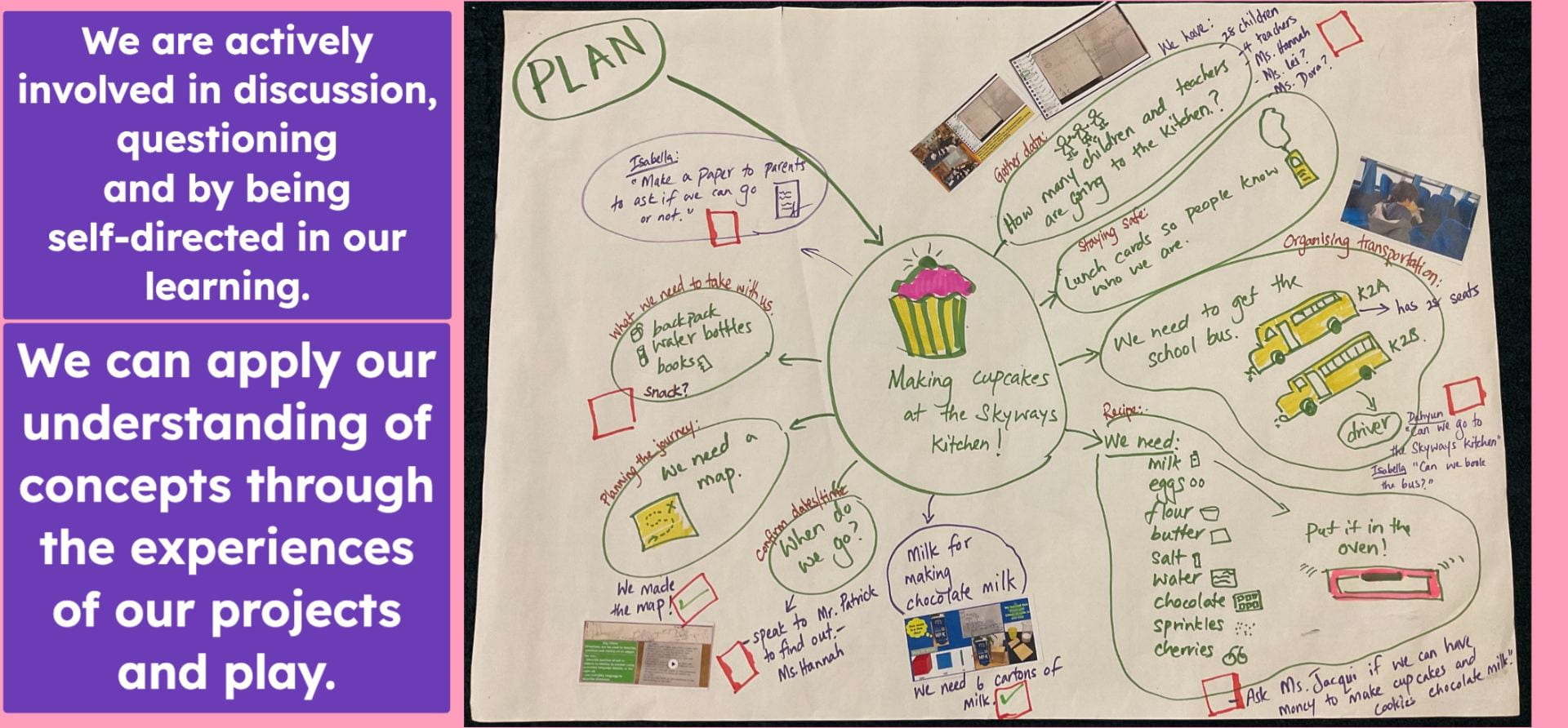
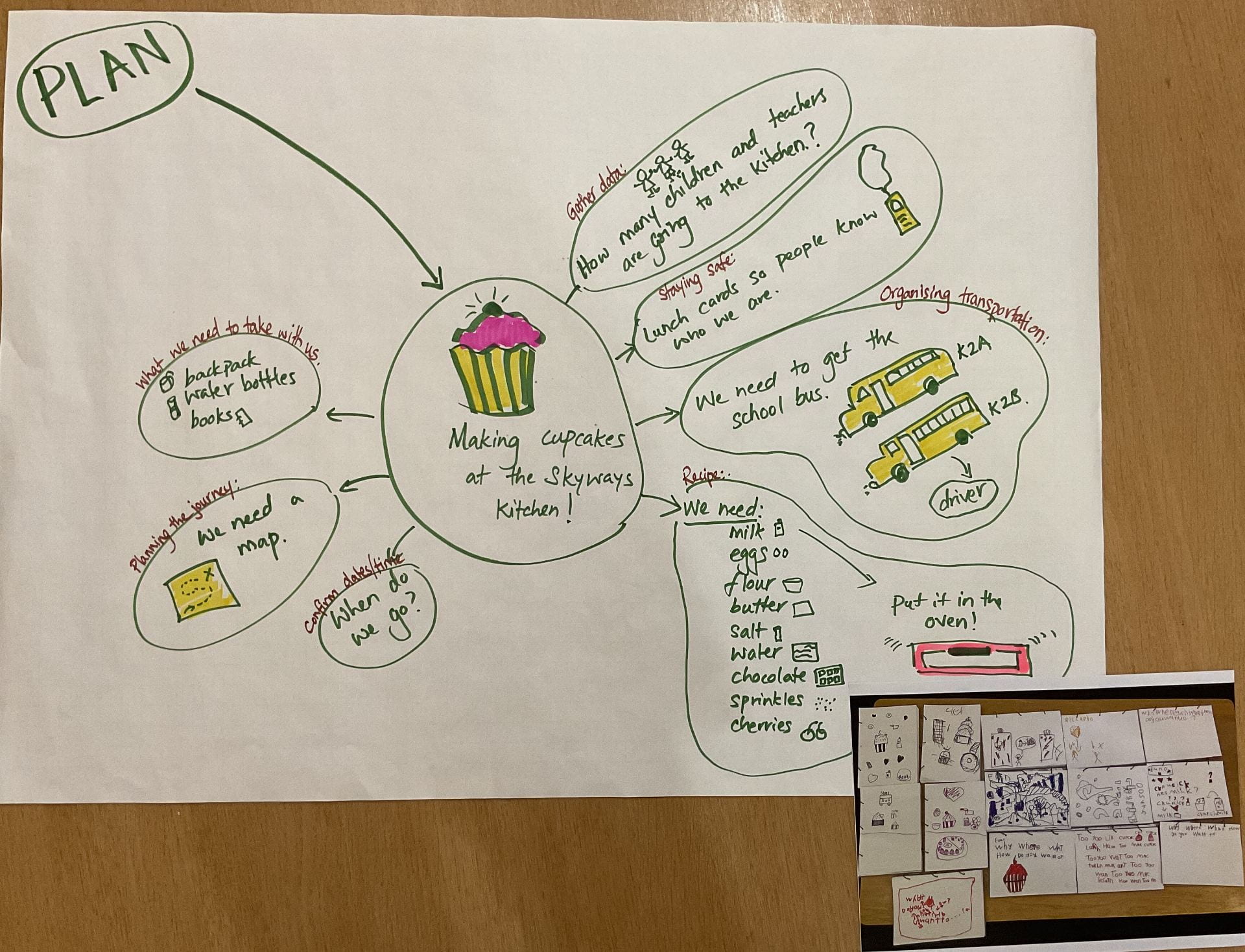
After months of research, problem-solving, and collaborative inquiry, the children were ready for their field trip to the Skyways Kitchen. We gathered all the materials we needed: the cartons of milk, the lunch cards, and the first aid kit that the children had planned to take. We stepped onto the school bus, excited to visit Skyways Kitchen to make birthday cupcakes. The children spoke about the map they had created, which now directed their journey to the kitchen.

Mr. Patrick had prepared spaces for the children to make chocolate chip cookies and decorate the cupcakes. The children enjoyed both making and decorating the cupcakes, adding frosting and topping the cakes with Smarties, sprinkles, and wafer biscuits. As they worked to decorate over 75 cupcakes, the children in K2B made chocolate chip cookies for both classes.

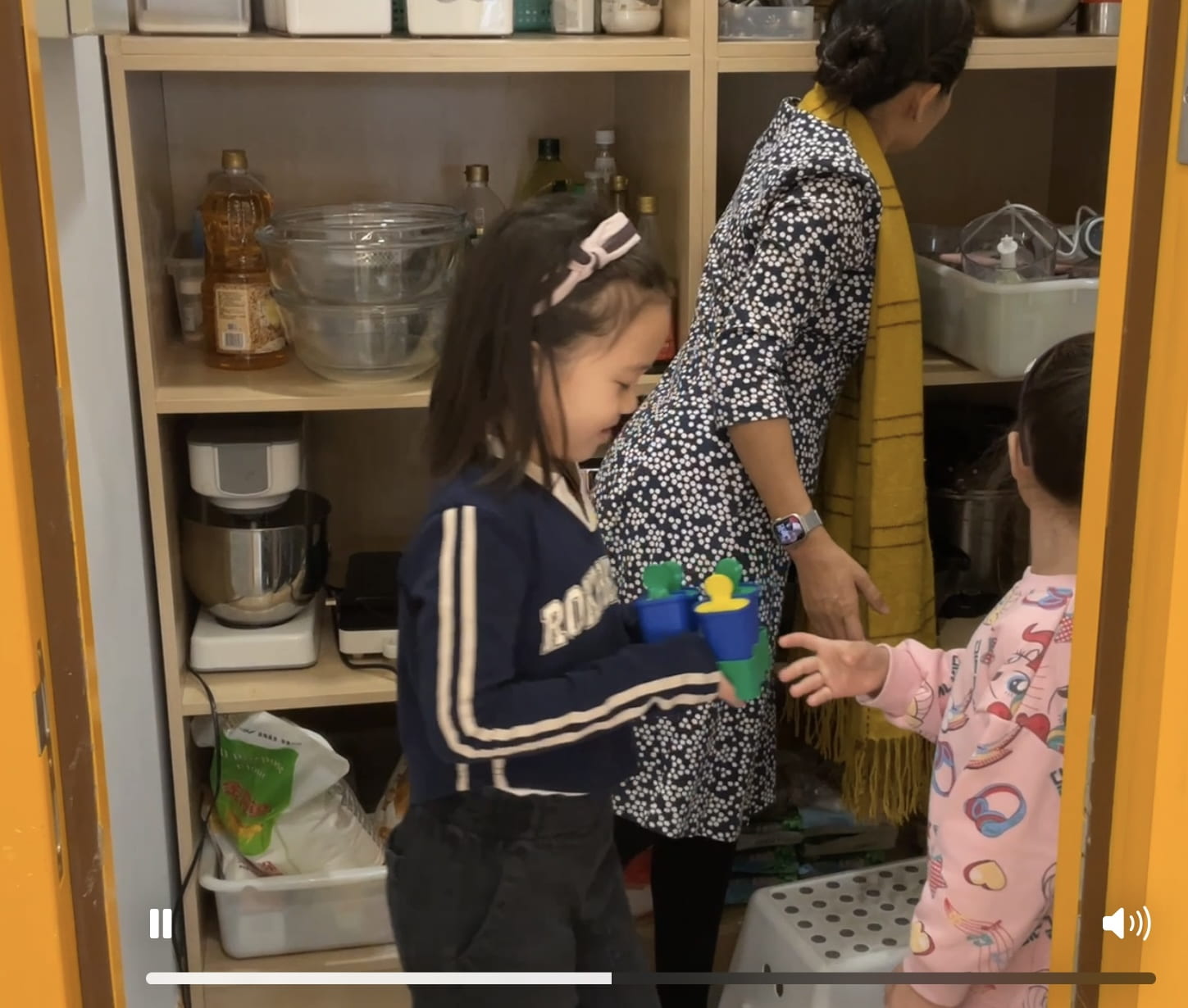
Next, we went on a tour of the kitchen, looking at all the different areas used to prepare breads, ice creams, chocolate treats, and pastries. Mr. Patrick explained the various sections of the kitchen, showing the children all the tools and materials used, as well as discussing safety and hygiene when preparing food.

Finally, the children enjoyed a treat of hot chocolate. We were pleased that the milk had not gone to waste but was instead used to make hot chocolate for everyone on the trip.


The Cupcake Distribution

The cleaning staff and gardeners were excited to come into the Early Years Centre to meet the children. They were eager to learn about the project the children had been working on and delighted by the thoughtful gesture.

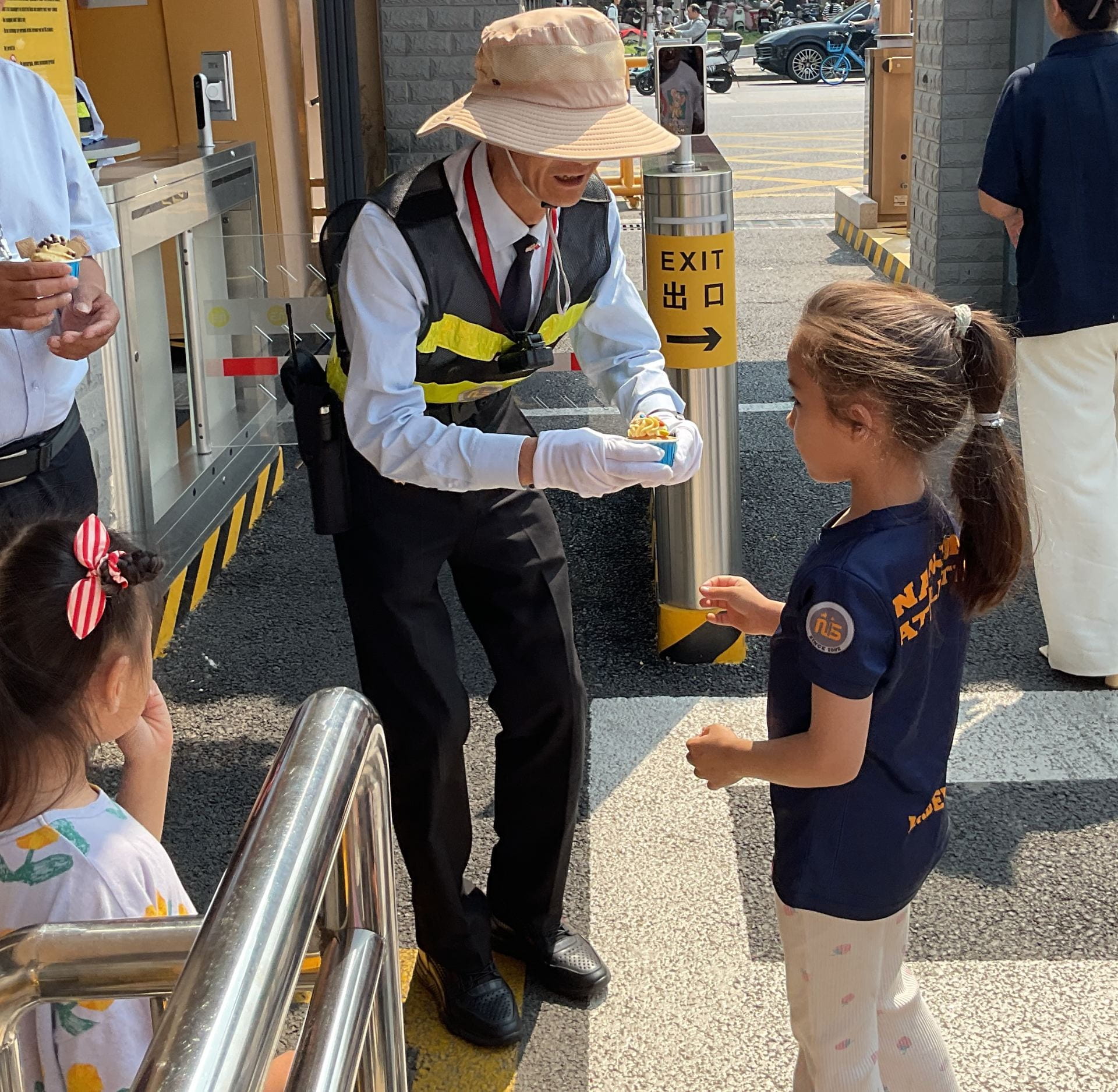
K2A visited all the different spaces with their teachers and their birthday cupcake trolley to distribute cupcakes to all the staff who had not received a cupcake for their birthday. They visited Aiden Kitchen, Homecaught, and the security guards.The children’s inquiry created opportunities for authentic learning experiences, allowing them to understand and appreciate the work that various members of the community engage in to make the school a positive and joyful environment. The children’s dedication to the project helped them learn more about themselves and the connections they share with those around them. This thoughtful gesture helped everyone feel included and appreciated

The Invitations

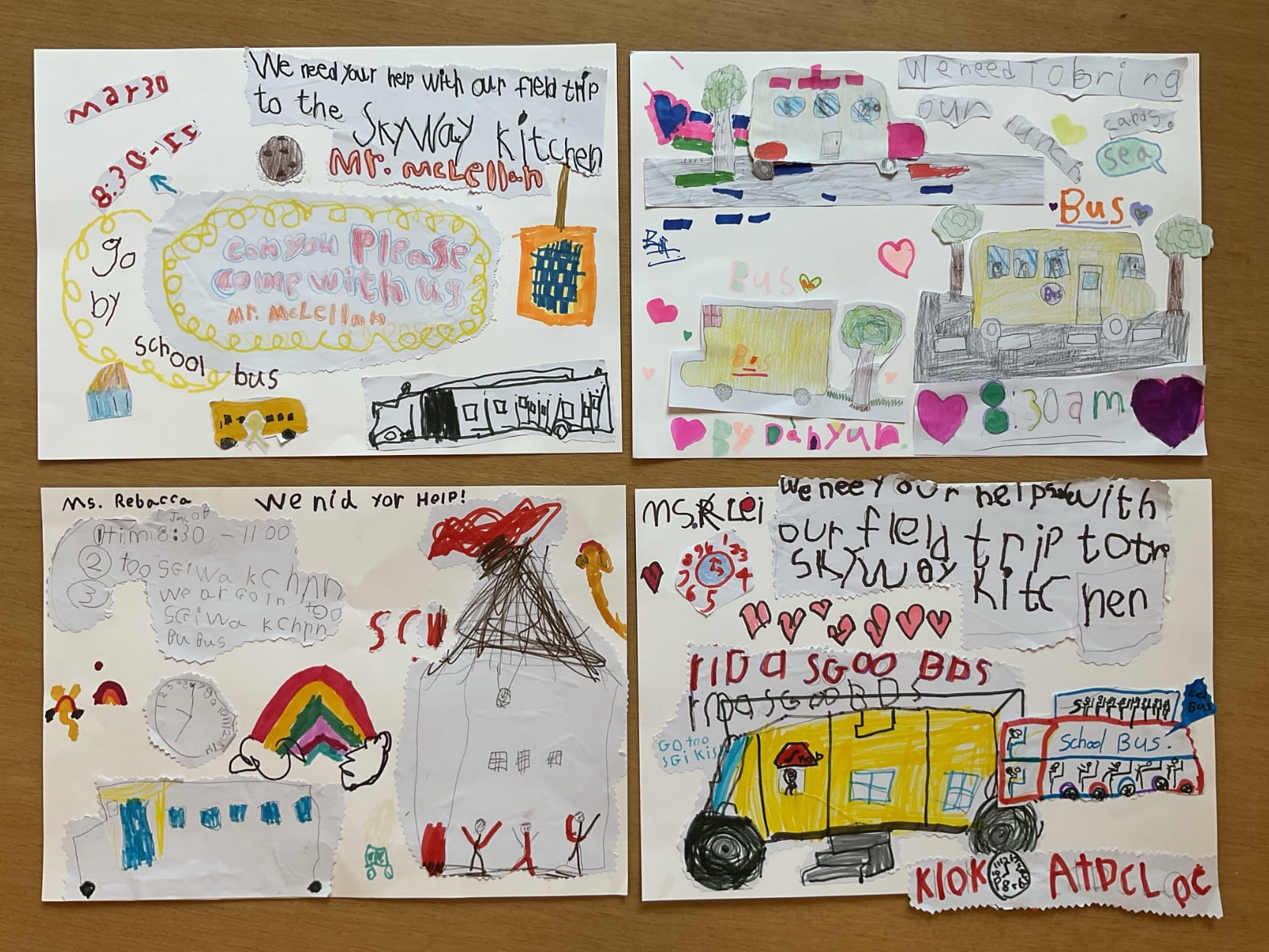
The children were ready to plan the rest of their trip to the Skyways kitchen. There were several activities they wanted to engage in during the trip, therefore, they had to think about additional support they needed. The children decided to invite some of their teachers to join the field trip to ensure some adults could support them. They sat with Ms. Hannah to decide on the important information they needed to include in the invitations, brainstorming and then designing the cards.

We are excited to finally visit the Skyways Kitchen to make the cupcakes for the community!

Exploring Growing Patterns

We asked the children, “What do we know about growing?”

  • Riccardo “It will let you be higher.”
  • Suzy “Growing like plants growing higher and higher and then it has fruits for me to eat.”
  • Junsu “Flowers growing.”
  • Archie “If flowers grow they have to get water.”
  • Adalyn “Just like some trees growing up and it has some flowers.”

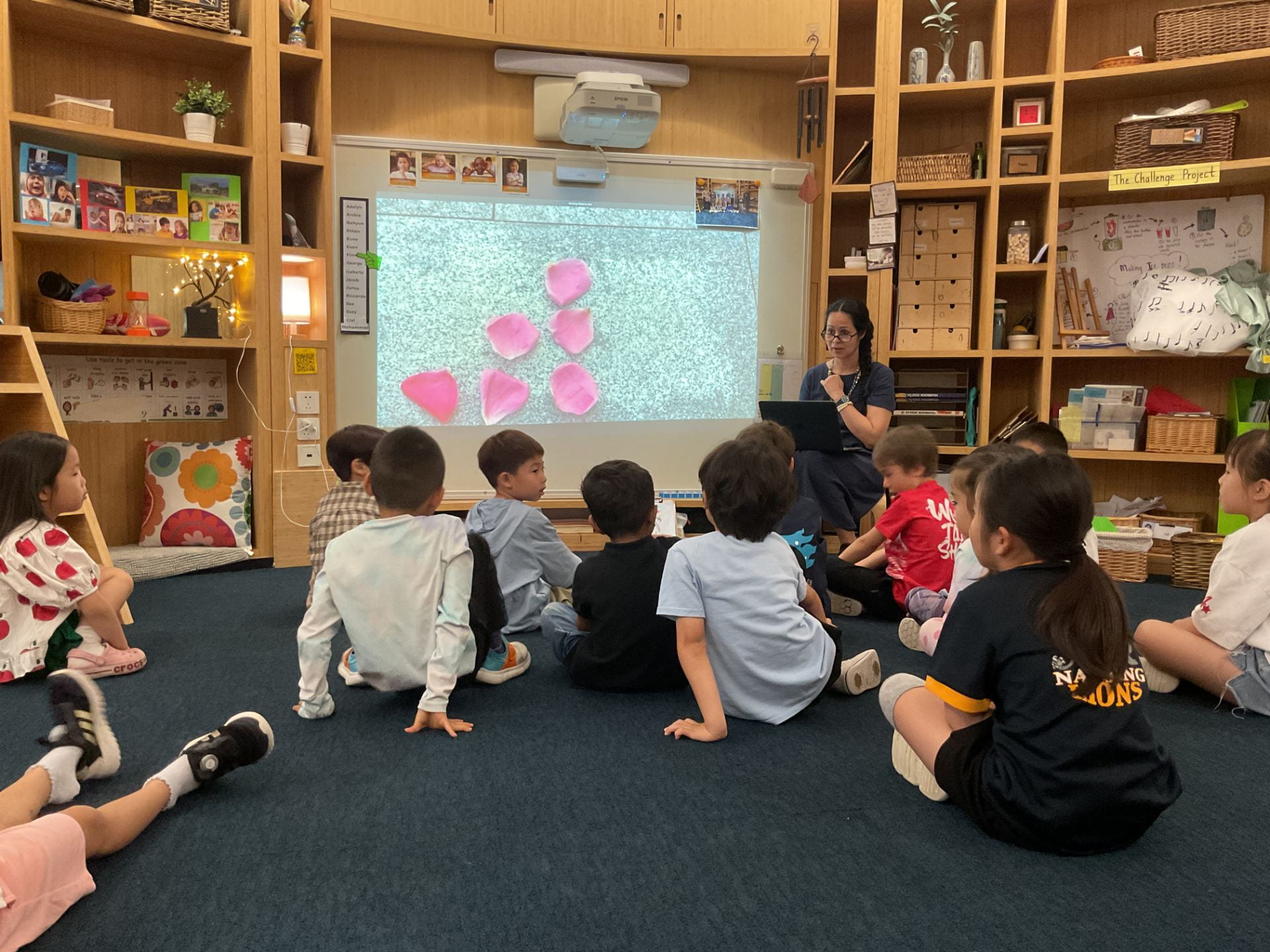
We shared a short video that introduced the children to the idea of ‘growing patterns’.

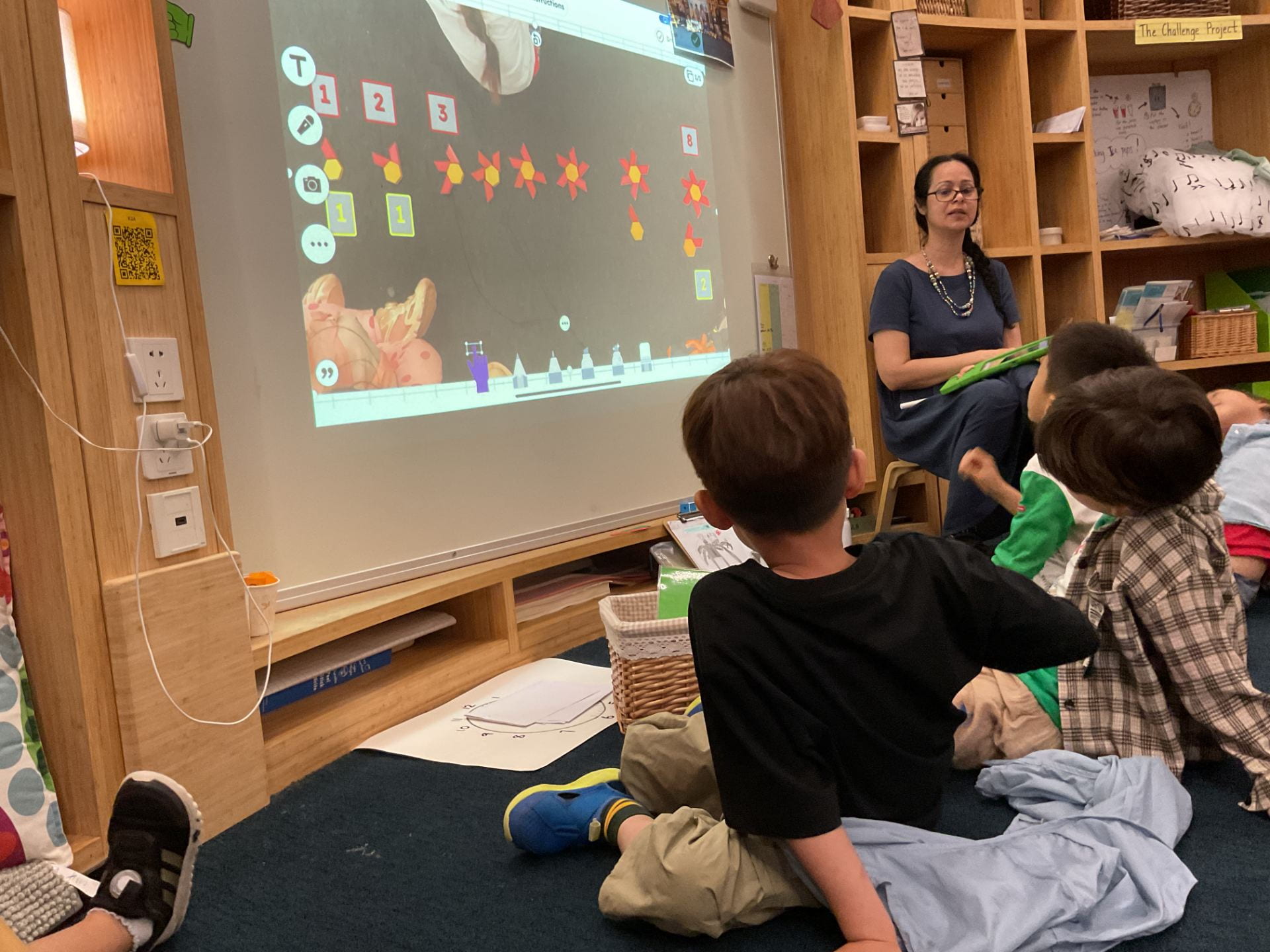
They noticed and talked about the way the petals were arranged. The pattern went up “by one” (Junsu), “like steps” (Jacob).  

Then, we used loose parts to create other growing patterns. With the nuts and bolts, the mathematicians noticed that the metal washes grew by 2’s, counting 2,4,6,8…

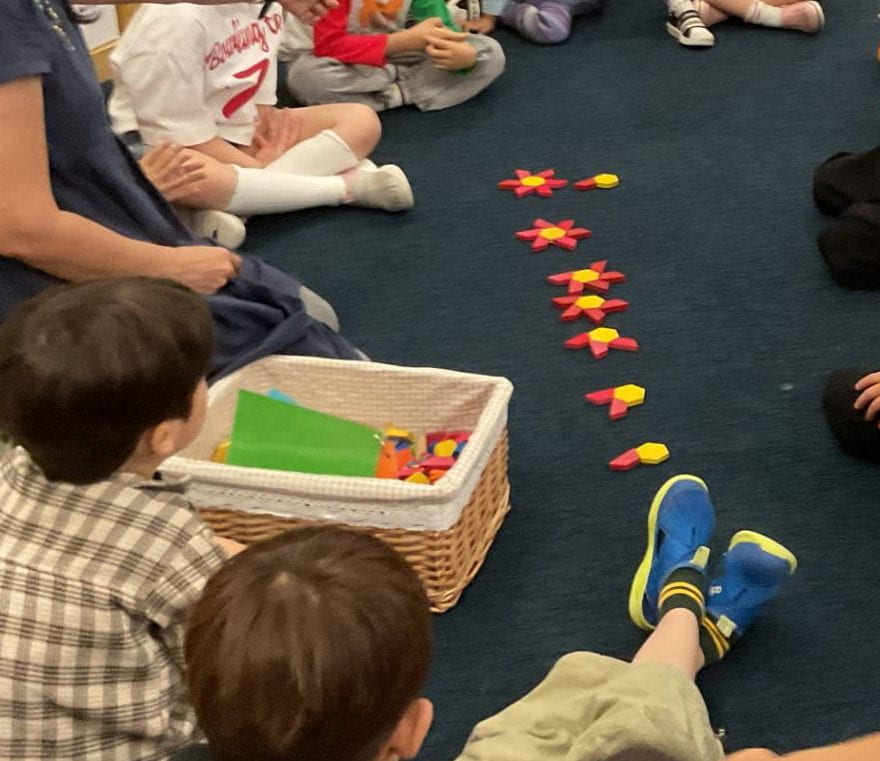
Next, we used geometric shapes to create a new pattern. This time, we added a new petal to the centre of the flower. Once the flower had all six petals, one flower transformed into two to accommodate the additional petals. We posted it on the Seesaw activity. Riccardo suggested that we include numbers to show the different ways the pattern was growing.

The Mathematicians will continue to work on using their creative ideas to make and share growing patterns.

Responses

What is Time?

We began by discussing the concept of ‘time’ to hear the different perspectives that the children would share about it.

  • Suzy “Time is telling you when you are eating lunch.”
  • Jacob “The time can tell you what time it is. It’s lunch time or breakfast time.”
  • Adalyn “Which time to listen.”
  • Euno “When we can go to design.”
  • Ciel “Tells us when it is night or afternoon because the clock tells us 6 o’clock, then it’s afternoon.”
  • Evan “The time to go to school, 7 o’clock.”
  • Riccardo “Can help you when you need to race.”
  • Junsu “Tell you what time to wake up or sleep time. Sleep time is 9 o’clock and wake up time is 6.”
  • Archie “In Tokyo, in my house, I see the time.”
  • Euno “I am sleeping at 8 o’clock.”
  • Dahyun “I see the time is going around, the black lines.”
  • Jacob “When time can tell you it’s time to listen and go to eat lunch or go to sleep.”
  • Isabella “If we don’t have time, we don’t know what time to sleep or go to school.”
  • Sea “I see the clock, The long hand is slow and the little one is fast, but the little one is not too fast.”

How can you tell the time?

  • Isabella “Look at the hands, they are pointing at the clock.”

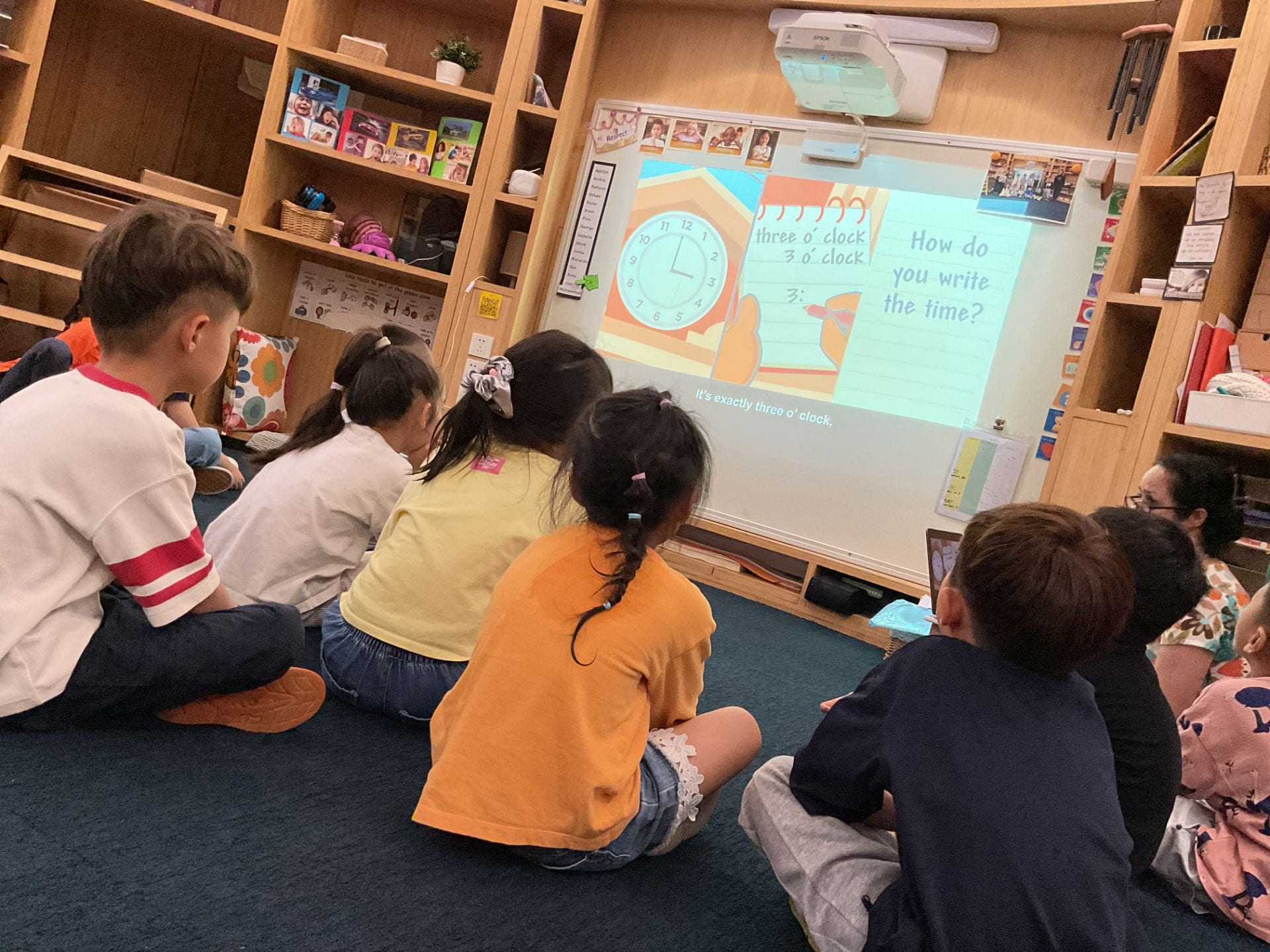
We invited the children to read the time on the classroom clock.

How do you write the time?

  • Jacob “When you look at the clock, you can see the time.”
  • Evan “The big line moves one number, that means 5.”

We watched a video to learn more about reading the time and then introduced the children to an activity they would complete on Seesaw to help them practice reading time to the hour and half hour.

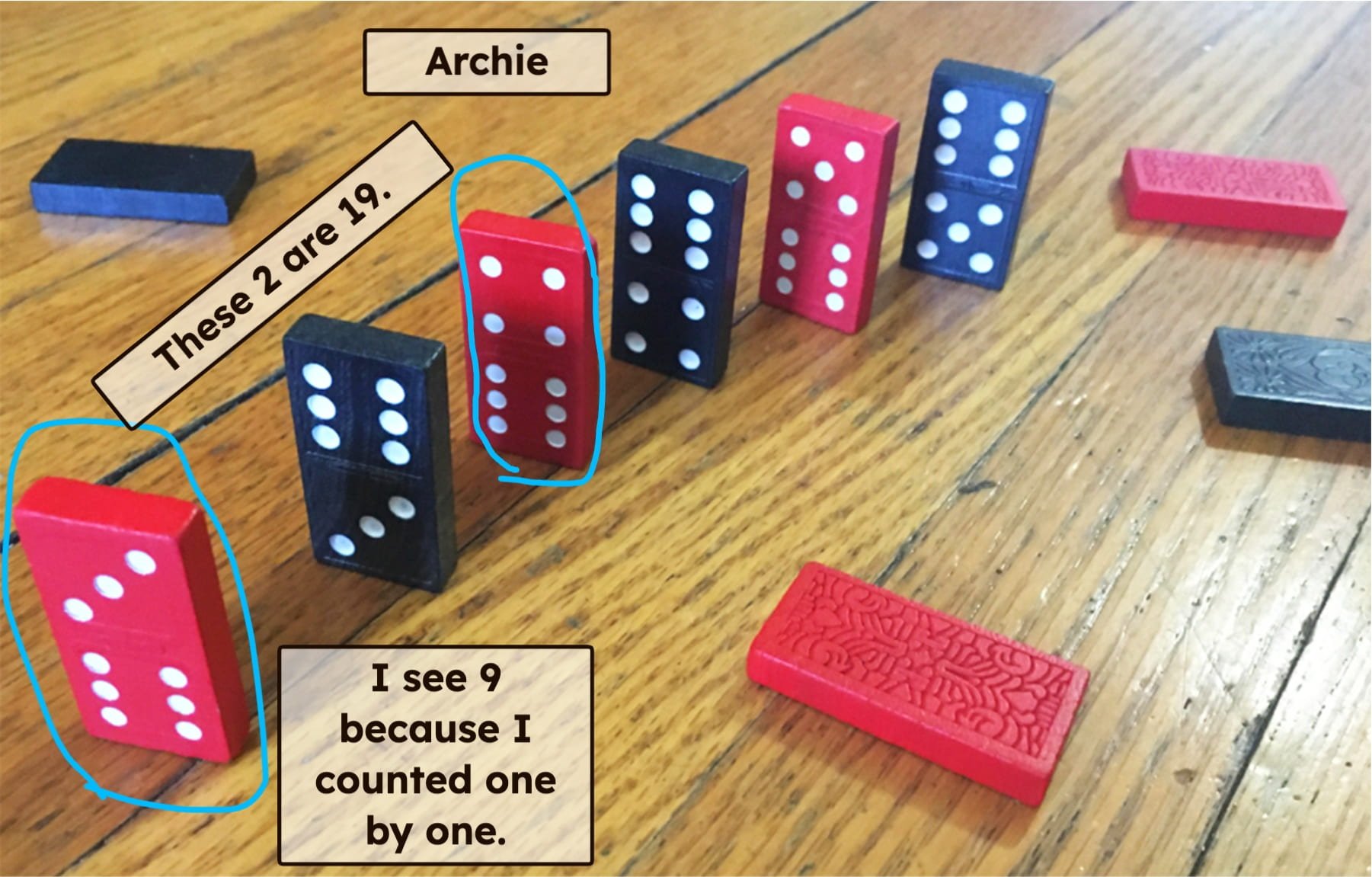
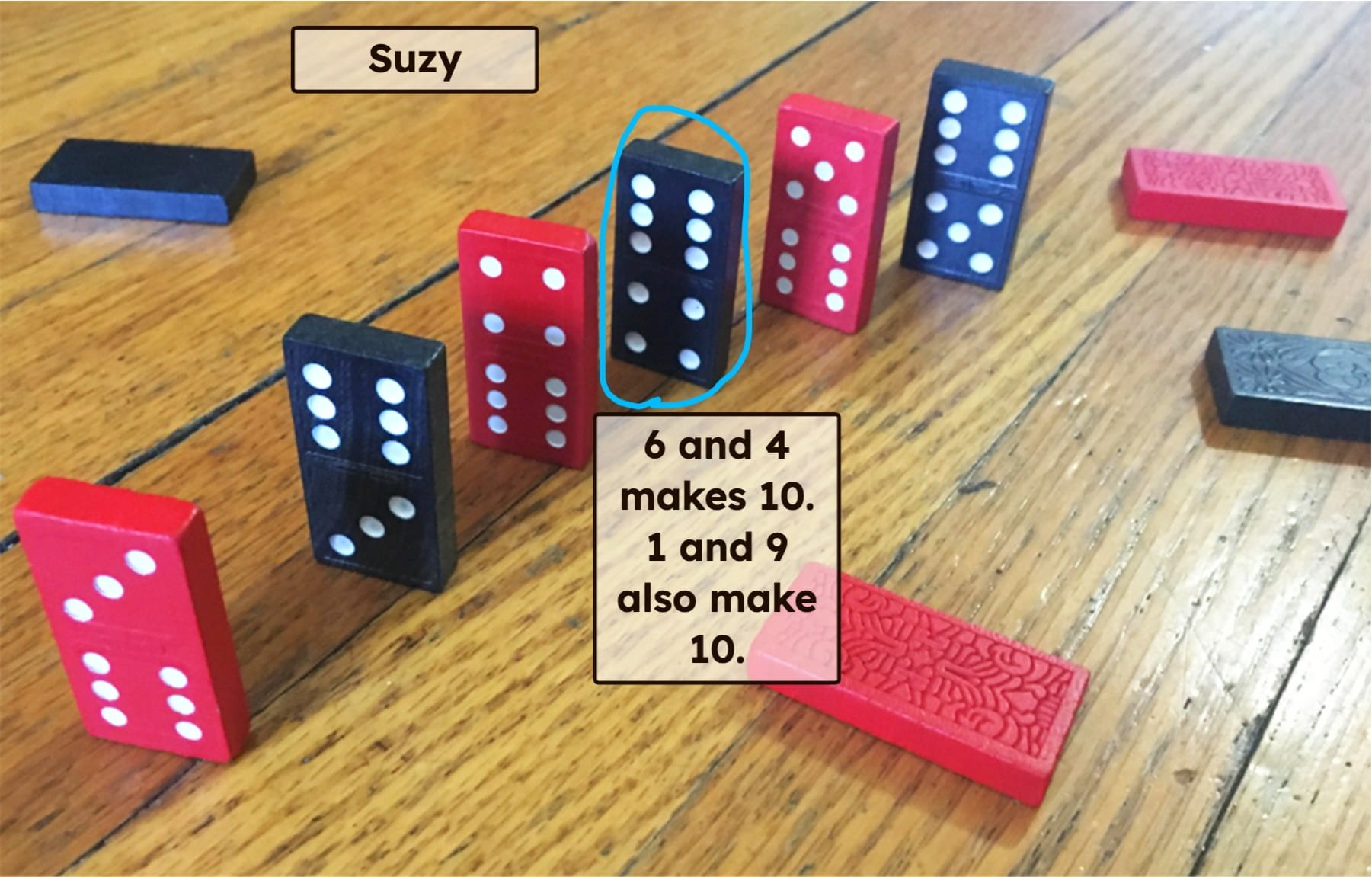
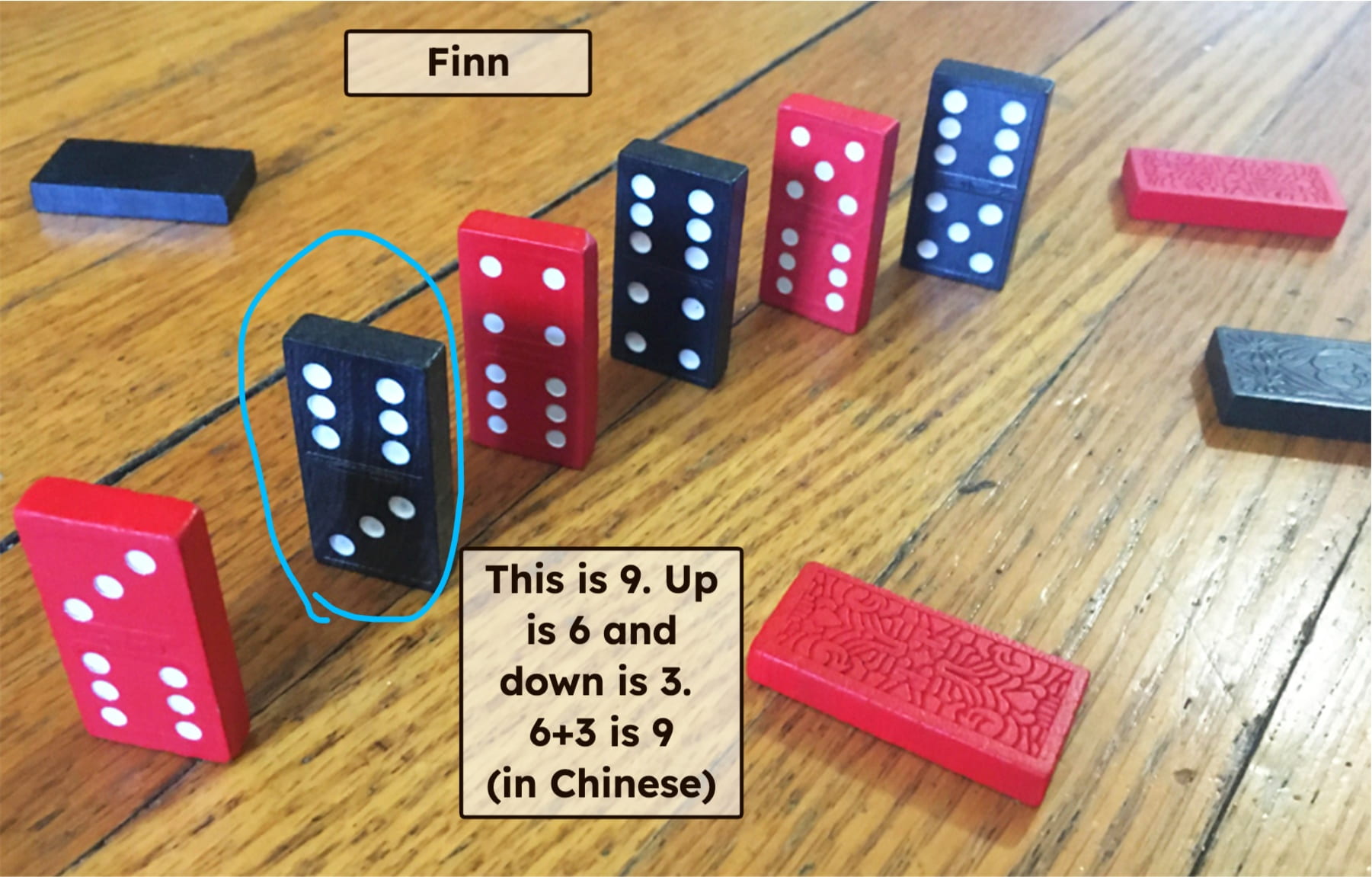
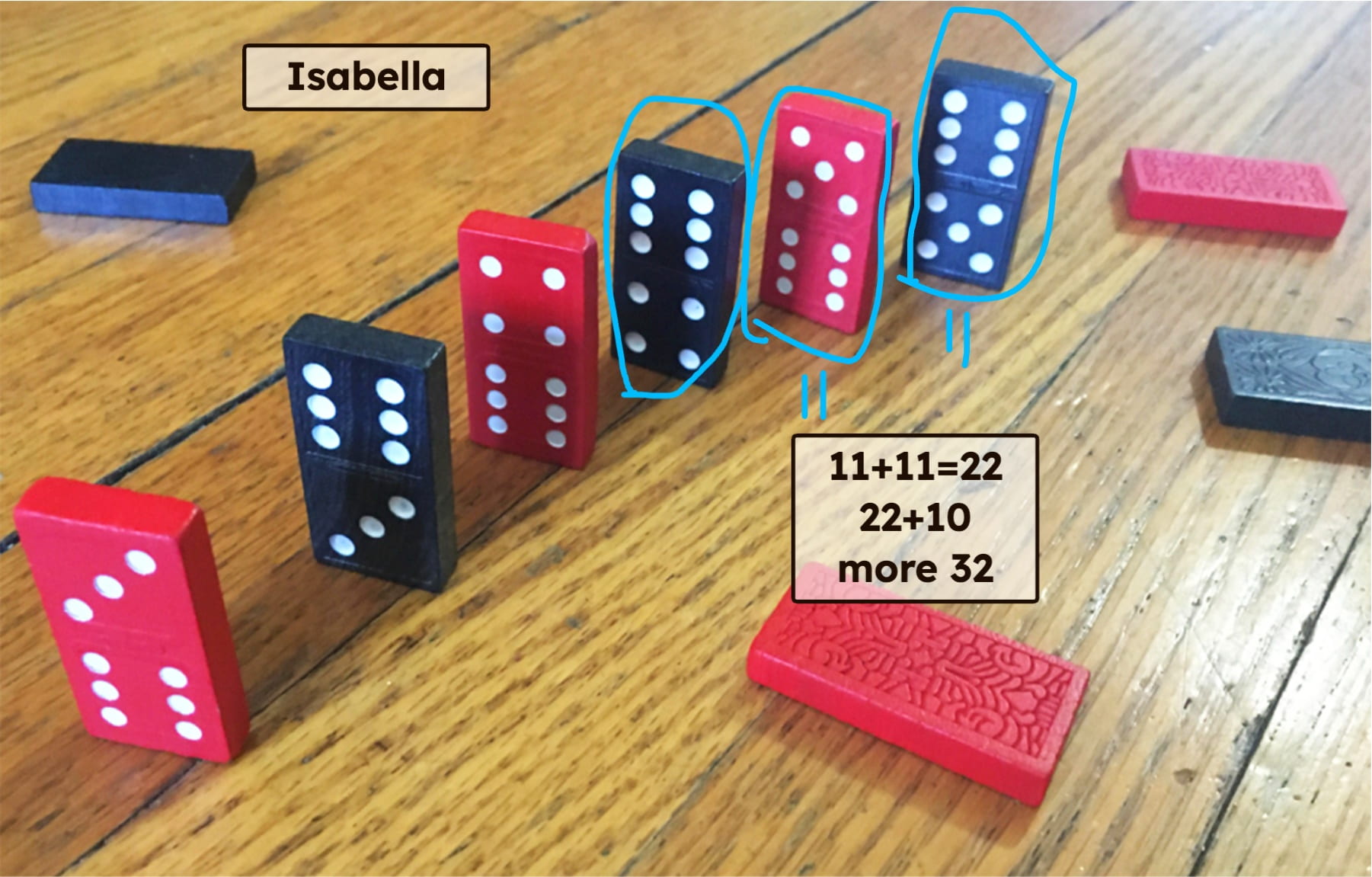
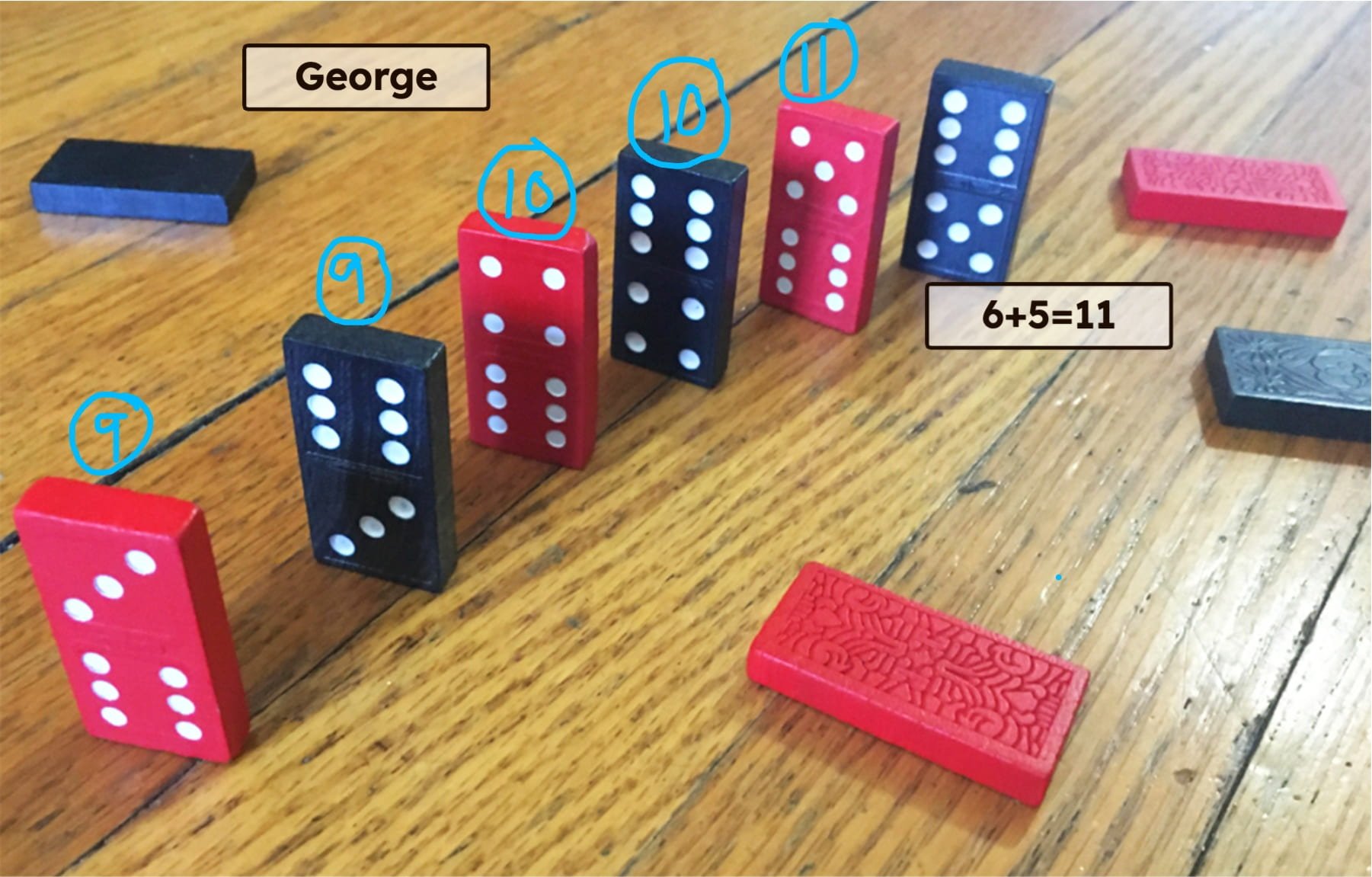
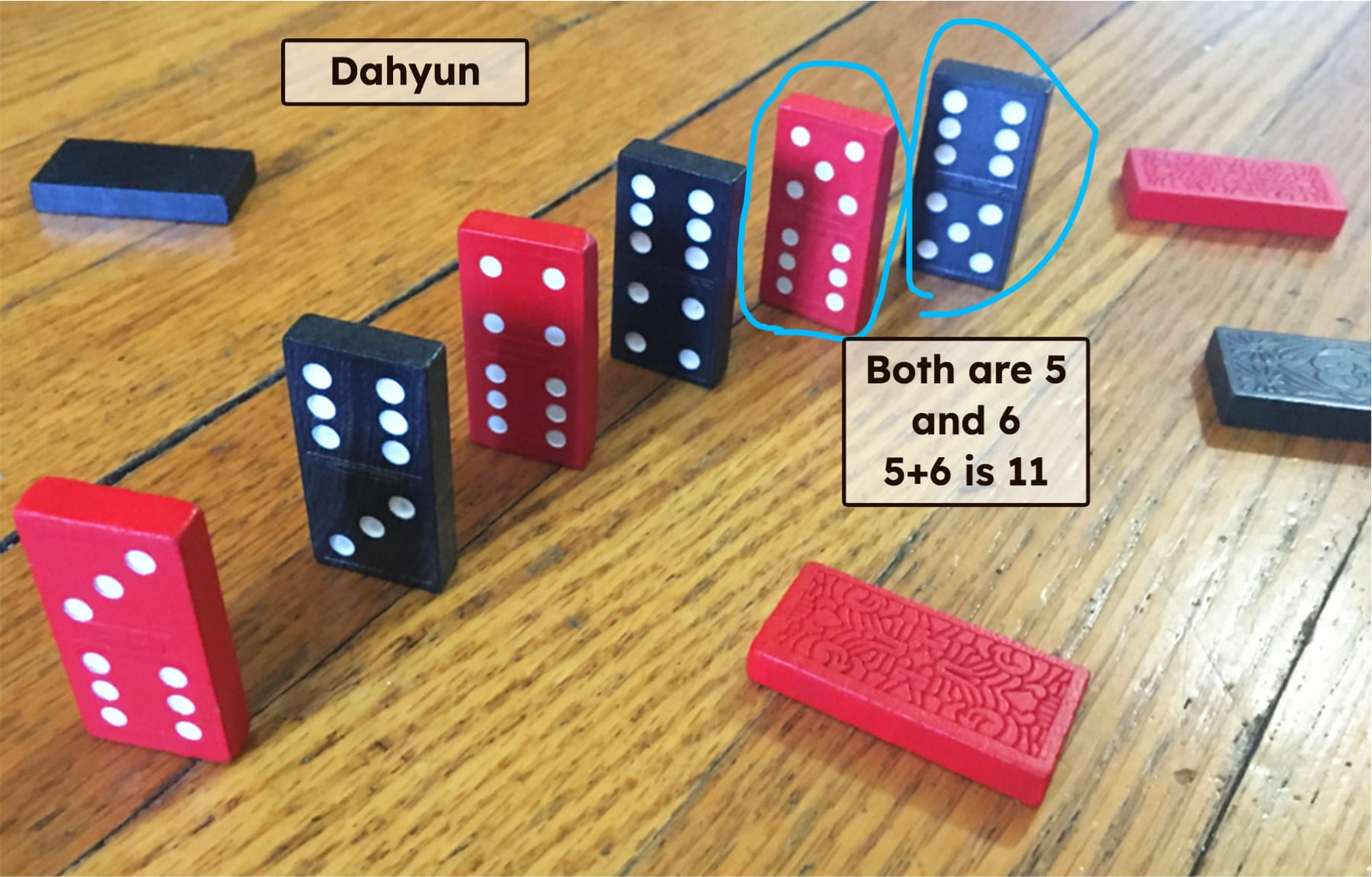
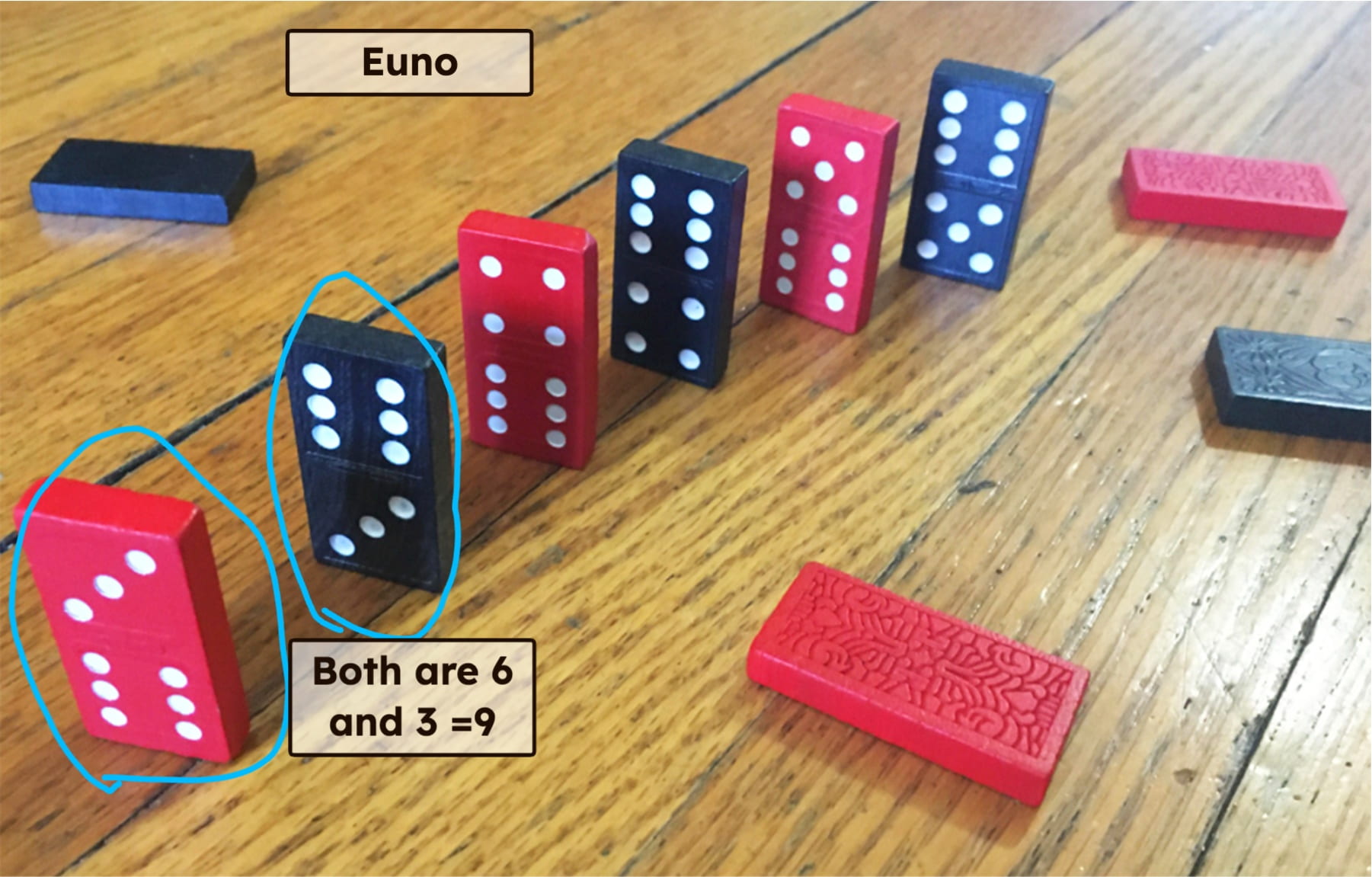
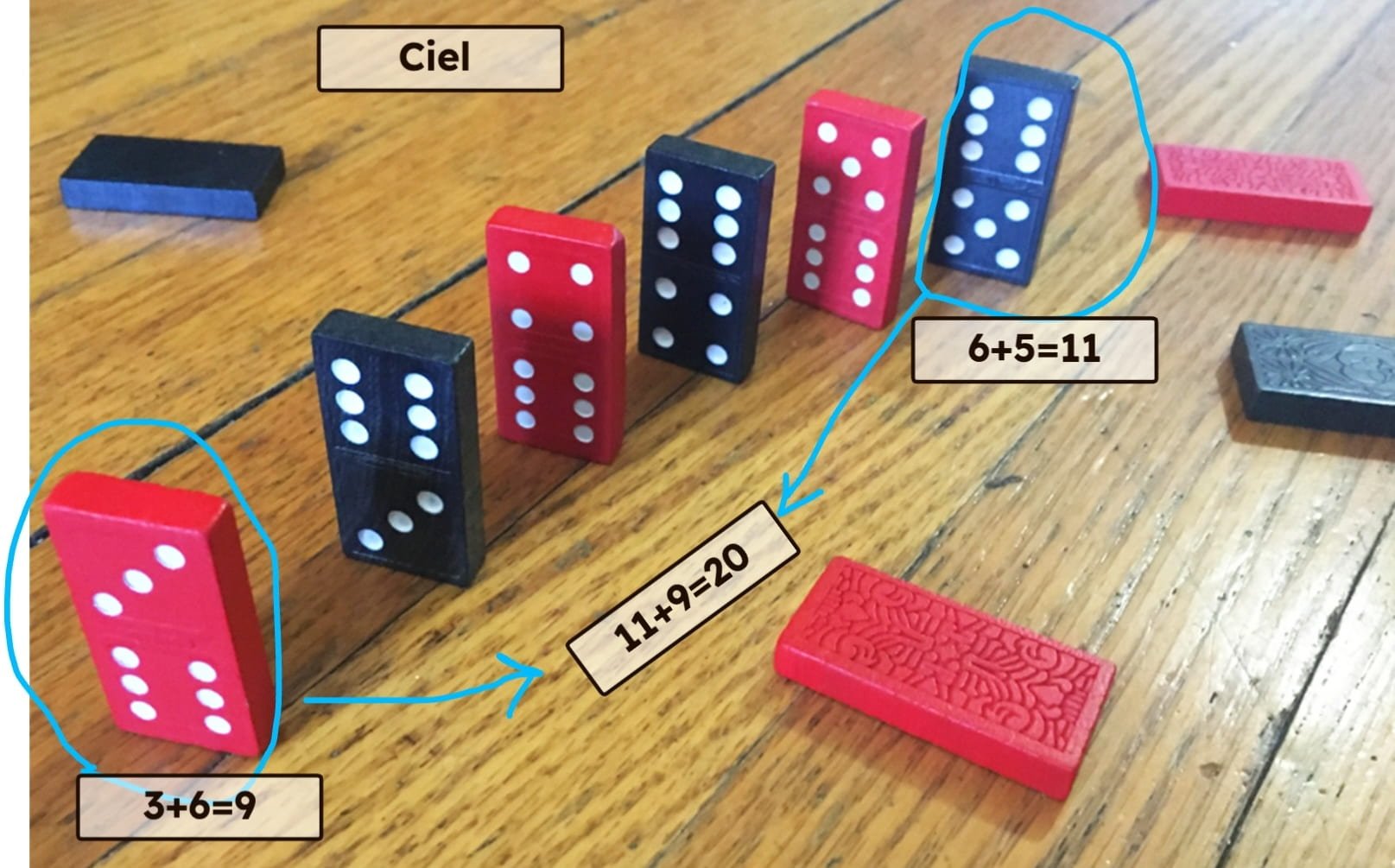
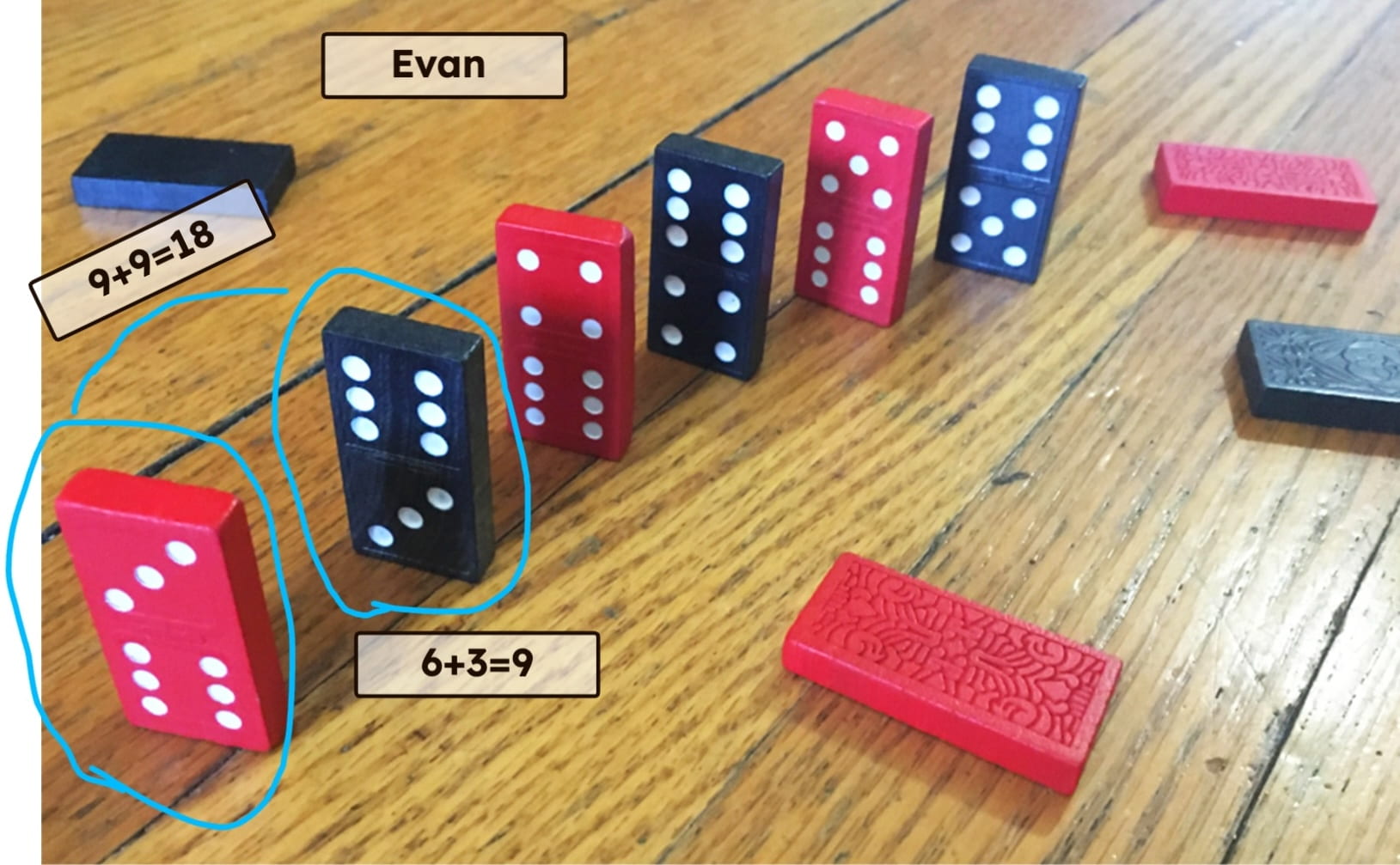
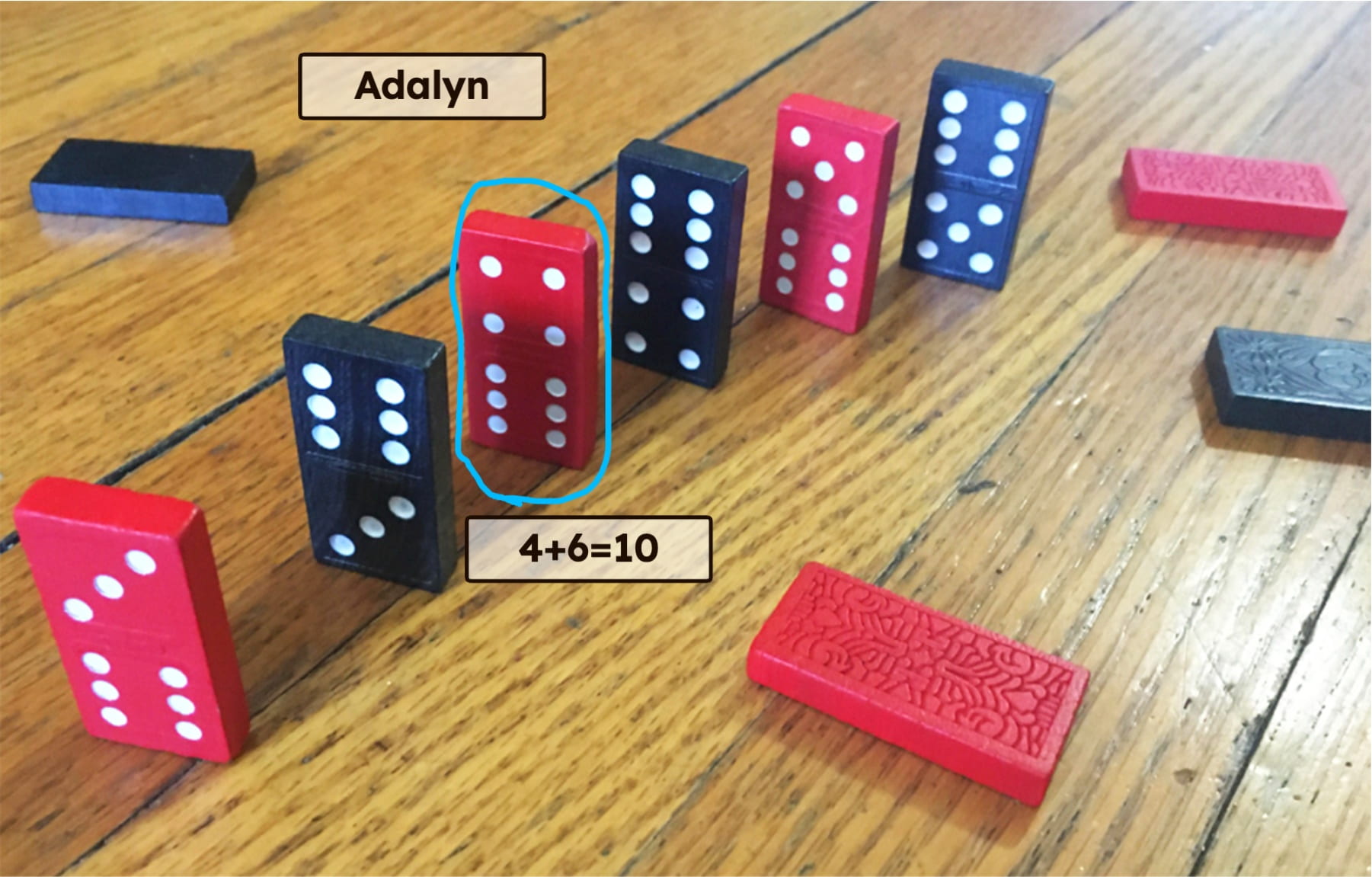
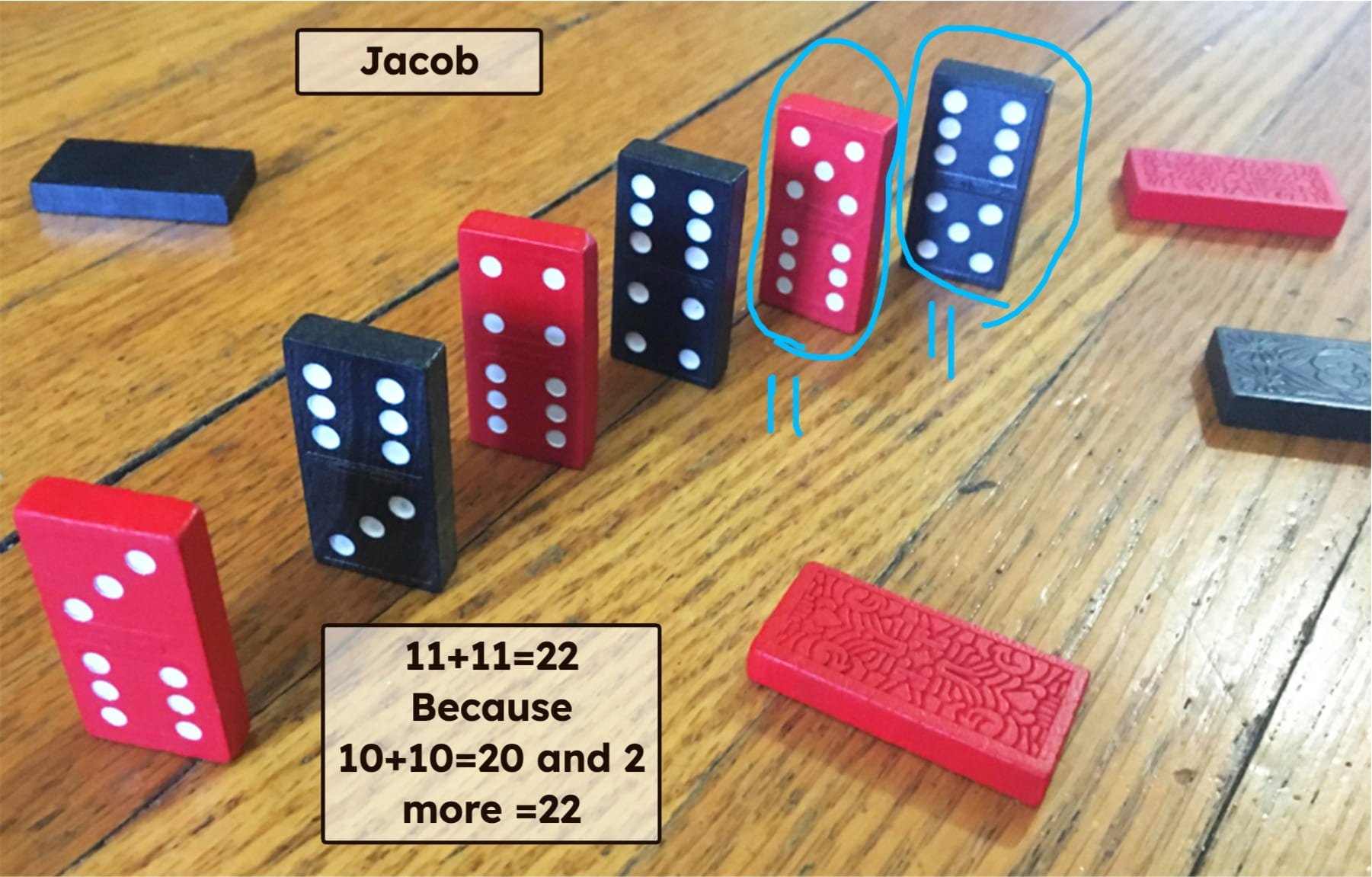
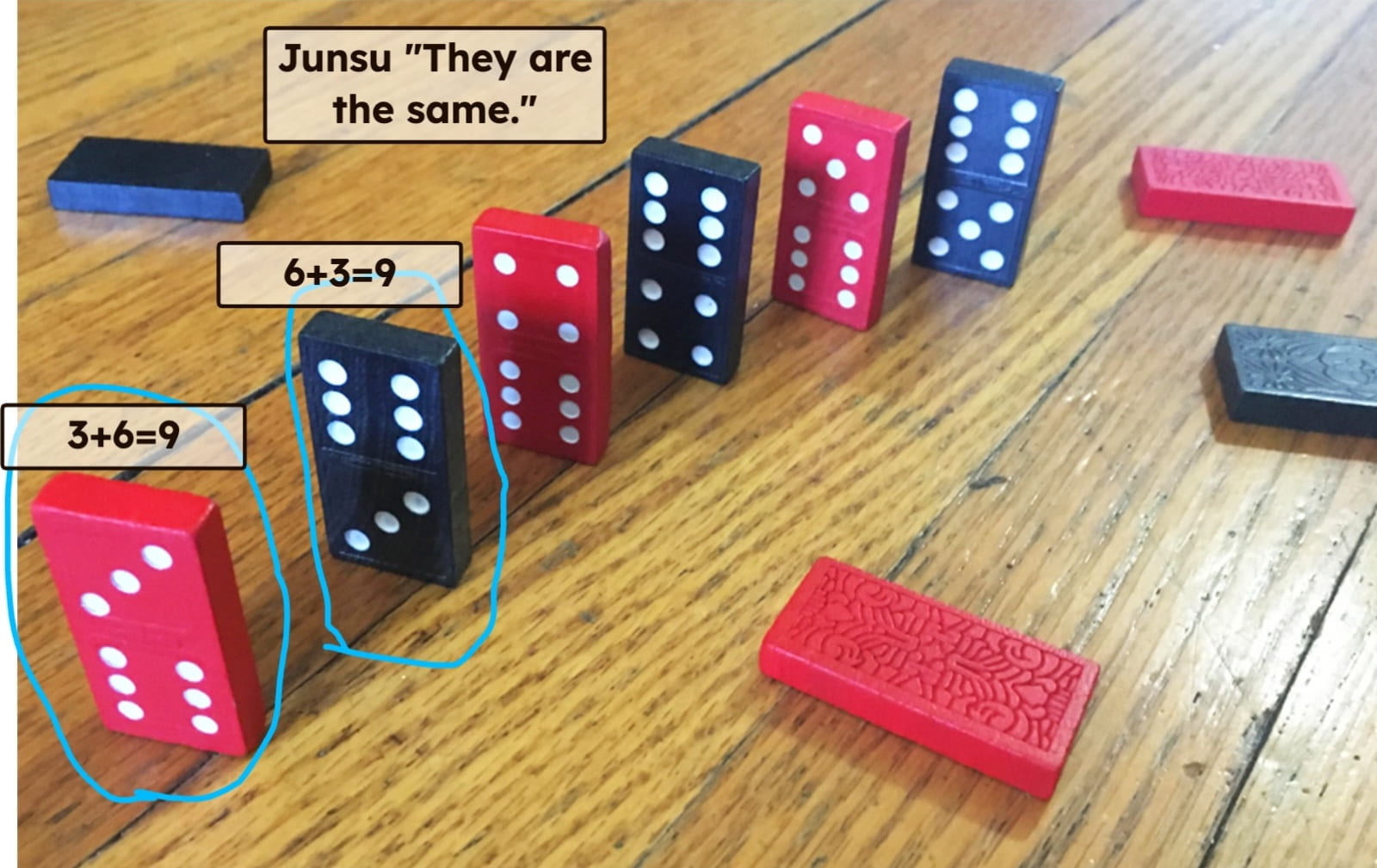
Math in Our World: Dominoes

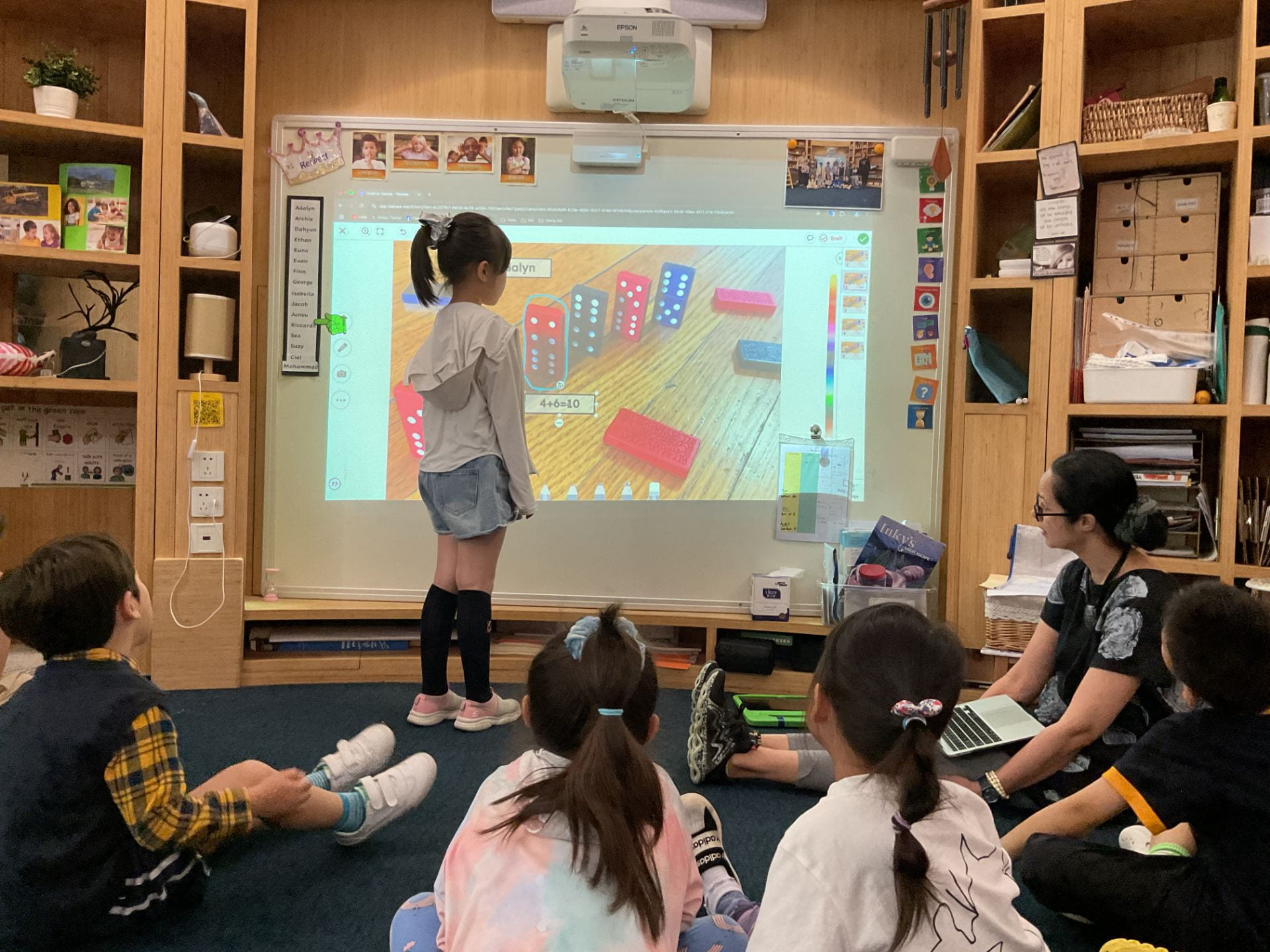
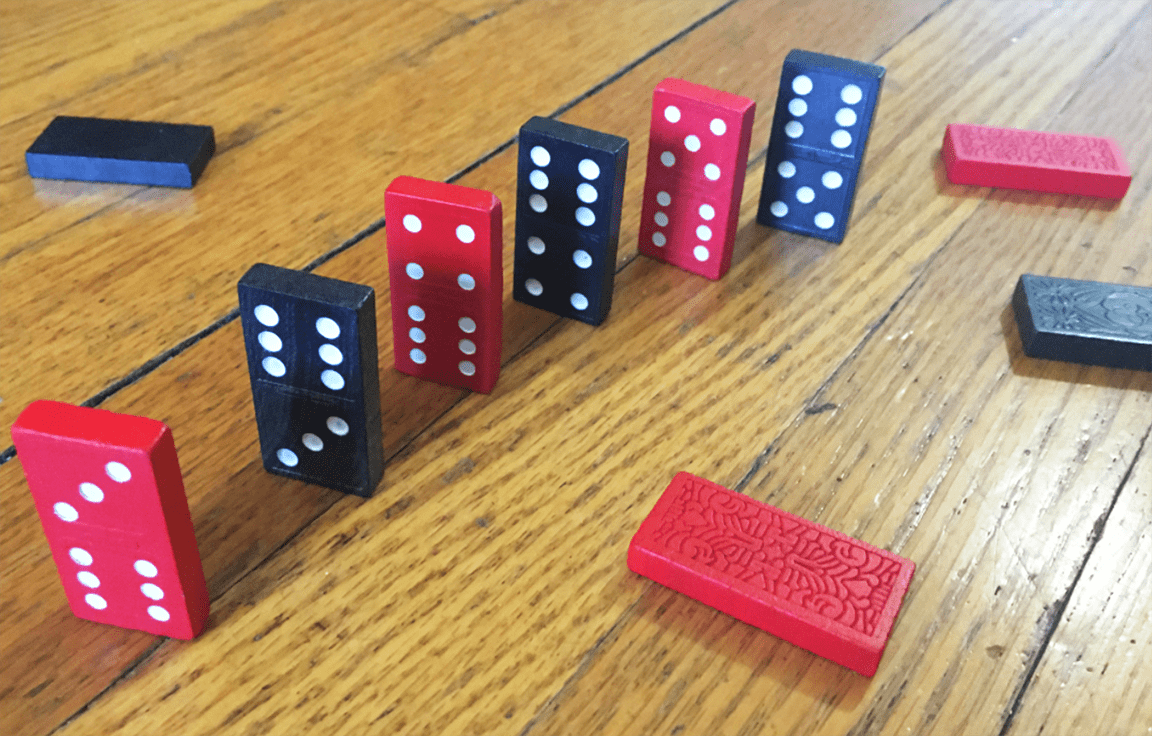
The children have been exploring and playing with dominoes. Noticing this interest in terminals, we decided to share an image to see what they would notice about the domino tiles.

What do you see?

What Math words can you use to share your thinking?

We wonder if the children would extend these ideas while ‘playing’ and creating with the domino tiles.  

Making New Paper

The children were inspired by Isabella’s experiment and wondered if they could make their own paper. Isabella and Adalyn volunteered to use the shredded paper that the children had collected to create new paper.

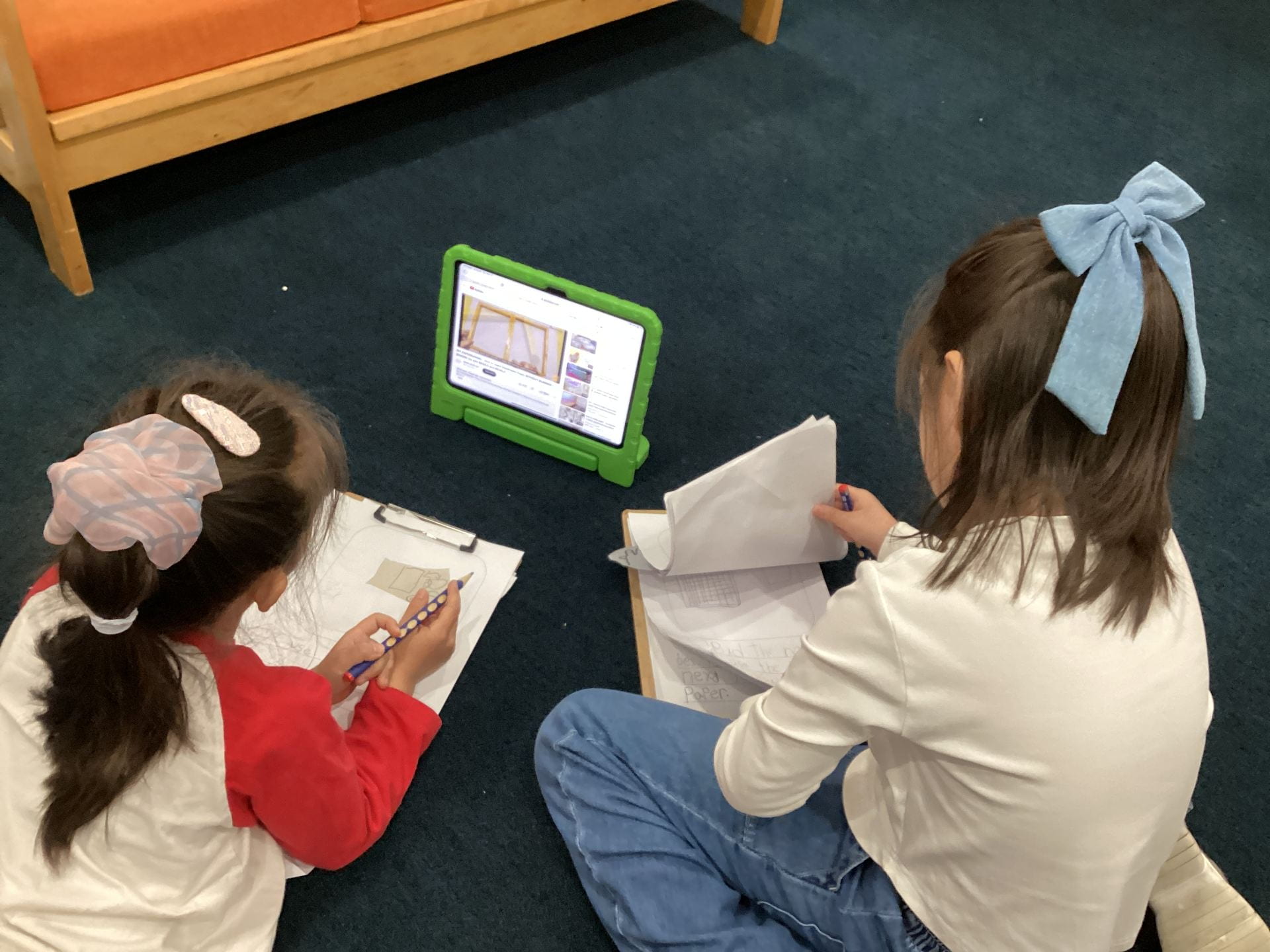
They began by conducting research, reading books and watching a video to learn how to make paper using used or unwanted paper scraps.

Isabella and Adalyn took notes as they watched the video, using pictures, words, and sentences to create their own ‘how-to’ book. In this information booklet, they provided step-by-step instructions on the process of paper-making.

They were careful to include pictures for each step and detailed instructions that guide the reader through the process of making paper.

Several weeks of research and note-taking were required to create the instructional book. Finally, Isabella and Adalyn were ready to put their research to the test, by following the instructions to make their paper.

They began by soaking the paper scraps in water for a few days.

Then, they turned the paper mixture into paper pulp, following different steps to ensure that the mixture of water and paper pulp was correct.  

Then, they dipped the frame into the water with the paper pulp until they had a thin layer of the mixture on the netting.

Finally, the frames were left to dry in the sun and the new sheets of paper were created by the team.

Isabella and Adalyn presented their learning to the class, sharing the various steps they took to create several pieces of new paper.

The inquiry process provided Isabella and Adalyn with opportunities to explore different tools and methods. The sequence of planning, data gathering, interpreting, and communicating enabled them to develop skills in information literacy. 

The team now wonder what other natural materials they could use to make paper.

The Highest Tower in the World

Is it a tower?

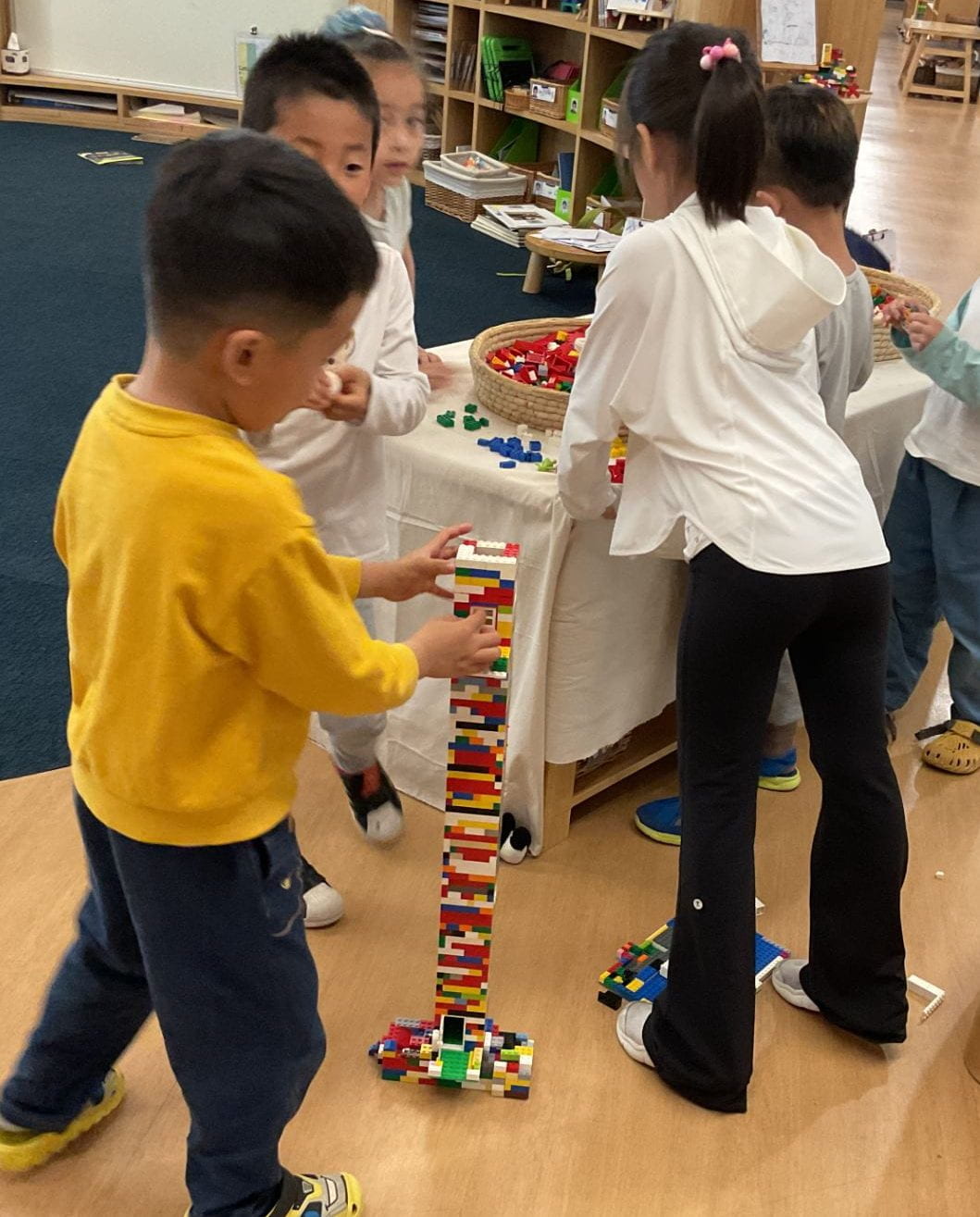
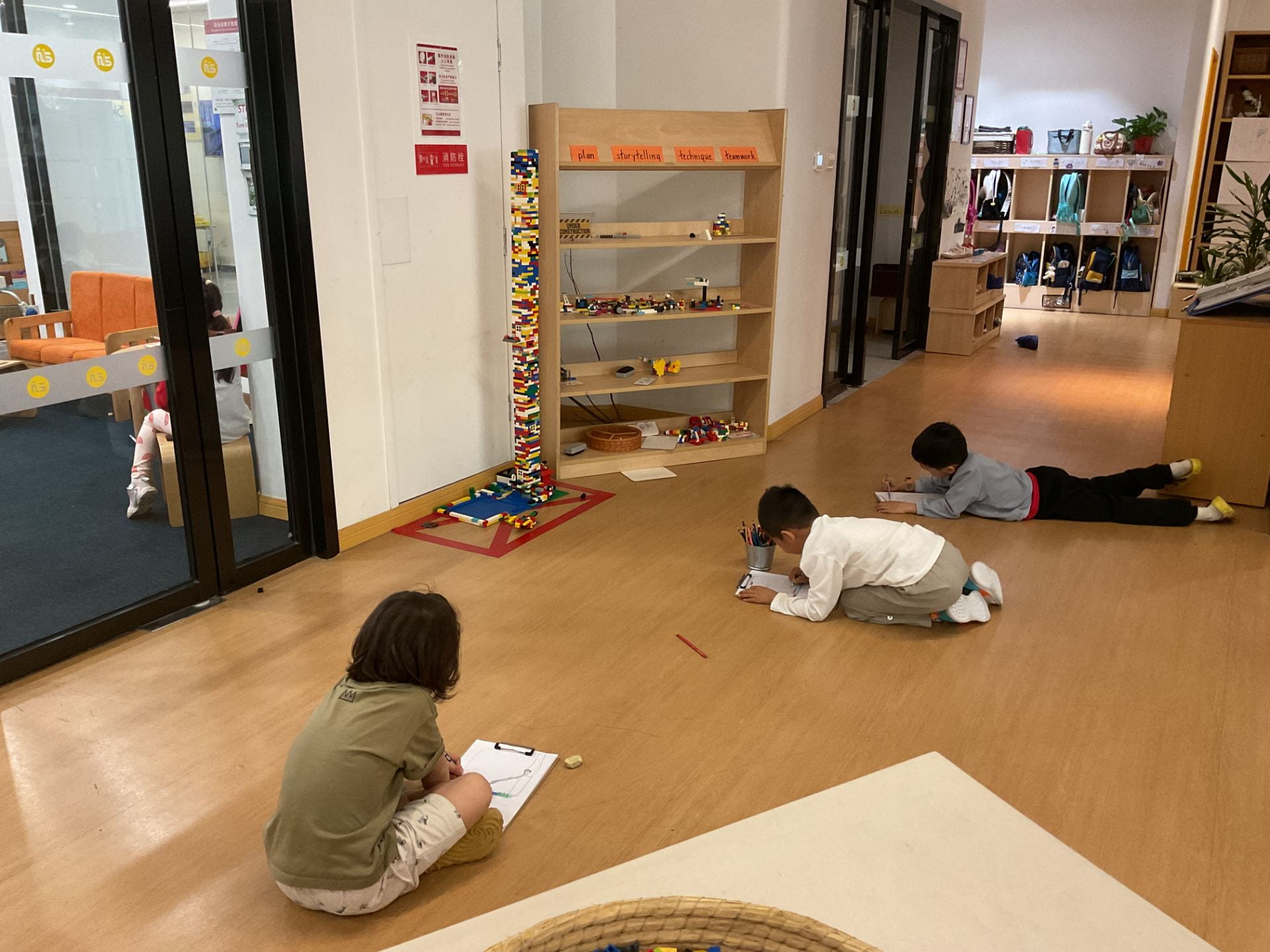
Over the last few weeks, a group of children have been collaborating to create a tower using Lego bricks. The idea was seeded by Jacob and Evan, yet many other engineers have joined this initiative.

As we watched the children engaging in their structural design, we noticed how the young engineers spoke to each other about their ideas, listened with intent and collaborated with enthusiasm with one goal in mind. 

Each section of the tower was thoughtfully put together, with the bricks being positioned purposefully to make sure there were no unplanned gaps around the perimeter of the structure.

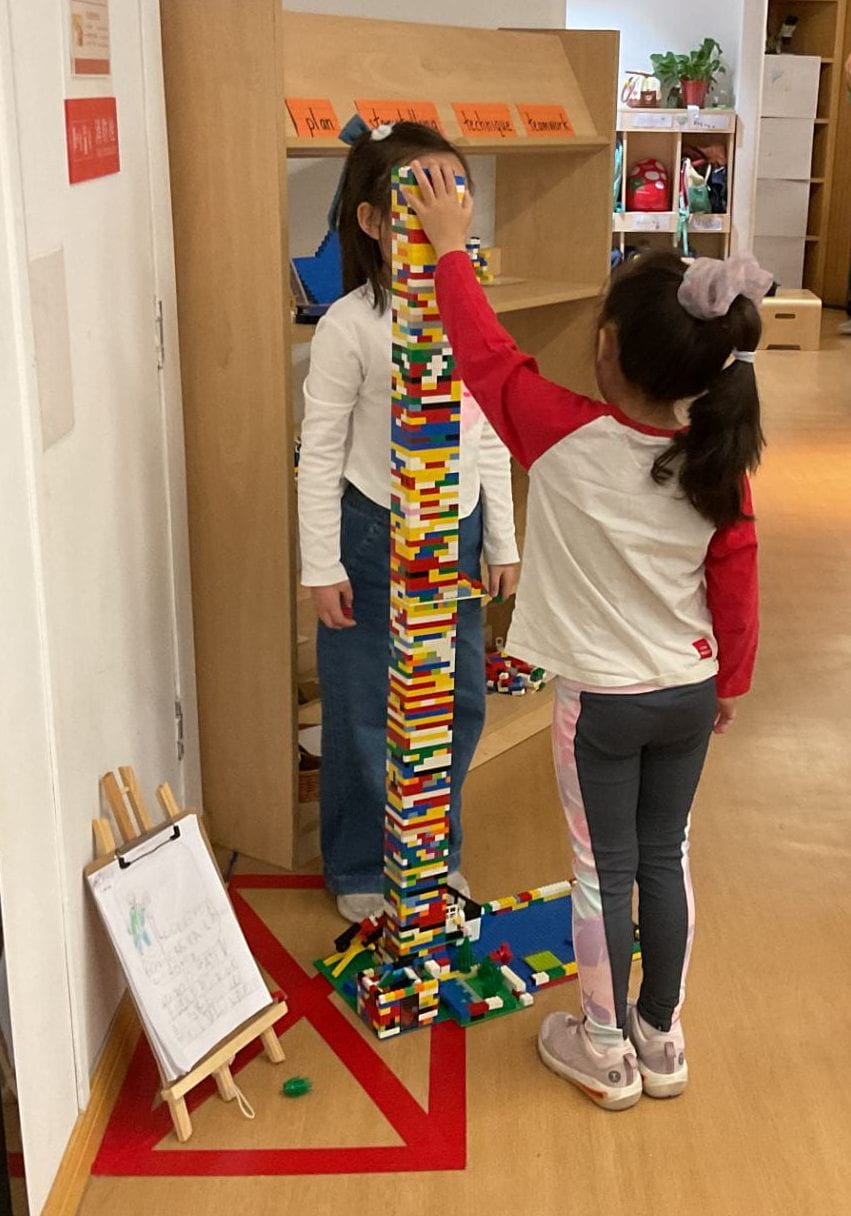
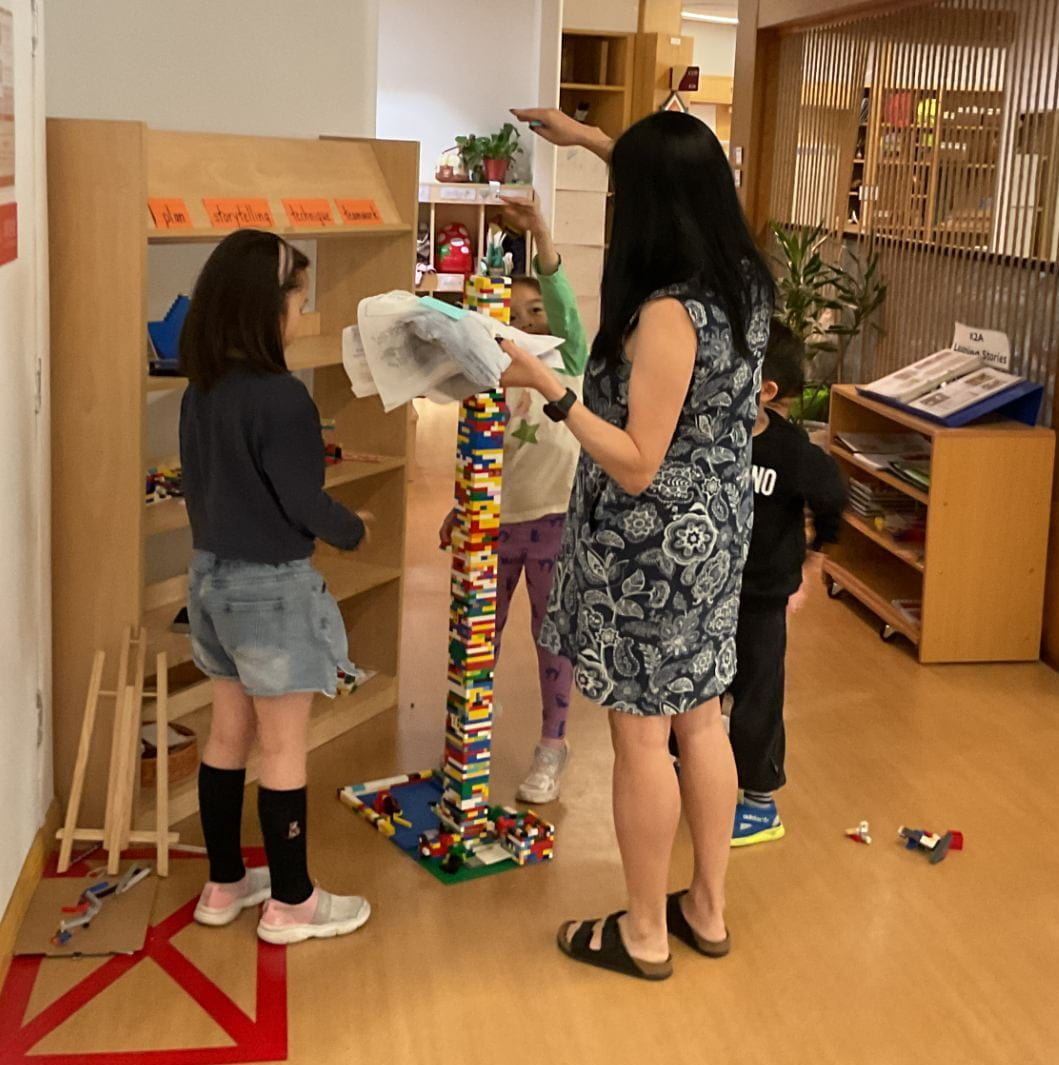
The building moved from the tabletop to the floor as it grew taller. The engineers sort out children to stand next to the structure, attempting to build the structure taller than them.

The engineers moved the structure to a safer space, to ensure that it would not collapse if someone accidentally knocked against it. Curious onlookers stopped by to learn more about the tower.

The Highest Tower in the World

As the weeks pass by, the structural designers continue to work on their structure, creating stories and narratives about this amazing piece of engineering.

  • Adalyn “We need to put the Lego to build the tower.”
  • Isabella “We need to use the tower to measure our height, sometimes.”
  • George “I made the tower with Evan, Ricky, Jacob, Isabella and Adalyn. It takes a long time because this tower is too tall.”
  • Evan “The tower has a swimming pool. The people can play too. The pool is at the bottom, on the side.”
  • Jacob “We have a swimming pool for a motorbike, and on the water motorbike. The people can ride on this and people can live in the tower.”
  • Isabella “On the other side of the swimming pool there is some space you can put Lego so sometimes when we don’t have the Lego pieces we can try to find it inside this.”
  • Adalyn “The people can jump to the pool from the middle.”
  • Isabella “On the side, you need to be careful because there is nothing to protect you.”
  • Riccardo “That one, the jumping one, Jacob tired to jump with his fingers and he jumped on the wall.”
  • Jacob “Because I need to try to see when the people jump do they jump in the pool or out. Because then when real people jump in the pool, then he will jump on the rock and will die. And the jumping pool is on the top.”
  • Evan “We are trying to build but it is too high. We tried to use a chair because it’s too high. Only Adalyn can reach it.”
  • Adalyn “I helped to build the tower. I stand on the chair and then I can reach it.”
  • Isabella “On the top, one time, Evan wanted to put another jumping thing on the top.”

  • Evan “I want to use a small people, middle people and big people all can jump. The small people jump from the small one, the middle people jump from the middle one and the big people jump from the top one.”
  • Isabella “They come because it is a hotel.”
  • Evan “And it is fun. The jumping and the motorbikes make it fun.”
  • Jacob “It is a free hotel.”
  • Isabella “It is in America. People have to fly in an aeroplane.”
  • Evan “Two aeroplanes, or three. Because this hotel has many floors. I think 200 floors.”
  • Isabella “Evan and me and Adalyn had the idea first. We started to build a little one and we think we can build it taller to measure the people’s height. Last time we want to measure Ms. Sophia and taller than Ms. Sophia last time but the Lego but the Lego is not enough.”
  • Jacob “We can borrow some Lego from K2B.”
  • Riccardo “I think I need to take some from PreK-K1B because our box is almost finished.”

We look forward to hearing and reading about the stories that take place in and around the tall tower in the world!

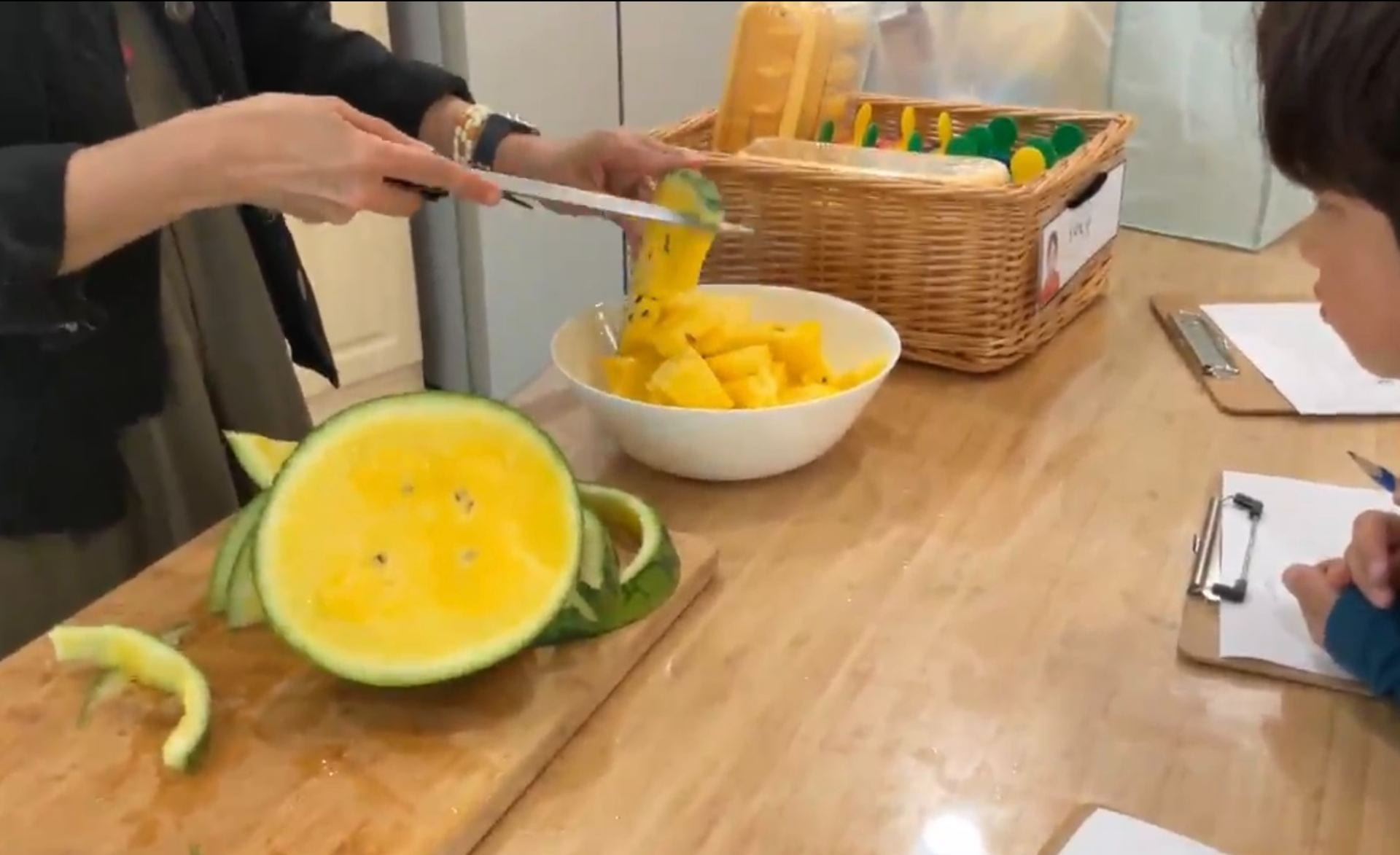
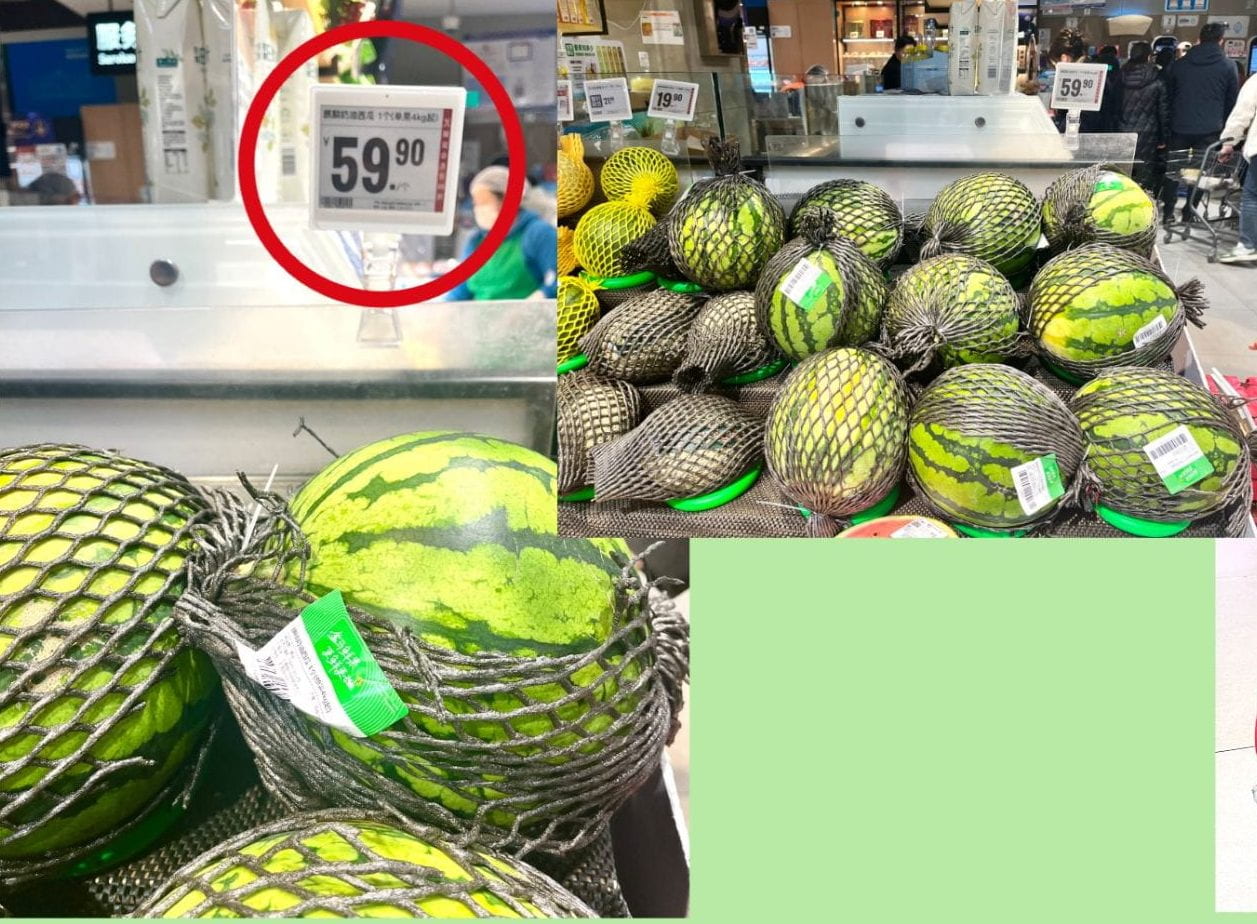
How many watermelons can we purchase for RMB59?

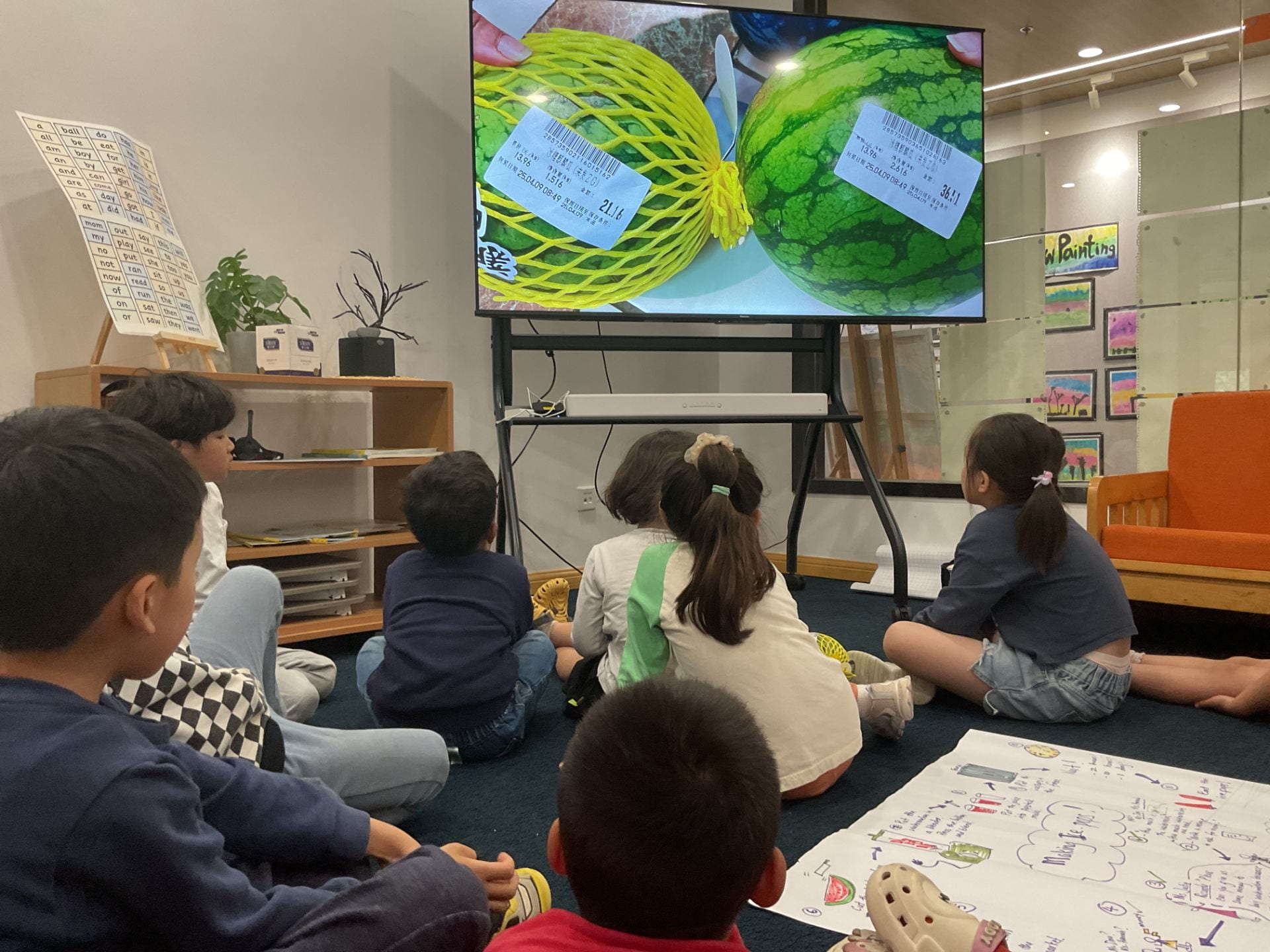
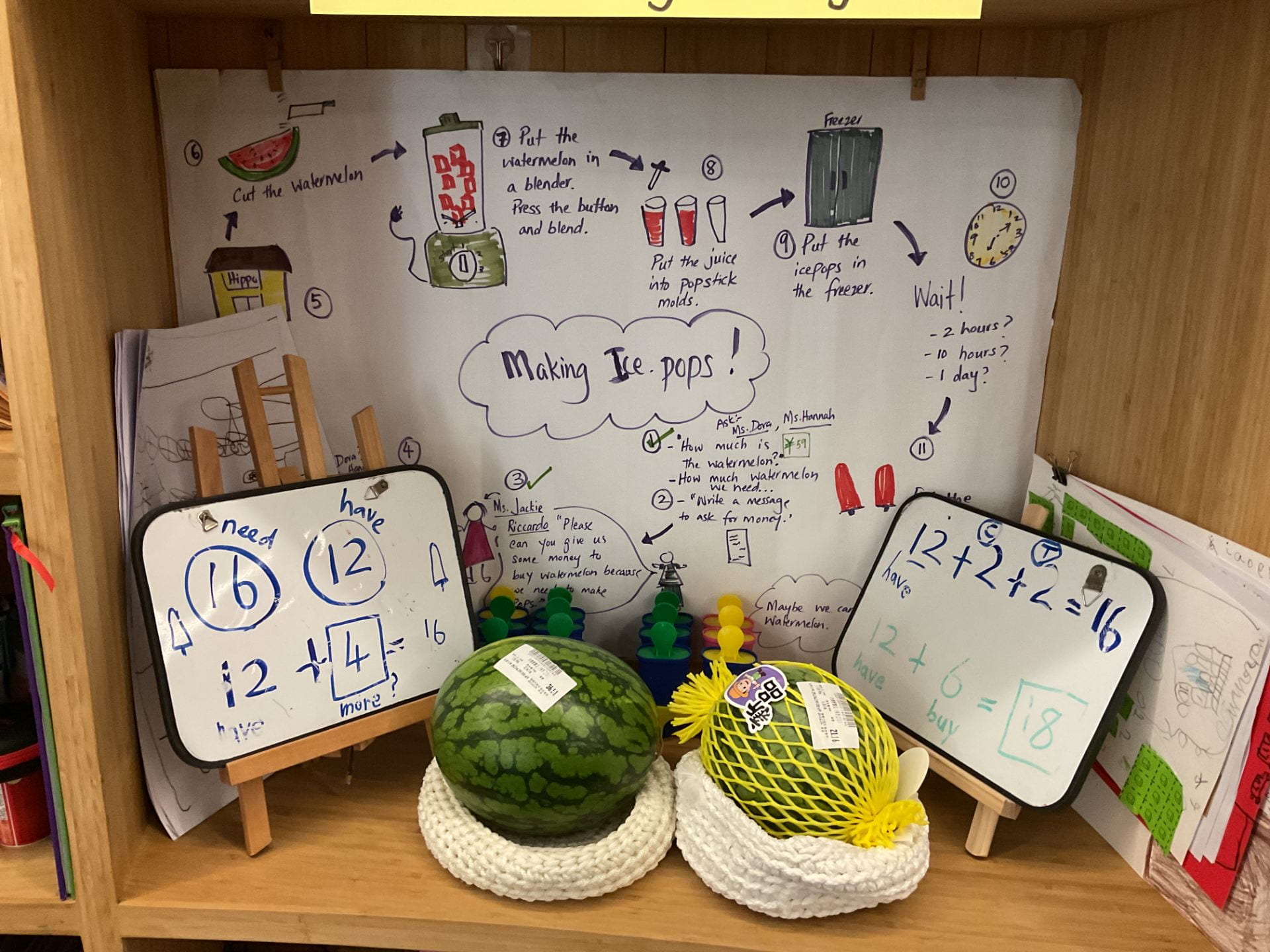
The children have been engaged in various activities related to ‘The Challenge Project’. Different teams will work on specific aspects of the project to help us stay organised. Following on from our inquiry into money, we were now ready to purchase the watermelon. It was time for us to have a small team walk across to the supermarket to buy the watermelon.

The shopping crew updated the others on their trip to the supermarket.

  • Riccardo “We went out of NIS.”
  • Jacob “We crossed the road. We walk over the walkway. Ms. Hannah helped us. The security guards helped us, he stopped the cars and we can go across the road.”
  • Isabella “We got to Suguo and we need to find the watermelon.”
  • Adalyn “We need to check the money. We had 59 RMB.
  • Suzy “We have to test it to see how heavy the watermelon is. Some of the small watermelons were not as heavy as the big ones.”
  • Isabella “We weighed the watermelons so we decide how many we need.”
  • Riccardo “The Suguo people helped us weigh the watermelon and told us how much money is it.”
  • Jacob “We carried it. If it is too heavy we cannot carry it so we need a small one.”
  • Riccardo “We choose 5 first. “
  • Jacob “We first gave them 57, then we gave them another 59. It was less than 59. 2 left.”
  • Adalyn “The two watermelon we add them and we buy them.”
  • Suzy “We went out of Suguo and we cross the road and we go back to NIS. We were safe.”

The experience at the supermarket helped the children experience the process of choosing and purchasing food items. On their trip, they needed to make many decisions and work together as a team to solve the problems they encountered.

Jacob “We are going to the supermarket to buy the watermelon for making the ice pop challenge. 3 minute challenge our buddy can make the watermelon ice-pop. We use 57 RMB to buy the watermelon and we took the middle one and one small one. We chose not heavy one, we choose the smaller one and smaller so we can carry this, used the basket too heavy. Me and Isabella carry it and go to school. We take a long time.”

Many opportunities for mathematical thinking and learning were explored. These authentic learning experiences are great opportunities for children to explore and learn about concepts through real-life experiences.

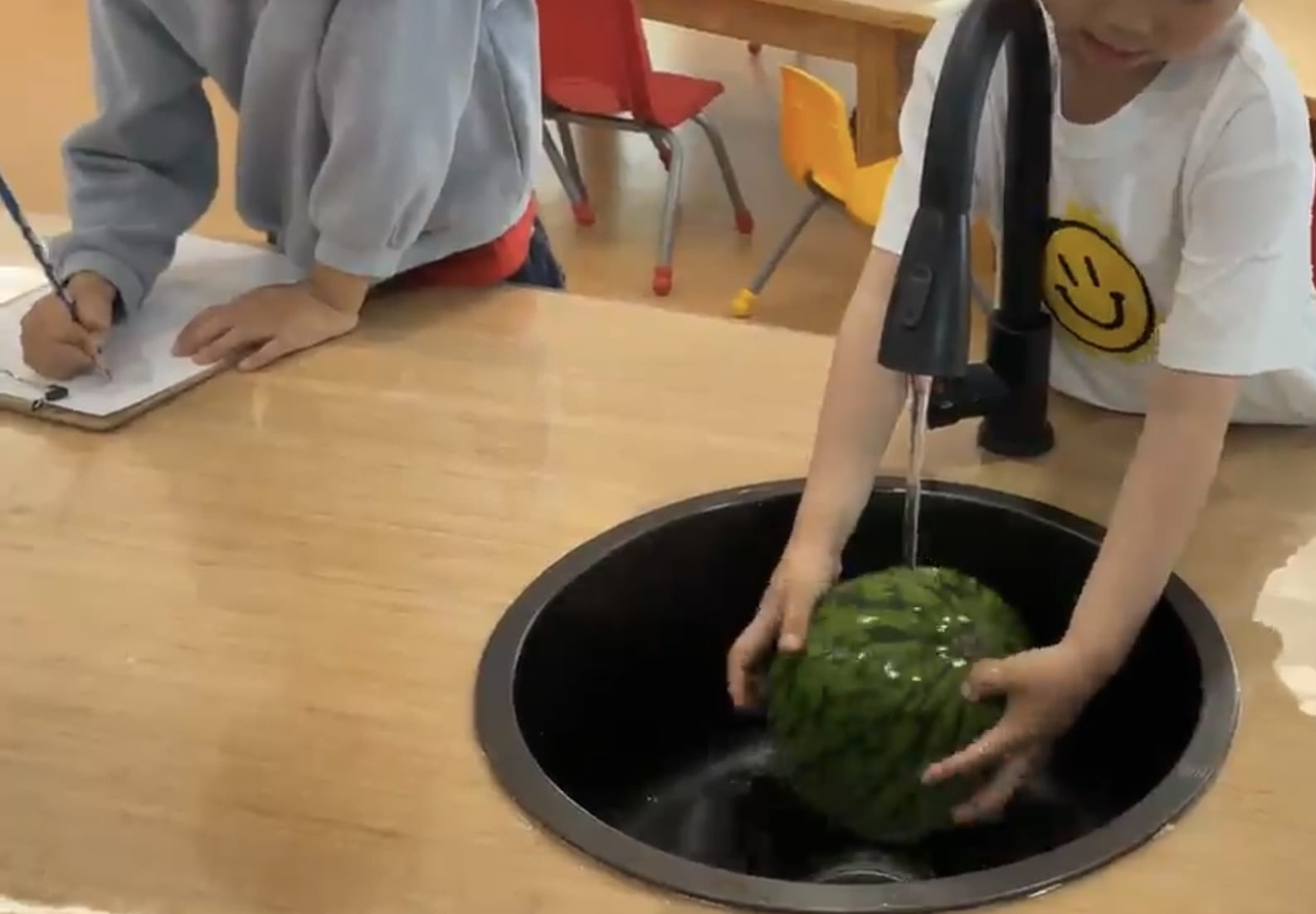
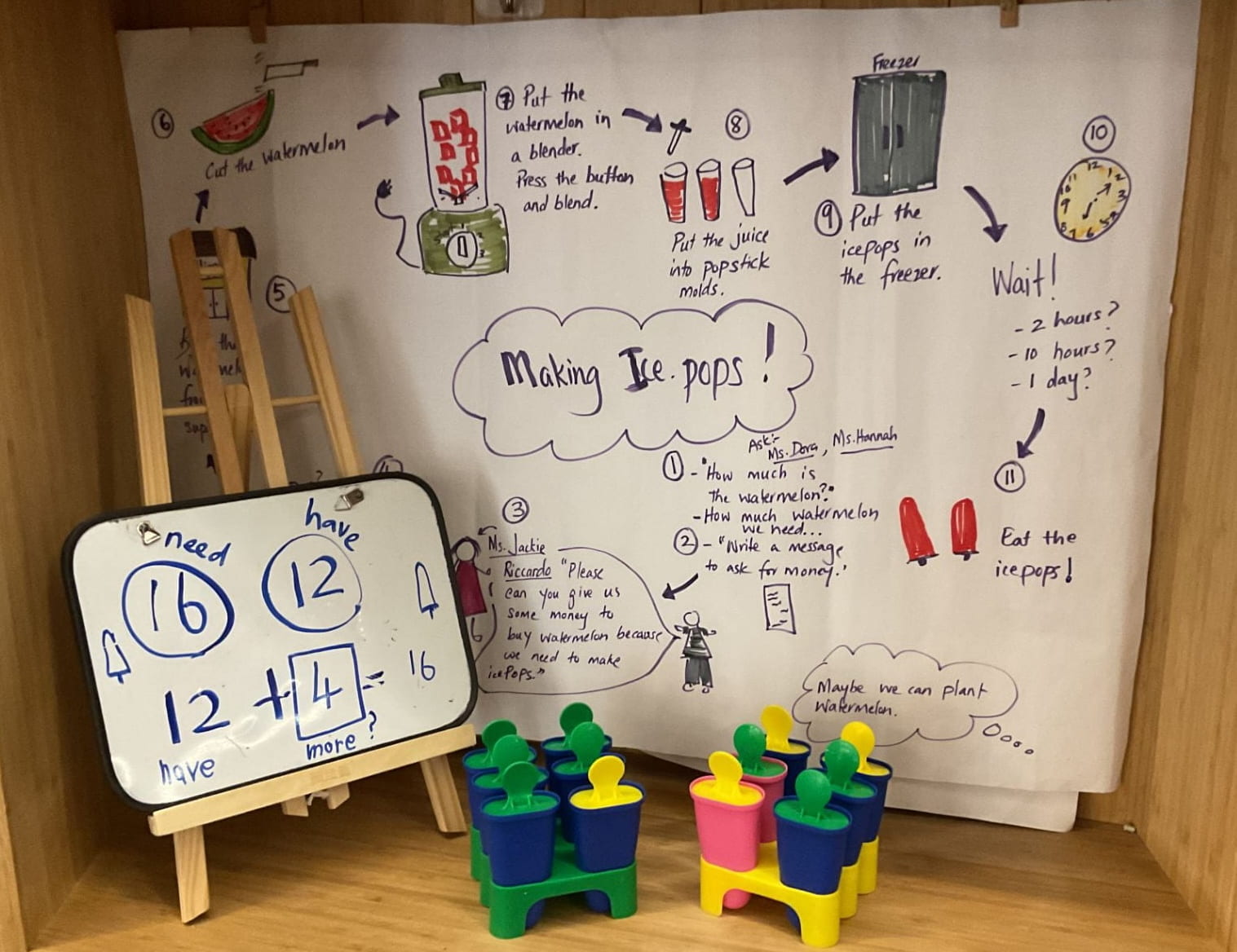
Our next step would be to carry out the test to find out how many ice pops we can make from one watermelon.


YAY! Making the Ice Pops!


  • Dahyun “We made the ice cream with the watermelon.”
  • Ciel “We put it in the freezer because then it will freeze.”
  • Evan “Then we took it out because we need to eat it in 3 minutes because we need to have a challenge.”
  • Isabella “It was really hard to take the ice pops out.”
  • Evan “Then we eat it in 3 minutes.”
  • Junsu “Some people don’t eat it in 3 minutes.”
  • Riccardo “It was really icy.”
  • Suzy “But it was yummy.”
  • Evan “It was so cold!”
  • Sea “We eat watermelon like ice pops. We eat it, it’s like cold. I ate it but my teeth was so cold.”
  • Adalyn “We eat watermelon ice-pops, it feels like cold.”
  • Isabella “It was sweet.”
  • Suzy “The ice pop, maybe it was sweeter a little bit more.”
  • Ciel “When Ms. Shemo took one ice pop out, it broke.”
  • Junsu “And watermelon is in the body.”
  • Dahyun “I eat ice cream then my body is so cold.”
  • Evan “I eat the ice cream my teeth feels off.”
  • Isabella “Riccardo finished the ice pop in 3 minutes. And Archie almost finished it.”
  • Sophia “Sea and Jacob finished next.”

The children explained, “It was a fun challenge because it was icy.”

We wonder what our next challenge would be…

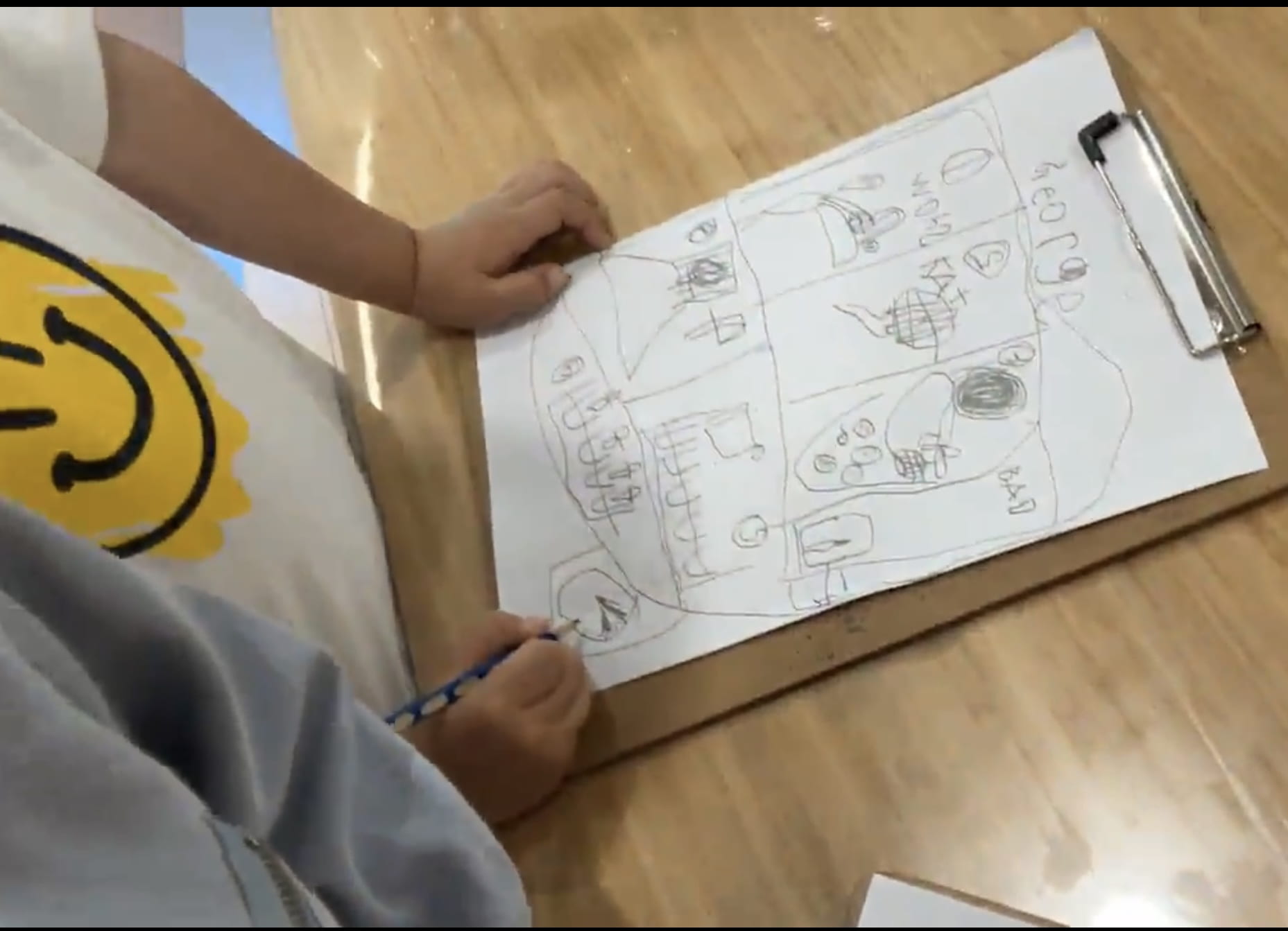
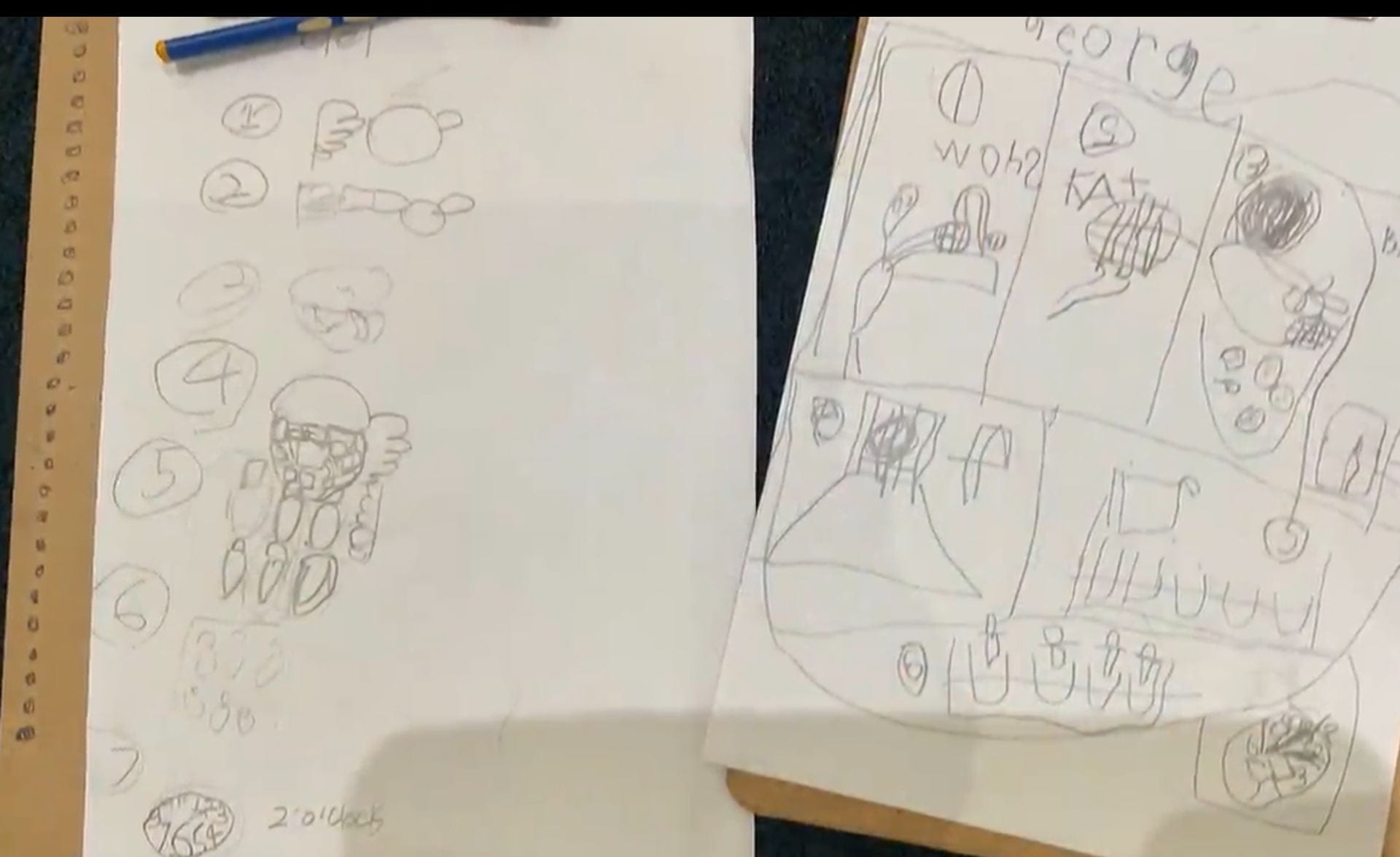
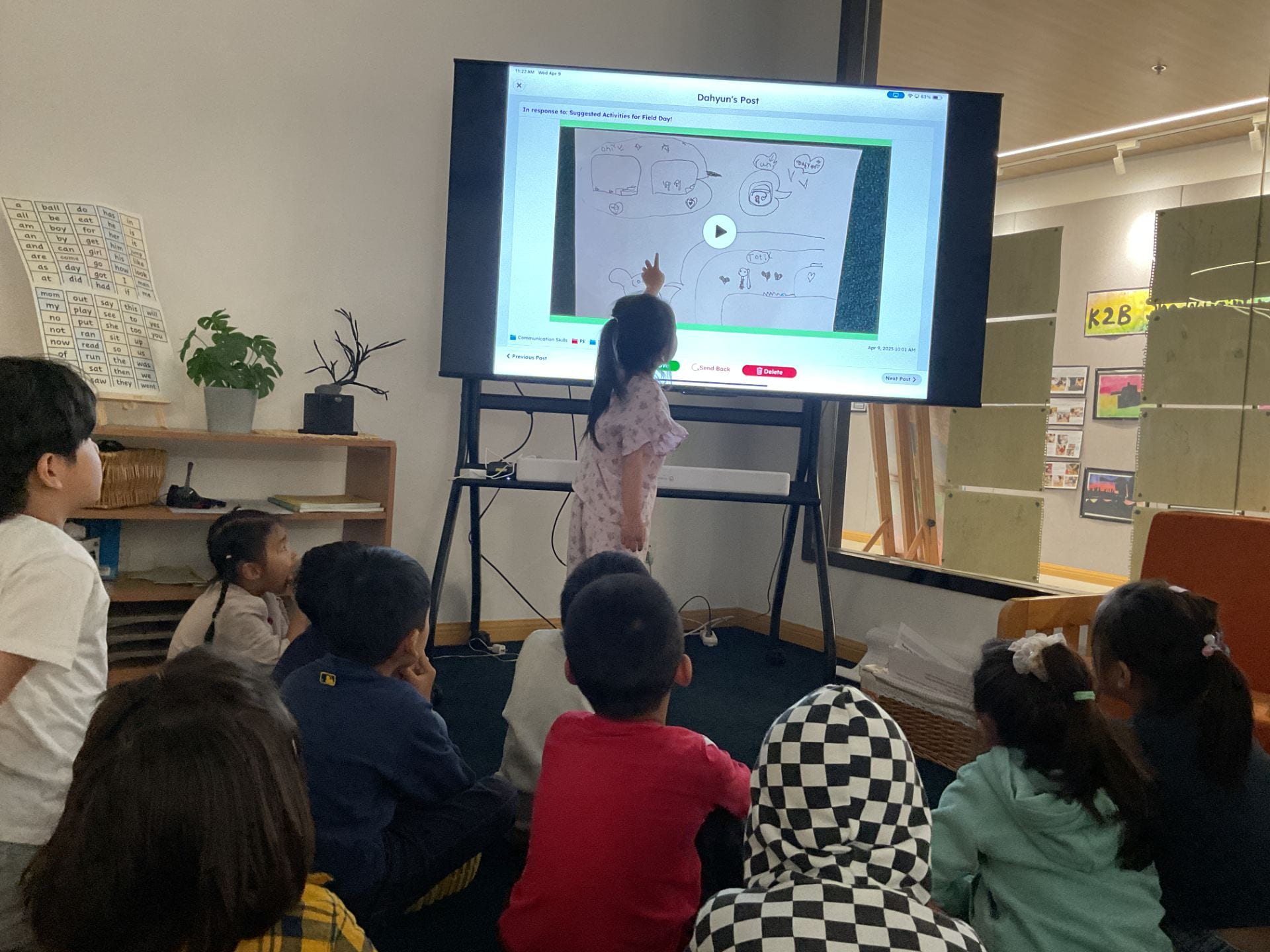
The Early Years Field Day

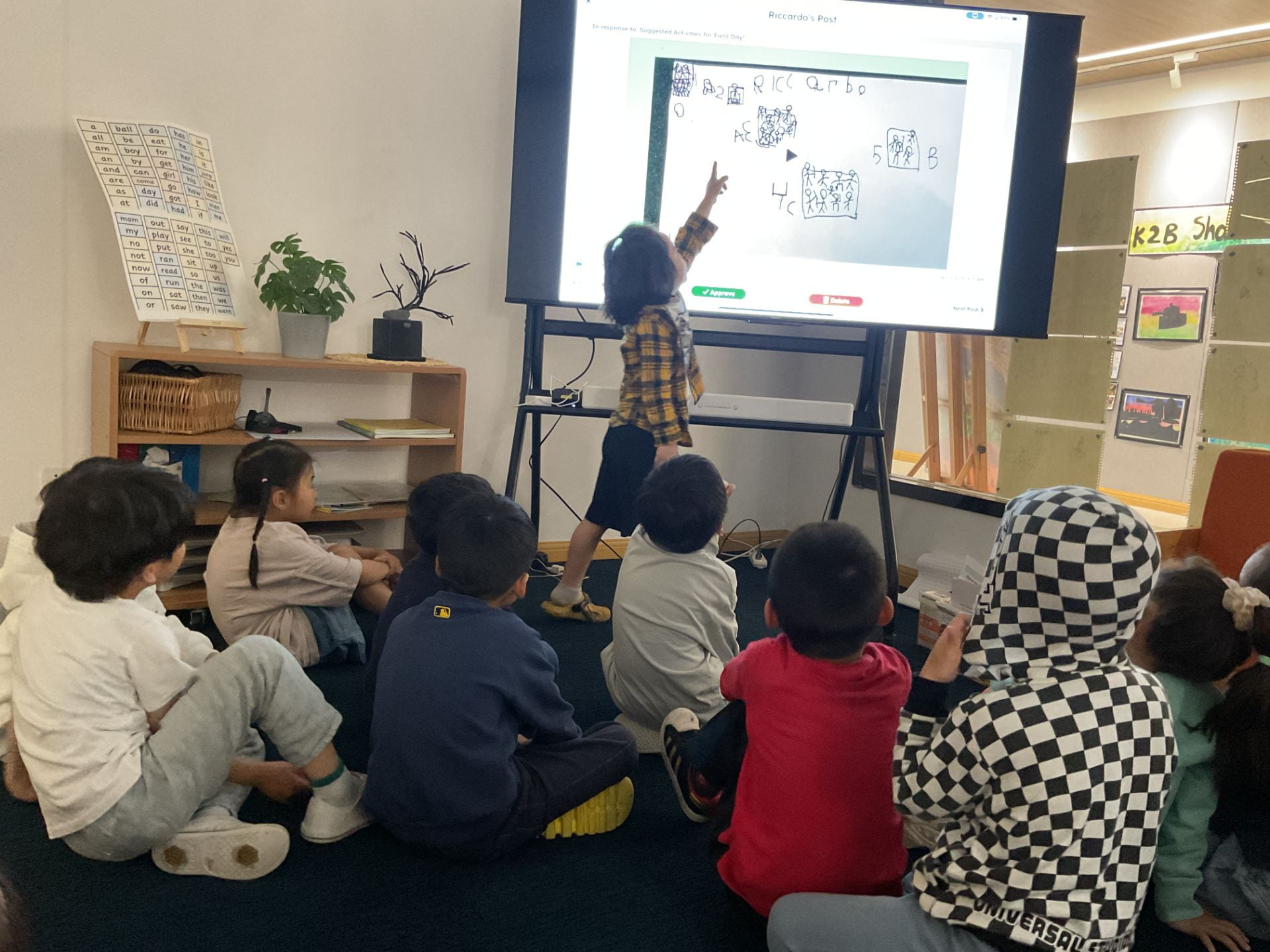
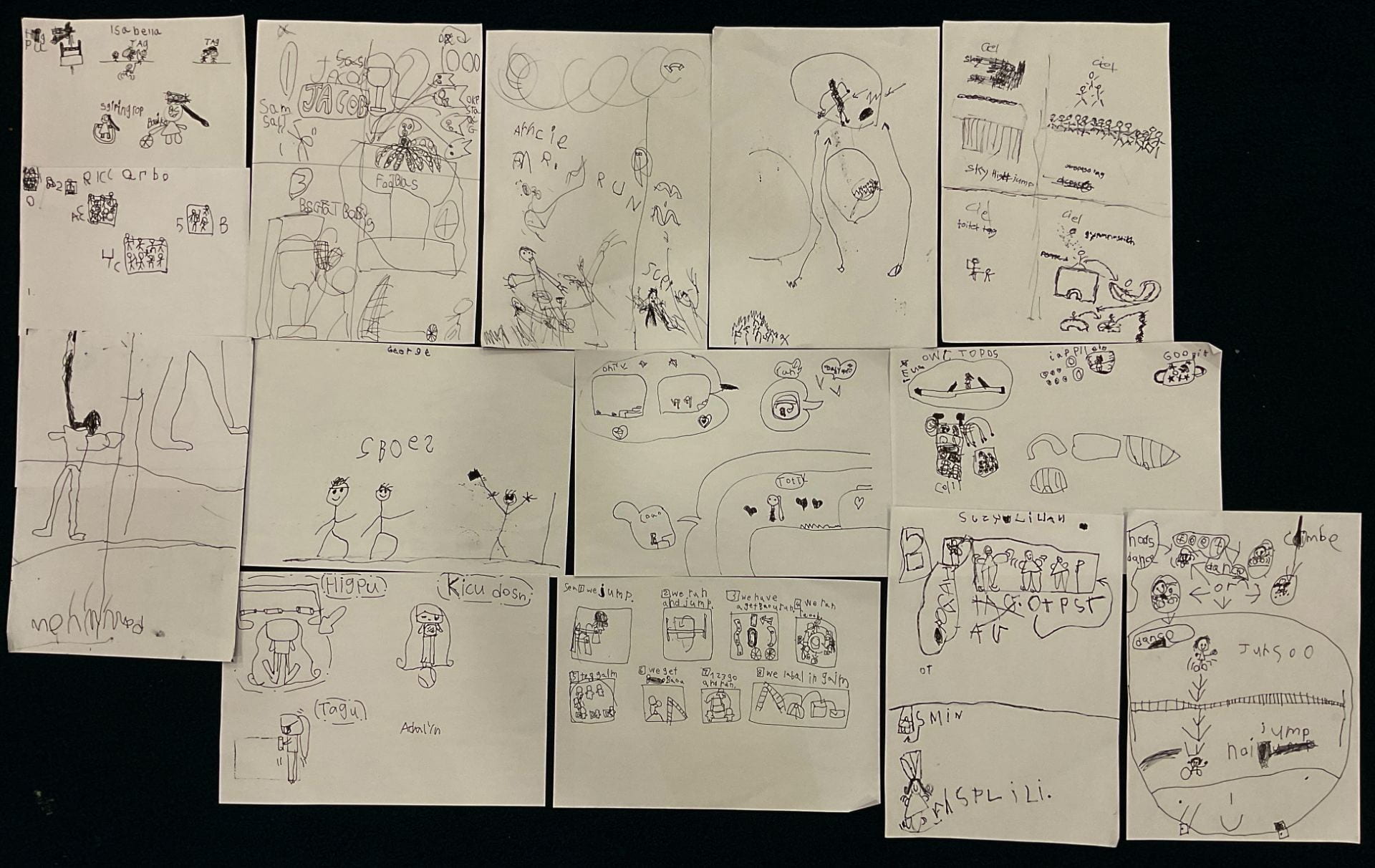
The Early Years Field Day is fast approaching, Mr. Lee wondered if the children had any suggestions for some activities they would like to share with parents. The athletes in K2 put down their thoughts on paper, using drawing and writing to explain their ideas. Then, they presented their ideas to the rest of the class.

  • Adalyn “I just wanted high jump and kicking the ball and Tag.”
  • Ciel “This is high jump, octopus tag and toilet tag and gymnastics.”
  • Dahyun “Octopus tag, toilet tag, running, climbing and high jump.”
  • Euno “Octopus tag, jumping, sit and go on a trolley play and gymnastics.”
  • George “This one is football, this one is running outside.”
  • Isabella “High jump, octopus tag, Tag, skipping rope and basketball and high jump.”

  • Jacob “Somersaults, basketball and football.”
  • Junsu “This is high jump and hand-stand and feet stand and dance.”
  • Mohammad “Running, kicking the ball.”
  • Riccardo “Octopus tag, high jump, alien tag, toilet tag, banana tag.”
  • Sea “This is run and jump, high jump, the team relay, and running round and pass the noodle to another person, tag game, climbing the ladder, running game and obstacle race.”
  • Suzy “Octopus tag, high jump, swing, trampoline.”

We wonder which of the suggestions Mr. Lee would consider including in the field day activities.

We hope the parents will put on their running shoes and be ready to watch, engage and celebrate the day’s events.

Children have ‘agency‘ when they have an active voice and stake in the classroom and community.

What do we know about money?

We have been planning a small group excursion to the supermarket in front of the school to buy a watermelon. This was the planned next step of our ‘Ice-pop Challenge Project’.

Jacob had learned that the watermelon would cost RMB 59. As a lead into the trip, we asked the children what they already knew about money.

  • Archie “Buying stuff.”
  • Adalyn “Buying food to eat.”
  • Dahyun “Buying Lego and pants.”
  • Riccardo “Where does money come from?”
  • Archie “Everyone has money, but some Indian people do not because the tornado happened and outside they are littering so much. But Japan has money.”
  • Isabella “The money is made of paper.”
  • Jacob “Buying something, when you want to learn something, then you can use the money to buy it. Like cubes.”
  • George “I have money. A little money. My mum gave me money. I use to buy toys.”
  • Sea “I have so many money because I have Korea money. And I put the money in the box and I have Nanjing money too. I think face on the money is different.”
  • Ciel “I have so many so I put in a piggy bank. It is a pig and there is a hole and we put the money, then it will be safe.”
  • Junsu “I have lots of money and I don’t know how much money I get. My dad didn’t tell me. I got the money from dad.”
  • Dahyun “Chinese money is different to Korean and Japanese money.”
  • Euno “I go to Dahyun’s house on Monday and I see Dahyun’s money is many. But I have little money. My grandma gives me money in Korea.”
  • Jacob “My home has lots of money but my mum and dad don’t tell me because then I will tell everybody and its not good. My money is more than other people. Other people want me to give money to him.”
  • Suzy “How do we make money?”
  • Ciel “We can make it with paper.”
  • Sea “I think you need to make with water and paper. If money is like paper.”
  • Jacob “I don’t know where we get money from but I know what is used to make it.”
  • Ciel “We get it from the bank. My mum gets it. They will change the money. There is a little hole and you put it.”
  • Adalyn “Work. My mum and dad work and can get some money.”
  • Sea “Dad is so long time at home and another day short time. He gets money.”
  • Jacob “My mum need to be at home to do our work. Like looking after me.”
  • We keep money is our home.
  • Archie “Give the money to the shop people.”

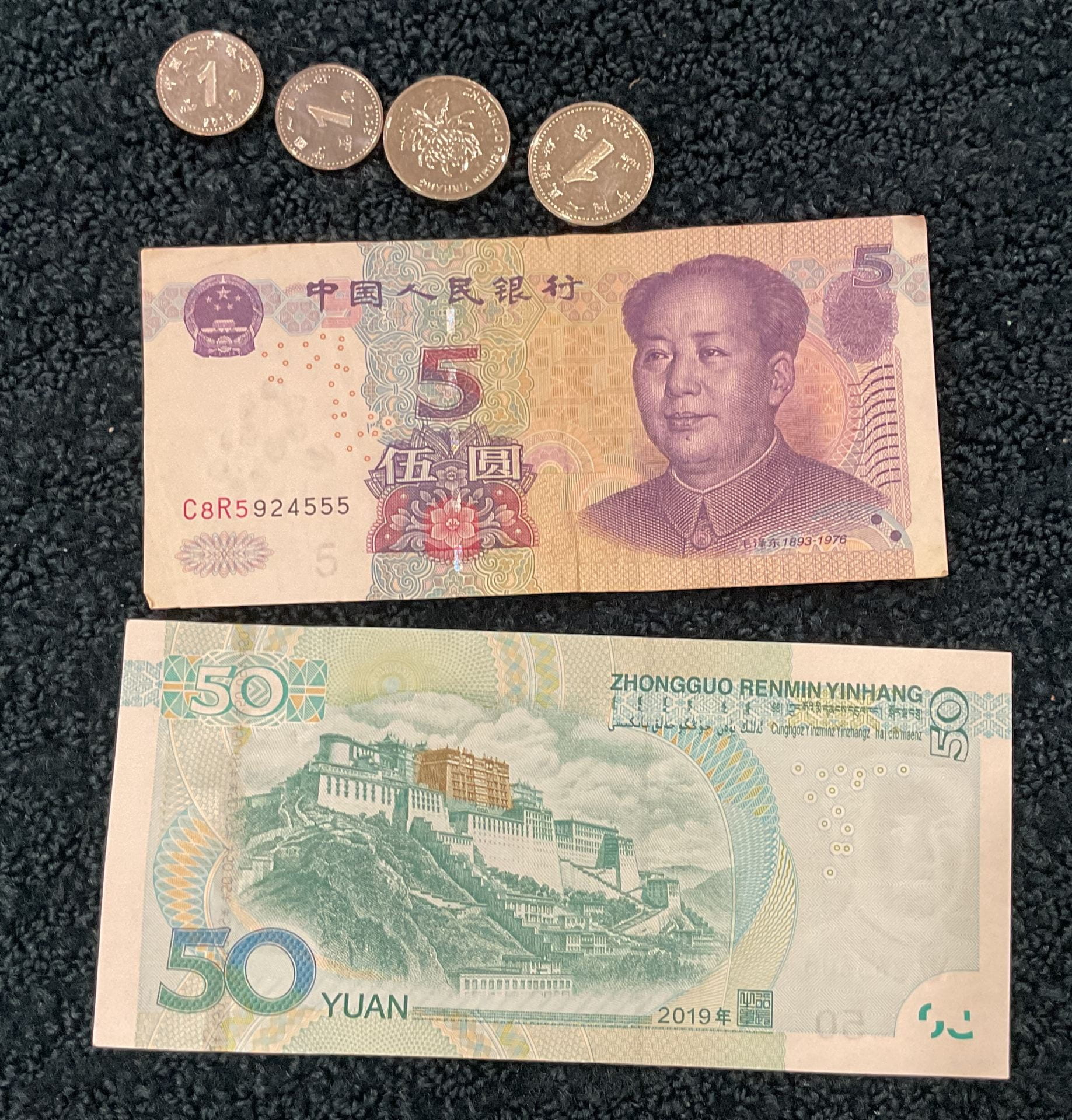
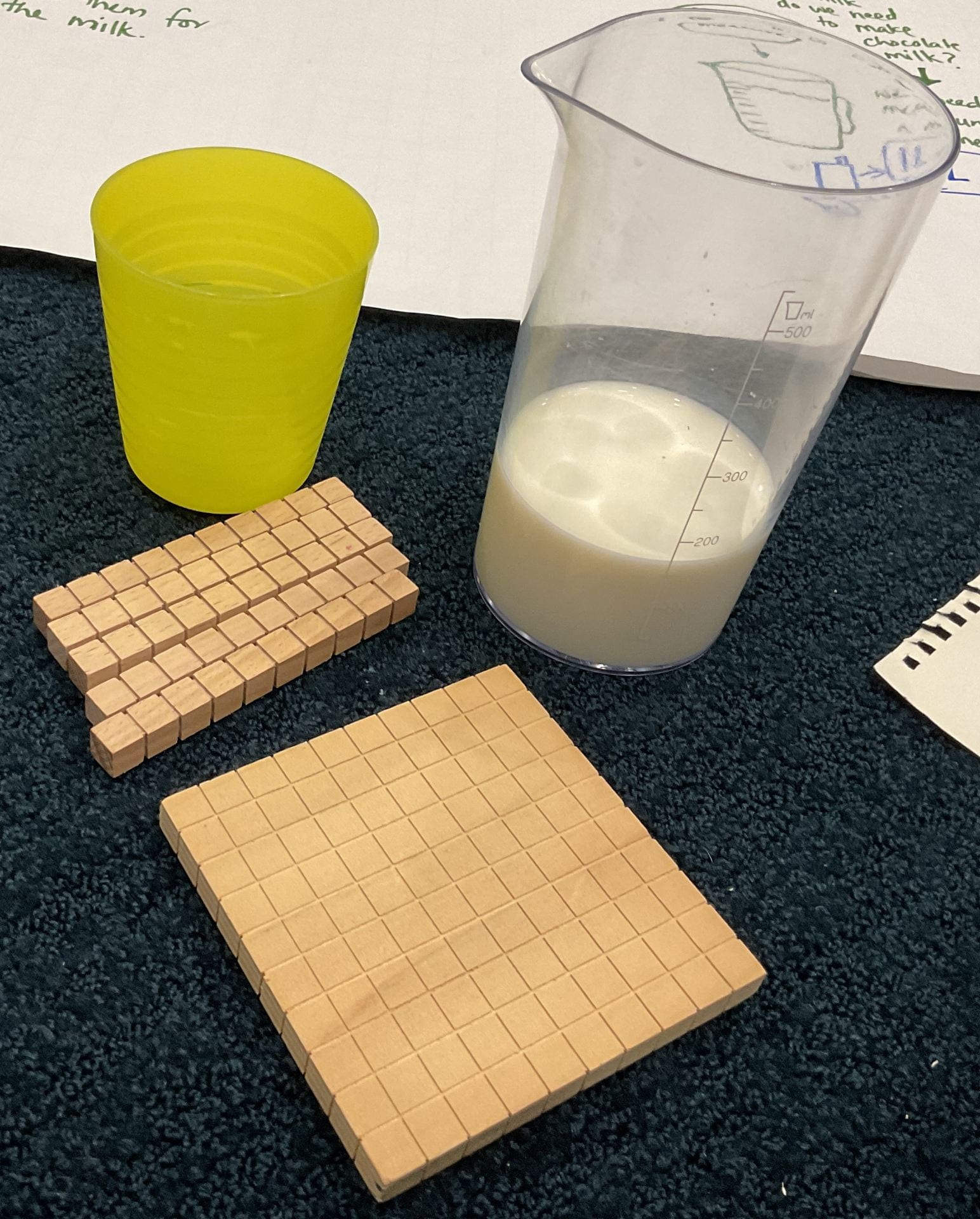
We decided to empty a wallet to find out how much money the teacher had. As we laid out the different coins and notes, The children began to talk about what they noticed about the money.We placed Base-10 blocks next to the notes and coins to talk about the value and calculate the total.

The children were curious about the different writing, symbols and images on the notes and coins and how they signified currencies from other countries.

  • Ciel “Money is also made of metal.”
  • Archie “The money is on paper and the colour is rainbow.”
  • Sea “Colour is different.”
  • Ciel “Because 20 is smaller than 10. Because then we know they are not the same.”
  • Euno “My money is five money, five 100 money.”
  • Suzy “Maybe we use the paper to cut around. A long paper, not too big and not too small. Suzy When we go to the supermarket we will draw the number then other people can know how many coins does the paper have. My money and daddy need money to buy food, because when we eat all the food then we can’t buy food.”

Jacob decided to calculate to find out how much money was in the wallet. Then, he set aside RMB 59 to buy the watermelon.

Next, a small group of children will visit the supermarket to buy the watermelon. Their research will help them calculate how many watermelons they will need to purchase to make enough ice pops for themselves and their Grade 5 buddies.

Illustrations: Feedback for Improvement

The kindergarten writers have been creating stories inspired by their personal experiences, play and imagination. We have noticed that their three-dimensional structures, Lego designs and play materials are part of their storytelling. As writers, they use mark-making drawings and words to communicate their stories with others. Illustrations are essential to the writing process as they help writers plan, describe and enhance the reader’s experience. This is true with both fiction and non-fiction writing. Considering the significance of illustrations in bookmaking, we decided to invite the children to improve their illustrations through feedback.

  • What can we learn from drawing a butterfly?

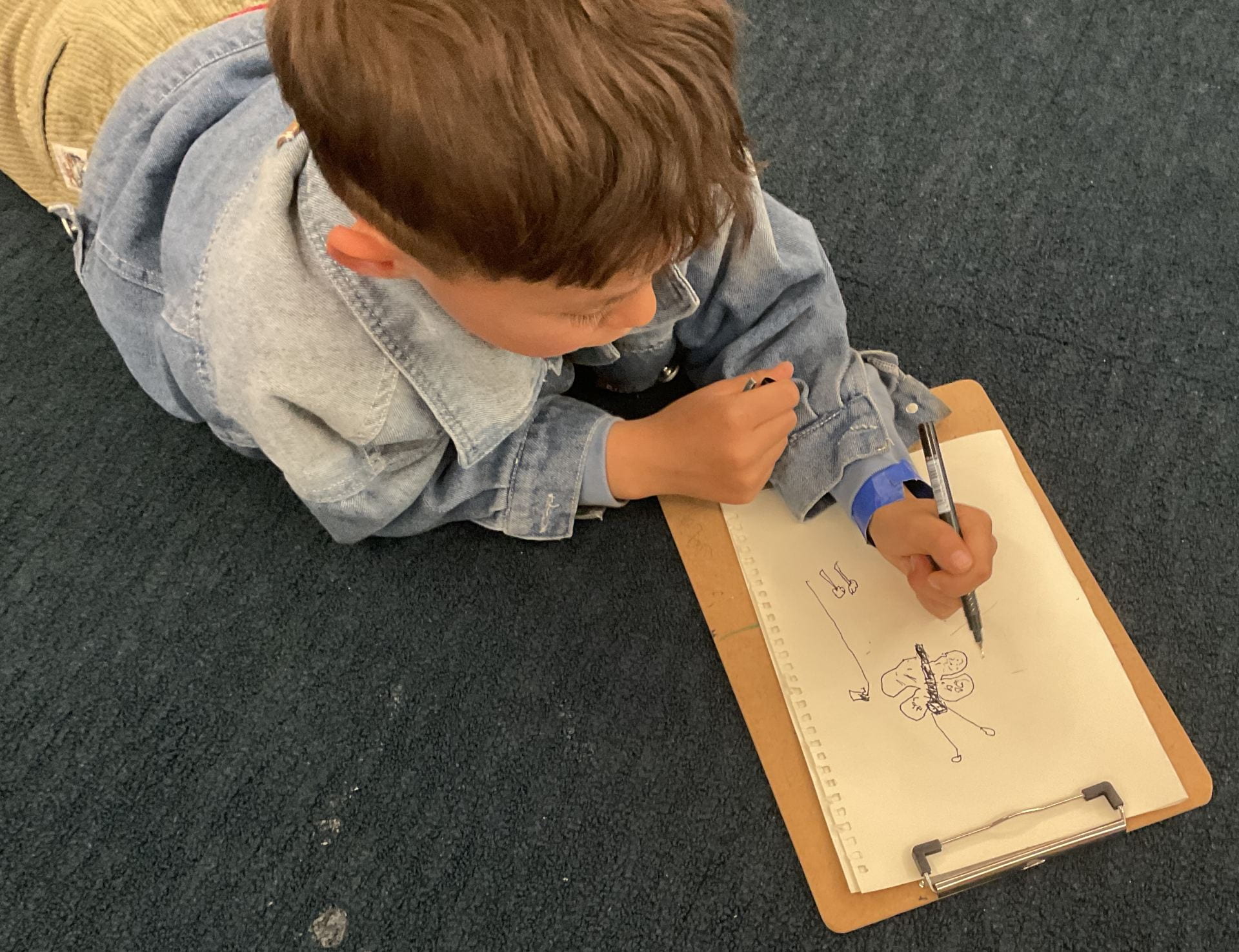
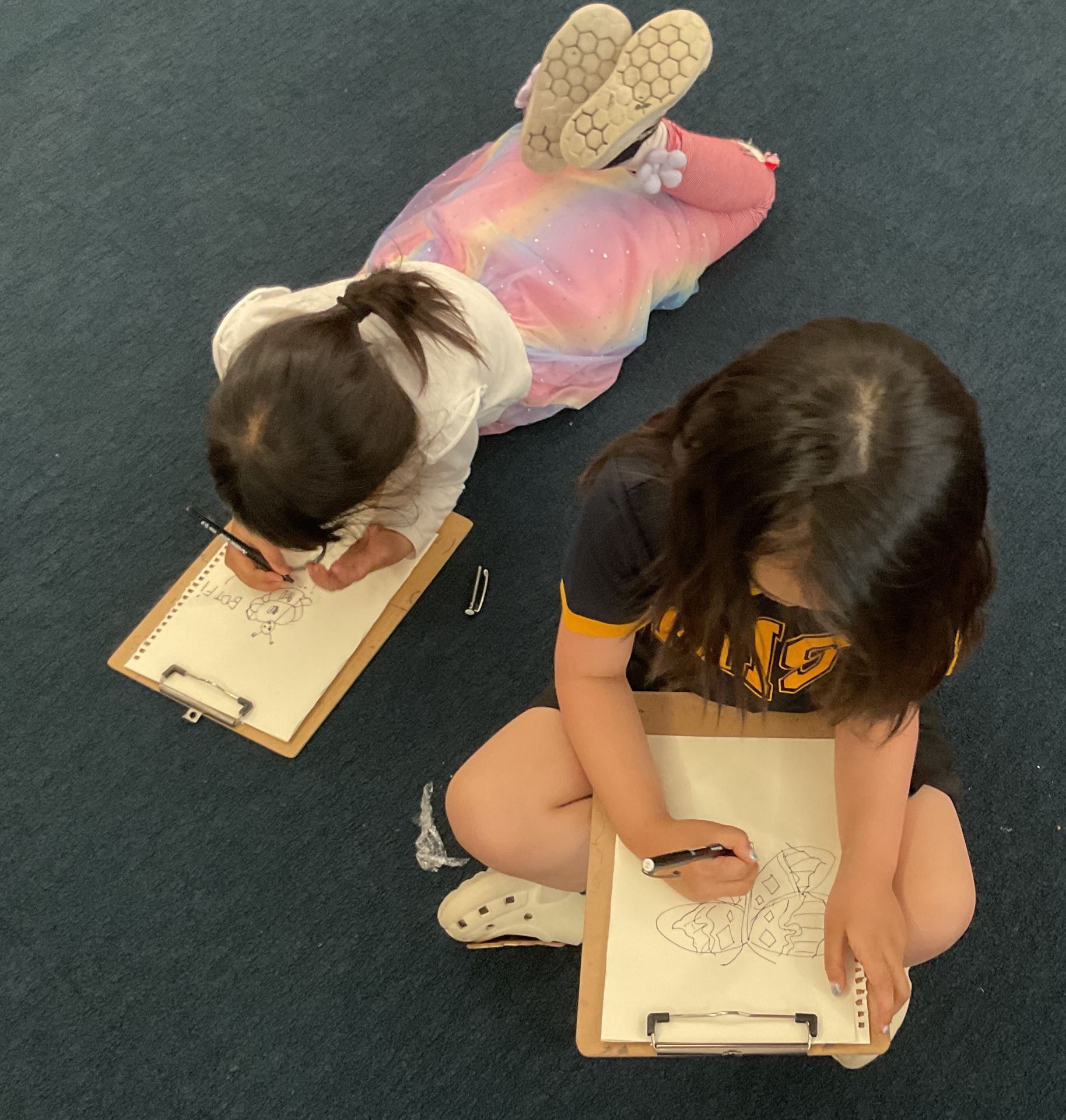
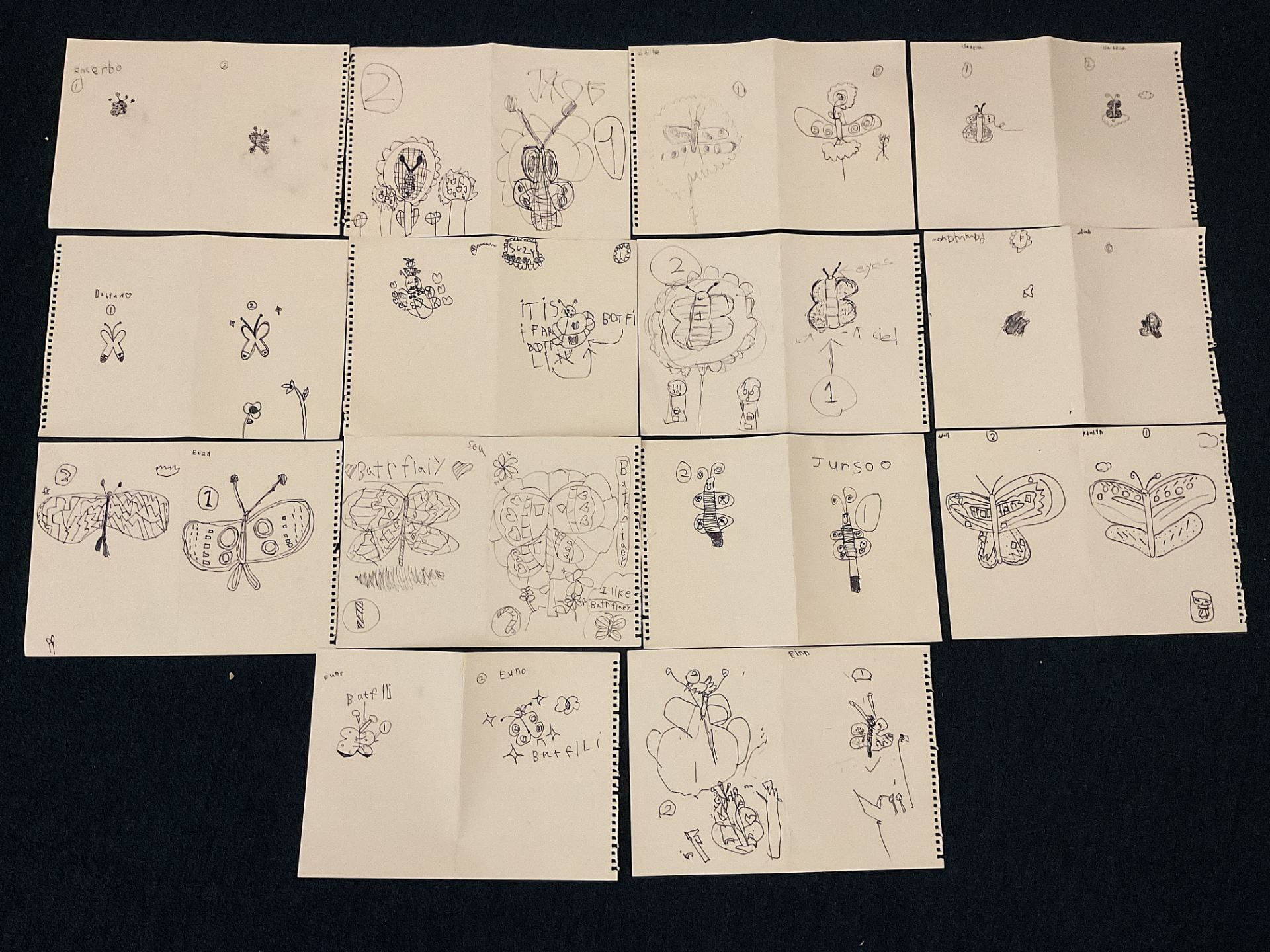
We began by inviting the children to make a quick sketch of a butterfly. The children swiftly tapped into their prior knowledge to recall all the important features of butterflies to create their drawings.

Then, we invited the children to go on a gallery walk, to look at all the different drawings. Were there any good techniques they could use to improve their artwork?

Next, the children drew a second butterfly, considering and using any new ideas they may have seen while viewing some of the other butterflies created by their friends.

  • How might feedback help writers and illustrators improve their work?
  • What is important to consider when drawing a butterfly?

How might we ‘use the eye of a scientist’ when drawing a butterfly?

We watched the video ‘Austin’s Butterfly’ to listen to young learners giving kindergarten artists critical feedback that could improve their work.

Using the eye of a scientist when drawing a butterfly.

The next day, we asked volunteers to offer their drawings for feedback.  Riccardo, Isabella and Adalyn chose to share their sketches with the class. Each child received a sticker to vote for their favourite butterfly, sketch one or two.

  • Sea “We draw the butterfly and we put a sticker, we choose 1 or 2 because I think that butterfly is beautiful and cutie.”
  • Adalyn “Because you choose number 1 and number 2. We can see and choose.”
  • Isabella “We choose the drawing so we can say which one to make it more better and say how to make it better things.”

  • Dahyun “Because we need to choose 1 or 2, and we can say what is better. And what is you like on the butterfly.”
  • Ciel “We get a sticker and we choose one picture what is beautiful and we put the sticker. Then, we tell what they need to do because otherwise, they don’t know how to make the picture better.”

We encouraged the young artists to consider the feedback they have received and given, and to think about how they might make their next butterfly drawing better.

  • Euno “I draw the last butterfly I draw it more beautiful, more decorations in my butterfly.”
  • Sea “I will draw more beautiful than step 1 and step 2, I put many colours and shapes.”
  • Adalyn “I will draw some patterns, lines and circles.”
  • Dahyun “I like friend’s ideas. More colour and more drawing.”
  • Isabella “I am going to put more details like nicer patterns.”
  • Jacob “We can have a detailed drawing and colouring to look more like a butterfly.”
  • Suzy “I am going to draw it more bigger, then I can put more beautiful things on it.”
  • Junsu “Draw patterns and shapes on the wings.”
  • Riccardo “Make it bigger and much better.”
  • Evan “I need details and colouring like yellow to make it more beautiful. Because I like yellow because it’s my favourite colour.”

The child’s conversations and reflections show…

  • their developing understanding that our experiences and imagination can inspire our creations
  • that they can describe what they notice about an artwork
  • how they reflect on their artwork and the work of others.

The artists set out to draw their butterflies. They referred to books and specimens to look for details. Each of them were drawn to different butterflies.

Craft Moves

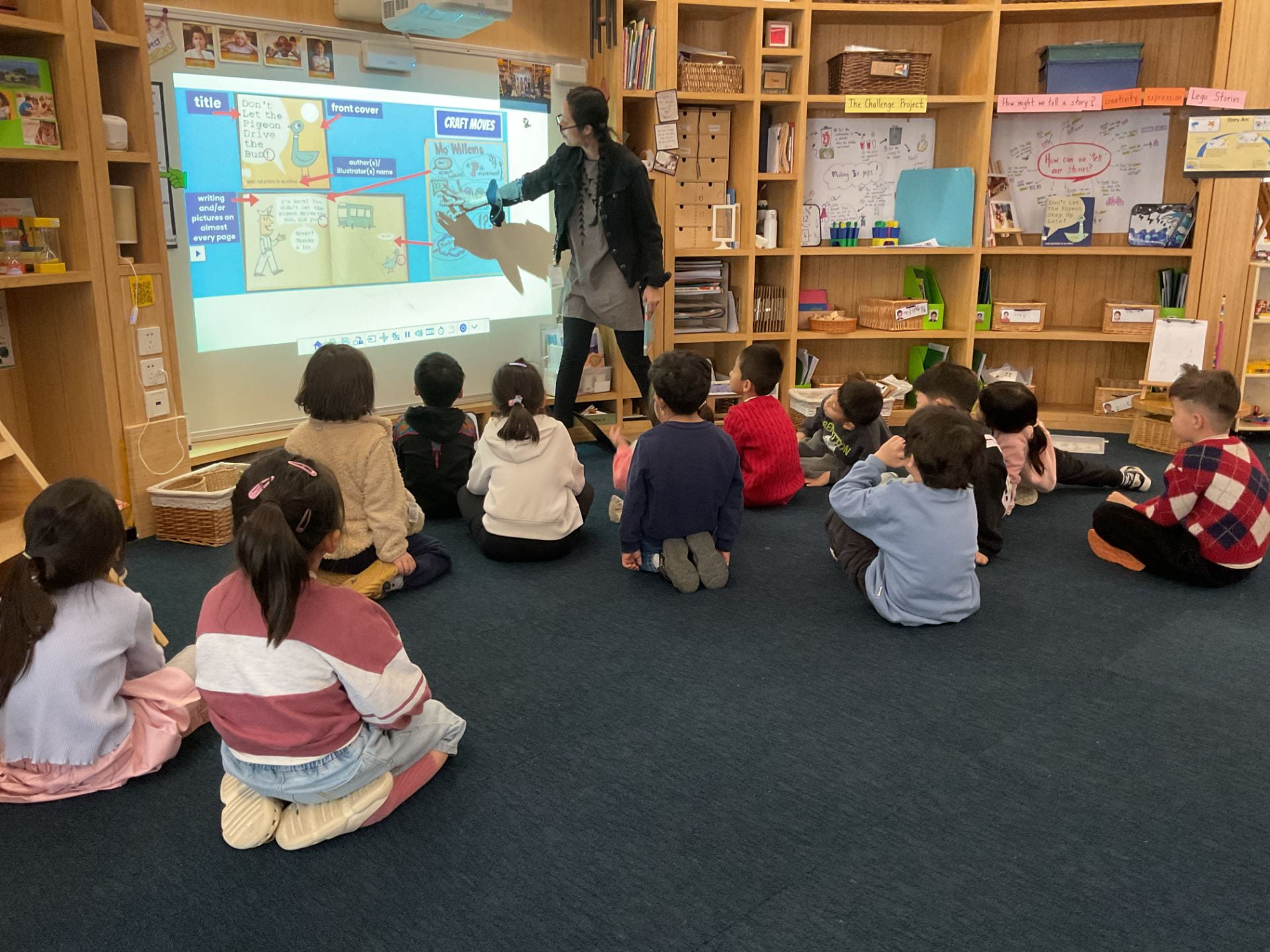
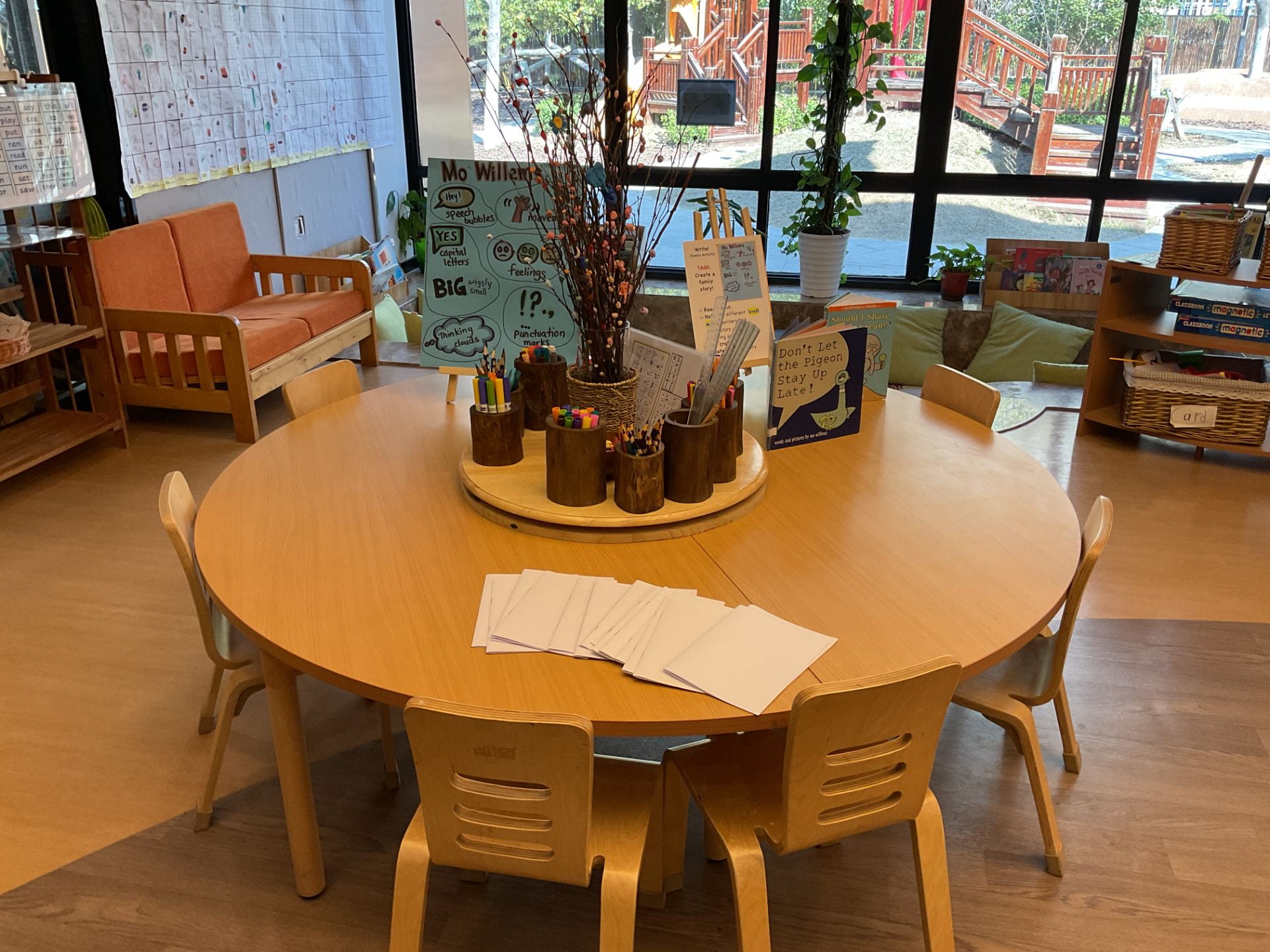
Mo Willems is one of our favourite authors. We have read his books over and over again. One of our favourite stories is ‘Don’t Let the Pigeon Drive the BUS!

How do authors and illustrators use lines, shapes and patterns in their picture books?

Notice how Mo Willems  uses letter, lines and shapes to create his drawings. We can explore drawing, creating and designing through our exploration of lines, patterns and shapes.

We read to book again and again and looked closely at the different ‘craft moves‘ the author has used. We explored how we can use some of these ‘craft moves’ in our writing. We also discussed how books were made and noticed that books have/can have:

  • a title
  • the authors name
  • the illustrators name
  • many pages
  • writing or pictures or both on almost every page

What do you notice, what do you see?

What ‘Craft Moves’ has Mo Willems used to create his picture books?

  • Isabella “I see a pigeon, the picture.” (cover)
  • Ciel “I know because it looks like a pigeon.”
  • Dahyun “Because it has a beak.”
  • Sea “I see a pigeon at the end of the book.” (hidden images)
  • Riccardo “It doesn’t look like a pigeon because his neck is too long.” (drawings can be different to real objects)
  • Euno “I see feathers on the pigeon.”
  • Junsu “I see the words. Don’t let the pigeon drive the bus.” (title)
  • Suzy “I see a coin.” (awards)
  • Jacob “That’s a panda book! The sticker on the side means it is an English book because in the library Ms. Mulder told me.” (organisation)
  • Isabella “The words on the bottom.” (name of the author)
  • Euno “Sometimes there’s a letter here, and it means the level of the book.” (levelled books)
  • Ciel “There is an exclamation mark on the book. When it is interesting people use it. And I see the comma, the one on the don’t.” (punctuation)
  • Sea “I see colours on the picture.” (visuals)
  • Mohammad “The eye.” (details)
  • Isabella “I see finger spaces.” (concepts about print)
  • Adalyn “I see a speech bubble.” (speech)
  • Isabella “That means someone is talking.”
  • Suzy “He [Gerald] is spinning.” (shows movement and action)
  • Junsu “The word is so long.”

How will the Kindergarten writers use these craft moves in their writing?

We invited the children to create their own stories using familiar or imaginative characters. They may want to add their details, speech bubbles and thinking clouds to add dialogue and thought.

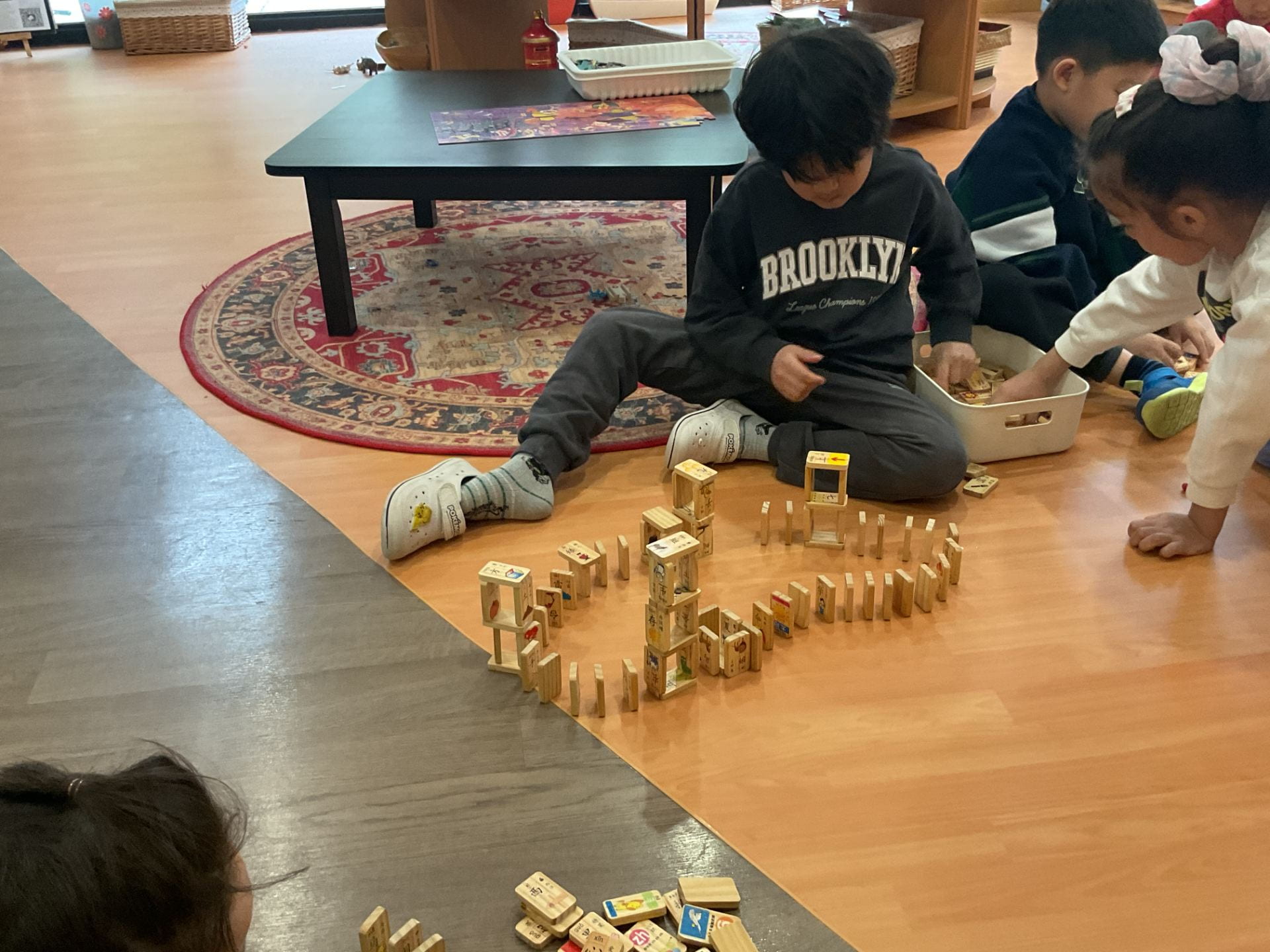
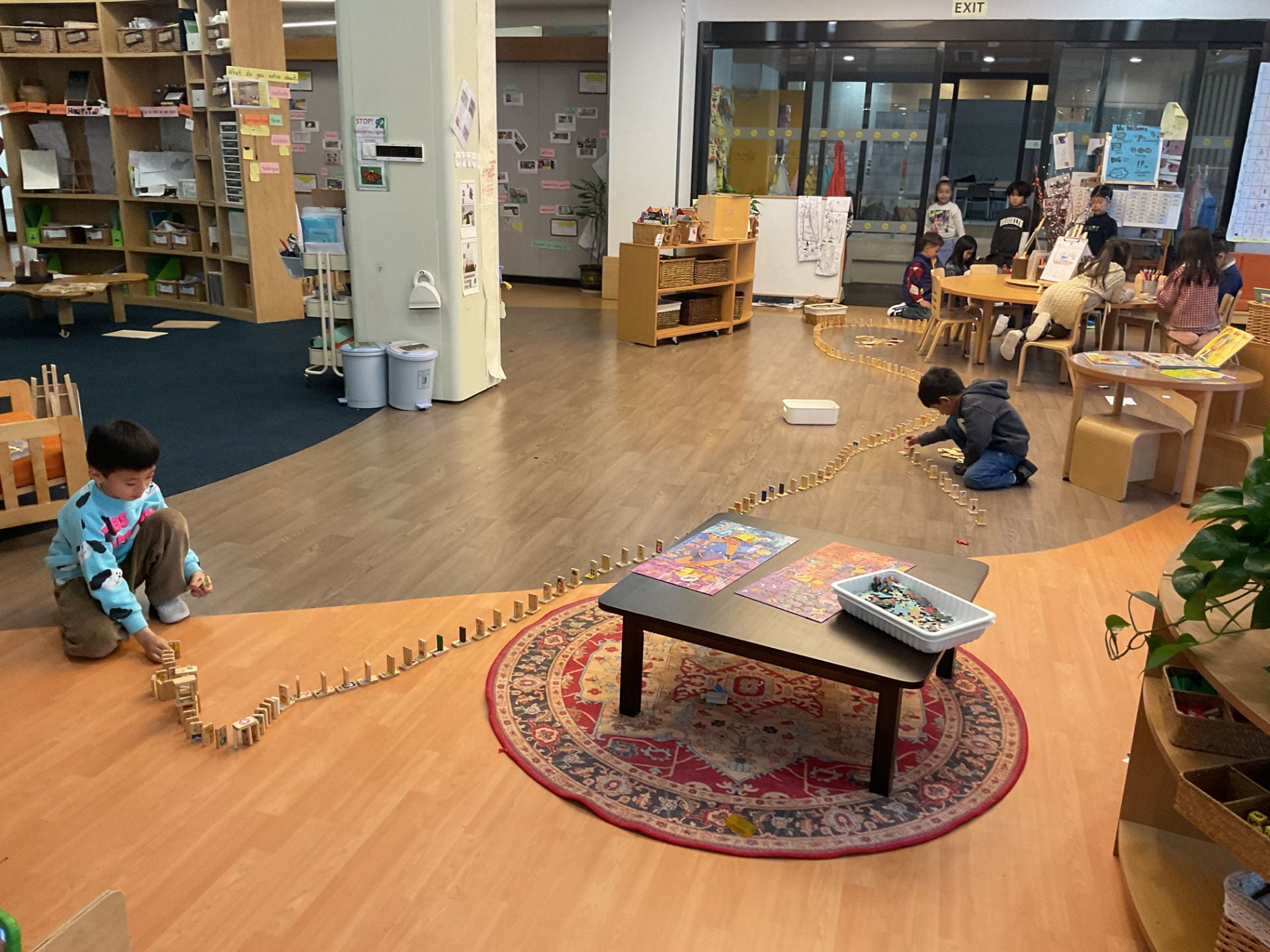
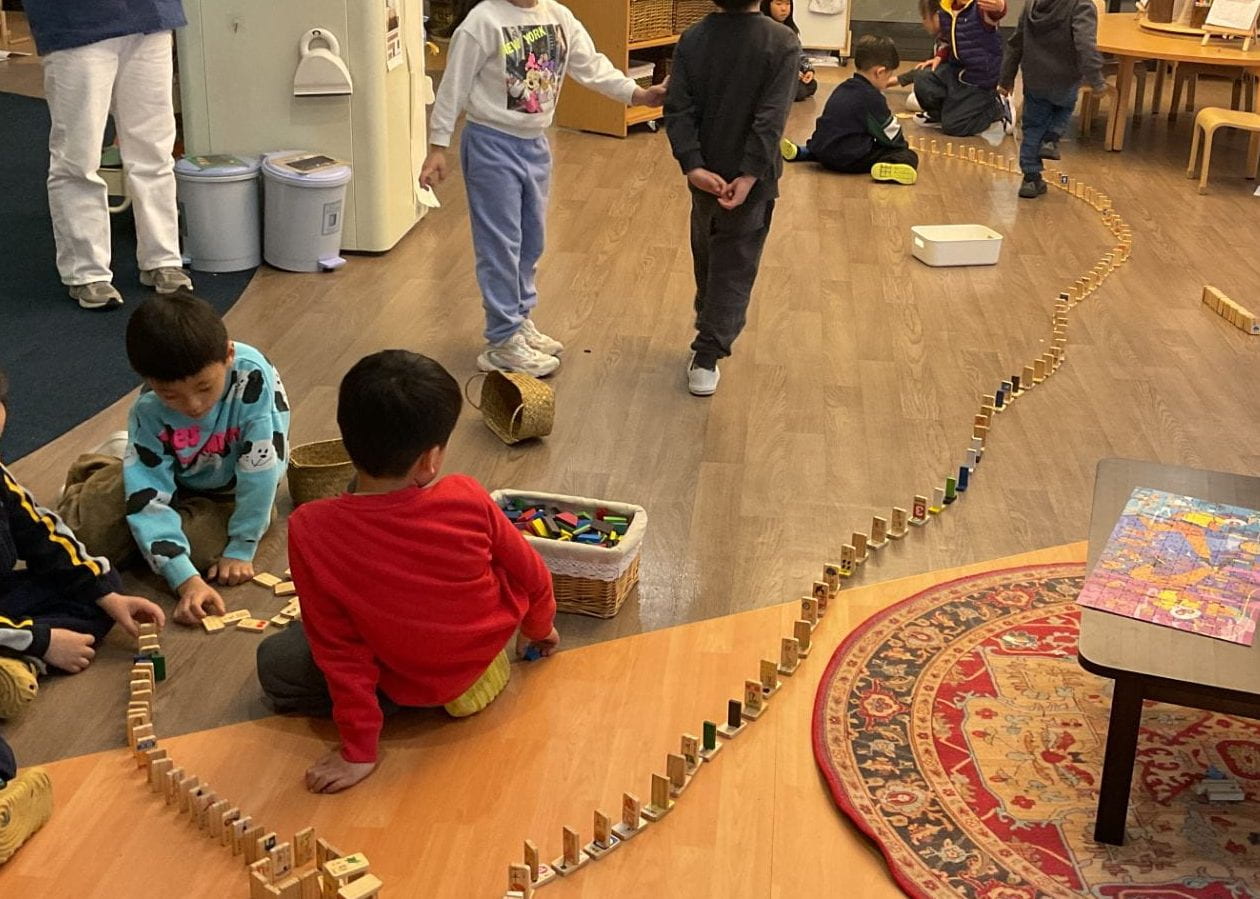
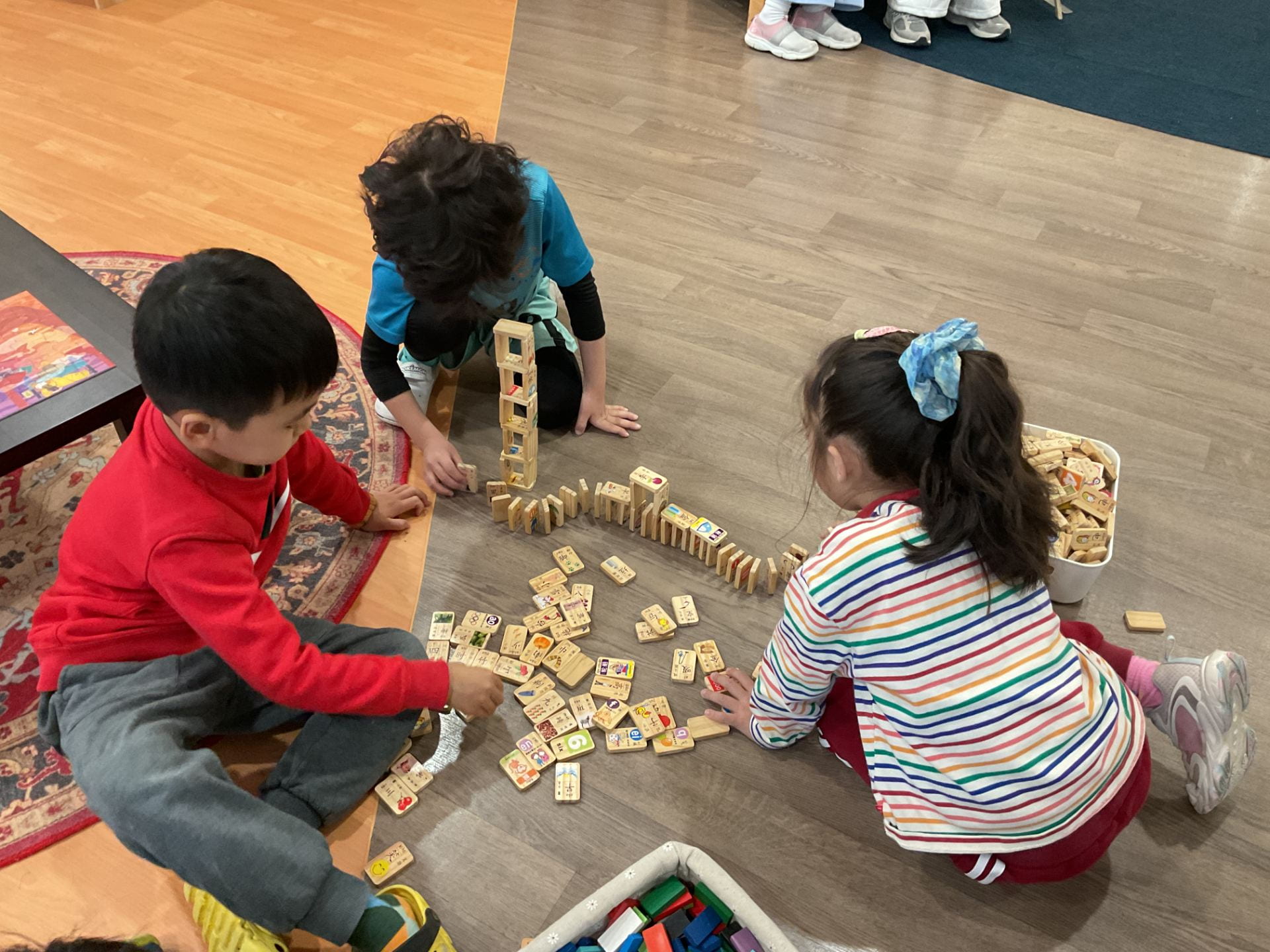
Domino Effect – How does it work?

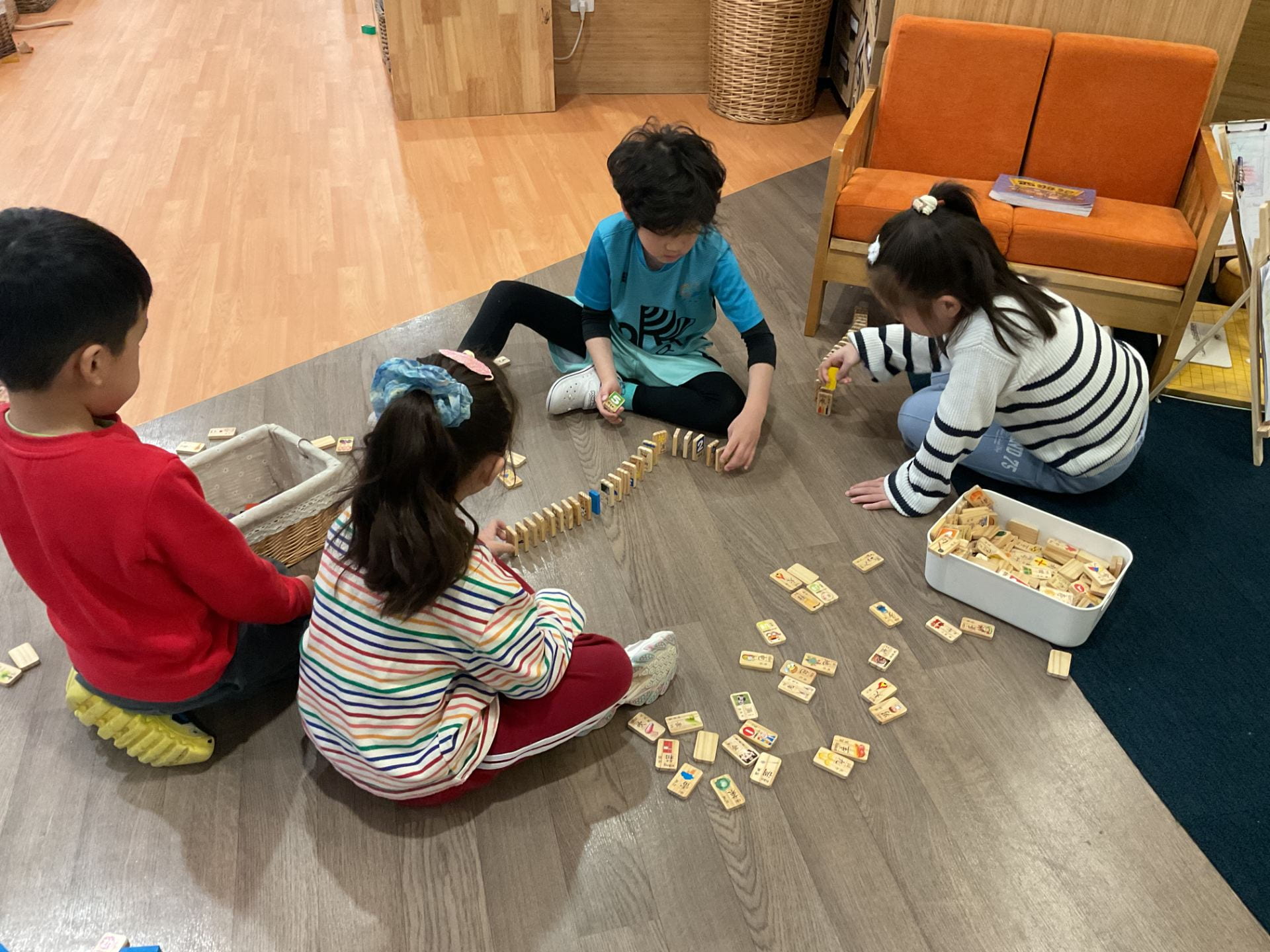
A group of children were interested in using Domino’s to create a game. They began to prop the dominoes up next to each other, to create a structure that would produce the domino effect. Each time they placed a few Dominoes, they fell over. 

How can we make the challenge more interesting?

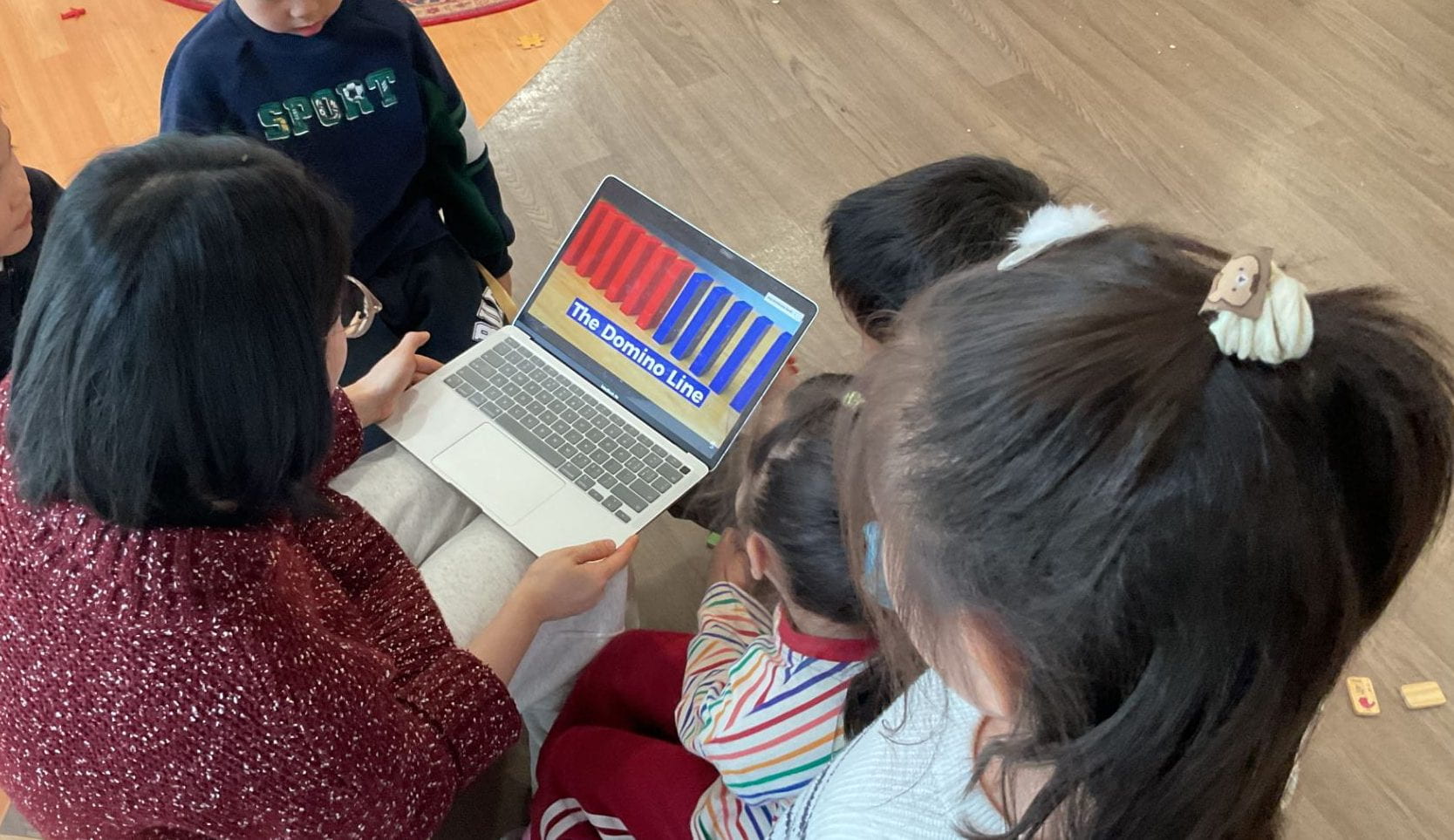
Noticing the children’s interest in creating the domino challenge, we decided to share a video that shared many different ways to create the challenge using a range of materials and toys to make it more exciting.

Isabella recalled watching a similar video in the past. She was excited by all the ideas that were shared.  

  • Ciel “Why do we need to watch the video?”
  • Euno “Because this important because Grade 5 made this game.”
  • Isabella “Because you can build it yourself in different ways.”
  • Sea “We can make it together it is fun.”
  • Junsu “We make more blocks and make fantastic fun.”
  • Dahyun “Because then we can make play for some things.”
  • Isabella “Because you can build more cooler stuff.”
  • Euno “We watch the video and we can make dominoes fun and we can play and be happy.”
  • Ciel “We can make and watch, then we will be good at dominoes.”

What are some important things to consider when we play with the dominoes?

  • Ciel “We need to tidy up when we are finished.”
  • Evan “Make a story with dominoes.”
  • Junsu “Dominoes is broken then they go straight and push and then fall.”
  • Dahyun “Be kind to each to each other and kind hands and kind voice.”
  • Isabella “We need to say kind words. Nice words.”
  • Suzy “We can’t do too loud or else people’s ears will hurt.”
  • Euno “We need to be safe with dominoes because we don’t have space and people kick the dominoes because we can’t see. SO careful to play dominoes (accidentally kick it).
  • Sea “We be kind to dominoes because dominoes fallen down the floor and people will slip and their back is hurt.”
  • Dahyun “We need to be kind or people be sad.”

The team went back to work on the chain. They persisted till they created a long chain. More children wanted to join in as it looked like fun! The domino chain spanned the width of the classroom. The team was ready to test the chain reaction. Gently, they pushed the final domino forward hoping for the others to come crashing down. However, the chain reaction only resulted in a few dominoes falling over each time, which resulted in the team knocking some over until they reached the end.Isabella watched what was happening, she said, “They need to be closer or it won’t work!” Ciel agreed and shared his observation too.

The next day Ciel went back to working with the dominoes. Others gathered around him and wanted to join in. They discussed who would use the different materials.

Ciel worked with Isabella. He made a few vertical structures, but they came down. Evan joined Isabella and Ciel.

Ciel “We can make a big circle inside the sofa!”

What information will help us create a successful chain reaction?

Over the next few days, the researchers continued to show their interest in creating the chain reaction. They wondered how they could create an effective reaction. Ms. Sophia suggested that they seek out more information to learn about the domino reaction. The team watched a video to see what they could learn.

  • Isabella “We are watching the video of making the domino video.”
  • Evan “Because we want to look at the dominoes because we don’t know what to build.”
  • Ciel “I see the dominoes standing straighly.”
  • Adalyn “We can look at the iPad we can learn how to build dominoes.”
  • Isabella “When you put the dominoes you need to grab the bottom, not the top. If you grab the bottom it won’t fall down, if you grab the top it will fall down.”

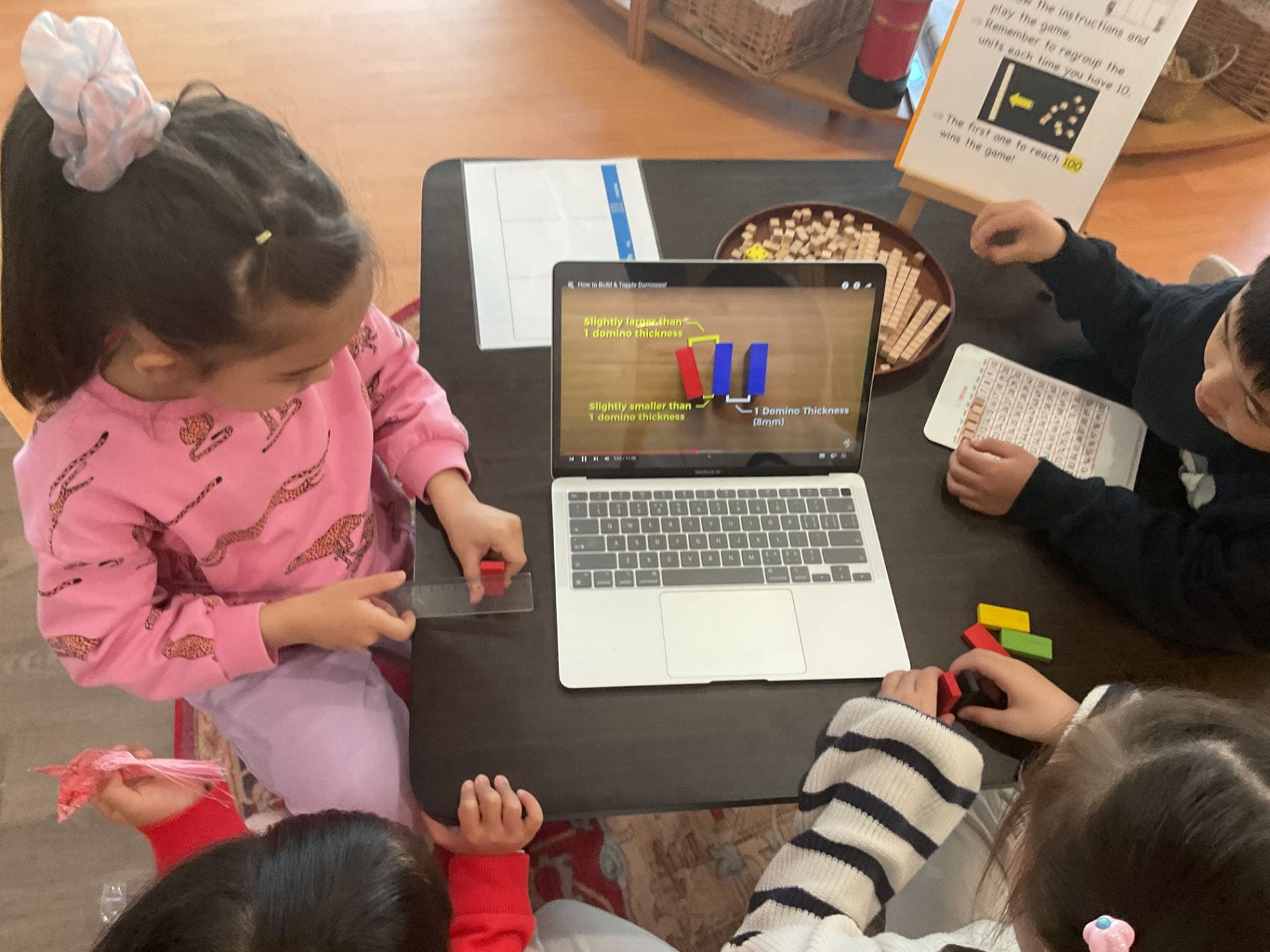
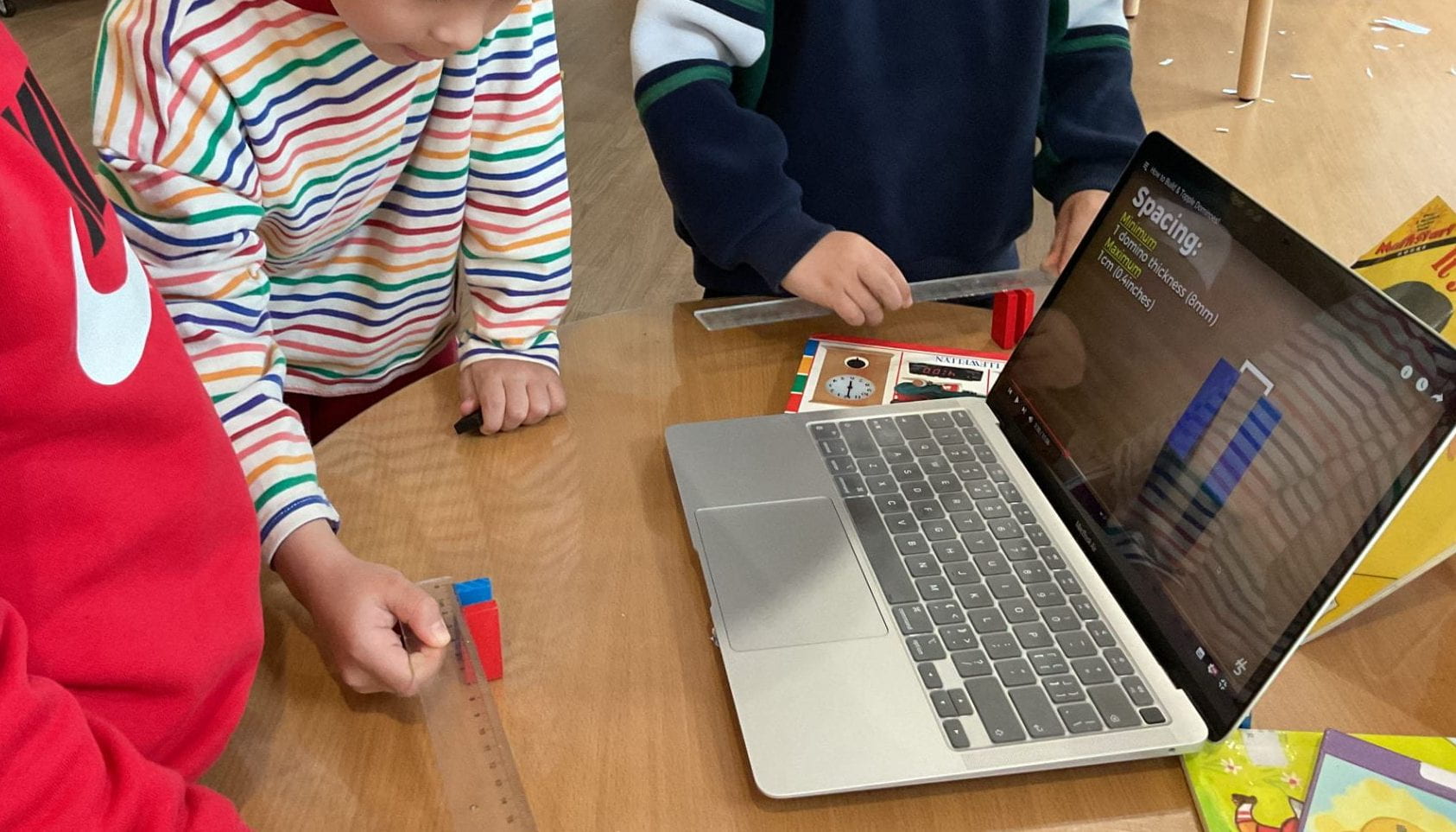
  • Evan “When we are building the dominoes we need to put 2cms away from each other because if you do it too far away then only one will fall.”
  • Isabella “It’s 0.8cms, the gap so it can fall down. 2cms is too far. It won’t fall down.”

The team used rulers to measure the distance that was suggested in the video. Then, they tested some of their ideas to see if they would work. They carefully curved the edges of the ‘test’ chain, being mindful of the distance they needed to maintain between 2 Dominoes.   

  • Isabella “We are trying to see if it can fall down. It fell down together.”
  • Ciel “We are going to build it to PreK-K1.”

As Ciel missed out on watching the video the first time, he asked to watch it with the others.

Ciel “The dominoes need to have a 1cm space between them because if we don’t do that it will not fall. I learned how to make interesting dominoes. I can make it interesting by making some cool dominoes.”

Considering that the team have now learned more about creating the domino effect we wonder…

  • …what new information the team will need to be more successful.
  • …what strategies the children will use to change the outcome of the domino challenge.
  • …how they will collaborate, sharing their ideas and suggestions to work as a team.

Student-Led Conferences

‘The learning belongs to the students, not the teacher. We are supporting our students to take ownership of their learning and to be able to think and talk about their learning with knowledge and confidence. When students know how they learn best and are able to reflect on their learning, they are able to advocate for themselves.’
(Parent Survival Guide to Student-Led Conferences, NIS)
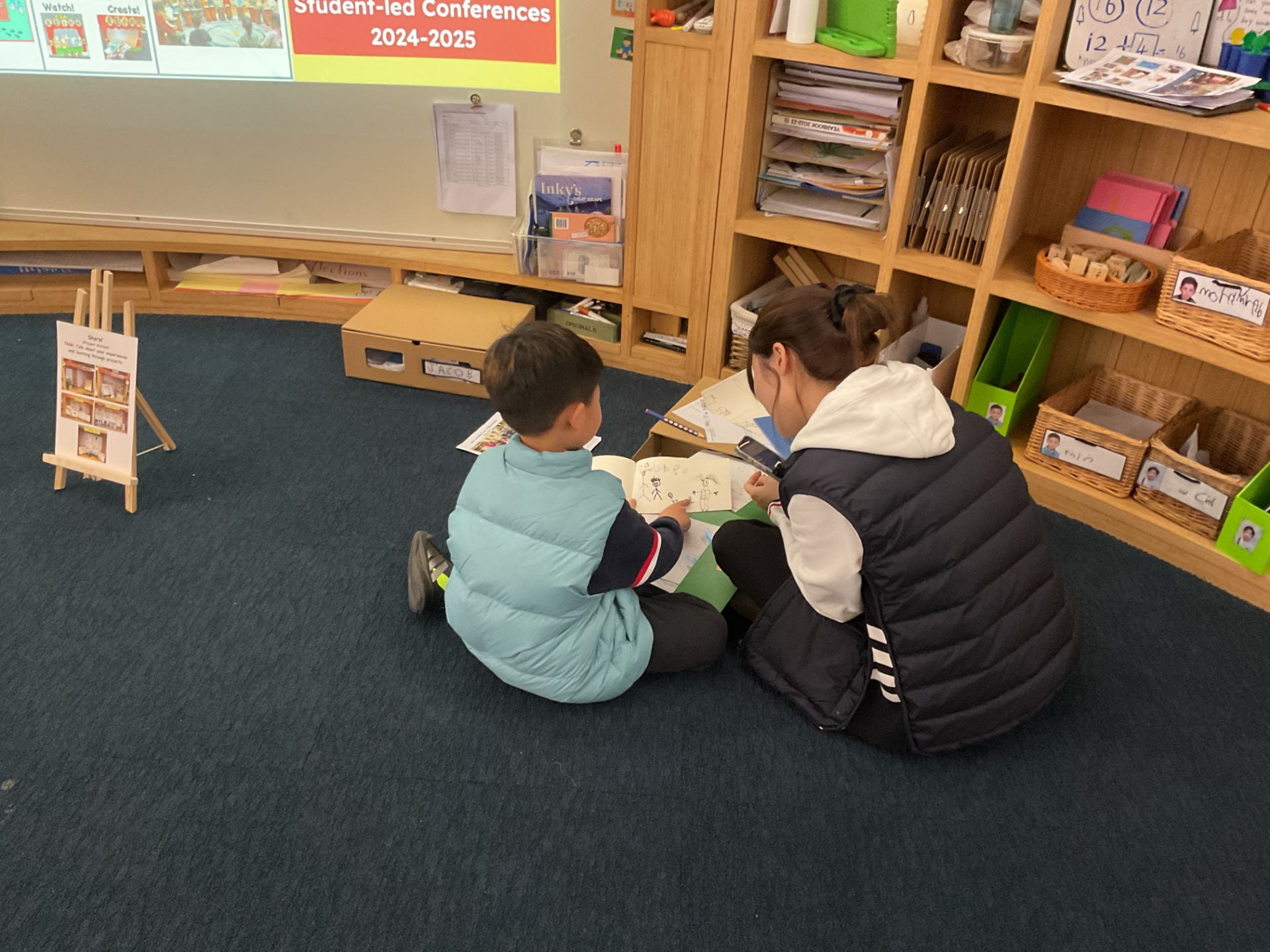
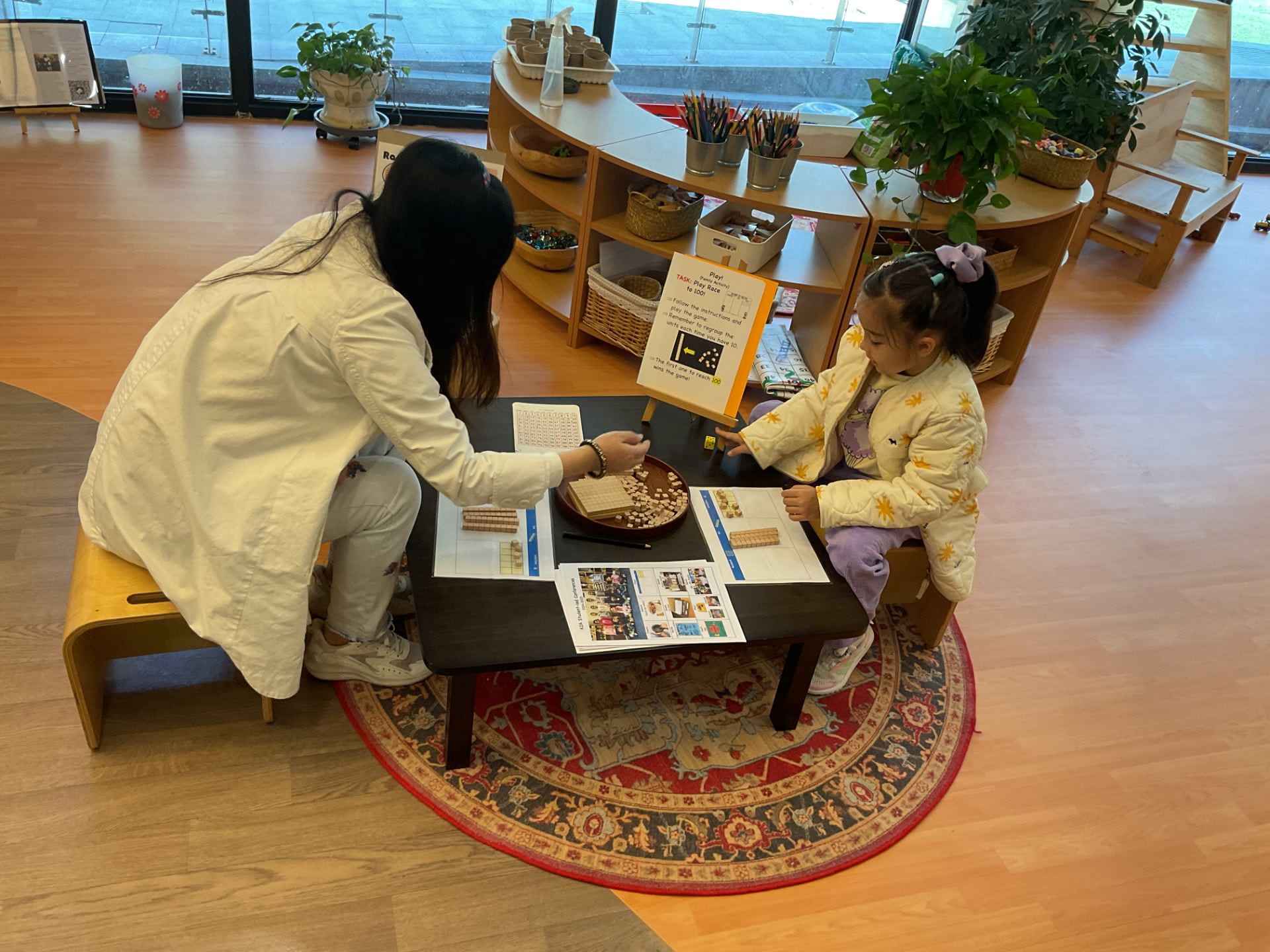
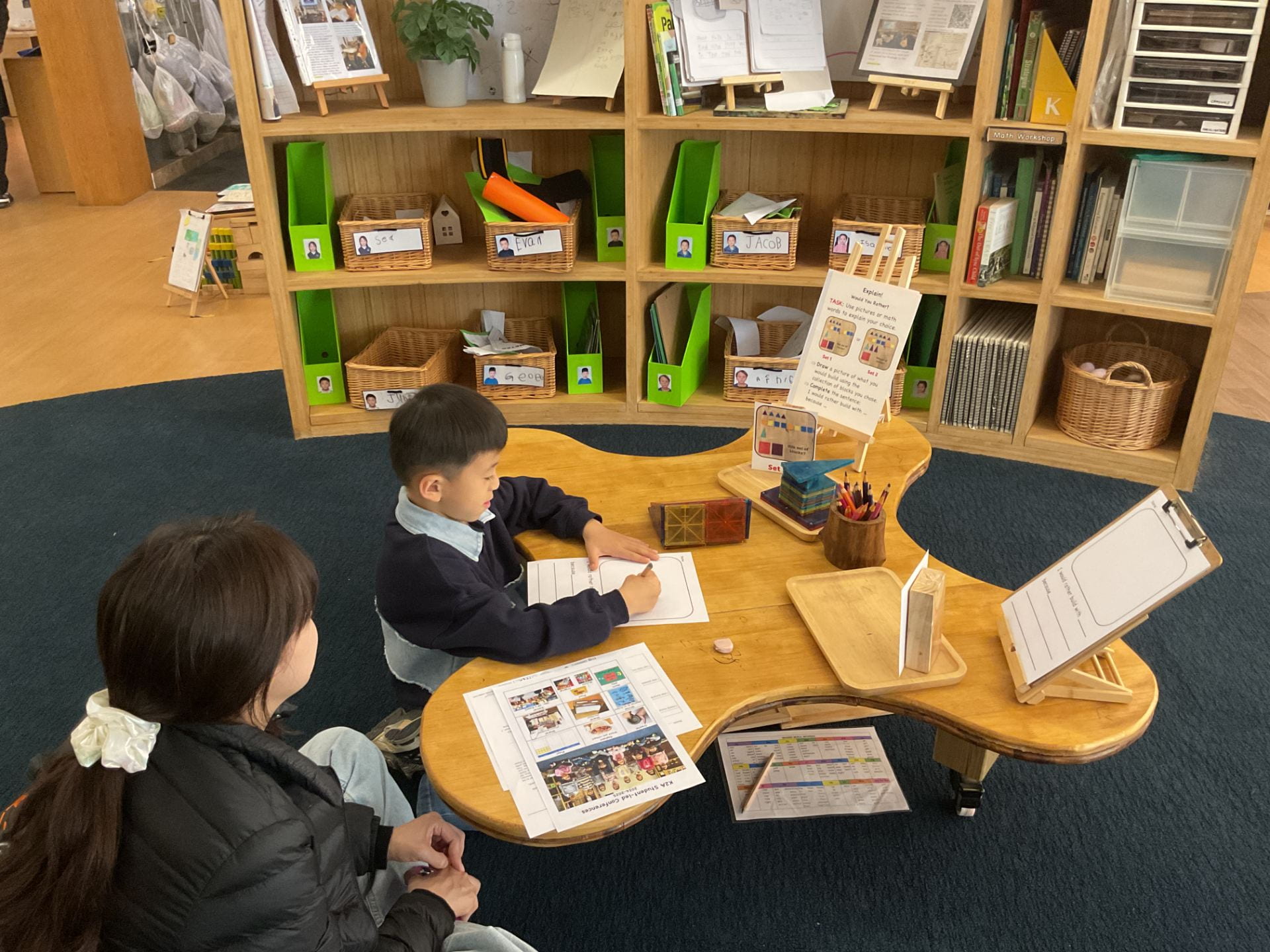
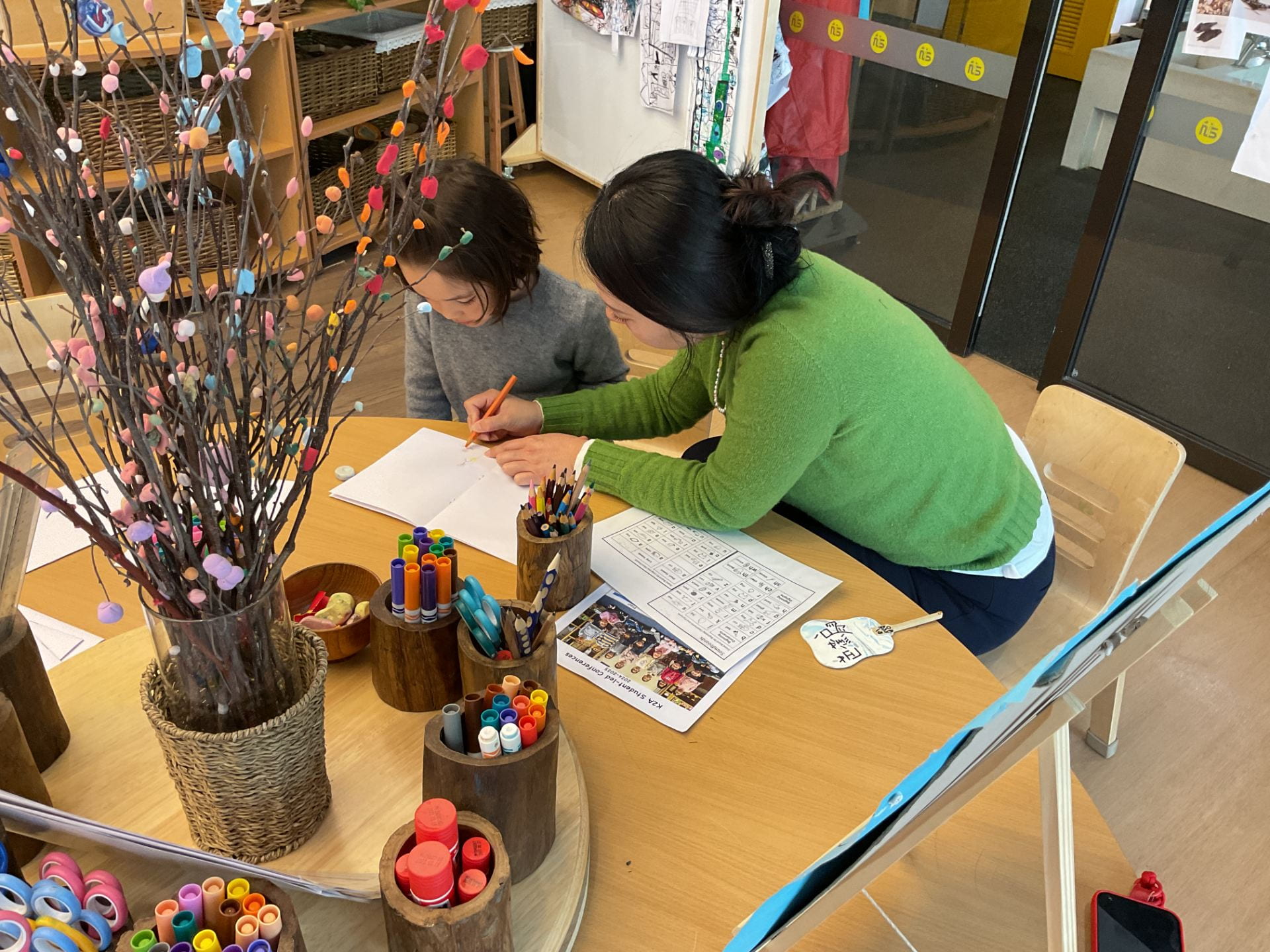
The Student-Led Conference is a special day in the school calendar. The children are excited to share this time with you, to show, share and lead learning stations around the campfire and the campus. You can help and support your child by maintaining a slow pace, helping them reflect, talk about and celebrate their growth as learners. It is a special day for the teachers as they guide and watch the children take ownership of their learning. 
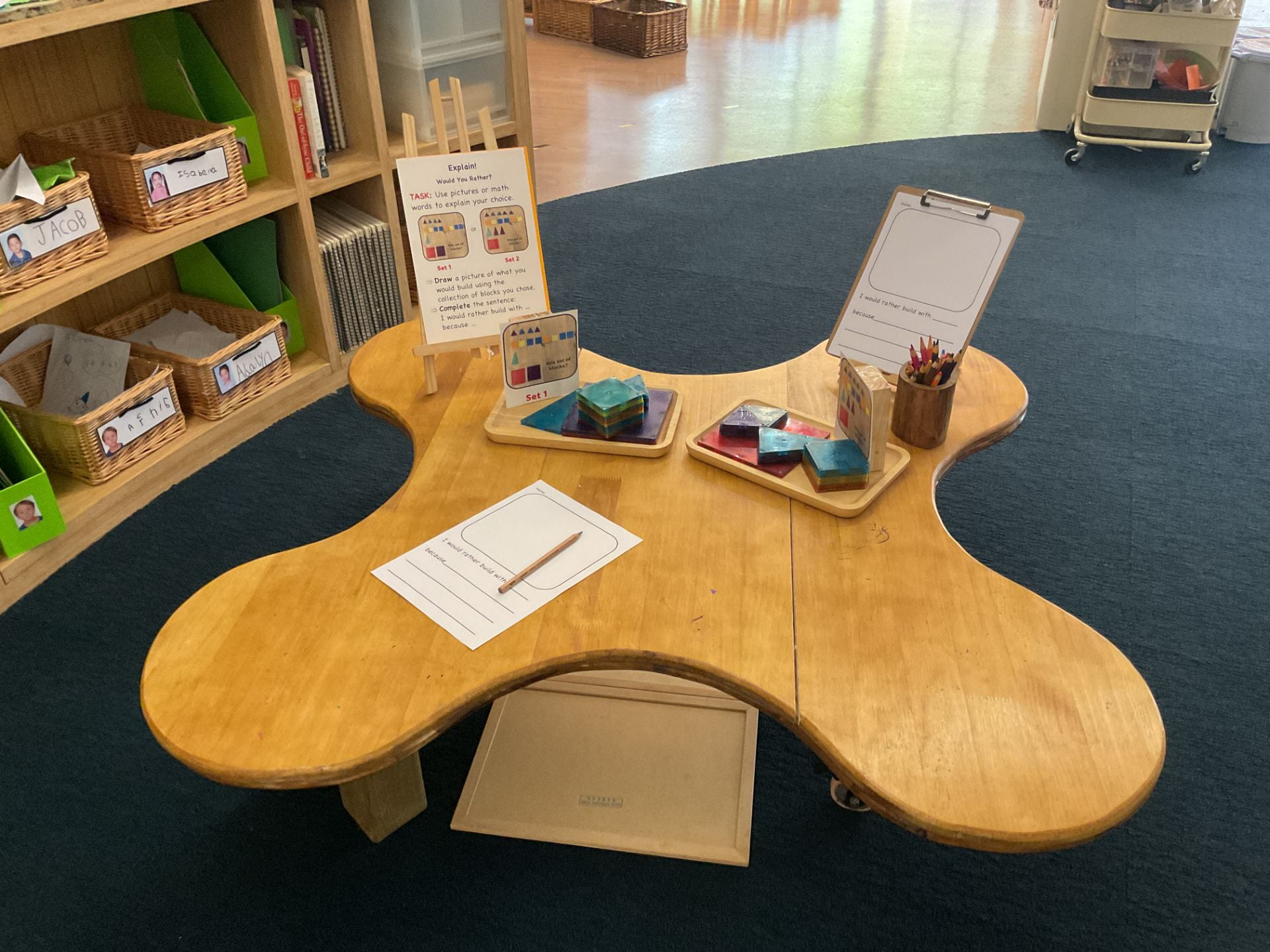
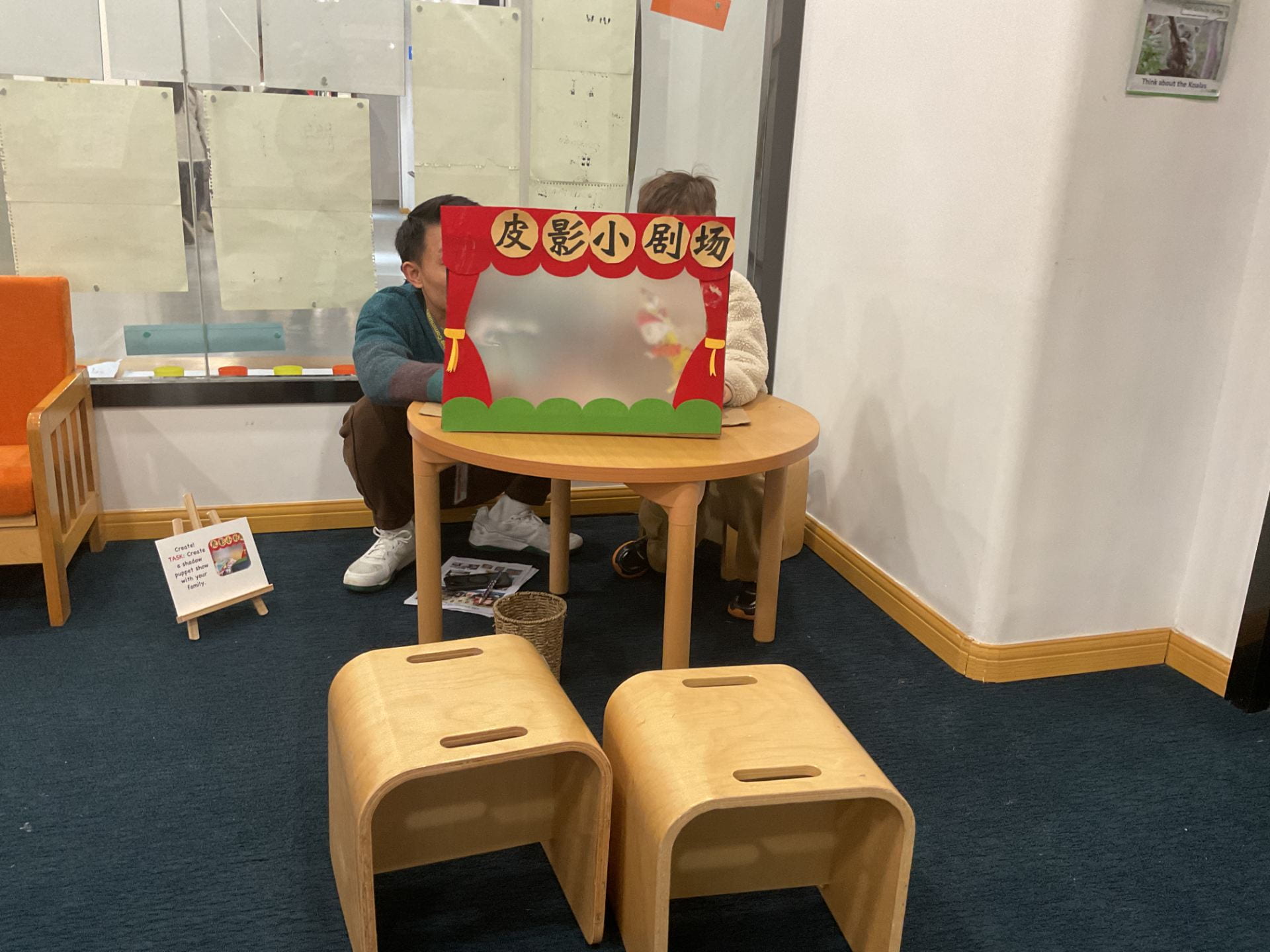
Learning Spaces


Reflections

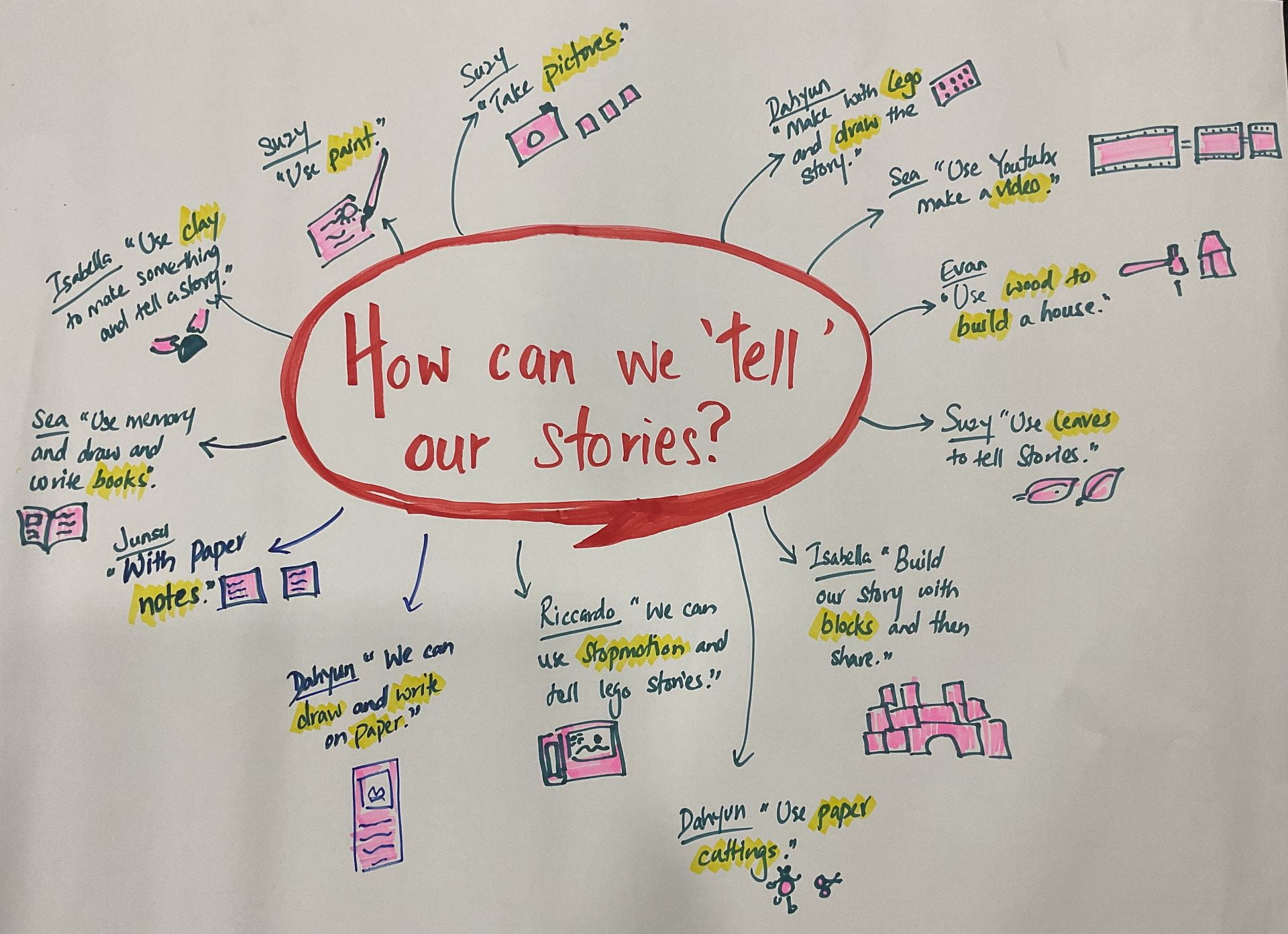
How can we ‘tell’ our stories?

We have noticed the children’s interest in telling stories in different areas around the classroom. We have seen them use manipulatives to retell familiar stories or use their imagination to create and extend stories.

We decided to invite the children to think about all the different ways they can ‘tell’ their stories.

How might we use a range of tools, materials and technology to capture and share our stories with others?

As we discussed the different ideas, we noted them down on chart paper.

We can…

  • Junsu “we can use note paper (Post-it notes).”
  • Sea “make a story with paper notes.”
  • Dahyun “we can draw and write on paper.”
  • Sea “use memory to draw and write books.”
  • Isabella “we can build our story with blocks and then share.”
  • Riccardo “we can use stop-motion and tell Lego story. In pk1 B I did it with Jacob.”
  • Suzy “we can use leaves from the garden to tell the story, I used glue to tape them on.”
  • Evan “use wood to make story and then paint it.”
  • Sea “use YouTube to make video.”
  • Dahyun “make story with LEGO and draw the story.”
  • Isabella “use clay to make something and then tell a story.”
  • Suzy “and then paint the clay.”
  • Sea “take a bus to the zoo and take a video.”
  • Jacob “and you can draw a picture.”
  • Suzy “you can take a picture (photographs).”
  • Dahyun “you can use paper cuttings.”

We referred to some of the stories that children have created. We shared Mohammed’s drawing of his first experiences in China, where he talks about his experiences using writing and drawing.

The children were inspired after watching Lego animation stories created by previous K2 students.

We wonder how the storytellers might use some of these ideas to create, write and share their stories during ‘Story Workshop’ time.


Story Workshop

The K2 storytellers have continued to use their imagination and life experiences to create interesting stories using manipulatives and ‘loose parts’.

We know that setting aside time to play with ideas and discuss possibilities with others helps young children grow as writers. During our mini lesson, we examined different samples of writing to explore how we might use illustrations and writing to enrich the reader’s experience.

Some of the key ideas shared were that we can:

  • include more details in the drawing
  • colour the pictures
  • ensure that the writing matches the drawings (connection)
  • check that sentences begin with a capital letter and end with punctuation
  • leave spaces between words
  • extend sentences to include more details
  • reread our writing to make sure it makes sense

The young writers agreed that the more details we include, the more it helps the reader create a clearer picture in their mind. 

Just Right Books

We gathered to talk about choosing and reading appropriate texts that are ‘a good fit’. When independent reading texts are too difficult, readers are often unable to recall important information from the text, which can also impact their understanding or comprehension.

We talked about how people make choices about the books they read. Readers read for pleasure, or to learn more about something that they are interested in.

But, how do we know that a book is just right for us?

The children were introduced to one strategy using the ‘five finger rule’.

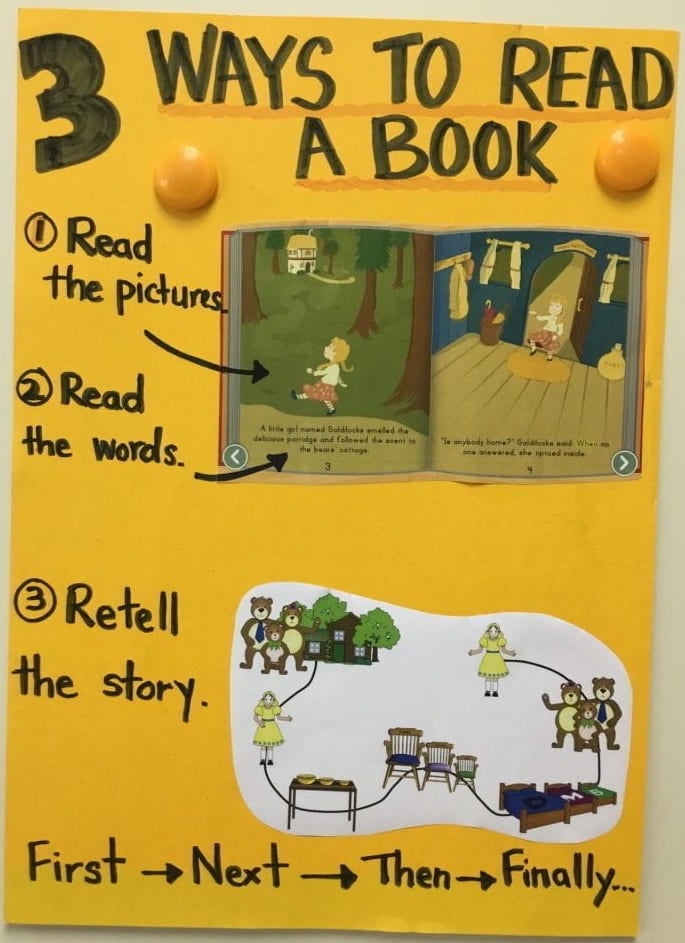
We also referred back to our previous discussion about the different ways we can read books:

  • reading the pictures
  • reading the words
  • retelling the story

Next, the readers chose three books for their book box and found a quiet bubble space to read independently.

Where do we keep the sand toys?

Ms. Jenny shared some photographs of one section of the EY playground, which has been closed off temporarily due to maintenance work. As we shared the photographs, the children discussed what they noticed. They were curious to find out how the maintenance staff would fix the ‘hole in the ground’ next to the sand pit.

One of the problems that children continued to focus on was that the walkway to the shelf where they store the sand play toys had been cordoned off.

They wondered where they might keep the sand play equipment after playtime. The children were thoughtful, explaining what might happen to the toys if they weren’t put away safely.

  • Euno, “These are the lines to tell you that going inside is dangerous. I saw a child go inside and then he go out and that’s dangerous.”
  • Isabella “There is a hole inside that needs to be fixed.”
  • Evan, “People are fixing the hole.”
  • Jacob “The hole is dangerous because if you slip inside you will be sucked in deeper and deeper and cannot come out anymore. (In mandarin)”
  • Isabella, “I see there is some water inside.”
  • Riccardo, “Can we lift the strings and go through in?”
  • Suzy “No.”
  • Isabella “We can stand outside of the lines and watch people fixing it.”
  • Suzy “But if we cannot go inside, how can we tidy up the toys?”
  • Euno “We cannot go inside but our tidy up shelf is inside, then we cannot put our toys back to the shelf inside.”
  • Evan “We should not throw the toys in.”
  • Sea “We cannot leave all the tools on the playground, they will look like trash.”
  • Riccardo “We can use the old tidy up area (shed).”
  • Suzy “Maybe we can give the toys to the fixing people and ask them to help put it on the shelf.”
  • Dahyun “We can make a new one (to be the tidy up shelf).”

The children thought hard to find a solution to the problem. After considering and discussing many different ideas, Mohammed said, “In the garden”.

We were curious about what he meant and decided to invite him to share the safe space he was thinking about. Mohammad went outside with Ms. Sophia to take photographs of the spaces he was referring to. He presented his ideas to the class, pointing to the different spaces we can keep the toys, till the shelf is accessible. Mohammad’s solution was to store the toys under the worktables near the garden.

They could also be hidden in the sand so they will be protected.

When Mohammad was done Junsu turned to Mohammad and gave him a thumbs up and said, “Good job Mohammad!”. The children agreed that this was a good idea!

The children’s conversation highlights their natural curiosity about the environment, and how they use their senses to understand how things work around them. It further highlights their enthusiasm to explore possibilities and be solution driven.

Writing Workshop – Plan, Write and Share

We took some time to reflect on our ‘Writing Workshop’. We watched a video of the children’s engagement during this time to help them reflect on what they do as ‘writers’. 

What good writers do…

  • Dahyun “Sound out letters and say the letters.”
  • Isabella “Draw and colour.”
  • Junsu “Write the words.”
  • Sea “Think of ideas to draw.”
  • Suzy “Focus on the writing, looking carefully. We need to think of what we need to draw.”
  • Euno “Write the words and read it, because we read it, we don’t know what we are writing. If we don’t read, we cannot say the words (talk about) and what we are drawing and writing.”
  • Dahyun “Try to think about the letters.”
  • Sea “We think, we use memory. We cannot draw and write if you don’t use memory.”
  • Suzy “Use pointers like arrows.”
  • Evan “Use labels to show things.”

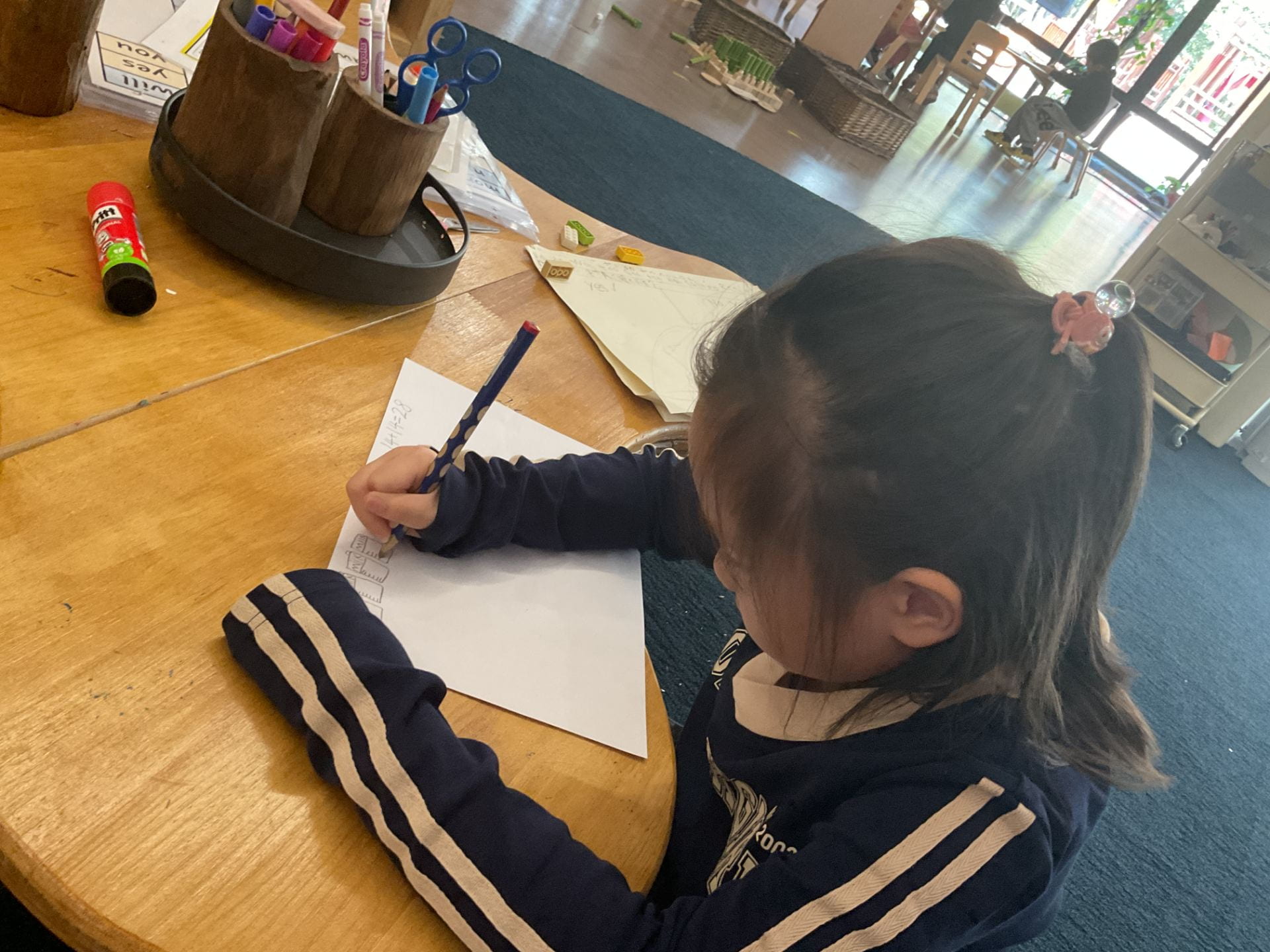
The writers thought about their next steps, making choices about the piece of writing they wanted to continue working on and making a ‘plan’ for writing. They could focus on drawing to add more details or writing words to match their illustrations. 

As they moved to their favourite writing spaces, we noticed how they used many of the different writing strategies and behaviours they had shared in their list of ‘what good writers do’.

During ‘time for sharing, we highlighted two pieces of writing to share with the class. The writers were encouraged to talk about what they did as ‘writers’.

This is an opportunity for the children to learn from each other, grow their craft and learn different techniques and strategies that make their writing interesting to their readers.

As we move forward, the children will revisit their work to either continue their writing or create new pieces of work during the ‘Writing Workshop’ time.

Retelling the story of ‘Floof’!

The children were excited to talk about and share the story of their favourite picture book ‘Floof’ by Heidi McKinnon.

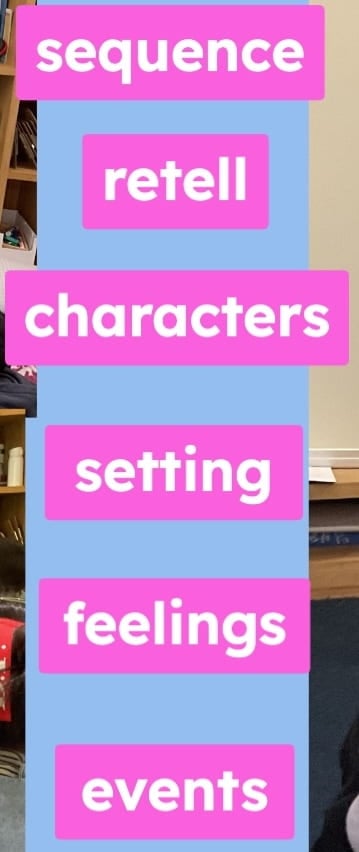
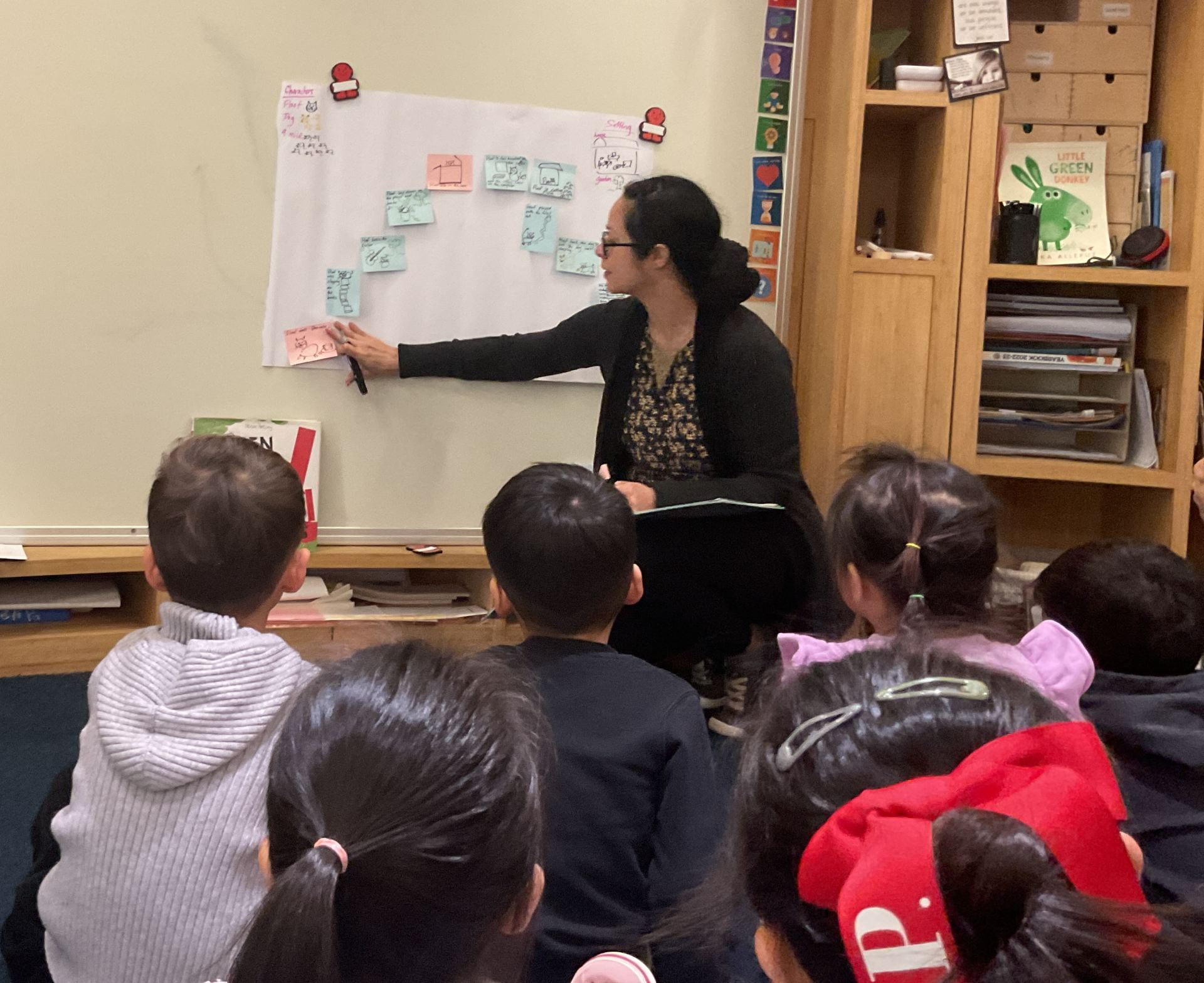
We began by talking about the different characters included in this picture book. We used chart paper to document the ideas and the events they recalled from the story.

  • Jacob “A dog, his ears are black.”
  • Ricardo “Mouse.”
  • Evan “9 mouse”
  • Dahyun “Floof has friends, the mouse.”
  • Junsu “9 mouse.”

Next, we discussed the setting, or the places where the story takes place. The children connected these places with the different objects and events.

  • Isabella “Kitchen, there was a pizza.”
  • Dahyun “There was some toilet paper.”
  • Jacob “He was watching TV.”
  • Evan “There was a computer, he broke the computer.”
  • Dahyun “The guitar, he broke the guitar.”
  • Junsu “Coffee.”
  • Isabella “A tennis ball.”

We used blue Post-it notes to draw and talk about the events in the story.

  • Dahyun “Floof is in the house, he is eating a pizza.”
  • Jacob “He was working then he is using computer and put the coffee to the computer. “
  • Dahyun “Then the computer was broken, then he broke the guitar.”
  • Jacob “He just lying down on the pot, then he broke the plant.”
  • Isabella “He sleeping on the books.”
  • Evan “He played with the toilet paper.”
  • Suzy “The dog is sleeping and he took the ball.
  • Jacob “The dog is yellow and his ears are black.”
  • Suzy “The dog was doing this.” (putting out her tongue to show)
  • Adalyn “The dog was sleeping when Floof took his ball and Floof broke the window.”
  • Isabella “The mice were in the kitchen and were eating pizza.”
  • Evan “He was playing with the strings and it was broken (on the curtain).”
  • Evan “It was a nice busy day from the end of the story.”
  • Jacob “That is a messy day.”
  • Dahyun “Then the story is finished.”

We placed the events in the story in sequence based on the children’s recollection of this story.

Finally, we were ready to read the story. As we turned each page, we checked back to our Post-it notes. We began to see that changes needed to be made for the story to be retold in sequence.

We used pink Post-it notes to include events that were not included in the original retail.

The children’s storytelling shows how the children were actively engaged in the process of retelling the story of ‘Floof’.  They included the key details, characters and settings, and answered questions related to the picture book.

The Trolley Project: Final Steps

The Trolley Project: Sourcing the Missing Parts

The trolley assembly team had been working on their project for a few weeks. Having lost some parts, they were trying to figure out their next steps. They had decided to reach out to different people in the community to ask for their help. The children checked their lists to see if all the missing parts were recorded on their papers. They found that they still needed to add one more piece of data, the missing back rings on the wheel. Then, they measured the part of the wheel that was going to be connected to the rings.

  • Evan “You should start it from ‘0’ like when we measure the milk.”
  • Jacob “It is 2.5 cm.”

Now that they had a list of all the missing parts, they decided that they were ready to ask members of the community for help and more information. They made a list of the people they were going to visit.

  • Adalyn “We are most familiar with Ms. Jo, so let’s start to ask her first.”
  • Isabella and Adalyn, “We once went to Mr. Arek’s room and we didn’t see these stuff in his room, so maybe he doesn’t have them.”
  • Isabella “We can go ask Mr. Matt next then.”
  • Adalyn “We can ask facility people the after. Finally, if none of those people have the missing parts, we can go ask the people who helped us purchase the trolley to buy a new set.”
  • Jacob “Ms. Jo, we are assembling a two-levels tall trolley, and some of the parts were missing, so we wonder if you can help us find some same ones in your room?”
  • Jo “Sure but what are they?”

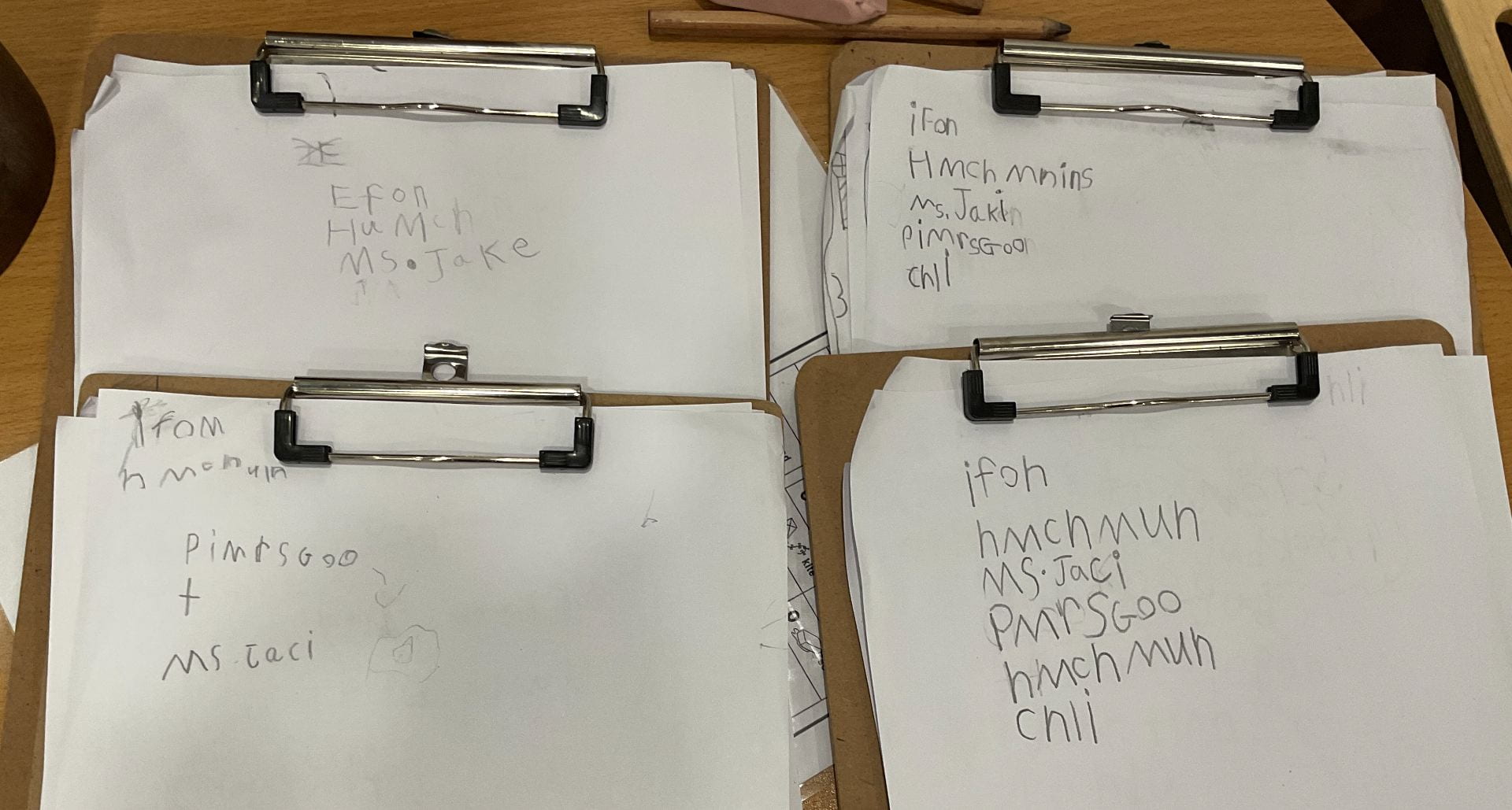
Evan showed Ms. Jo his clipboard and pointed at the stuff on it, “We need some screws which is 8 cm long and some nuts.”
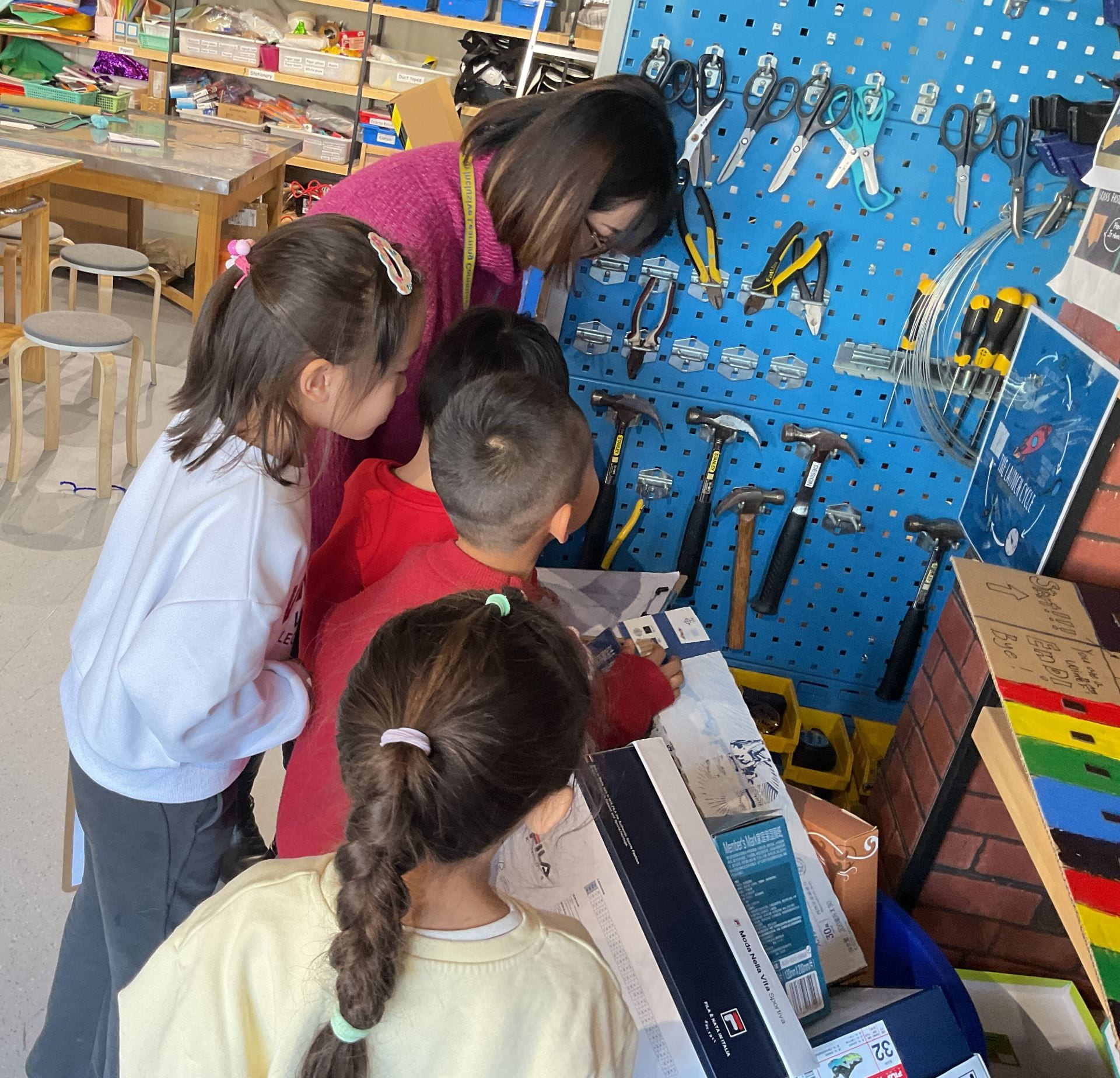
  • Isabella “We need some hooks too.”

Ms. Jo led the team to her tool board and checked but she didn’t have any of the parts that we needed.

  • Isabella “It is fine, we can go ask other people.”

When the facility staff member came in the afternoon, the team showed him the parts that got lost and what they were looking for. Unfortunately, he told them that they do have some screws and nuts, but they don’t have the same ones that we need.

Adalyn “We need to go ask Ms. Cherry if she can help us buy another set of the small pieces now.”

The team began to plan their visit to see Ms. Cherry.

  • Sophia “What would we need to say to her?”

  • Evan “The trolley pieces are missing. We need the screws, nuts, black rings and hooks.”
  • Sophia “What other information do we want from Ms. Cherry?”
  • Jacob “We are missing some parts of the trolley, can you ask the people who sell the trolley to sell the little pieces to us?”
  • Adalyn “I think she will say yes because I used to buy things online, some of the small parts were missing and I can ask the shopkeeper to only order those certain parts.” (in Mandarin)
  • Sophia “Any other questions we want to ask if she says yes?
  • Adalyn “Who do we need to ask for the permission when we need to order something?”
  • Jacob “Should we ask Ms. Jacqui if she can give us some money to buy it? Do we need to send a message to Ms. Jacqui and ask her?”

Children wrote down their questions before heading over to see Ms. Cherry.

The children went over to the main building to meet Ms. Cherry. They explained the problem to her, showing her their drawings and documentation to help her understand which pieces were needed to complete the trolley.

When the team returned, they recorded the information that Ms. Cherry shared about the process of ordering things for the class.

  • Evan “We need to fill an E-Form.”
  • Adalyn “We need to fill the money of the things that we need.”
  • Isabella “We need to first ask the permission from Ms. Jacqui. We ask her in the system.”
  • Adalyn “We choose Ms.Cherry in the system so the form can be sent to her.”
  • Isabella “We choose Primary school to find Ms Jacqui.”
  • Adalyn “We need to type the title of the things we need to order.”
  • Isabella “We need to write the number of things in the system.”
  • Adalyn “We need to click save.”
  • Evan “You need to write your name in the system as well.”
  • Jacob “We need to put our classroom in it so when it is arrived people know where to deliver it. We can check the list after we click save. If there’s any mistakes, we need to correct them.”
  • Adalyn “We check the list and send out.”
The team were excited to learn that a box had arrived in the post.

They opened it up to find the missing pieces that they needed to assemble the trolley.


Presenting the Trolley

The team presented the trolley to the class.

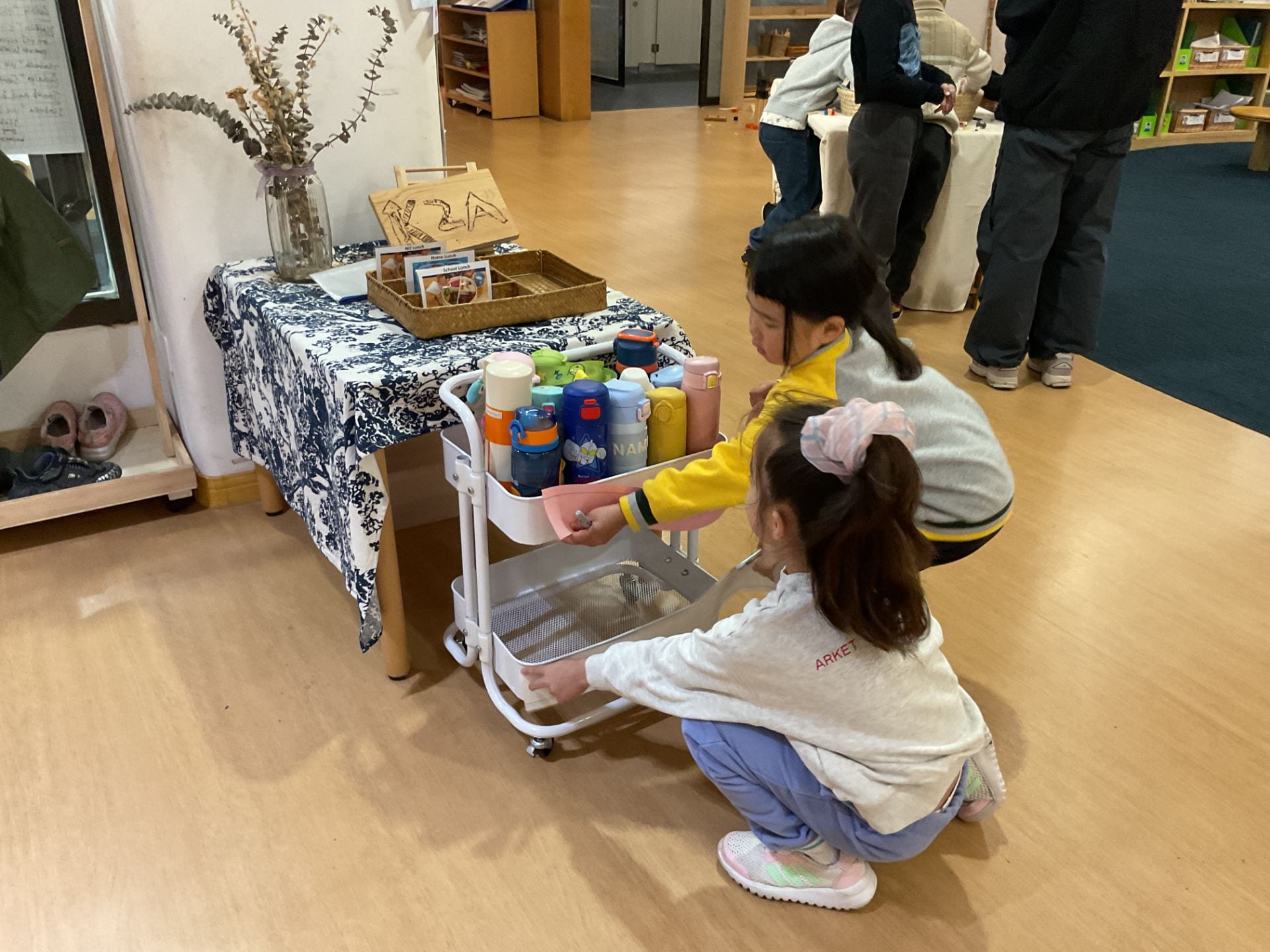
  • Adalyn “We are making the trolley to put the water bottle and the snack.”
  • Evan “And lunch.”
  • Isabella “When we are pressing the screws they were very hard.”
  • Adalyn “So we used the tool.”
  • Jacob “And the nuts is difficult to tighten up.”

  • Evan “We used the tools because we need to because it’s so hard to tighten them up.”
  • Teacher “Did you sometimes disagree with someone else.”
  • Isabella “We figured it out. We tried it out and then one worked. We listened to each other. We tired the idea of the person who said it the first.”
  • Evan “I think I took some months (to finish the trolley) because the pieces is gone.”
  • Jacob “We need to ask some people and they said no.”
  • Adalyn “And then we buy it.”
  • Isabella “It’s not money to get it. It was free. Because it was just a little.”
  • Teacher “How will we look after the trolley?”
  • Suzy “Maybe we can ask PreK-K1 because they also have a trolley.
  • Isabella “I can also ask PreKK1B.”


Reflecting on Learning…

The team took many months to put the trolley together. They had to overcome obstacles and collaborate to achieve their final goal, ‘to assemble the water bottle trolley’. Reflection is an important part of learning, therefore we paused to encourage the team to think about the skills they have learned, the knowledge they have acquired and attitudes they have developed as a result of their learning. They made a list of ideas they wanted to share with their friends.

  • We tried everyone’s ideas to find out what works best.
  • We needed to help each other put the screws and nails because you need strong muscles to fix them.
  • We listened to each other so that we could know everybody’s ideas.
  • We took turns to talk so we can hear those ideas.
  • We had to be mindful, that means we are listening and looking at other people.
  • We had fun.
  • The best part was completing the trolley because we can use it.

The children wanted to ask PreK-K1 how they look after the trolley. Isabella and Suzy volunteered to speak to them. They came back with suggestions on where to place the trolley and how to use it carefully.

Through their inquiry, the team have developed a better understanding of the different ‘systems in place at the school to help the community maintain the school facilities and equipment. These authentic experiences have helped the team explore how ‘interconnected’ we are as we collaborate and work to ensure the community within the school has what it needs to support teaching and learning.

By using their ‘senses’ to explore the world around them, the team had opportunities to pursue their ideas based on their curiosities, documenting their thinking through a variety of mediums.
The team had opportunities to explore mathematical concepts about ‘measurement’ and ‘number.

They developed their literacy skills as they took notes at interviews, documented their thinking, created plans and noted reflections using illustrations, words and sentences. Presenting ideas and updates to the class encouraged the team to see themselves as problem-solvers, risk-takers and communicators.

– Jacob’s statement, “You turn right to tighten the screws and left to untight (loosen the screws).” Shows how the team developed their skills and knowledge about tools (wrenches and Allen keys) for making and design.

The Field Trip Updates

How many cartons of milk do we need to give everyone a cup of chocolate milk?

After working with a group of mathematicians to calculate how many cups of milk there were in one carton of milk, Adalyn took the initiative to work out how many cartons of milk we needed all together to make chocolate milk for both K2 classes. She illustrated the problem and the process, using pictures, words, numbers and symbols to show her problem-solving strategies

Adalyn explained her process to the class, suggesting that 6 cartons of milk would be enough for the 28 children, four teachers, Ms. Hannah and Mr. Patrick. She also suggested that we bring the two remaining cups back for Ms. Dora and Ms. Jacqui.


How many seats are there on one school bus?

Ciel counted the number of seats on the school bus…


Ciel “I counted the bus seats because then we can go to the field trip. Then we can know how many children and teachers can go in the bus. We will need 2 buses because if one bus has 28 seats but teachers go too, so there won’t be seats for the teachers so we need one more bus. Then the K2A teachers go in the K2A bus and the K2B teachers to in the K2B bus.”

We updated our trip planner, including more information, checking off tasks that we have completed and adding more steps where appropriate.

When children have AGENCY they:

  • can apply their understanding of concepts through their experiences, projects and play.​
  • are actively involved in discussion, questioning and by being self-directed in their learning.

The Survey

We referred to our plan for the trip to the Skyways Kitchen to plan our next steps. The children were eager to invite K2B to join us on the trip to the kitchen. The team created a survey to find out how many children and teachers would like to join K2A on the trip.

Suzy “We can ask them, ‘Do you want to come to the Skyways kitchen to make the PTA but the cupcakes?’” The team wrote their question and possible responses. Then, they went off to K2B to speak to their friends.

Dahyun “I am finding the letter and big letter and I write that. Because then I know letters. Because I sound it out and find the letter, and it helped.”  

Euno “I write the question. I used the alphabet chart to find the letters. I see the alphabet chart and I can write the word.

I sound the letter. It was a little bit hard but then I sound and write and see the alphabet chart and write.”

Euno “I asked ‘Do you want to go to the cafeteria for making the PTA cupcake? And they said ‘yes’. I tell him sign your name on the paper on the ‘YES’.”

Dahyun “Because he want to go to Skyways kitchen and make cupcakes so they say it in the paper. Everybody said yes.”

The surveyors presented the data to the rest of the class explaining their process and what they learned as a result of their research.

Suzy “We are going to K2B and ask them and then I write the names. Everyone wants to go!”

While presenting the information, the class noticed that one child did not want to join the field trip. We wanted to make sure that the team had surveyed all the children. Therefore, we decided to check the responses against the K2B class list. As the names were called we realised that two of the children had not responded to the survey.

The researchers went back to collect the data they needed.

The class was pleased with the results both teachers and 13 of the 14 children wanted to join the field trip.

Having collected the information they need, they are ready for their next step, deciding on the date and booking the school buses for the trip.

How much is a Watermelon?

Jacob was inspired by our challenge project, particularly the part about making ice pops with watermelon juice. He decided to visit a supermarket to learn more about watermelons. On his return, he shared what he had uncovered.

Jacob used the question starters to help him present his learning to the class.

  • Jacob “Me and my mum is going to the supermarket because we want to look the watermelon is how many money. And how big and how small. I go to Hippo to look how heavy and small. I went yesterday. I take a photo because then we know how heavy. It was 59 RMB.”

Jacob’s presentation made us wonder how many watermelons we might need to make the ice pops. We wanted to make sure we had enough for the project, but we also didn’t want to waste any food. 

  • Suzy “Maybe we can first get one watermelon and then we can test it because then if we didn’t know how many too much or too short.”
  • Evan “We need to ask Ms. Jacqui about the money for the watermelon.”
  • Jacob “We need to listen to other people and look.”
  • Suzy “Say it nice and loud because then other people cannot hear.”
  • Sea “I don’t know if Ms. Jacqui gives the money.”
  • Isabella “We need to tell Ms. Jacqui how many money we need.”
  • Dahyun “We can find the market.”
  • Euno “We don’t tell any people then we don’t have money so we cannot buy the watermelon.”


Can we have some money?

A group of children volunteered to take the project plan to Ms. Jacqui to ask her about the money they needed for the project. The children explained that they would need 60 RMB to purchase one watermelon to test the ice pops. Ms. Jacqui was excited to hear all about their plans and invited the children to think about the different steps they needed to take to plan a safe field trip across the road.   

They needed permission slips, money to purchase the watermelon and teachers to accompany them on the trip.   


Do we have enough ice-pop moulds?

Teacher “What about the moulds for the ice pops do we have enough for everyone?”

Isabella recalled using the ice pop moulds when she was in K1 and decided to reach out to Ms. Hannah to see if she could find them in the Early Years kitchen. Mohammed and Adalyn wanted to help Isabella with the task.

The team looked in all the cupboards to look for the ice pop moulds but couldn’t find them. After a lot of searching, they found two sets of 6 ice pop moulds in the Early Years pantry.  

The children decided that they needed 16 moulds for the children and the teachers in K2A. But they only had 12! They used what they knew about numbers and calculations to help them solve the problem.

They decided that they need to buy 6 more moulds to have enough for everyone in K2A.

A Map to the Skyways Kitchen

What is a map?

When Patrick came in to talk to the children about their field trip to the Skyways kitchen, Riccardo and Evan asked him if he had a map to help us get to the kitchen. Patrick did not have a map but provided the children with directions on how to get to the location. We referred to the information and realised that we would need to create our own map using the information.  

We began by asking the children what they knew about maps.

  • Dahyun “A map is if we don’t know a place we can see the map.”
  • Sea “We don’t have a map, we take a map in the school.”
  • Riccardo “You can use a map to find treasure.”
  • Evan “You can use a map to drive the car.”
  • Adalyn “You can use a map to find somewhere.”
  • Isabella “You can use a map to find some place you don’t know.”
  • Suzy “You can use a map to find a place to drive.”
  • Euno “When you want to go to a market but you don’t know where is the supermarket, you see the map.”
  • Jacob “When you don’t know how to go home, then you can use a map to go home.”
  • Sea “We don’t have a map, we can see a map in a handphone.”
  • Dahyun “We cannot go to NIS we can see a map.”
  • George “If you want to go somewhere you can go with a map.” (in Mandarin)
  • Evan “You can walk with a map in the phone.”
  • Riccardo “In some maps, some things are in the right place and some things are not.”
  • Ciel “If you don’t have a map you can talk to another people.”
  • Sea “We don’t have a map in the phone we can put it in the car screen.”
  • Euno “You don’t have a map on the phone you see the iPad map.”
  • Ciel “If you don’t have a map you can make one.”
  • Euno “Mum’s handphone has a map, so my mum has a map.”

What does a map need to have?

  • Ciel “You need a paper, and markers. It has a house, schools.”
  • Sea “Supermarkets, hospitals, fire stations.”
  • Suzy “A car on the road.”

A team of children signed up to create a map to help us with our trip.

The cartographers documented the information using everyday language to describe directions, plotting locations, traffic symbols, and signs along the roadway.

They discussed the ‘purpose‘ of crosswalks and traffic lights and how they keep people safe.

  • Suzy “If we have traffic lights, other cars can go first, then the people will go, and then the traffic light will go green. When the traffic light is green the cars can go. The people have to stop because then they will go under the car’s wheel, that is super dangerous.”
  • Ciel “People need a crosswalk because people need to walk to the street. When you are on the crosswalk you need to look left and right because the car can hit you. When the walking man traffic light turns to green then you can walk. When it is red you can’t go. I go with my sister on the crosswalk. We have elevated roads because we can see the nature.”

The children’s conversations share their understanding of the ‘function’ of signs and symbols and safety equipment and how they communicate meaningful information to road users.


What is 1 Metre?

The cartographers paused to think about some of the information Patrick shared with the directions to the Skyways kitchen. The instructions read ‘go 200 metres’

Teacher “What is 200 metres?”

  • Isabella “We only heard centimetres before.”

Teacher “What is a centimetre?”

  • Isabella “The ruler.”
  • Sea “Only have numbers up to 30 centimetres.”
  • Evan “I think 1 metre is 100 centimetres.”
  • Ciel “I think 1 metre is 9 centimetres.”
  • Jacob “I think 5 centimetres is 1 metre.”
  • Evan “I think 200 centimetres is 1 metre.”
  • Ciel “I think 10 centimetres is 1 metre.”

We noticed that the children’s estimates ranged from 5 to 200 centimetres.

Therefore, we decided to provide them with a comparison example.

  • Shemo “I am about one and a half metres tall. How many centimetres might that be?”

As they looked carefully at the height of the teacher, Isabella recalled measuring height using a long ruler in the classroom.

  • Isabella “Mr. Seth has bigger rulers!”

Isabella brought back a ruler that was 50 centimetres long. The children looked at the number and realised that it wasn’t tall enough to measure the teacher. Isabella went and brought back a longer ruler that was 100 centimetres long.

They placed the ruler close to the teacher, but she was taller than the ruler. They placed the 50cm ruler above the 100cm ruler, the teacher was still taller than the ruler. Finally, they placed a 30-centimetre ruler above the other rulers and added the numbers together.

  • Ciel “I think Ms. Shemo is about 160 centimetres tall.
  • Sea “Because 100 and 50 and 10 is 160!”

Through this discussion, the children concluded that the 100-centimetre ruler was one metre. Now, they wondered how to show 200 meters on the map. After some thought…

  • Isabella “We can just write 200 meters on the paper!”

The children’s conversations and problem-solving show their developing understanding of standard units of measurement and how they are used in everyday life experiences.

Once the cartographers complete their map, they will present it to the rest of the class for feedback. We wonder how feedback and reflections will lead to improving the final map of the directions from NIS to the Skyways kitchen.


The Final Map

The map was presented to the class for feedback. The children decided to colour in the map to make it look ‘beautiful’.

They also suggested that including names (labels) will be helpful.  The children gathered around the map to include the different elements discussed.

They used what they knew about letters and sounds to write the labels.  We noticed the children helping each other when words were too hard to spell.

Finally, Ciel included a title for the map.

Planning the Ice Pop Challenge

We revisited the 3-Minutes Challenge Project, where the children had suggested creating a range of activities based on an inquiry into ‘time’. They were excited to plan their ice pop challenge and gathered to think about the steps they would need to follow to complete the task and have the challenge.

As the children shared their ideas, we documented the details on large chart paper using illustrations, words and symbols to communicate information.  

The children were excited to make watermelon ice pops. They tapped into previous experiences of planning a field trip, explaining how forms needed to be filled in and permission sought to go ahead with the field trip.

They will have to find out how many ice pops need to be made. This would include calculating how many they need to make in total for the children in K2A and 5A buddies.

The children suggested asking Ms. Dora or Ms. Hannah how much the watermelon may cost. This would help them estimate and make a request for money from the school for the project. Next, a team would need to complete an order form and take it to Ms. Jackie.

  • Riccardo “We need to go and ask Ms. Jackie and say, ‘Please can you give us some money to buy watermelon because we need to make ice pops’.
  • Suzy “You need to just walk across the road to the Hippo Supermarket.”

The children suggested that we ask Mr. Dora and Ms. Hannah if they could help us visit the supermarket.

The children explained the steps we needed to follow such as preparing the watermelon, blending the watermelon to make the juice and finally freezing the molds of juice to make the ice pops.

We wonder how the children will gather and organise the information to help them plan and prepare for the challenge.

The Chocolate Milk Project: Calculating Volume

The children are deeply engaged in their inquiry, solving problems and organising themselves to help plan the field trip to the Skyways kitchen. One of the suggestions they had was to make chocolate milk at the Skyways kitchen. We decided that this would be a good opportunity for the children to solve a real-life problem using their understanding of number and calculations. 

How many milk cartons do we need to make chocolate milk for all the children and teachers in K2?

We began by estimating how much milk they thought they would need.

  • Evan “I think 2 boxes of milk because we can drink with 2 classes, because one class can drink one milk.”
  • Adalyn “We don’t know how much one box of milk has.”
  • Ciel “I think it has 20 or 25.”
  • Jacob “I think 25 meters. We can measure it. With a ruler.”

Estimating how many cups of milk are in one carton.

The mathematicians drew to share their ideas, the estimates ranged from 10-20 cups in each milk carton.

We noticed that the children were referring to the ‘units’ (millilitres) of measurement when talking about volume. Riccardo had also suggested using a measuring cup with numbers on the side to measure the milk. Their explanations and suggestions communicated their working theory that, ‘we can use a ruler and measuring tools to measure accurately’.  Having noticed this interest in using standard units, we decided to draw their attention to the 1L displayed on the milk carton.

But how much is a litre (1L)?    

As the children are familiar with the use of the Base 10 system to represent numbers and number relationships, we used the blocks to draw a parallel to the ‘volume’ discussing the value of one, ten, one hundred and one thousand.

The mathematicians concluded that the milk carton had 1000ml, or one litre (L) or 2 of the 500ml jugs of milk.

We decided to check if Jacob’s estimate that a cup of milk was of 25ml was correct. We poured out one cup of milk from the carton and used the measuring jug to measure it. We learned that there was 150ml of milk in one cup. We used Base10 blocks to show the number.

How would we know how many cups of milk were in each milk carton?

The mathematicians used words, images and numbers to make their thinking visible. As they documented their ideas, we noticed that they were calculating the quantity in millilitres and cups. Therefore, we continued to use the Base-10 blocks to help them calculate, solve and explain their math problem.

We noticed that each child processed the problem and documented their strategies differently. They shared and listened to each other’s strategies and thinking and helped each other with the calculations.

Together, they learned that a carton of milk had about 6 cups of milk.

The team presented their process and learning to the class.

  • Ciel “We measured what milk is inside.”
  • Evan “We measured about 100 of milk.”
  • Jacob “One box has equals 6 cups of milk. Because we already measured it. One cup has 150 %.”
  • Evan “2 cups have 300 ml.”
  • Adalyn “4 have 600ml because 300+300=600”
  • Evan “6 cups have 900 because we think it.
  • Adalyn “Because 600+300=900ml and 100 left over.”
  • Evan “Yes, because 900+100=1000.”

We look forward to our next steps as we plan our trip to the Skyways kitchen. 

Writing How-To Books

‘How-To’ Writing is one of our favourite writing units in kindergarten as the children love getting to be the expert as they teach others. Following on from our previous writing mini lesson, which focused on creating a piece of collaborative text that provides information on how to give a cat a bath, we created a list of all the things that the children would like to teach others. We began by brainstorming all the things we know how to do.

We collected all the ideas the children shared on a chart paper to create a collection of ideas they can refer to when they make their how-to texts.

Some of their ideas were how to:

  • make cookies
  • brush your teeth
  • dress up
  • eat independently
  • conduct an experiment
  • read a book
  • put on your shoes
  • pack a bag
  • play with the cat
  • grow a plant
  • take a photograph
  • make a video
  • make pizza
  • draw a picture
  • make ice cream
  • catch a cat
  • take a bath
  • make a pie

We noticed that the children had many different interesting ideas about the things they can teach others. After revisiting the collaborative text, we referred to our list of key features of how to books.

The writers were excited to create their how-to texts. They began by drawing and labelling a list of things they would need to complete the tasks. Next, they will tell what to do in sequential steps.

We look forward to sharing these texts with others to help them learn how to complete different tasks successfully.  

‘How-To’ Books

The children have been exploring how to create instructions as part of their ongoing investigations linked to classroom projects. We decided to read a mentor text to help the children think more deeply about the importance of a list of materials and the sequence of detailed steps when telling others how to complete a task.

We read the storyHow to Give Your Cat a Bath: in Five Easy Steps by Nicola Winstanley, illustrated by John Martz. In this hilarious and clever “how-to,” a little girl tries to follow a series of steps to bathe her unwilling cat. Although the task seemed simple, the cat makes it challenging to follow the steps. As the steps keep changing, the cat keeps escaping and the mess keeps escalating.

We decided to create our own instructions on ‘how to give a cat a bath’.

We documented the children’s ideas on large chart paper, including illustrations, labels, numbered steps and details. Each suggestion was discussed to ensure the details made sense to a reader.


We look forward to seeing how the children apply their learning in new contexts, through their independent and group project work.

A plan to make Chocolate Milk!

We decided to revisit our first ideas about the wasted milk. The children recalled Mr. Patrick’s suggestion to make chocolate milk when they visit the kitchen.

  • Adalyn “We can use the milk to make chocolate milk.”
  • Riccardo “But we don’t know how to.”
  • Suzy “I know, Mr. Patrick knows. We can ask him.”
  • Jacob “K2A and K2B are going to drink the chocolate milk.”
  • Riccardo “We need chocolate to make the chocolate milk but we don’t have it. Maybe we can go to the cafe to buy some chocolate.”
  • Jacob “We can buy the chocolate from the cafeteria where we get lunch.”
  • Suzy “We can go to buy the chocolate from the chocolate shop.”
  • Jacob “We can collect milk from K2A, K2B and K1 when we have lunch in the kitchen. We can ask them for the milk that is not used.” 

Teacher “How much milk do we need?”

  • Jacob “We can measure the milk with a ruler.”
  • Riccardo “We can measure it with the ruler plate, the plate with numbers.”

The children’s conversation revealed their understanding that we use tools to measure accurately. They suggested using a measuring cup to find out how much milk we need to collect for both classes to have a cup of chocolate milk.

Planning a Field Trip

During Atelier time, the children revisited the PTA cupcake project. They were excited to tell George why they had decided to visit the Skyways bakery and make the birthday cupcakes as it was his first day back in K2A.

Inviting K2B

The children had suggested inviting the children and teachers in K2B to join the field trip. However, the K2B class didn’t know many details about the project. The children decided it would be a good idea to provide more information to determine if they wanted to join the field trip to the kitchen.

What would we need to tell them about the trip?

  • Why do we want to go on a field trip
  • Where we were going
  • What we hope to do and how we will do it
  • Who will go on the field trip
  • What we will do once we get there
  • Jacob explained why we were going to the kitchen.
  • Mohammad reminded everyone that we were going to make a “Cake” in the kitchen. He wondered if he could make a cake shaped like a “car”!
  • Adalyn “We want to make some cupcakes.”
  • Riccardo “For people who didn’t have PTA cupcakes.”

  • Suzy, Mohammad and Jacob quickly recalled Patrick’s suggestion about making chocolate milk with the leftover milk that we collected after lunch.
  • Jacob wondered if we could get to the kitchen in our vehicles.
  • Ciel wondered if we could make people.
  • Junsu wondered if we could make a vehicle to take us there.

The children documented their ideas about making the cakes, thinking about all the ingredients they needed to make the cupcakes.

Next, the children will prepare to interview the children in K2B to share their plans and ask them if they would like to join the field trip.

We decided to revisit our plan to make the cupcakes.

The children referred to the plans they had created when they were in the Atelier. They discussed the ideas they had documented in their notebooks.

  • Dahyun “We need milk, eggs, flour, butter, chocolate, salt, water, cherries, sprinkles…”
  • Suzy “We need to go there by school bus.”
  • Adalyn “We need the lunch card.”
  • Jacob “We need the lunch card so people know who we are.”

This led to a deeper conversation about the concept of safety. Jacob suggested that we book 2 school buses. Susy explained why when she said,
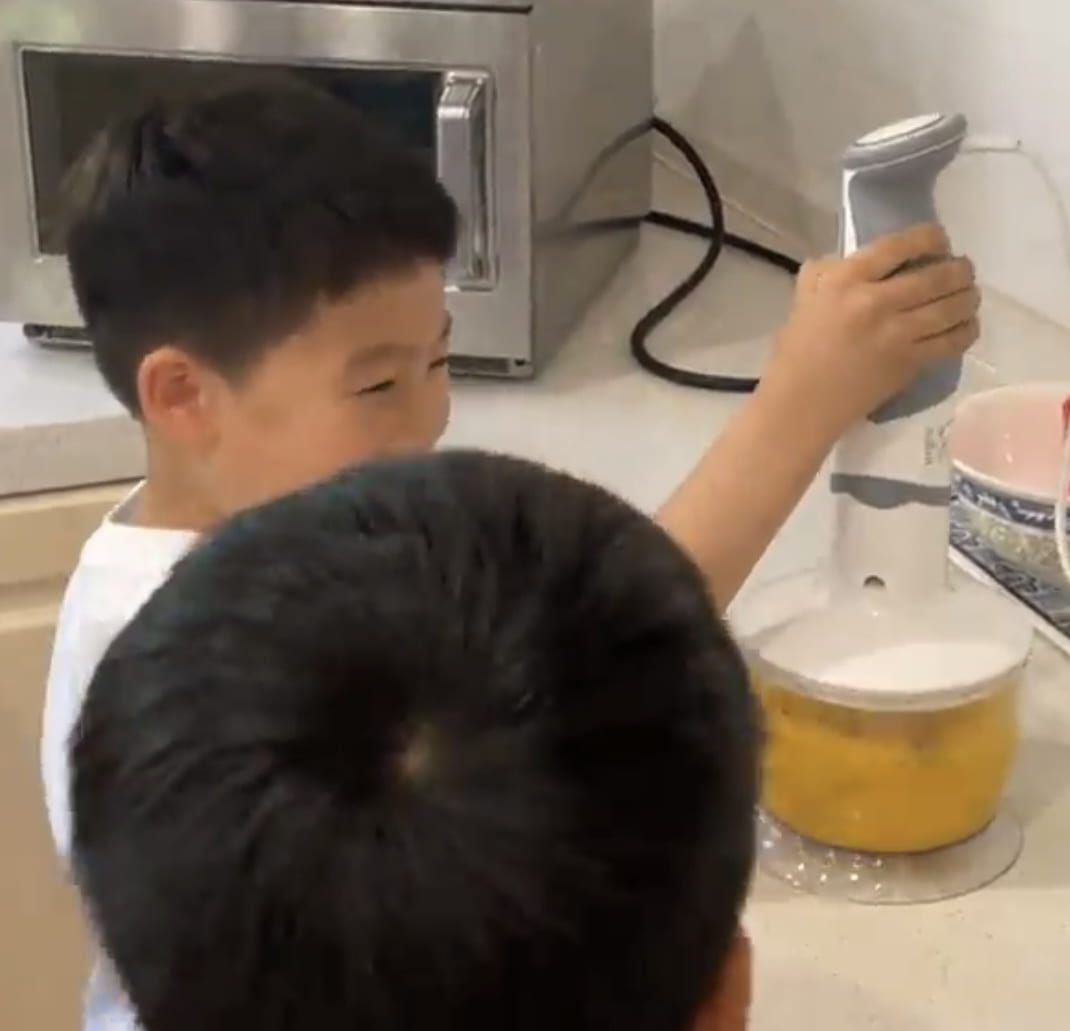
  • Suzy “One for K2A and one for K2B.”
  • Jacob “We can go count how many seats are there in one bus.”
  • “We have 26 children in K2” explained Ceil, calculating the total number of children in both kindergarten classes.
  • Evan “We need a map. We need our water bottle.”
  • Jacob “Backpacks.”
  • Dahyun “We need the big oven. And we need our books.”

We documented all the children’s ideas and suggestions for their next steps. It was clear that many different aspects needed to be considered and planned before we went on the trip to the kitchen. They would need to:

  • calculate the quantity of milk they would need to take with them
  • gather the required data, and then organise and book the school buses
  • Create the map to make sure we know how to get to the location safely
  • and consider all the different items we would need to take with us to make sure we have a safe and fun learning experience.

Interviewing Patrick from the Skyways Bakery

The children invited Patrick from the Skyways Bakery to come in as they wanted to learn more about the kitchen.

Isabella “We want to go to the Skyways.”

Suzy “We want to make cupcakes.”

Patrick began by talking to the children about the bakery, how it is organised and the different departments that are involved in the function of the bakery. He was in charge of creating new products and making sure that the quality of the products remained the same.

  • Riccardo “How much is one cupcake?”
  • Euno “Is the cupcake 5 or 10?”

Patrick said he was not 100% sure so he would send the exact price for each cupcake when he returned to the bakery.

  • Evan “How to make cupcake and ice cream.”

Patrick talked to the children about the difference between a cupcake and a muffin.

  • a muffin could be considered a breakfast item and a cupcake is usually not
  • a cupcake usually has a topping and a muffin typically doesn’t
  • a cupcake is softer than a muffin. This is mainly due to the use of sugar and the different quantities of ingredients such as flour and eggs.

The children were excited to learn that they make bread, cakes, ice cream and chocolate treats in the kitchen. He invited the children to come to the bakery kitchen to learn how they make these items.  

  • Dahyun “How to make milk?
  • Sea and Dahyun “Do we need milk for the cupcakes?”

Patrick explained that sometimes they do but also make cupcakes without milk. They often use milk powder instead of liquid milk. 

  • Dahyun “How do you make cupcakes and ice cream?”
  • Riccardo “How to make cupcake? I don’t know how to make the cupcake. We need to go to your bakery to learn how to make the cupcake.”
  • Junsu “Can we learn how to make ice cream?”

Patrick invited the class to visit the kitchen in the city to observe the process! The children cheered with excitement. He said we could come at 9:00am when his staff are working to watch the process. The kitchen is about 9 kilometers away, about a 20-minute drive from NIS.  

  • Suzy “Can we go to the cupcake room to learn how to make cupcake? What do we need to bring with us?”
  • Jacob “I want to help to make cupcakes. Can we do that?”

Patrick “You might have to bring a stool because our tables are all for adults, so to be able to do something with the equipment at the table you will need one.”

He explained that there is a section for hot items like bread and baked goods, and another for cold items like ice creams, cakes and desserts. The ovens and equipment might be very big so we have to think about staying safe. 

  • Evan “Do you have a map to help us get there?”
  • Jacob “How do we get there?”
  • Patrick “From the school gate…”

Patrick provided detailed directions. We wonder how the children might document this information to help them reach the bakery.

  • Sea, Dahyun and Euno “We want to make cupcake, do we need milk?”
  • Ciel “Can we use K2A milk to make cupcakes?”

Patrick “You bring the milk, we heat it up and we can add chocolate to make chocolate milk.”

We look forward to the children’s next steps in planning their trip!

Student Presentation on the Recycling Center in Nanjing

Two years ago, Patrick was in K2A. During this time, he was interested in learning about waste and recycling and made a presentation to his class after conducting his research. Patrick is now in grade 2. He recently visited a waste recycling center in Nanjing in response to a unit of study in class and was excited to return to K2 to share what he had learned during his visit.

Oliver, who was in K2A the previous year, had created a poster about waste disposal while learning about recycling. Patrick referred to Oliver’s poster, explaining which items could be disposed of in the different coloured recycling bins. The children have noticed some of these bins around the school campus and were eager to learn more about their function in recycling.

Patrick shared many different photographs of the recycling center, providing explanations on the Process of transporting and sorting materials such as paper, food and plastic waste. He was excited to talk about how long it takes for materials such as paper, fabric and plastic to decompose.

The next day, we revisited Patrick’s presentation.

  • Suzy “It is the machine.”

  • Riccardo “He said it is so stinky.”
  • Suzy “They take long to disappear.”
  • Jacob “In soil. They will disappear in the soil. How many years it takes to disappear.”

  • Suzy “Cardboard is harder than paper so it has the different number. It takes longer to disappear than paper.”
  • Suzy “This is for the trees.”
  • Isabella “This is from the food garbage. Its good for the plants.”
  • Riccardo “So they can grow up big like the trees.”
  • Jacob “I put the new soil in the new plants in the NIS garden, before K2. Ms. Hannah let me help she, I was putting new soil because then the trees will be grown up.”
  • Evan “The things get grabbed and it takes it away.”
  • Isabella “It can carry the weight of two elephants.”

  • Ciel “This is wood. This is to make something new. Maybe wooden chairs.”

  • Jacob “Wooden tables. Some people can make wood chairs and wood tables and something else with wood.”
  • Riccardo “And have glass waste.”
  • Junsu “This is cans. This is waste cans.”

  • Jacob “It will make it into new bottles. Someone will use the fire to make it like disappear, then you can make the new bottle.”
  • Suzy “They are recycling it.”
  • Mohammad “This garbage. This is bad. Water bottle in garbage.”
  • Suzy “Patrick wanted the NIS to be not so stinky. Too many trash. The children are making the trash because they have a lot of trash in their hands from the paper and bottles.”
  • Jacob “And some cans. And wood and cans.”
  • Suzy “He wants us not to make so many trash.”

Ms. Shemo showed the children her snack bag. It was made of plastic.

  • Suzy “Because you have the plastic bag which is going to be the trash.”
  • Jacob “Even the tissue.”
  • Suzy “Ms. Shemo will throw the plastic bag in the bin and then it’s going to be stinky. It is going to take 30 years to disappear.”
  • Jacob “If you don’t want to eat the bread, then it will be in the trash too.”
  • Riccardo “You can buy a snack box to carry it to school.”
  • Jacob “You can wash it then”

Ms. Hannah “Do you notice any trash waste around you at home?”

  • Riccardo “I don’t have trash at home.”
  • Hannah “How do you have no trash? What do you do?
  • Riccardo “Its only a little bit because we don’t use so much. Because my mum throws the trash in the other places.”
  • Euno “I only have a little bit trash at home because so many trash is waste food. Korean trash is different but here we can find other trash altogether. In Korea trash is not wasted.”

We wonder about the action the children will take in response to Patrick’s presentation on the importance of recycling.

Waste: Leftover Milk

We have been exploring the concept of ‘waste’ in many different situations around the classroom. We have been thinking about and taking action to solve some of the problems we have noticed with food and paper waste. We decided to gather the children to discuss yet another issue to do with food waste during lunchtime.   

We began by trying to identify the problem.

  • Suzy “Some of the people don’t like the milk.”
  • Euno “People wasting the milk. Because we drink one box of milk. We cannot drink the other box of milk.”

The children agreed that the leftover milk was going to waste. We began to look for ways we could solve this problem.

What are the things we can do?

  • Suzy “We can drink the leftover milk during the snack time.”

We discussed this idea further and invited the children to think of possible solutions to the problem.

  • Riccardo “We can use the milk to make something.”
  • Isabella “We don’t have cups for the milk during snack time.”
  • Evan “We can make cups.”
  • Suzy “I made a cup during Olivia’s birthday.”
  • Isabella “Bring the colour cups from the EY kitchen.”
  • Suzy “We should ask the kitchen Ayi if we can use the cups. The Ayis who cook the lunch.”
  • Jacob saw possibilities with reusing some of the empty milk cartons when he explained, “We can use the empty box to make something.”
  • Suzy added, “Maybe we can use the box for making paper.”
  • Riccardo “Ask other classes if they have plastic cups for us to use.”
  • Evan “We can ask the big kitchen for some cups.”
  • Dahyun “Go and ask other classes do they have some cups.” She suggested asking a Grade 3 class!
  • Riccardo “Maybe grade two?”
  • Euno “Maybe K1? When I was in K1, we have cups, white cups.”
  • Riccardo “We can buy some cups.”

What if we don’t like the milk?

  • Adalyn “We can try.”
  • Suzy “We can drink a little bit, if you think you don’t like it you can try it again.”
  • Riccardo “If you don’t like the milk, you shouldn’t pour the milk in your cup.”
  • Isabella “If you don’t like milk you can drink water.”
  • Suzy “You can drink juice, I see a K2B kid drinks the juice.”
  • Evan “I think it comes from the big kitchen. If you want the juice, you can tell the Ayi of the kitchen.

Ricardo provided another suggestion…

  • Riccardo “Use the milk to make something!”
  • Ciel “Maybe we can make some chocolate milk.”
  • Isabella “Hot cocoa.”
  • Evan “Hot chocolate.”
  • Euno “Strawberry milk.”
  • Junsu “Banana milk.”
  • Dahyun “Lemon milk.”
  • We could hear the children’s excitement about flavoured milk.
  • Evan “Yoghurt.”
  • Jacob “We can make some chocolate yogurt.”
  • Isabella “Ice-cream.”
  • Evan “We can put vanilla in.”
  • Suzy “We can put some strawberry jam.”
  • Ciel “My sister can make ice cream with yoghurt. She put yoghurt in the fridge and she can make ice cream with the yoghurt. She puts some fruit when she makes the ice cream.”
  • Jacob has not forgotten his solution to the waste problem saying…“We can use the milk boxes to make some funny things.”

As we listened to the children’s creative ideas and solutions, we noticed their developing understanding of the choices we can make to reduce waste. We look forward to exploring some of these suggestions, to create an action plan for their next steps.

1 2 3 20