Math in Our World: Dominoes

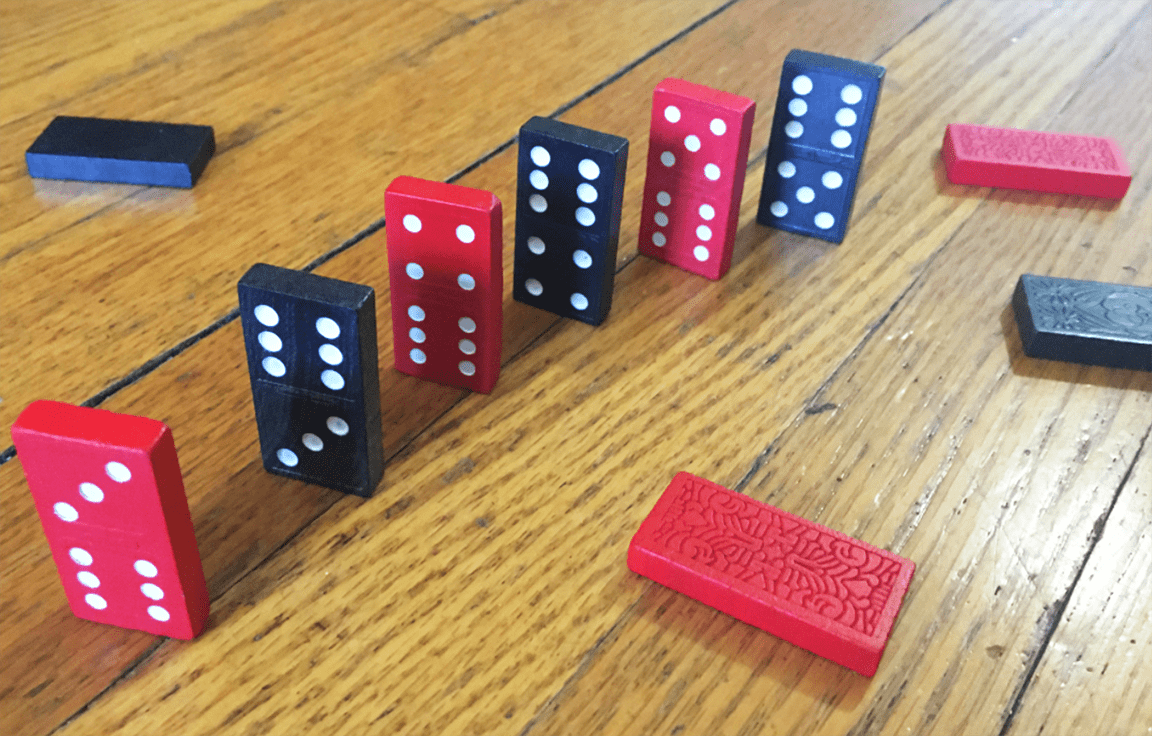
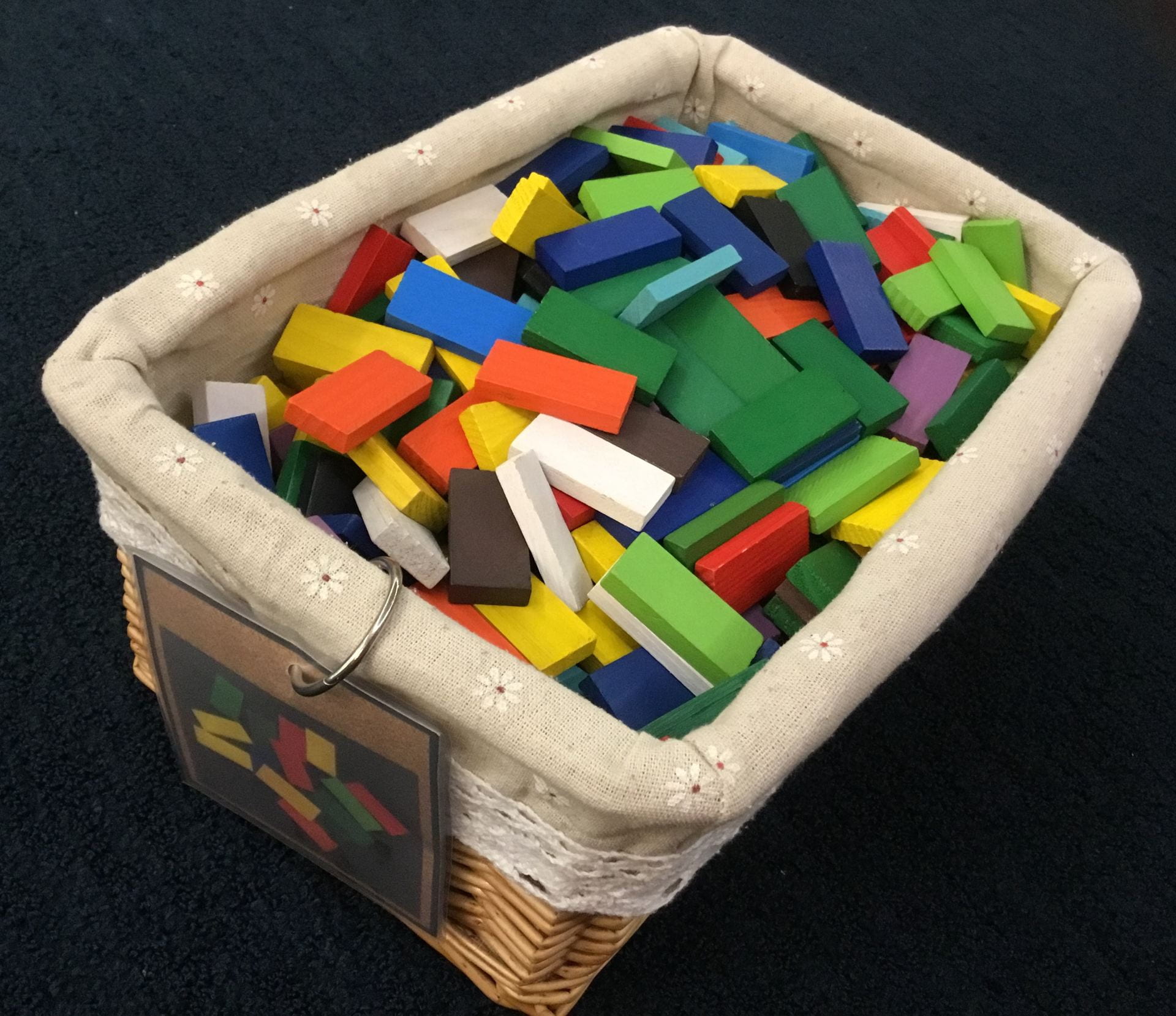
The children have been exploring and playing with dominoes. Noticing this interest in terminals, we decided to share an image to see what they would notice about the domino tiles.

What do you see?

What Math words can you use to share your thinking?

We wonder if the children would extend these ideas while ‘playing’ and creating with the domino tiles.  

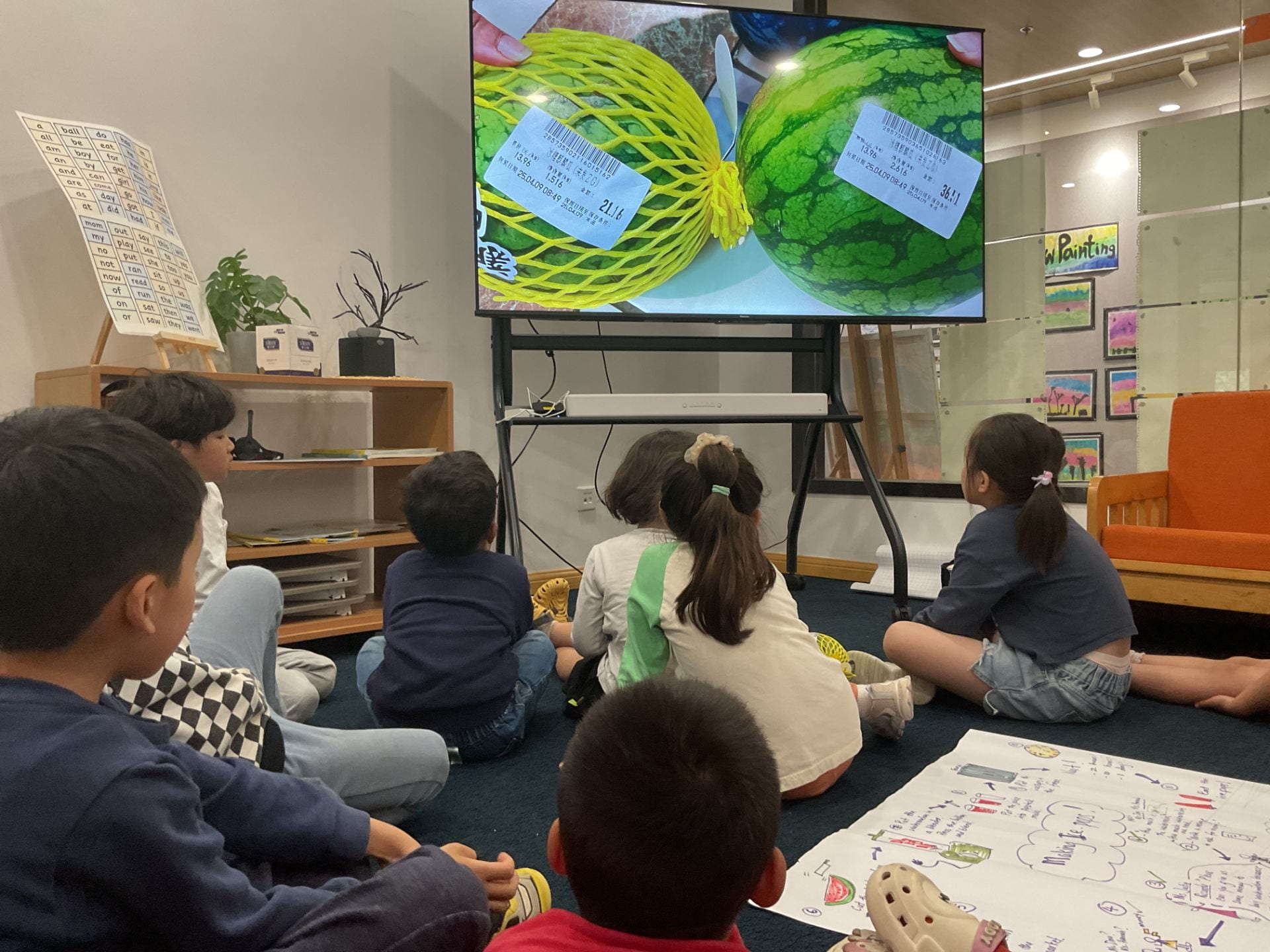
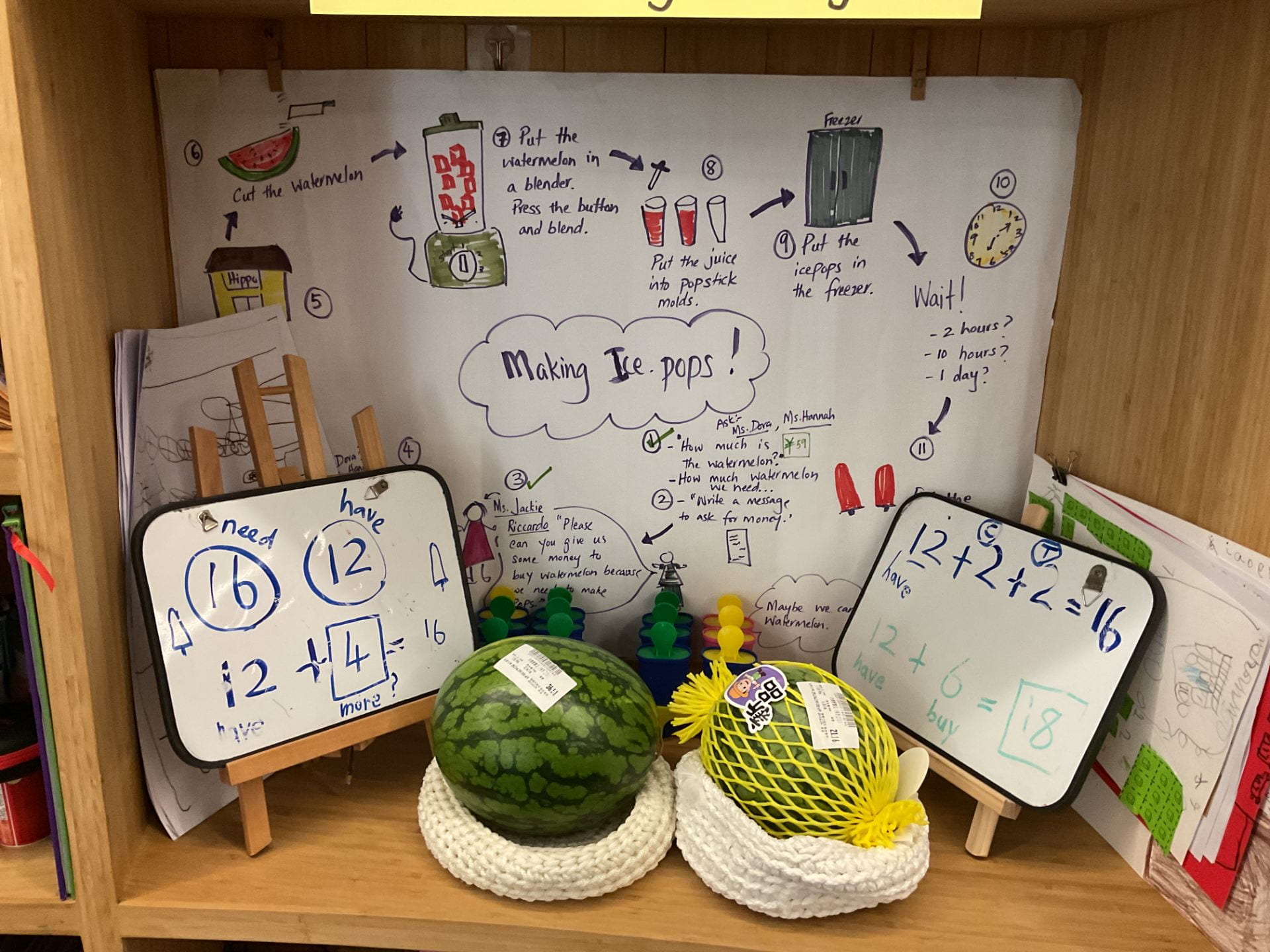
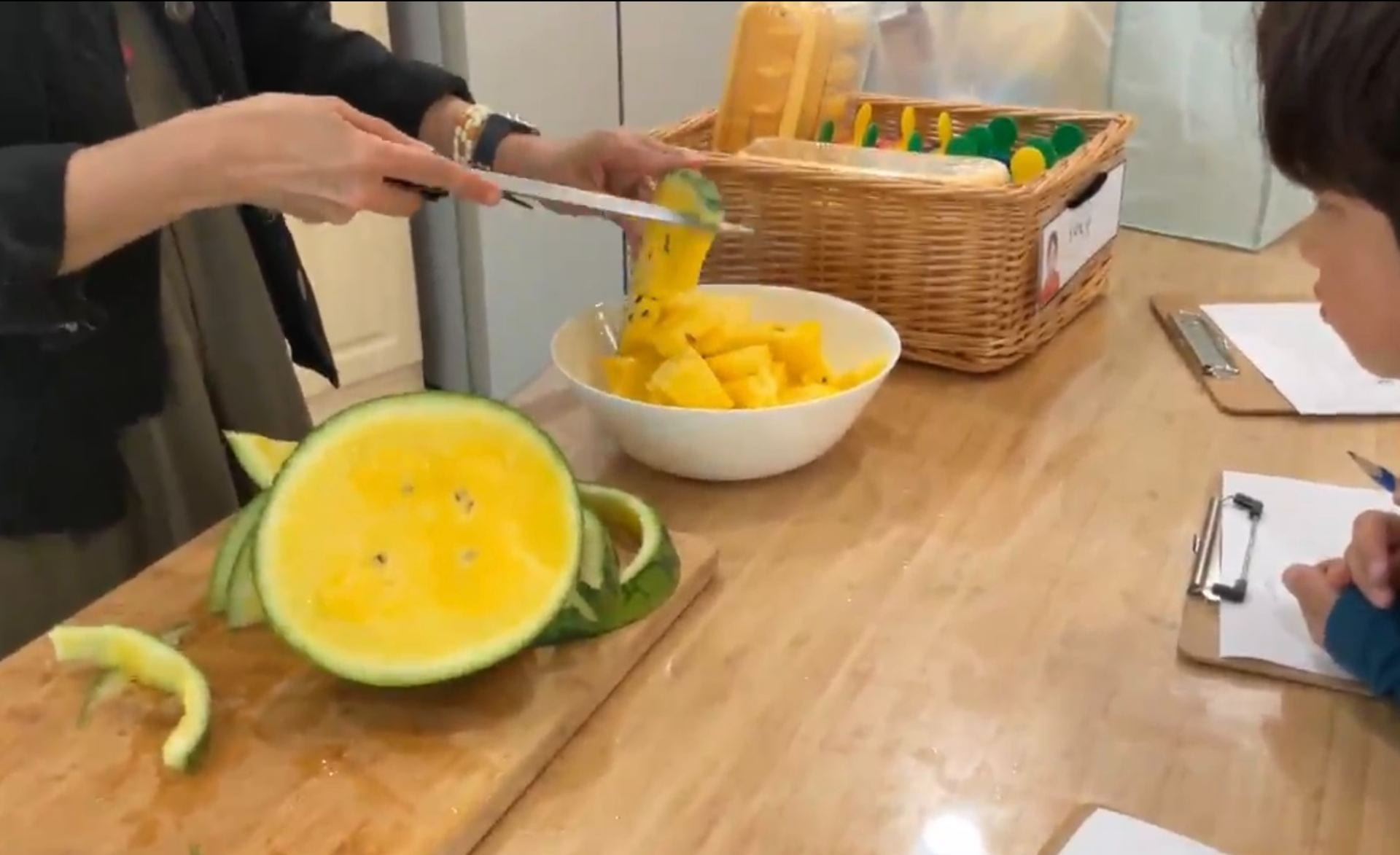
How many watermelons can we purchase for RMB59?

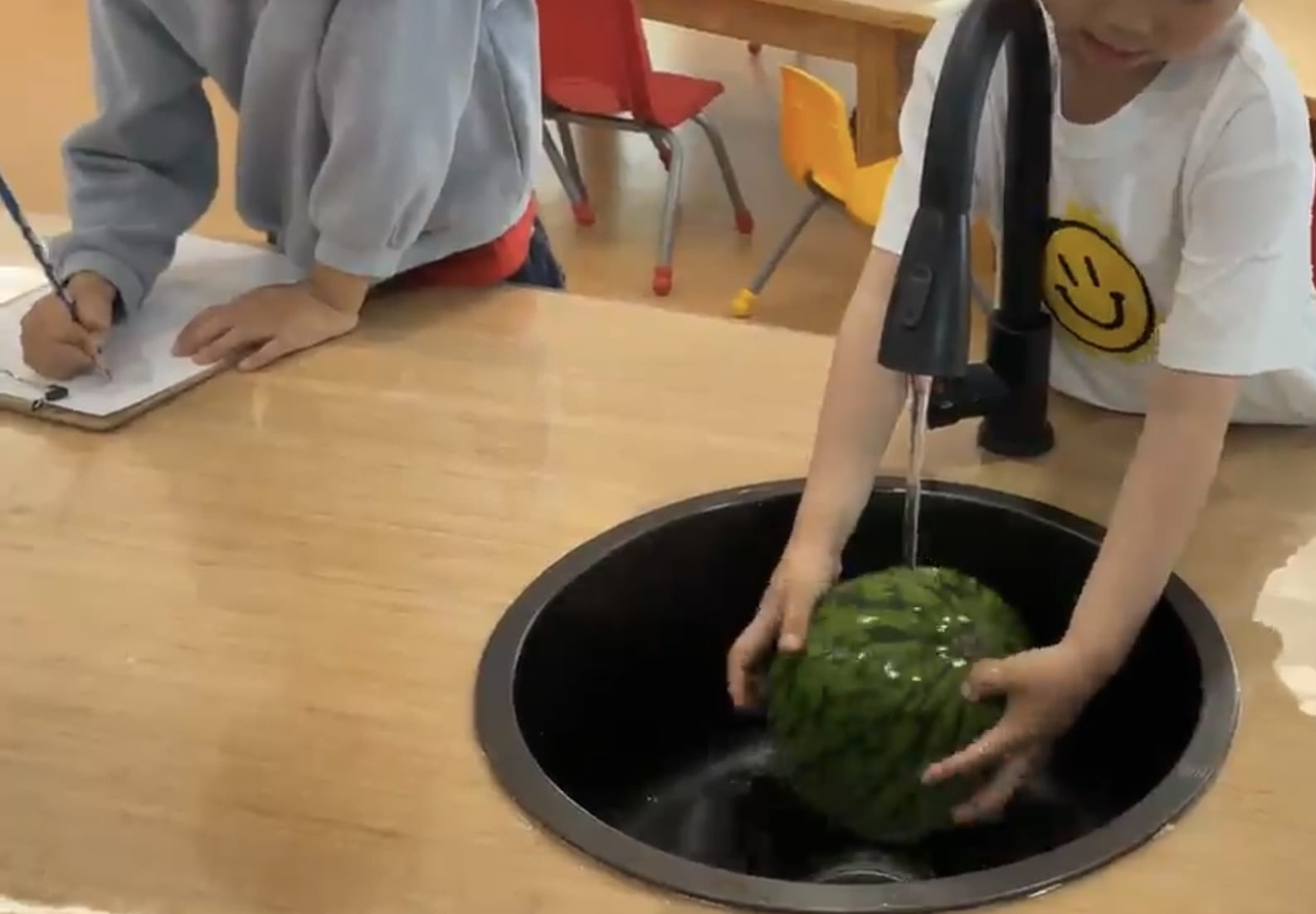
The children have been engaged in various activities related to ‘The Challenge Project’. Different teams will work on specific aspects of the project to help us stay organised. Following on from our inquiry into money, we were now ready to purchase the watermelon. It was time for us to have a small team walk across to the supermarket to buy the watermelon.

The shopping crew updated the others on their trip to the supermarket.

  • Riccardo “We went out of NIS.”
  • Jacob “We crossed the road. We walk over the walkway. Ms. Hannah helped us. The security guards helped us, he stopped the cars and we can go across the road.”
  • Isabella “We got to Suguo and we need to find the watermelon.”
  • Adalyn “We need to check the money. We had 59 RMB.
  • Suzy “We have to test it to see how heavy the watermelon is. Some of the small watermelons were not as heavy as the big ones.”
  • Isabella “We weighed the watermelons so we decide how many we need.”
  • Riccardo “The Suguo people helped us weigh the watermelon and told us how much money is it.”
  • Jacob “We carried it. If it is too heavy we cannot carry it so we need a small one.”
  • Riccardo “We choose 5 first. “
  • Jacob “We first gave them 57, then we gave them another 59. It was less than 59. 2 left.”
  • Adalyn “The two watermelon we add them and we buy them.”
  • Suzy “We went out of Suguo and we cross the road and we go back to NIS. We were safe.”

The experience at the supermarket helped the children experience the process of choosing and purchasing food items. On their trip, they needed to make many decisions and work together as a team to solve the problems they encountered.

Jacob “We are going to the supermarket to buy the watermelon for making the ice pop challenge. 3 minute challenge our buddy can make the watermelon ice-pop. We use 57 RMB to buy the watermelon and we took the middle one and one small one. We chose not heavy one, we choose the smaller one and smaller so we can carry this, used the basket too heavy. Me and Isabella carry it and go to school. We take a long time.”

Many opportunities for mathematical thinking and learning were explored. These authentic learning experiences are great opportunities for children to explore and learn about concepts through real-life experiences.

Our next step would be to carry out the test to find out how many ice pops we can make from one watermelon.


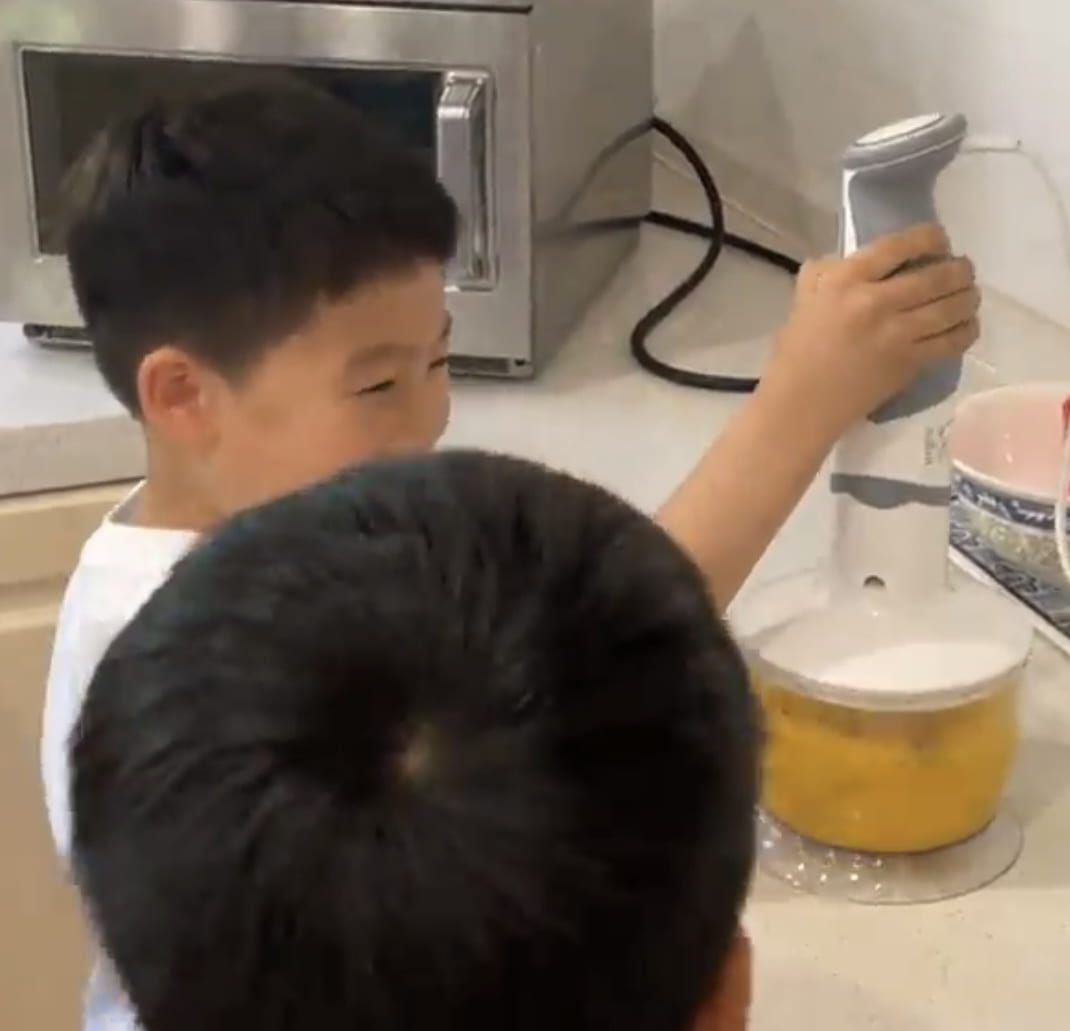
YAY! Making the Ice Pops!


  • Dahyun “We made the ice cream with the watermelon.”
  • Ciel “We put it in the freezer because then it will freeze.”
  • Evan “Then we took it out because we need to eat it in 3 minutes because we need to have a challenge.”
  • Isabella “It was really hard to take the ice pops out.”
  • Evan “Then we eat it in 3 minutes.”
  • Junsu “Some people don’t eat it in 3 minutes.”
  • Riccardo “It was really icy.”
  • Suzy “But it was yummy.”
  • Evan “It was so cold!”
  • Sea “We eat watermelon like ice pops. We eat it, it’s like cold. I ate it but my teeth was so cold.”
  • Adalyn “We eat watermelon ice-pops, it feels like cold.”
  • Isabella “It was sweet.”
  • Suzy “The ice pop, maybe it was sweeter a little bit more.”
  • Ciel “When Ms. Shemo took one ice pop out, it broke.”
  • Junsu “And watermelon is in the body.”
  • Dahyun “I eat ice cream then my body is so cold.”
  • Evan “I eat the ice cream my teeth feels off.”
  • Isabella “Riccardo finished the ice pop in 3 minutes. And Archie almost finished it.”
  • Sophia “Sea and Jacob finished next.”

The children explained, “It was a fun challenge because it was icy.”

We wonder what our next challenge would be…

What do we know about money?

We have been planning a small group excursion to the supermarket in front of the school to buy a watermelon. This was the planned next step of our ‘Ice-pop Challenge Project’.

Jacob had learned that the watermelon would cost RMB 59. As a lead into the trip, we asked the children what they already knew about money.

  • Archie “Buying stuff.”
  • Adalyn “Buying food to eat.”
  • Dahyun “Buying Lego and pants.”
  • Riccardo “Where does money come from?”
  • Archie “Everyone has money, but some Indian people do not because the tornado happened and outside they are littering so much. But Japan has money.”
  • Isabella “The money is made of paper.”
  • Jacob “Buying something, when you want to learn something, then you can use the money to buy it. Like cubes.”
  • George “I have money. A little money. My mum gave me money. I use to buy toys.”
  • Sea “I have so many money because I have Korea money. And I put the money in the box and I have Nanjing money too. I think face on the money is different.”
  • Ciel “I have so many so I put in a piggy bank. It is a pig and there is a hole and we put the money, then it will be safe.”
  • Junsu “I have lots of money and I don’t know how much money I get. My dad didn’t tell me. I got the money from dad.”
  • Dahyun “Chinese money is different to Korean and Japanese money.”
  • Euno “I go to Dahyun’s house on Monday and I see Dahyun’s money is many. But I have little money. My grandma gives me money in Korea.”
  • Jacob “My home has lots of money but my mum and dad don’t tell me because then I will tell everybody and its not good. My money is more than other people. Other people want me to give money to him.”
  • Suzy “How do we make money?”
  • Ciel “We can make it with paper.”
  • Sea “I think you need to make with water and paper. If money is like paper.”
  • Jacob “I don’t know where we get money from but I know what is used to make it.”
  • Ciel “We get it from the bank. My mum gets it. They will change the money. There is a little hole and you put it.”
  • Adalyn “Work. My mum and dad work and can get some money.”
  • Sea “Dad is so long time at home and another day short time. He gets money.”
  • Jacob “My mum need to be at home to do our work. Like looking after me.”
  • We keep money is our home.
  • Archie “Give the money to the shop people.”

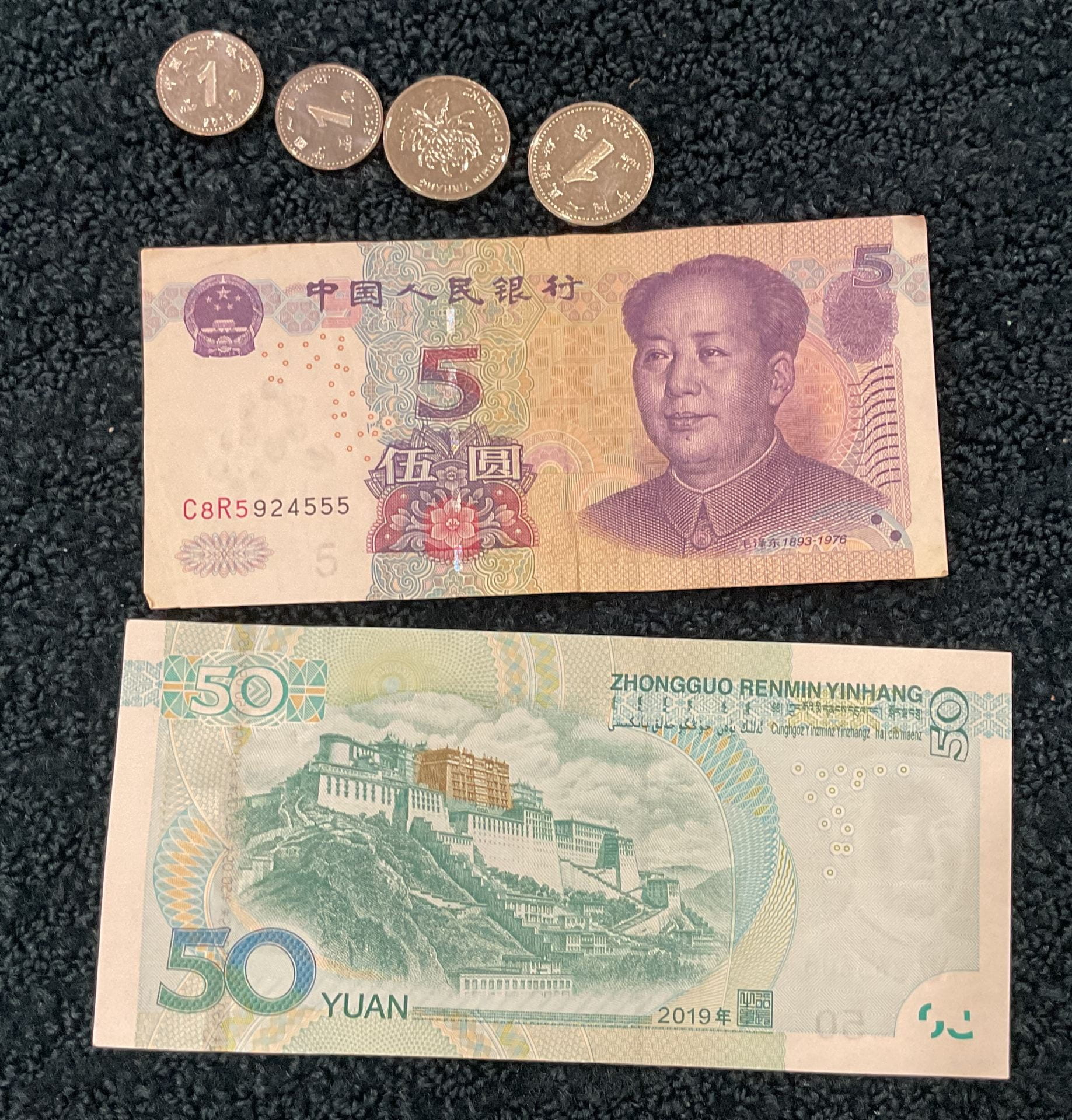
We decided to empty a wallet to find out how much money the teacher had. As we laid out the different coins and notes, The children began to talk about what they noticed about the money.We placed Base-10 blocks next to the notes and coins to talk about the value and calculate the total.

The children were curious about the different writing, symbols and images on the notes and coins and how they signified currencies from other countries.

  • Ciel “Money is also made of metal.”
  • Archie “The money is on paper and the colour is rainbow.”
  • Sea “Colour is different.”
  • Ciel “Because 20 is smaller than 10. Because then we know they are not the same.”
  • Euno “My money is five money, five 100 money.”
  • Suzy “Maybe we use the paper to cut around. A long paper, not too big and not too small. Suzy When we go to the supermarket we will draw the number then other people can know how many coins does the paper have. My money and daddy need money to buy food, because when we eat all the food then we can’t buy food.”

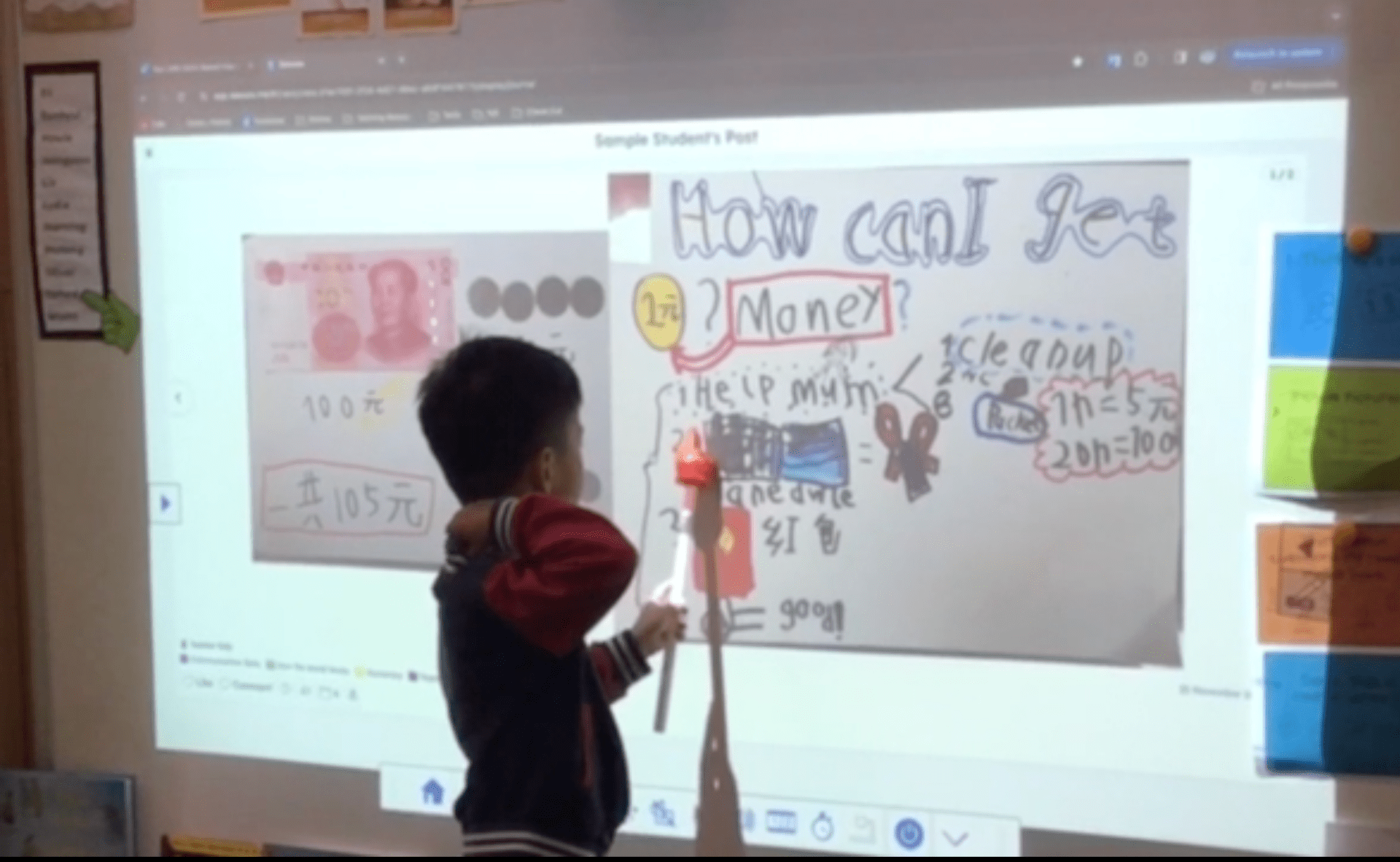
Jacob decided to calculate to find out how much money was in the wallet. Then, he set aside RMB 59 to buy the watermelon.

Next, a small group of children will visit the supermarket to buy the watermelon. Their research will help them calculate how many watermelons they will need to purchase to make enough ice pops for themselves and their Grade 5 buddies.

The Field Trip Updates

How many cartons of milk do we need to give everyone a cup of chocolate milk?

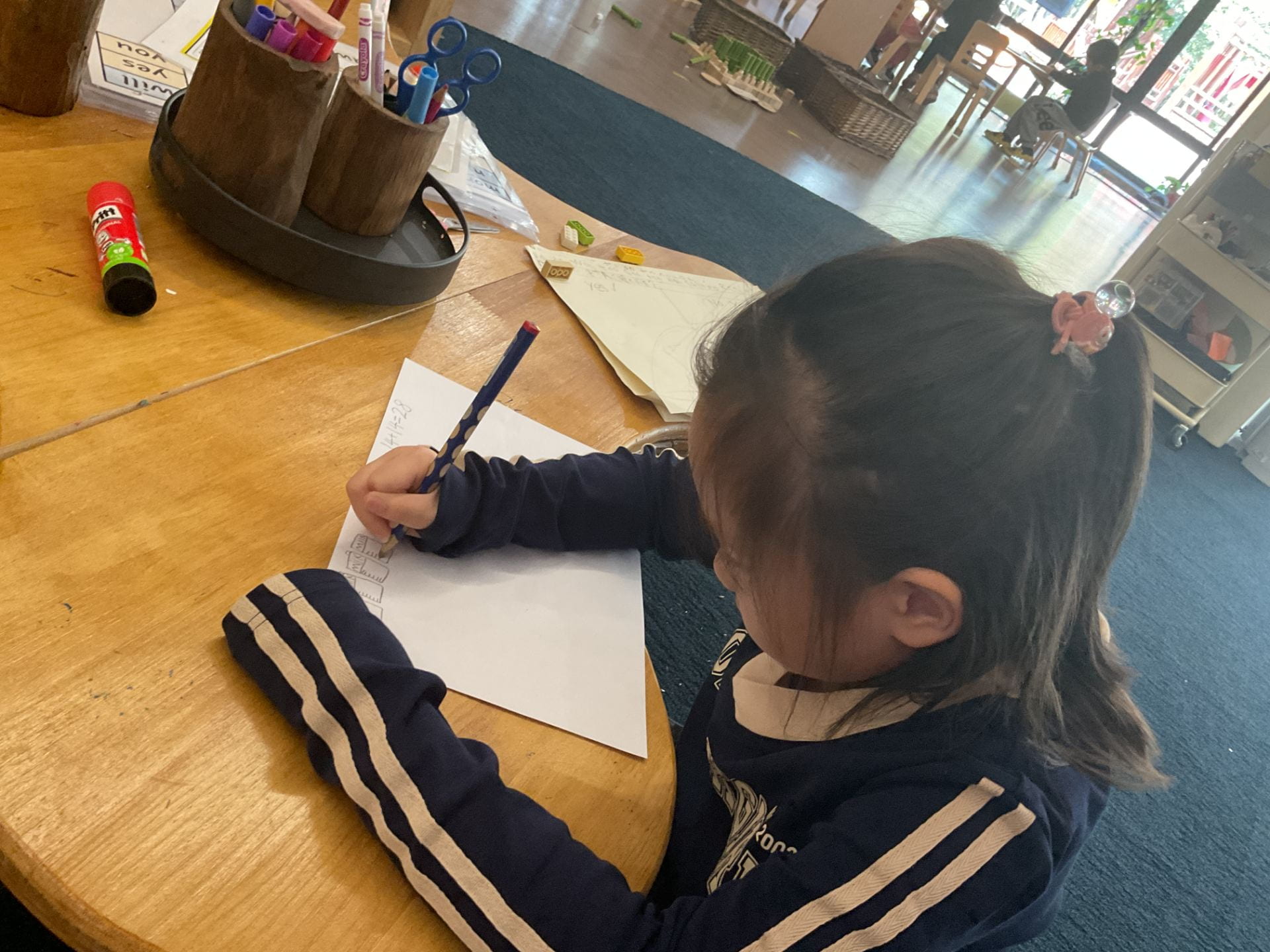
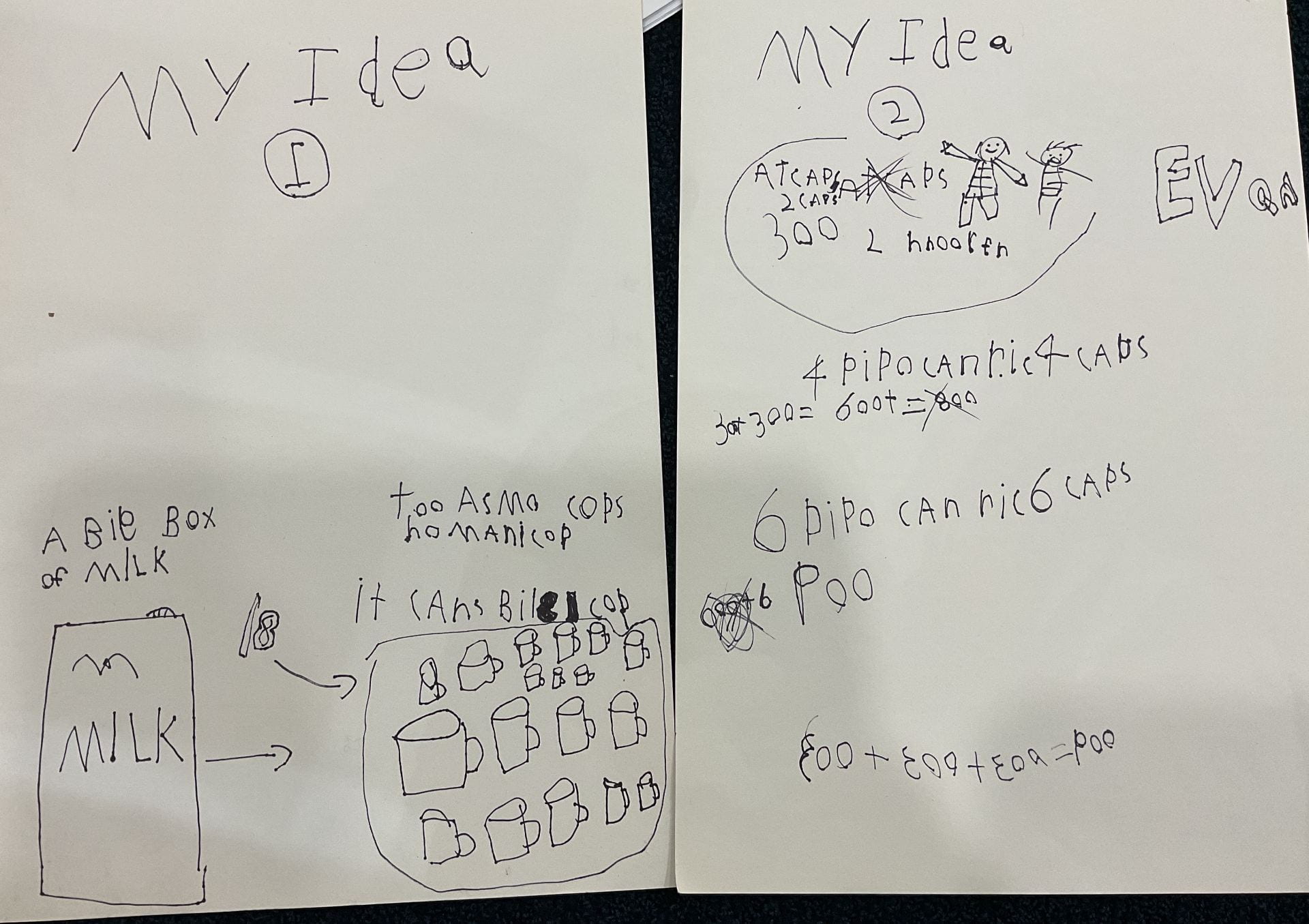
After working with a group of mathematicians to calculate how many cups of milk there were in one carton of milk, Adalyn took the initiative to work out how many cartons of milk we needed all together to make chocolate milk for both K2 classes. She illustrated the problem and the process, using pictures, words, numbers and symbols to show her problem-solving strategies

Adalyn explained her process to the class, suggesting that 6 cartons of milk would be enough for the 28 children, four teachers, Ms. Hannah and Mr. Patrick. She also suggested that we bring the two remaining cups back for Ms. Dora and Ms. Jacqui.


How many seats are there on one school bus?

Ciel counted the number of seats on the school bus…


Ciel “I counted the bus seats because then we can go to the field trip. Then we can know how many children and teachers can go in the bus. We will need 2 buses because if one bus has 28 seats but teachers go too, so there won’t be seats for the teachers so we need one more bus. Then the K2A teachers go in the K2A bus and the K2B teachers to in the K2B bus.”

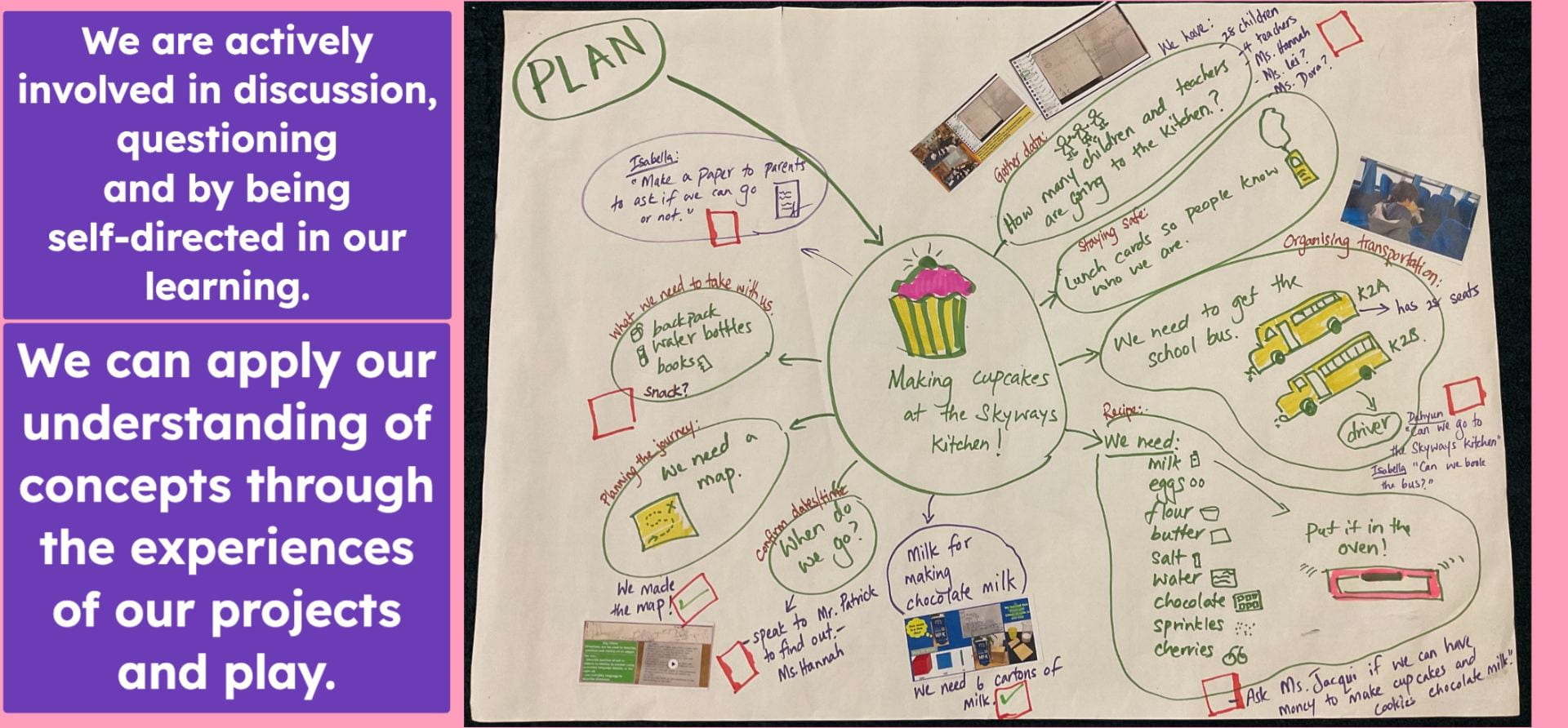
We updated our trip planner, including more information, checking off tasks that we have completed and adding more steps where appropriate.

When children have AGENCY they:

  • can apply their understanding of concepts through their experiences, projects and play.​
  • are actively involved in discussion, questioning and by being self-directed in their learning.

The Survey

We referred to our plan for the trip to the Skyways Kitchen to plan our next steps. The children were eager to invite K2B to join us on the trip to the kitchen. The team created a survey to find out how many children and teachers would like to join K2A on the trip.

Suzy “We can ask them, ‘Do you want to come to the Skyways kitchen to make the PTA but the cupcakes?’” The team wrote their question and possible responses. Then, they went off to K2B to speak to their friends.

Dahyun “I am finding the letter and big letter and I write that. Because then I know letters. Because I sound it out and find the letter, and it helped.”  

Euno “I write the question. I used the alphabet chart to find the letters. I see the alphabet chart and I can write the word.

I sound the letter. It was a little bit hard but then I sound and write and see the alphabet chart and write.”

Euno “I asked ‘Do you want to go to the cafeteria for making the PTA cupcake? And they said ‘yes’. I tell him sign your name on the paper on the ‘YES’.”

Dahyun “Because he want to go to Skyways kitchen and make cupcakes so they say it in the paper. Everybody said yes.”

The surveyors presented the data to the rest of the class explaining their process and what they learned as a result of their research.

Suzy “We are going to K2B and ask them and then I write the names. Everyone wants to go!”

While presenting the information, the class noticed that one child did not want to join the field trip. We wanted to make sure that the team had surveyed all the children. Therefore, we decided to check the responses against the K2B class list. As the names were called we realised that two of the children had not responded to the survey.

The researchers went back to collect the data they needed.

The class was pleased with the results both teachers and 13 of the 14 children wanted to join the field trip.

Having collected the information they need, they are ready for their next step, deciding on the date and booking the school buses for the trip.

The Chocolate Milk Project: Calculating Volume

The children are deeply engaged in their inquiry, solving problems and organising themselves to help plan the field trip to the Skyways kitchen. One of the suggestions they had was to make chocolate milk at the Skyways kitchen. We decided that this would be a good opportunity for the children to solve a real-life problem using their understanding of number and calculations. 

How many milk cartons do we need to make chocolate milk for all the children and teachers in K2?

We began by estimating how much milk they thought they would need.

  • Evan “I think 2 boxes of milk because we can drink with 2 classes, because one class can drink one milk.”
  • Adalyn “We don’t know how much one box of milk has.”
  • Ciel “I think it has 20 or 25.”
  • Jacob “I think 25 meters. We can measure it. With a ruler.”

Estimating how many cups of milk are in one carton.

The mathematicians drew to share their ideas, the estimates ranged from 10-20 cups in each milk carton.

We noticed that the children were referring to the ‘units’ (millilitres) of measurement when talking about volume. Riccardo had also suggested using a measuring cup with numbers on the side to measure the milk. Their explanations and suggestions communicated their working theory that, ‘we can use a ruler and measuring tools to measure accurately’.  Having noticed this interest in using standard units, we decided to draw their attention to the 1L displayed on the milk carton.

But how much is a litre (1L)?    

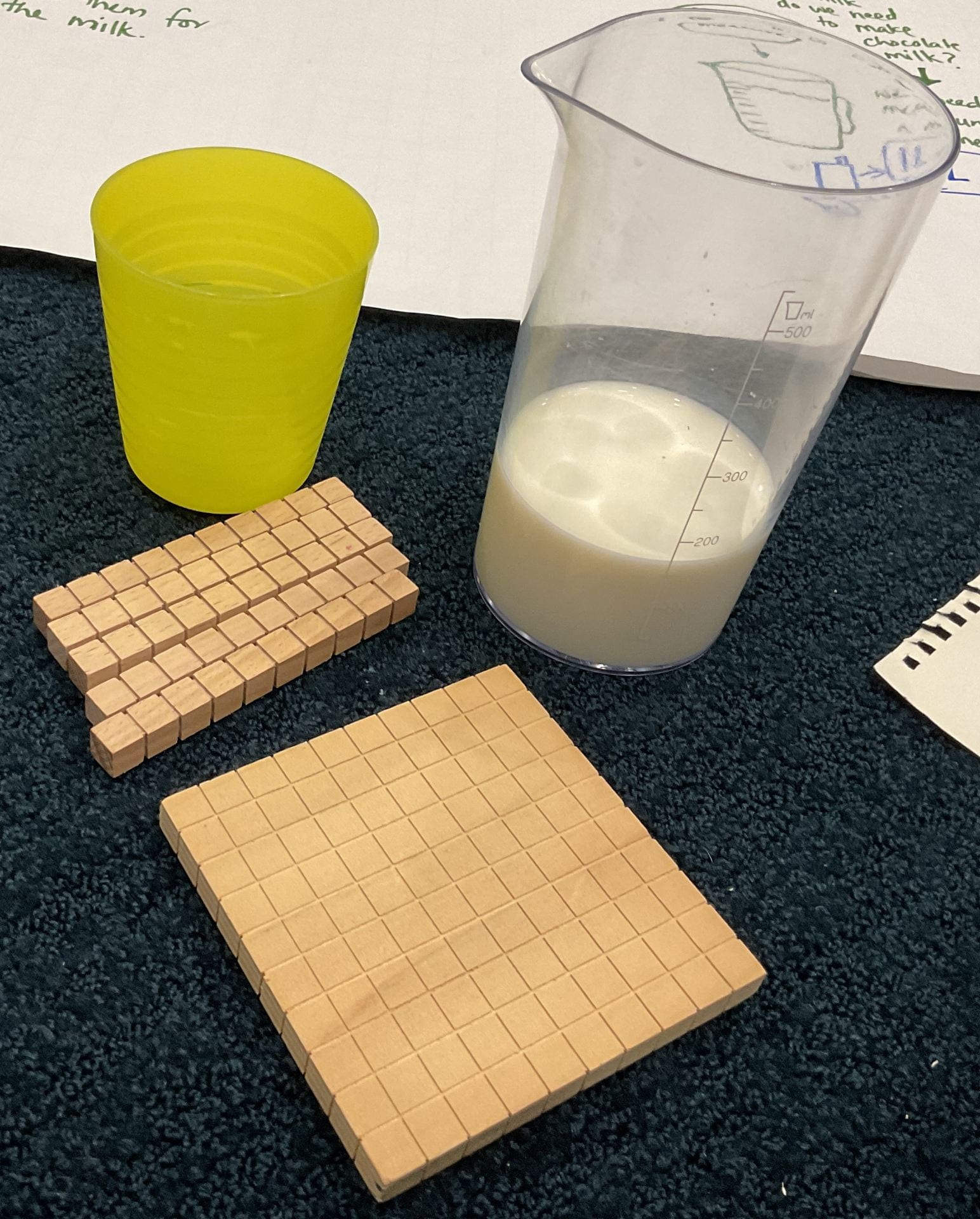
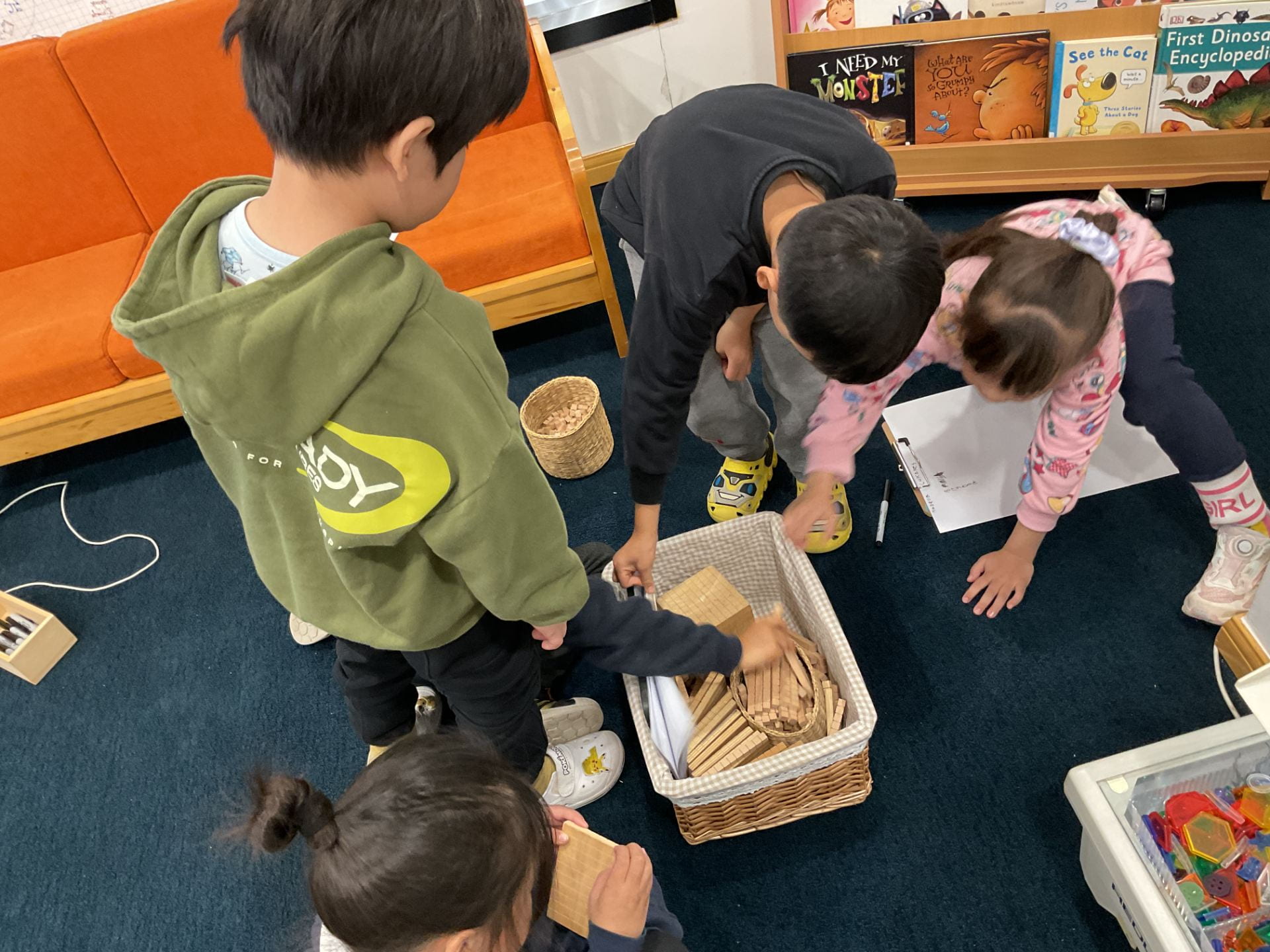
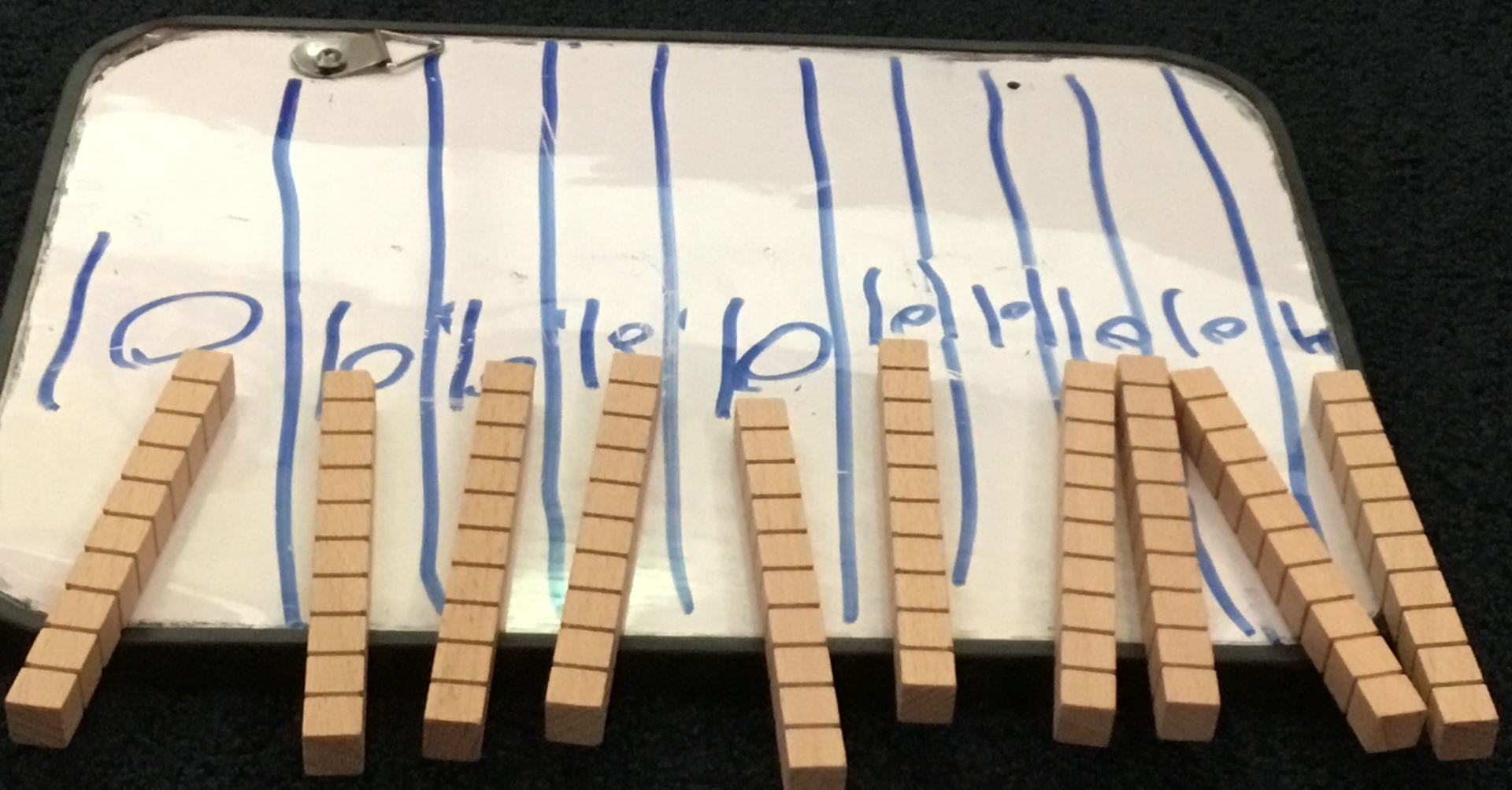
As the children are familiar with the use of the Base 10 system to represent numbers and number relationships, we used the blocks to draw a parallel to the ‘volume’ discussing the value of one, ten, one hundred and one thousand.

The mathematicians concluded that the milk carton had 1000ml, or one litre (L) or 2 of the 500ml jugs of milk.

We decided to check if Jacob’s estimate that a cup of milk was of 25ml was correct. We poured out one cup of milk from the carton and used the measuring jug to measure it. We learned that there was 150ml of milk in one cup. We used Base10 blocks to show the number.

How would we know how many cups of milk were in each milk carton?

The mathematicians used words, images and numbers to make their thinking visible. As they documented their ideas, we noticed that they were calculating the quantity in millilitres and cups. Therefore, we continued to use the Base-10 blocks to help them calculate, solve and explain their math problem.

We noticed that each child processed the problem and documented their strategies differently. They shared and listened to each other’s strategies and thinking and helped each other with the calculations.

Together, they learned that a carton of milk had about 6 cups of milk.

The team presented their process and learning to the class.

  • Ciel “We measured what milk is inside.”
  • Evan “We measured about 100 of milk.”
  • Jacob “One box has equals 6 cups of milk. Because we already measured it. One cup has 150 %.”
  • Evan “2 cups have 300 ml.”
  • Adalyn “4 have 600ml because 300+300=600”
  • Evan “6 cups have 900 because we think it.
  • Adalyn “Because 600+300=900ml and 100 left over.”
  • Evan “Yes, because 900+100=1000.”

We look forward to our next steps as we plan our trip to the Skyways kitchen. 

A plan to make Chocolate Milk!

We decided to revisit our first ideas about the wasted milk. The children recalled Mr. Patrick’s suggestion to make chocolate milk when they visit the kitchen.

  • Adalyn “We can use the milk to make chocolate milk.”
  • Riccardo “But we don’t know how to.”
  • Suzy “I know, Mr. Patrick knows. We can ask him.”
  • Jacob “K2A and K2B are going to drink the chocolate milk.”
  • Riccardo “We need chocolate to make the chocolate milk but we don’t have it. Maybe we can go to the cafe to buy some chocolate.”
  • Jacob “We can buy the chocolate from the cafeteria where we get lunch.”
  • Suzy “We can go to buy the chocolate from the chocolate shop.”
  • Jacob “We can collect milk from K2A, K2B and K1 when we have lunch in the kitchen. We can ask them for the milk that is not used.” 

Teacher “How much milk do we need?”

  • Jacob “We can measure the milk with a ruler.”
  • Riccardo “We can measure it with the ruler plate, the plate with numbers.”

The children’s conversation revealed their understanding that we use tools to measure accurately. They suggested using a measuring cup to find out how much milk we need to collect for both classes to have a cup of chocolate milk.

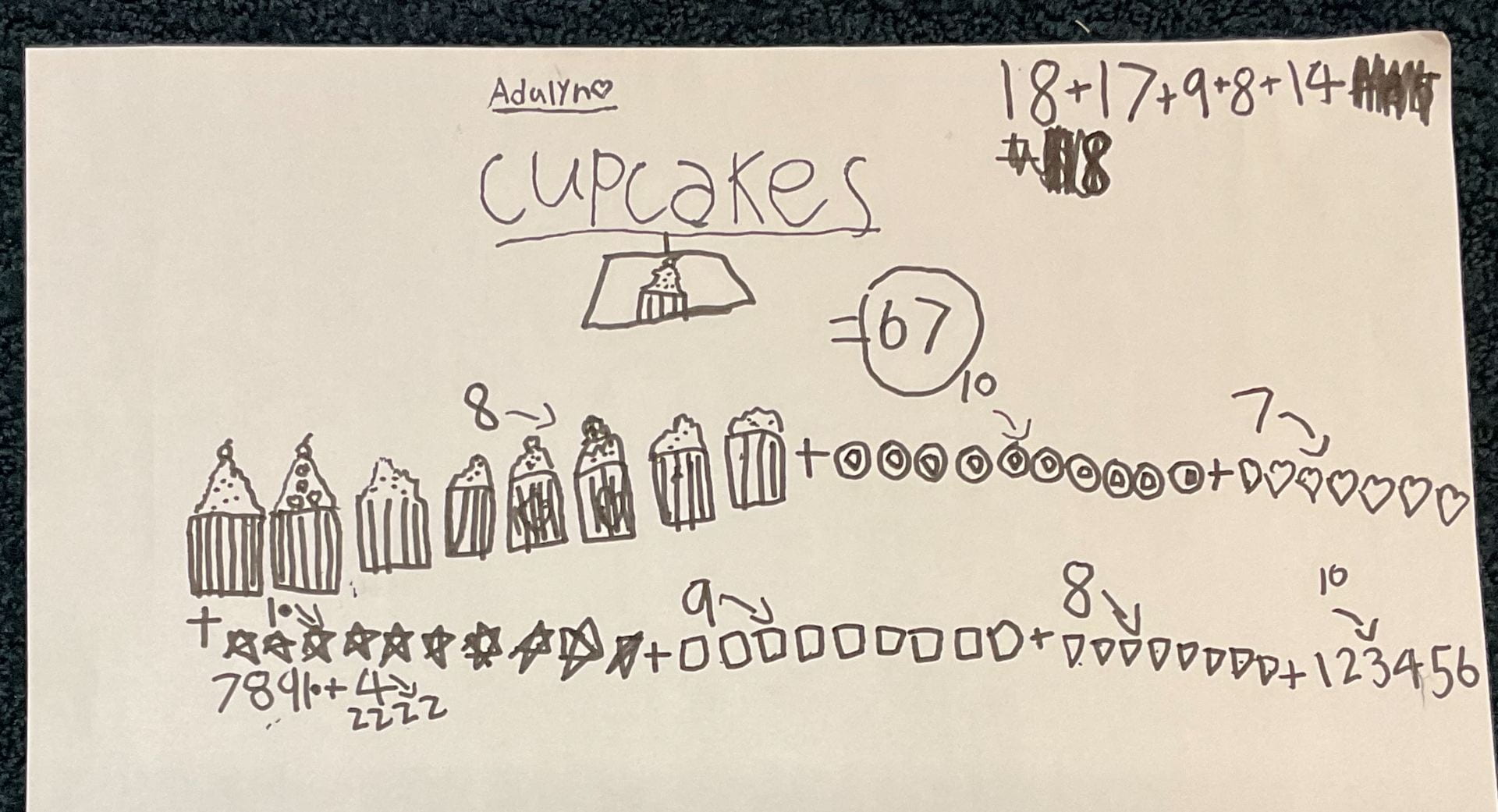
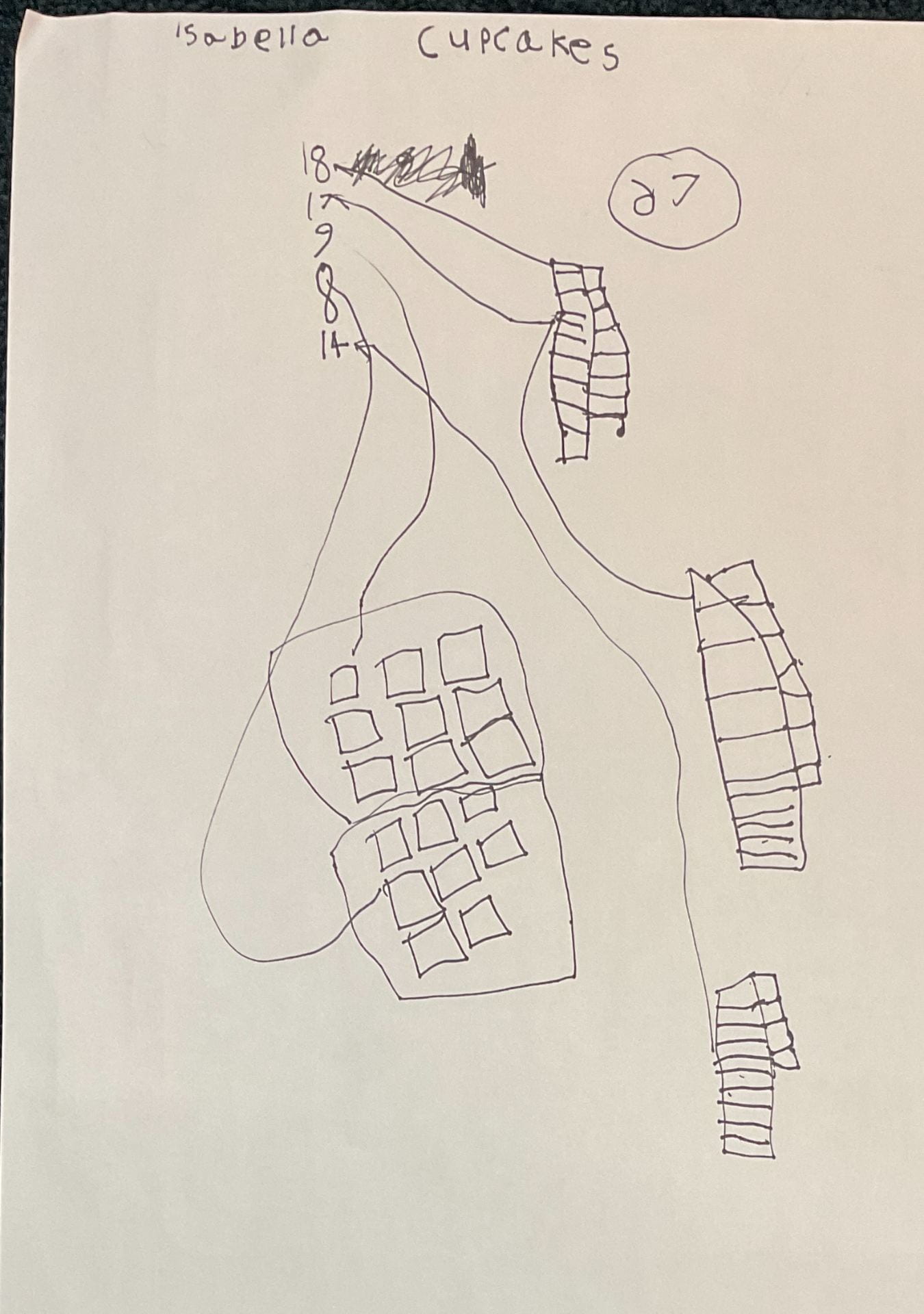
How many cupcakes do we need to make?

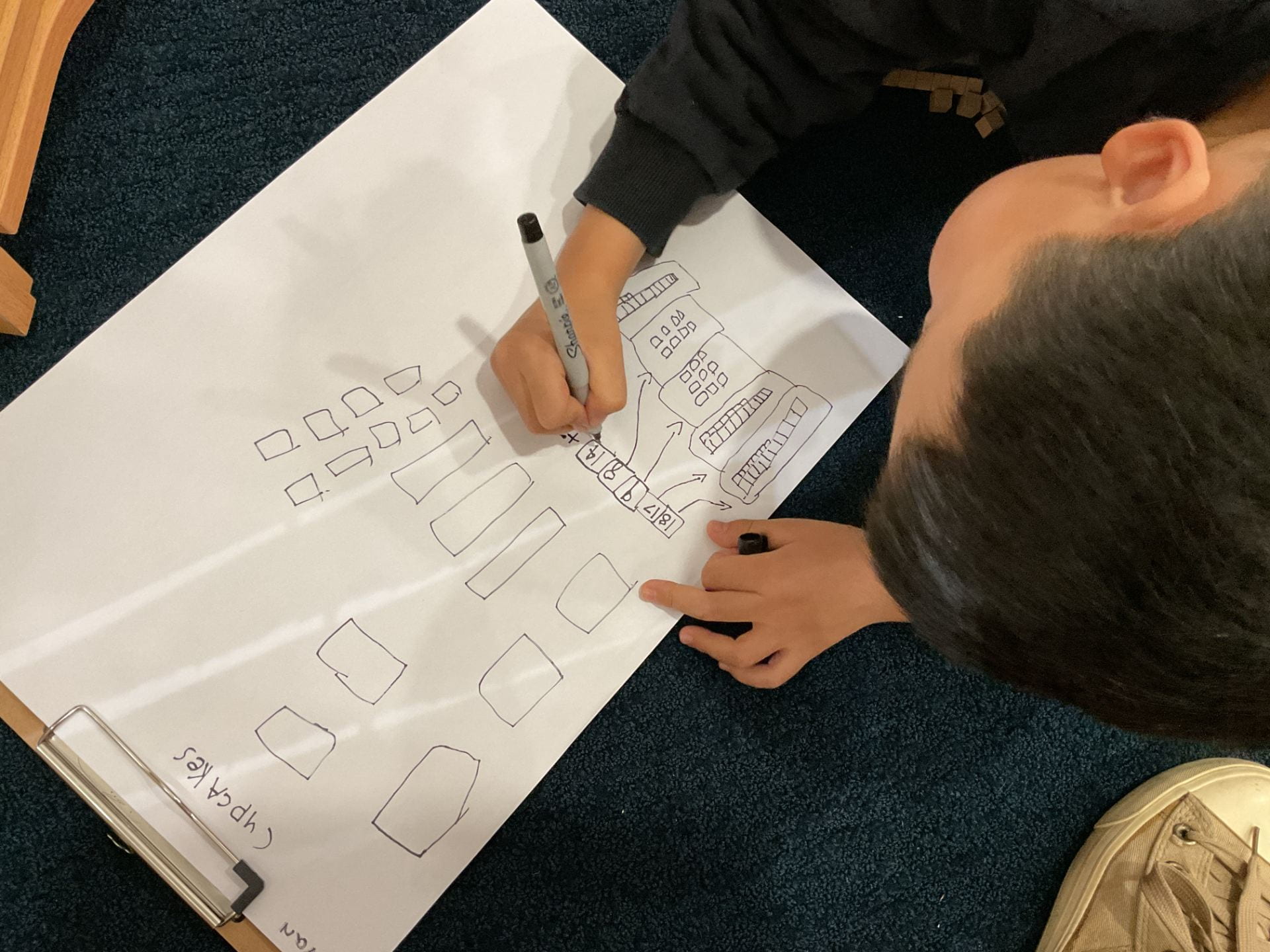
A team were tasked with calculating how many cupcakes they needed to make for the NIS community that did not receive the birthday cupcakes.

The children went back to the list to see how they could solve the problem. Paper, pens and manipulatives were available as resources.

  • Jacob “We are going to the PTA where they make the cupcake so we will have a trip.”
  • Ciel “If you lose the PTA cupcake, you will tell the teachers and the teachers will help you find it.”
  • Isabella “We are putting the numbers together to figure out how many all together.”

  • Suzy “We are writing the people who didn’t have the PTA cupcakes. We will give them a cupcake.”

  • Evan “We used the counting blocks to see how to count the numbers because it’s too hard for us.”

  • Isabella “We need to have the same number. Maybe we need to agree with each other then we can say the same number.”
  • Suzy “We can talk to each other then we can have the same number.”

Further to the children’s suggestion, we decided to use the virtual Base 10 blocks to discuss and solve the problem together. The children helped colour and count the different addends to find the total.

The cupcake problem helped the children explore the different strategies we can use to solve number problems. Making their thinking visible through their drawings helped them communicate their ideas with each other.

Additionally, the children explored the relationship between their drawings and manipulatives and their function in solving mathematical problems.

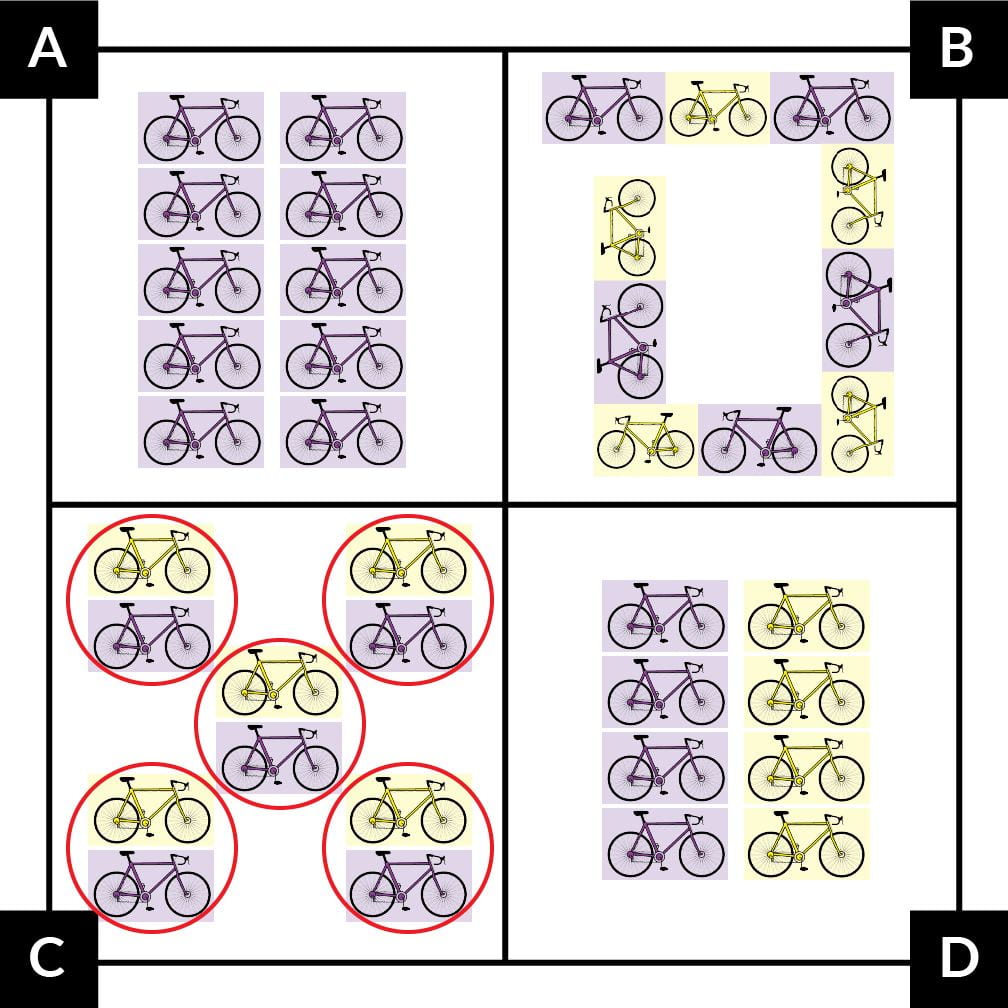
Which one does not belong? Bicycles

Which one does not belong? Why?

The children were encouraged to look carefully at the four different quadrants with bicycles. They had to decide if A, B, C or D did not belong and explain why. A group of children focused on the positioning of the different bicycles explaining that some were parked in the shape of an X and others in rectangles. Ciel noticed that some bicycles were smaller than others. Isabella and Suzy decided to count the number of bicycles to decide which section did not belong. We moved to count the number of wheels in each section. Then we counted how many purple or yellow bikes each section had.

The children use their knowledge of doubling to find the total, explaining that 4 + 4 was 8, 5 + 5 was 10, 8 + 8 was 16 and 10 + 10 was 20.

The ‘which one but doesn’t belong’ activities help the children look carefully at the clues provided to make decisions. It encourages them to think about what they know about numbers, patterns, shapes and data, and to explore connections to make decisions. These mathematical conversations help the children estimate, notice and analyse information to develop their mathematical identities

The Trolley Project – Measuring Accurately

The team reviewed the information they had gathered about the missing components to decide their next steps. Isabella volunteered to help with the process.  

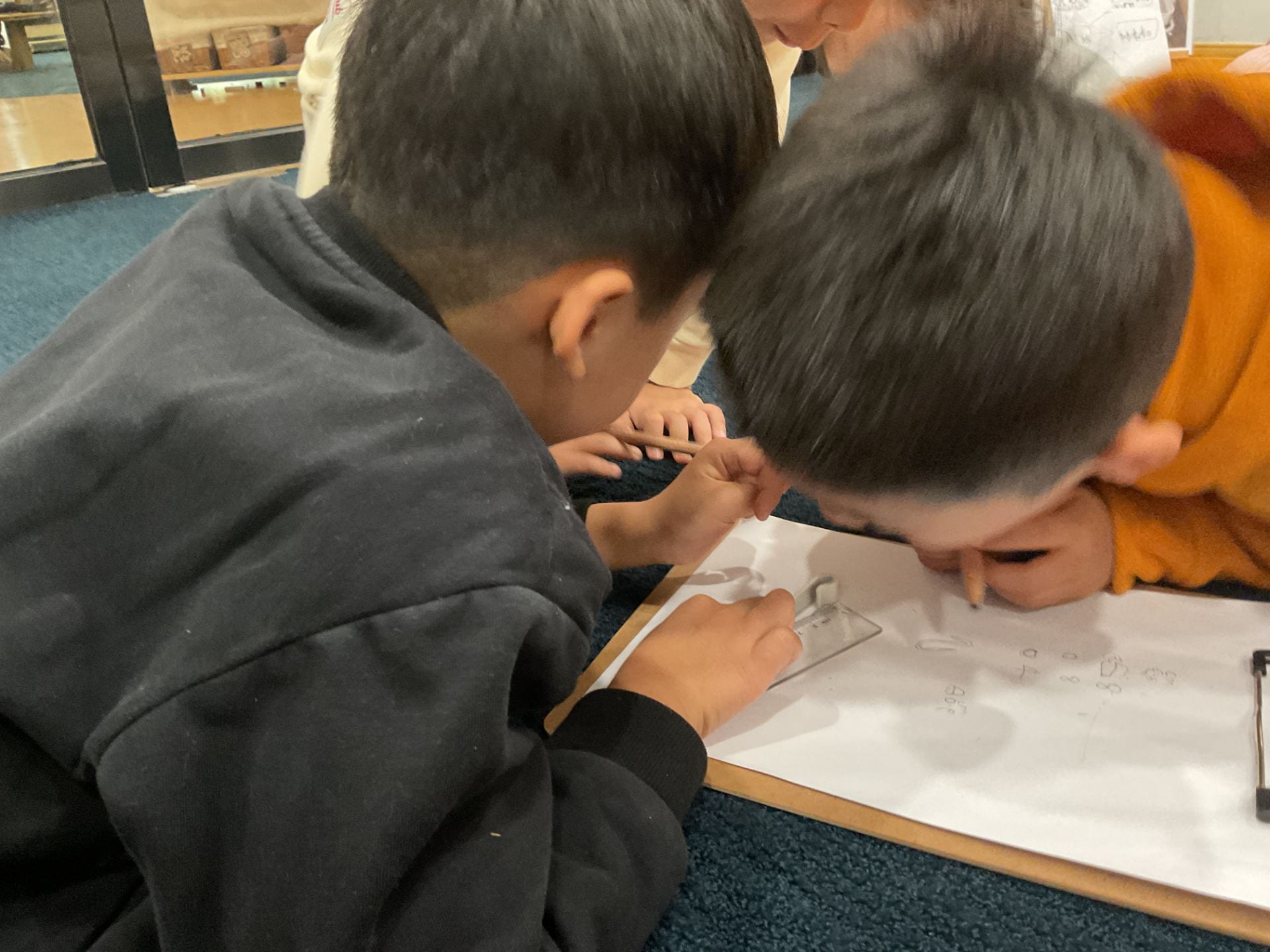
They decided that an important first step was to measure the missing parts accurately, to order the correct items. The team used what they knew about measurements and measuring tools to begin their work.     

  • Jacob “You should measure it from the top.”

  • Adalyn “But I think it is better to only measure the stick part.” (She thought she should start with 1cm.)
  • Jacob “The length of the screw is a bit longer than 3 and a half.”

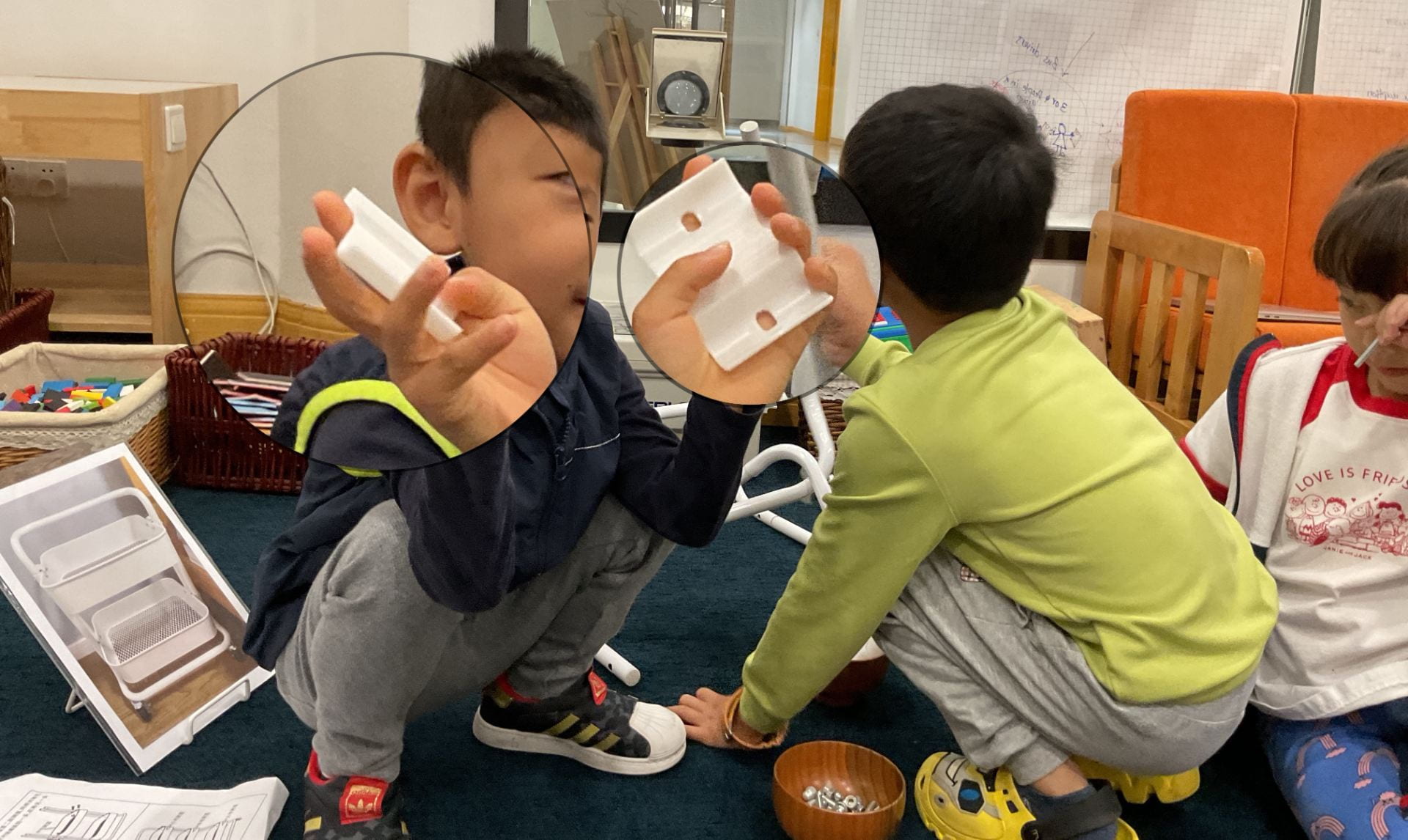
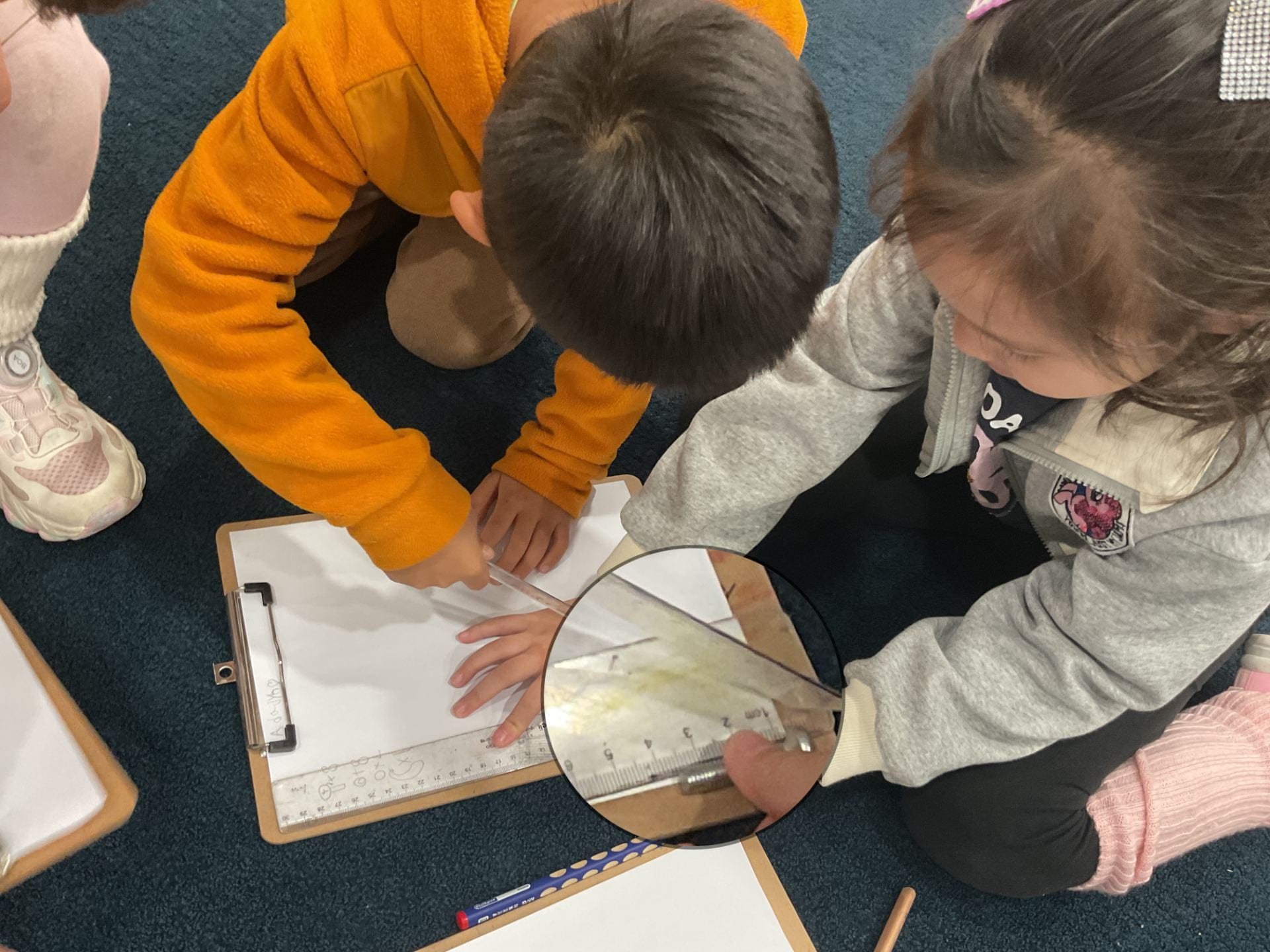
The team sought Ms. Sophia to discuss the function of the hash marks on the ruler, exploring the connection between millimetres and centimetres. They found that each small space was 0.1cm, and the measurement was 3.6 centimetres.

Evan placed marks on the picture and drew an arrow to the number, to show the purchasing officers which part of the screw they were measuring.

He wrote the unit cms beside it, which lets others know what the number means. Everyone decided to follow Evan’s method to avoid any confusion.

Jacob decided that he wanted to measure the diameter of the nut and placed the ruler on the head of the nut to find the measurement.

Evan and Jacob measured the length of the hook, it was 4.5 cms.

Adalyn thought it was necessary to also measure the width of the hook, “It is 0.9 cm wide!”

  • Jacob “We don’t have the black rings to use as a example because they are all missing. But I can draw a picture of them instead.”
  • Adalyn “But it is not the exact thing. It’s just your picture of the thing, and there must be some differences between your drawing and the thing we want. We can take a photo of the wheels to show people, because the rings are for the wheels.”
  • Isabella “And we should measure the wheels as well.”
  • Adalyn “It is 7 cm.”
  • Jacob “No, it is 8 cm.”
  • Adalyn “If you measure it from 0, it is 7 cm, and if you measure it from 1, it is 8 cm.”

After we took a break from the project, Adalyn and Isabella decided to work together to find out how many millimetres there are in 1 cm using a ruler to count all the small lines between the 2 numbers.

  • Isabella “It is too hard for me to count the small lines because they are too small.”
  • Adalyn “We need a magnify glass to help us look more clearly.”

They worked as a team to figure out that there are 9 lines between 2 numbers on the ruler, and if they add the two long lines right under the two numbers, there are 11 lines.

Isabella “So how many millimetres are there in 1 cm? 9 or 11?

Food Waste – Choices and Responsibility

We have been discussing the concept of waste, thinking critically about the choices we can make to reduce food waste. A photograph of the food waste in K2 during lunchtime led to many discussions about choices and our responsibility to reduce waste.

The children wondered how much food waste we had at lunchtime. We decided to collect the leftovers from the lunch boxes to find out.

How do we know how much food there is in the box?

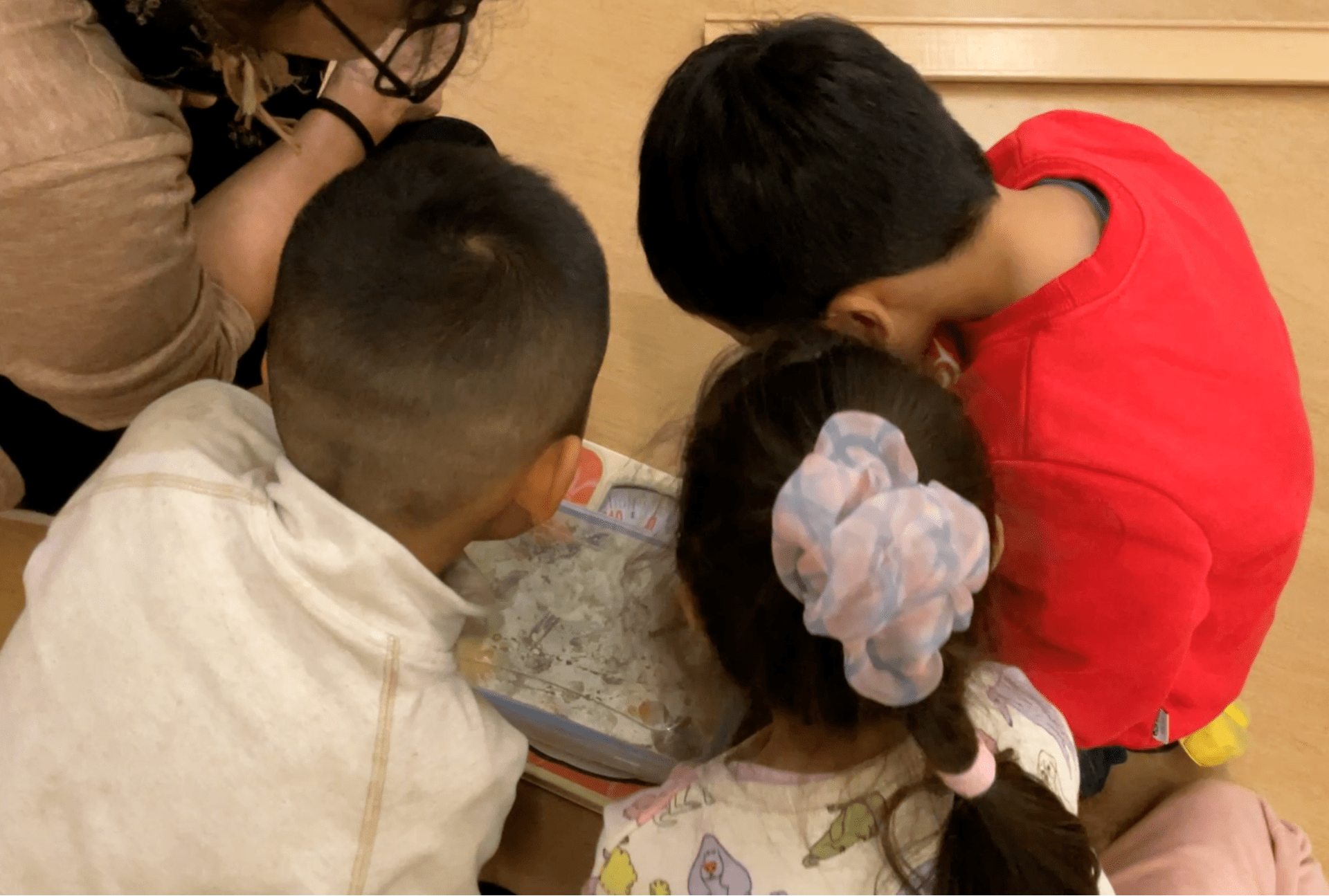
We decided to read a book about measurement to help the children think about the tools we use to measure ingredients and food.Having seen the images in the book, we decided to weigh the leftover food. Mr. Arek told us there were scales in the cafeteria for this purpose. A team went over to the cafeteria to see if they could weigh the box of leftovers.

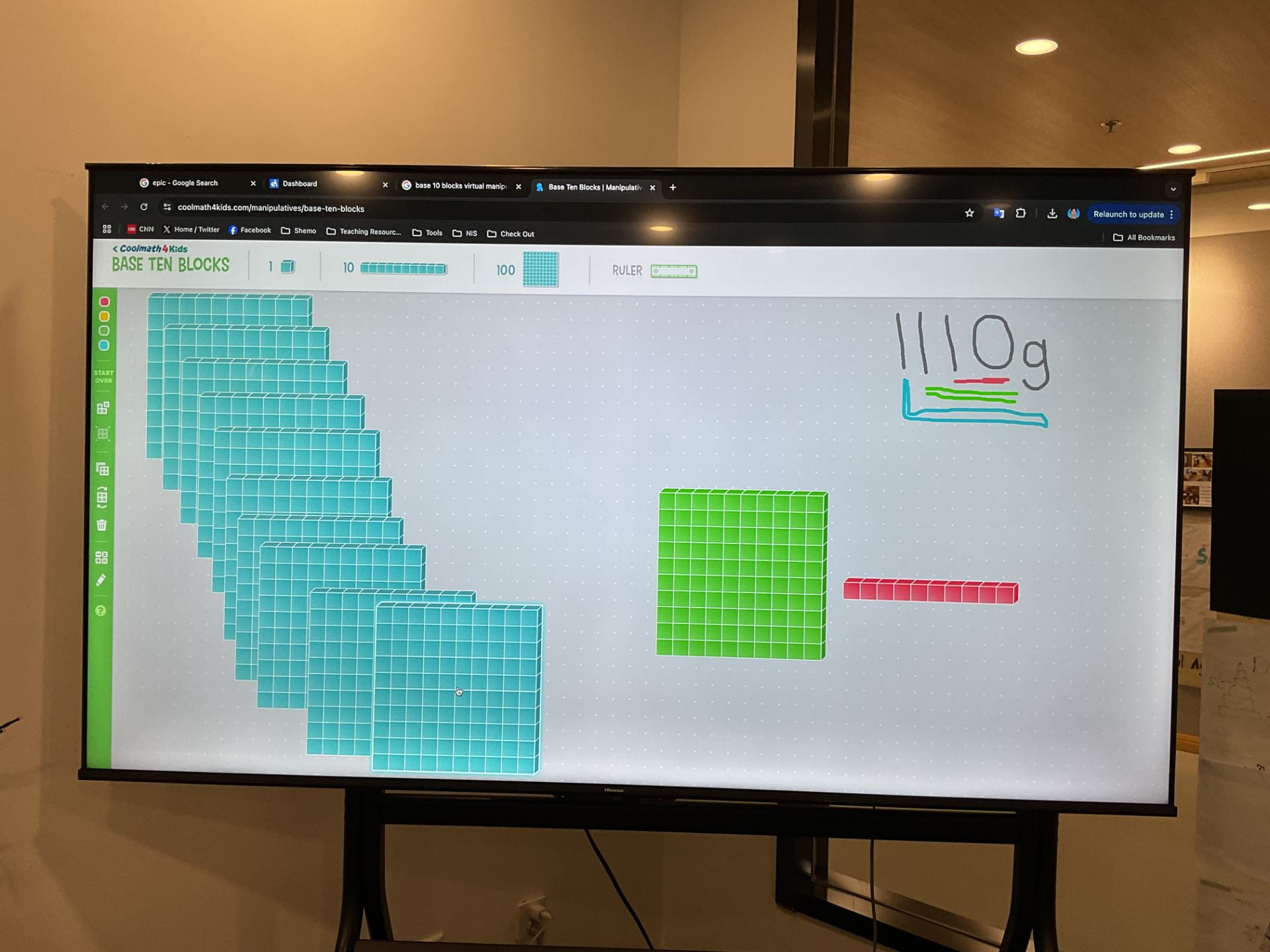
They learned that the box was 1111 grams. When we returned to the classroom the children used a scale Mr. Seth had in his classroom to see if it recorded a similar weight. They also tried weighing the box of food using a bathroom scale.

Children were unsure about the number that was recorded on all the different scales. On day one we had 1110g of food waste. We decided to use manipulatives and virtual tools to talk about big numbers.

Reflecting on the waste we had collected, the children decided to make an effort to reduce the waste by:

  • eating more food from their lunch box
  • trying to eat different foods they don’t normally try
  • Remind their friends to eat more and talk less

On the second day, we weighed the leftovers to see if there was a difference. This time the scale recorded the weight of 534 grams.   

Was the food waste more or less than on day one?

We used the base 10 blocks to see what these two numbers looked like. We talked about regrouping the hundreds to make a 1000 when showing the number 1110 grams. We used the words more and less to describe the two lots of manipulatives.

Having seen that the second day’s waste was less than the first, we decided to explore some other ideas to reduce food waste. We discussed the different foods that were offered as options in the children’s school lunch box.

Which of these foods were their favourite which ones did they dislike eating and why?

The children drew and wrote to share all their favourite school lunch options.  

We wonder how we might organise the data that we collect about the school lunch.

  • What does the data tell us about the food the children prefer to eat?
  • How might we use this information to improve some of the choices we have for school lunch?

Voting for 3 Minute Challenges!

We have noticed the children are showing interest in the concept of ‘time’. Isabella and Adalyn have been thinking about what they can do in 3 minutes.

But how long was 3 minutes? We used an online timer to ‘feel’ the time pass by. The children sat patiently, thinking about the length of time that passed by.

We challenged them to think about the things they could do in 3 minutes. They drew to share their thinking:

  • Euno: Draw a heart, Take a photo, Talk and share 3 ideas
  • Isabella: Run 3 circles in the playground, Read 2 small books in the library, Put my socks on
  • Ethan: Go to sleep, Cooking a cookie, Eat snack
  • Archie: Go on a train to Africa, Come to school in 1 minute, Go to Japan in 5 minutes, Put my shoes on
  • Jacob: Make a paper airplane, Build a puzzle, Make a Lego car
  • Evan: Make a block tower, Eat lunch, Draw a house
  • Adalyn: Run 2 circles in the playground, Pack my backpack, Talk about a tower
  • Suzy: Eat an ice-cream, Build a tower with coloured blocks, Run 3 circles in the outside playground
  • Dahyun: Put shoes on, Draw a heart, Read 2 little bit small books
  • Sea: Read a book in the library, Wash your hands for lunch, Swim across the pool
  • Finn: Wash hands, Put on my jacket, Write my name, Put on my shoes
  • Riccardo: Write my name, Draw a clock, Eat a sausage
  • Junsu: Go a friend’s house with daddy, Read a big book in the library, Robots break the blocks

We gathered many different, interesting ideas and wondered which ones to try out. We decided to vote on each child’s ideas, using tally marks to track our data.

While discussing our next steps, we wondered if other children in the Early Years would also enjoy some of our challenges. The children believed that K2B and PreK-K1 could also do some of the challenges as they run fast and like ice cream because everyone likes ice cream!

We look forward to seeing how the children develop a plan to present these ideas to others.

The Trolley Project – Parts and Instructions

Over the last few days, the team of assemblers have continued to work on the trolley. They felt it was very challenging to put the parts together. They gathered to discuss the problem before they began their task.

They began by looking carefully at all the different parts of the trolley.

  • Isabella “We have the small parts such as screws and wheels.”
  • Adalyn “We have the nuts.”

  • Jacob “We have the holders for holding the sticks.”
  • Isabella “We have the tools for assembling the trolley.”
  • Evan “We have the words.”
  • Adalyn “那个叫说明书。”(that’s called the instruction) A picture of the trolley.”
  • Jacob “The big parts of the trolley, like the baskets and sticks to connect them.”

Now that we have all the different parts of the trolley and the tools to assemble it, where do we start?Adalyn suggested that they read the instructions carefully. Isabella emphasised the importance of the pictures in the instructions. However, as they tried to assemble it, Evan could see that it was very wobbly. Isabella suggested taking the wheels off. Jacob agreed, explaining that this could come right at the end.

  • Isabella “There are some numbers that show us the steps.”
  • Jacob “Some parts such as the long sticks are too hard for us to insert”
  • Evan “We don’t have enough muscle.”
  • Jacob “We need an adult to help.”
  • Isabella disagreed and said, “We children can work together”.

The team continued their work together, assembling and dismantling parts of the trolley as they tried to complete the task. During the week, a clean-up in the Early Years centre posed a new problem!  

One morning, when the team went back to continue with their project, they found some of the parts were missing. How can we assemble the trolly without the parts?

Yet again, the team sat down together to work out which parts were missing. And how they might solve the problem. Isabella suggested that they look at the paper instructions to figure it out.

The instructions provided information on all the different parts that were required to assemble the trolley. They needed screws, nuts, black rings on the wheels, hooks and the holders. Together the team tried to calculate how many of each they needed in total. The problem invited the children to use their understanding of calculations to find the number of missing parts.

  • The nuts: Adalyn “We need 12 in total and we used 4, so 8 of them are missing.”
  • Hooks: Jacob “We had two before and now we only have one.”
  • The holders for the screws: Evan “There are 6 in total on the instructions, but there are three levels in the instructions, and we only need 2 levels for our trolley so we need two more.”

They continued to work on creating a list of items they needed. Then, the team plan their next steps to solve the problem. 

Jacob suggested asking the facilities department for the missing parts because they have the staff who come and fix items that are broken in the classroom. Isabella suggested reaching out to Mr. Matt as he helped fix the table. Jacob recalled Mr. Arek helping to fix ‘The Nest’ in the playground. Adalyn thought Ms. Jo might be able to help as well as she has lots of different materials for making things.

  • Adalyn “If none of the people that we mentioned above has the parts we need, we can buy another set of the small losing parts we need.”
  • Jacob disagreed, “if we buy only a set of the small parts, the other trolley is going to miss some parts.”
  • Evan disagreed with Jacob, “I think the shop must have some extra small parts.”

Everyone agreed with Evan’s suggestion, and they decided to ask the school purchasing office to help them source the missing parts. To do this they decided they had to:

  • take a photo of the parts they need
  • make a list of the parts that need to be purchased
  • measure the size of the different parts to give accurate information.

They worked together to gather all this information to take to the school’s purchasing officer. We look forward to their next steps as they solve the problem of ordering and purchasing the missing pieces in the trolley.


How tall is the Tower?

The tower in the block play area cannot be missed!!

It has been standing tall for a few weeks, with only its steeple toppling over on a few occasions when children pass by or try to adjust the blocks that support its design. We noticed the children adjusting the columns, replacing and testing out different shapes to see which ones offer better support. Through trial and error, the engineers developed and tested theories about balance, shapes and design.  

They were now more intentional when choosing the shapes for different sections of the tower. For instance, they realised that using broader, flatter shapes horizontally provided more foundational support and that they could make the steeple taller by using cylinders with a greater diameter at the bottom. Throughout the process of experimentation, the engineers discussed and negotiated ideas, looking for ways to work collectively to reach their goal, of building the tallest tower.  

Through inquiry, we explored different ways to measure the height of the building. At first, the children used non-standard units to measure the tower.

Then, a team uncovered the use of standard units and decided to measure the tower using a ‘flexible, long ruler’, a measuring tape.

The children shared estimations of the height of the tower.

Then, we used the measuring tape to measure the tower accurately. The children were excited to learn that the tower was 190 centimetres tall!

During outdoor playtime, a group of children met Mr. Lee and explained that they had built a tower that was taller than him. Mr. Lee decided to check if this was true. As he stood next to the tower he asked, How tall am I?  


Making Sense of Data

We have been conducting surveys, and documenting data to answer questions that help us understand how objects and events can be organised differently. A group of children have also taken this further by creating a survey and interviewing the community to help them find answers to their ongoing questions related to their projects.

Our next step was to sort and organise the information in a way that made sense to others.

During Morning Meeting, we introduced the children to some tools and resources they could use to sort data.We decided to use Unifix cubes, an easy resource for children to create simple concrete graphs as they work with data.

Through this experience the children:

  • gathered information by asking questions
  • sorted and recorded data on a concrete graph
  • explained data using simple comparative language; more, less, all together, and difference

How might we use what we have learned in new situations to make sense of the world around us?

Base 10 Blocks

A team of mathematicians worked together to solve a math problem.

We used Base 10 Blocks and place value mats to help us calculate. 

  • Ethan “Put 2 cubes for red.”

  • Suzy “10 blocks in the squares because there are 10 spaces.”
  • Archie “Counting the blocks to see how many blocks Sea has.”
  • Ethan “Ms. Shemo got the blocks every time there is 10.”
  • Isabella “Then, she gave one long one.”
  • Evan “10 in the long one.”

We played an addition game with regrouping 1’s for 10’s using one dice, Base 10 Blocks and a place mat. The children were excited to add the blocks each time and practiced grouping.

Big Ideas: the base 10 values system is used to represent numbers and number relationships.


The Game!

Isabella and Adalyn decided to create their own game using bricks, glass stones and sticks. The goal of the game was to earn lots of glass stones. You had to pass the ball to each other using a stick. Each time you shoot the ball into the goal, you get a brick. When you have 7 bricks you can trade it for a glass stone.

We noticed that the game designers revisited the rules of the game many times to make changes that made the game more exciting. They listened to each other and made changes through negotiation. The person with the most stones is the winner!

The World of Shapes

Story #1

Riccardo was exploring the kinetic sand in the Early Years to create shapes. He said, “I can show you something. I made a ball and I can turn this ball into an oval.”

Riccardo’s explanation shows his developing understanding of the characteristics of shapes.

Story #2

Throughout the day, we often gather on the carpet in a circle to share ideas, discuss wonderings, or explore new concepts. One morning, the children discussed their seating spots, triggering a discussion about the purpose of gatherings and the importance of a shape.

Jacob noticed that the class community didn’t make a ‘circle’ explaining, “This is not a circle, this is like a oval.” We drew a circle on a whiteboard and asked Jacob to explain the difference. He drew on the whiteboard to share his explanation, “A oval are the circle but you pull out the sides a little bit.”

We also used a beaded chain to demonstrate Jacob’s idea. This led to a discussion about the importance of the circular shape when we sit together, as everyone can be seen and everyone feels included.

Story #3

Euno, Dahyun and Sea were creating structures using different coloured cubes.

Euno counted the shapes on one side as she wanted to know how many shapes she had used in her design. How do we use shapes to make shapes?

Sea used her shapes differently, focusing on creating a rainbow pattern. We wonder how many more shapes she used each time her colour grew.   

Story #4

Evan, George and Jacob had created a house for Little Panda using different shapes. They were trying to figure out how many shapes they had used and estimated to solve the problem. Jacob pointed out that he saw ‘a square on each side of the structure!’ We wondered how many shapes they used in total to create the final structure and if we could identify some of these shapes.

We look forward to diving deeper into the ‘world of shapes‘ to learn more about them, to explore how shapes could impact the choices we make.


The Rainbow

Noticing the questions and wonderings the children had about Sea’s rainbow, we decided to print the photograph and present it back to the children.

What did they notice?

  • Isabella I see coloured blocks”
  • Adalyn “It’s like a rainbow.”
  • Suzy “It looks like a rectangle.”
  • Evan “I see so many colours in the picture, six colours.”

We wondered how the children may represent what they see. They worked independently using lines, shapes and colours to represent their observations on paper.

Next, we gathered to look at each other’s pictures and share what we noticed.

  • Isabella “I see some small square blocks.” The children agreed with Isabella’s observations.
  • “It has colours like a rainbow.” Explained Ethan making connections with what he already knows about colours.
  • Adalyn “It has a rectangle!”

How would we draw a rectangle? What would we need to remember?

  • Evan began to explain his thinking, using gestures to show straight lines that are connected. We illustrated his ideas on the chart paper, “two sides are long and two sides are shorter.”

How many square blocks did Sea use to create her rainbow?

  • Isabella thought hard and decided to share an estimate (a good guess) “Maybe 100 blocks because it’s too many blocks we can’t count.”
  • Suzy began to count the colours with the rest of the class joining in to help.

2 red, 1 purple, 5 blue, 9 green, 13 yellow and 17 orange cubes were used.

We wonder how we might work out how many cubes were used in all.  


As the young mathematicians went out to explore the classroom spaces, we witnessed more rainbows scattered across the classroom.

Sea seems to have inspired her friends with her rainbow structure!

Math Talks: Snacks

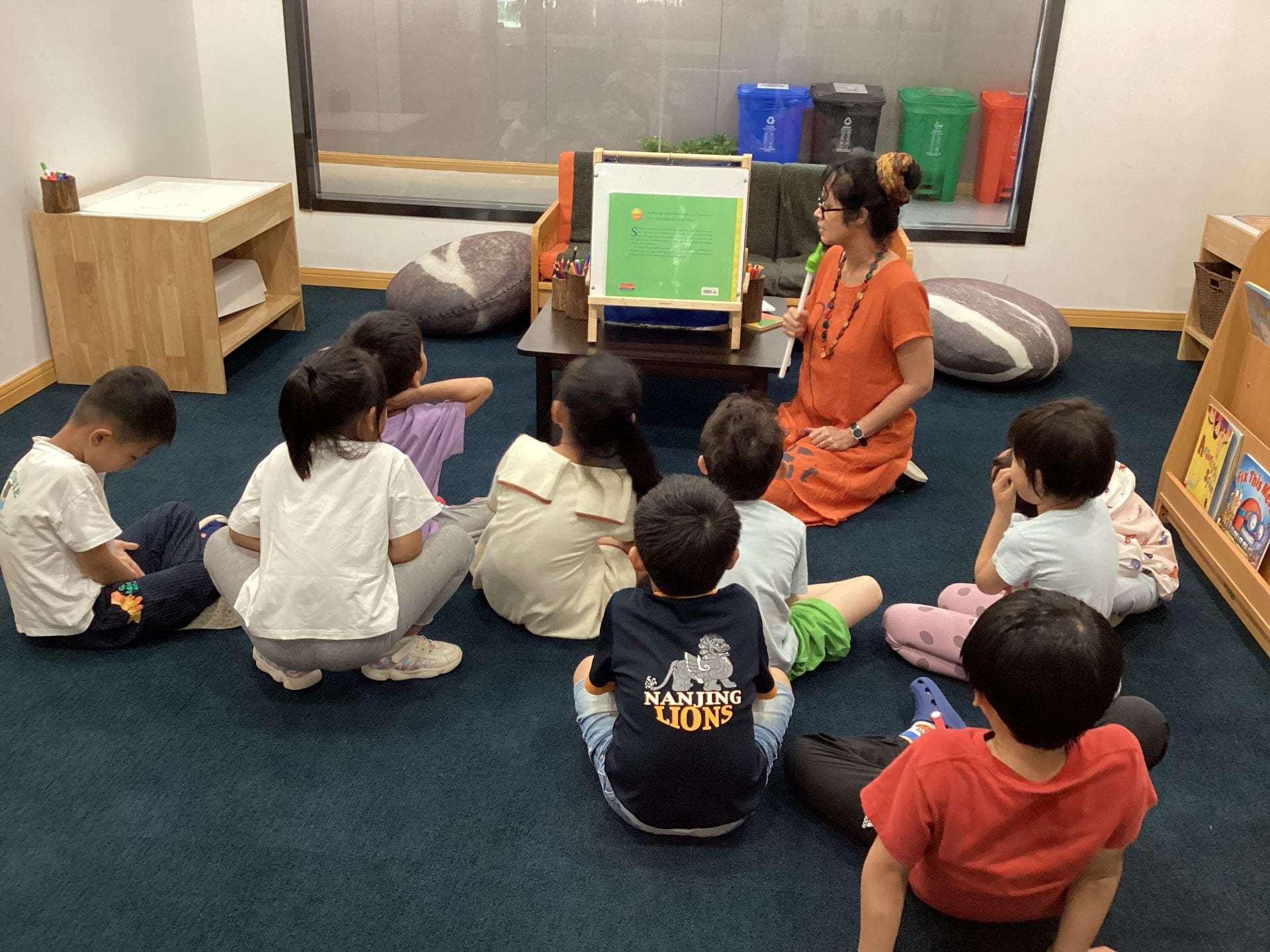
During our Morning Meeting, we gathered to join in a Math Talk. A Maths Talk is a collaborative process where children’s thinking, ideas and strategies are discussed, shared and or exchanged. The routine reveals children’s understanding and misunderstandings and encourages dialogue about mathematical concepts.

The children’s thinking was provoked by an image. Questions were asked to help the children notice details in the image. 

– What do you notice? What do you wonder?

– Use pictures, numbers, or words to show or tell what is happening.

The children were encouraged to think about the image. Then, they documented their observations using paper and coloured markers.

Next, they shared their observations and thinking with the class.

Finally, they included their documentation in their Maths journals.

Approaches to Learning (ATL’s)

  • observe carefully
  • analyse and interpret information
  • notice relationships and patterns
  • listen actively and respectfully to others’ ideas and listen to information
  • participate in conversations
  • understand symbols, use mark-marking to convey meaning
  • document information and observations in a variety of ways

All Kinds of Boots


What do you notice? What do you wonder?

We documented the children’s observations and questions.

See

  • Morning “Some shoes are small and some shoes are big.”
  • Motong “There are many different colour shoes and some are tall and some are short. I see 10 pairs of shoes.”
  • Wyatt “Many colours on the shoes.”
  • Oliver “Some shoes are fat and some shoes thin.”
  • Jeongyoon “There are 20 shoes.”
  • Eli “Some boots are for rain and some boots are for walking and some are for winter.”
  • Oxford “One is green. Some are made out of feathers and some are not. Some boots are in the ice. Some boots have no stickers in the front.”
  • Beomjun “3 little shoes and big shoes is 3.”
  • Eunbyul “Big, medium and small boots.

Questions

  • Jeongyoon “Whare there have the shoes and the boots?”
  • Wyatt “Why has many coloured boots and shoes?”
  • Motong “Why are there black shoes?”
  • Oliver “I know that the boots are used for walking or snowing for but what else are they for?”
  • Eli “Why do some have a name on the front and some don’t?”
  • Oxford “Why do we need the stickers?”

We counted our shoes to see how many pairs we had all together.

We had 11 pairs!

Task:

– Create your own 2’s collection using objects in the classroom.

– Count in 2’s using your objects.

Challenge: Use collections to share more ways to skip count!

The children develop an understanding:

– that the operations of addition and subtraction are related to each other and are used to process information to solve problems

– of how number operations can be modeled in a variety of ways

– that there are many mental methods that can be applied for exact and approximate computations

The Egg Carton Problem

We began by asking the children what they see, think and wonder about the image. We documented their observations using words, numbers and symbols.

See

  • Eunbyul “I see eggs.”
  • Wyatt “Egg box and eggs.”
  • Eli “Six eggs in the box.”
  • Oliver “I see words on the box. There are holes on the box. 6+6 is 12.”
  • Motong “There are six eggs and there are no six eggs. There were 12 eggs and it only 6 eggs.”
  • Jeongyoon “I see a table.”

Think…

  • Wyatt “I think this is a bird’s egg.”
  • Liz “I think its chicken eggs because birds’ eggs are not big.”
  • Oxford “I don’t think this is not a bird’s eggs, this is eating eggs.”
  • Lydia “The chicken egg is for the people to eat.”

Questions:

  • Wyatt “Why there have eggs?”
  • Motong “Why there are only 6 eggs but 12 spaces?”

We modelled another way to arrange the 6 eggs in the box. We used manipulatives and drawings to share many ways to represent our thinking.

Then, the children were invited to share multiple solutions to a problem.

If you had 6 eggs left in your egg carton, how would you place them?

Share your sorts using pictures, numbers and symbols.

Egg Problem Template

The children develop an understanding:

– that the operations of addition and subtraction are related to each other and are used to process information to solve problems

– of how number operations can be modeled in a variety of ways

– that there are many mental methods that can be applied for exact and approximate computations

The Shape Test

A paper cube that Oliver made after the paper experiment led to a discussion about 3-dimensional shapes.

The team wondered about the strength of paper shapes and decided to test their theories.

The team wondered:

  • if some paper shapes were stronger than others.
  • which shapes they could make to test their theories.

The team recalled a previous learning experience of going on a shape hunt and decided to refer back to the activity to choose the 3-dimensional shapes they wanted to make and test. When choosing the shapes Oliver stated, “Sphere is impossible for me cause how can you fold the paper round. I want to make a cylinder!”

Eli pointed at the pentagonal prism, “I want to make that one.”

Having thought about their options for paper, they decided to choose card stock instead of paper for their test as they believed it would be stronger than the A4 paper.

Oliver made his first paper cylinder by rolling up the paper and fastening it with tape. However, he quickly noticed that the edges weren’t flat and realised that this would impact the test. He decided to make a second cylinder, taking care to keep the edges of the shape levelled. During testing, Oliver discovered that the top and bottom edges of his first cylinder were not stable enough, so he decided to make a new cylinder.


Having looked at the pentagonal shape, Eli realised that to fold a pentagon, he needed to divide the paper into five equal parts. Eli initially used a ruler to draw lines but found that the width of one ruler was too narrow, which resulted in a lot of extra space at one end.

Then, decided to use the width of two rulers, but each section was too wide and there wasn’t enough space on the card for 5 equal sections.

Eli shared this challenge with the teacher, explaining that he wanted to divide the long edge of the paper into five equal parts.

Having heard Eli’s challenge, the teacher decided to bring Eli’s attention to the concept of measurement to think about what he already knows about the function of hash marks and numbers on a measuring tool.

Ms. Eileen “How long is that edge? How did you measure it?”

  • Eli thought about this and then pointed to the ruler and said, “Use ruler.”

Eli used the ruler to solve his measurement challenge, learning that the length of the paper was about 30 centimetres.

Ms. Eileen “How can we divide 30 into 5 equal parts?”

Eli found the unit cubes and counted out 30 unit cubes to represent the 30cms. Then, he divided them into 5 equal parts, with each part being 6cm.

Finally, Eli drew out the lines and folded his paper pentagonal shape for the test. The researchers were now ready to test their shapes!

The team decided to choose books that were of a similar size for their test. As they placed one book at a time on the shapes, they began to see that although the shapes were made with paper, they were extremely strong.

The team had enough books to reach a total of 19 books for each shape. Then, they ran out of books!

As they didn’t have enough of the same books in the classroom to support the progression of the experiment, they decided to test their shapes in the library.

The team’s paper and shape experiments have allowed them to think about the function of shapes and materials in design and engineering and the impact of forces like compression and tension that act on structures. Through their experimentation, they continue to explore how the design can impact the strength and stability of structures.



PATTERN BLOCK DESIGN CHALLENGE

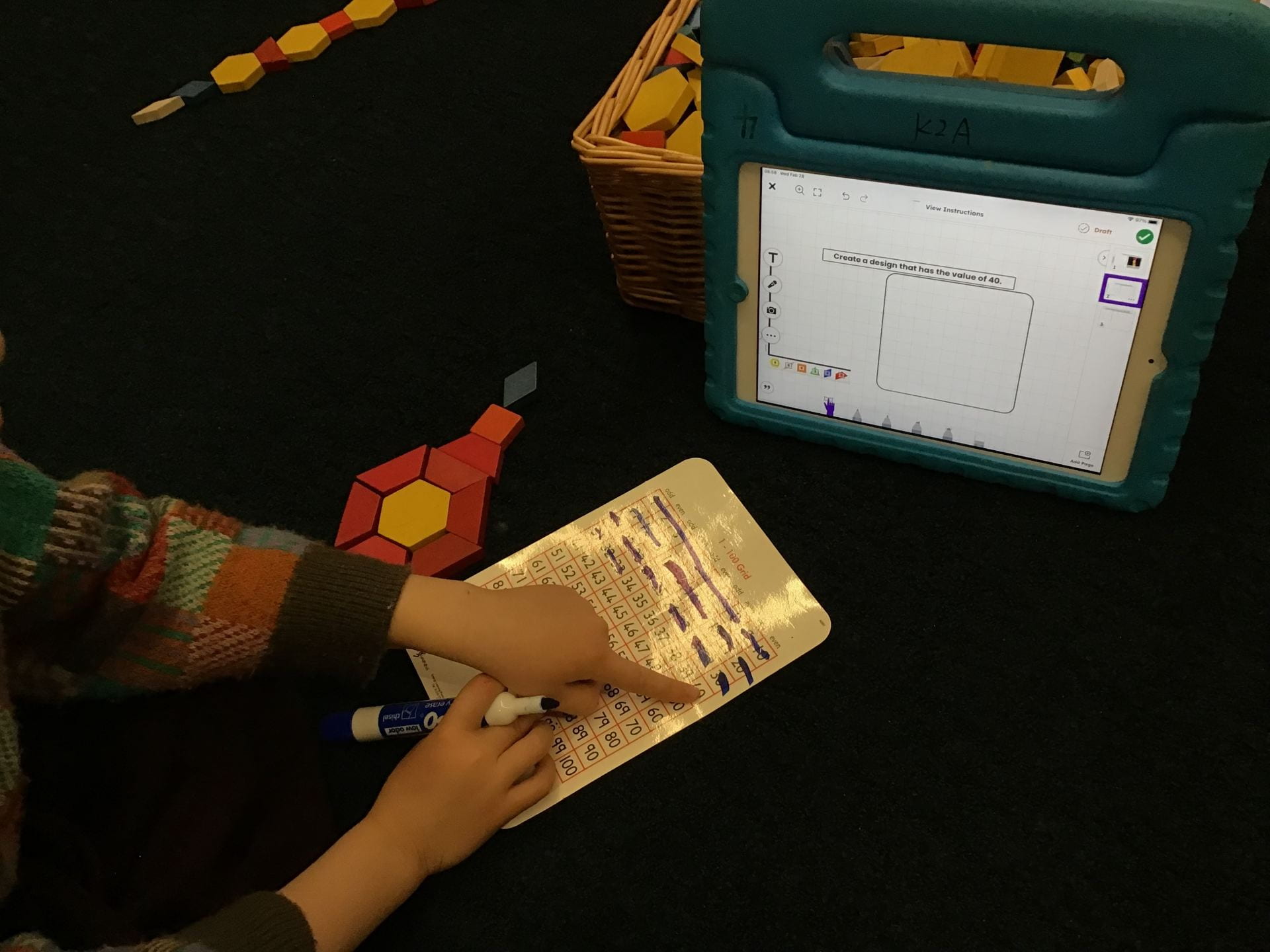
The students were invited to use Pattern Blocks to create designs. Each pattern block shape had a value. The complete design needed to have a total value of 24, 40 and 60.

Next, the students completed a bar graph using the information in their Pattern Block design.

Instructions:

  1. Use Pattern Blocks to create 3 shape designs that have a value of 24, 40 and 60.
  2. Take a picture of your designs.
  3. Upload your pictures to Seesaw.
  4. Complete the graph to show how many shapes you used in your design.

Creating the designs involved a lot of problem-solving, thinking, calculations and conversations.

What designs might YOU create?

What is the SUM of YOUR design?

How to make Banana Cookies!

One child was excited about bringing his Nana to school one morning. She lives in Australia but visited him during the Chinese New Year holiday. Over the holidays he planned an activity that he could do with Nana in school. They decided to show the children how to make banana cookies.

He bought the ingredients with Nana and then tested his recipe at home. Then, he made a video to share his process with his friends. When school reopened after the holidays, the child invited Nana and his Aunty to school as they were the cookie experts.

Next, we had to work out how many cookies we needed.

  • Motong “We counted how many cookies we need to make.”

  • Jeongyoon “We needed 29 because 4+5=9 and 1+1=2 so we need 29. 15+15=30 so 15+14=29.”

Through their conversations, we noticed that the children were thinking about the operations of addition and subtraction and how they are related to each other.

  • Liz “We made banana cookies.”
  • Motong “We make cookies and Eli’s Nana helped us to make.”

  • Eli “We are putting coconut oil in the bowl and it is good for the cookies because it’s very yummy.”
  • Lydia “We mix the things to make the banana cookie.”
  • Oliver “The cookie was almost finished so I put one little drop of the dough on the paper and then I put it in the oven.”
  • Motong “We put the banana cookies in the oven because it will change the cookies when it is hot.”
  • Oliver “It turns browner.”

The children were exploring the impact of temperature and how it could change textures and substances.

  • Wyatt “We made cookies to take to K2B and ate it.”
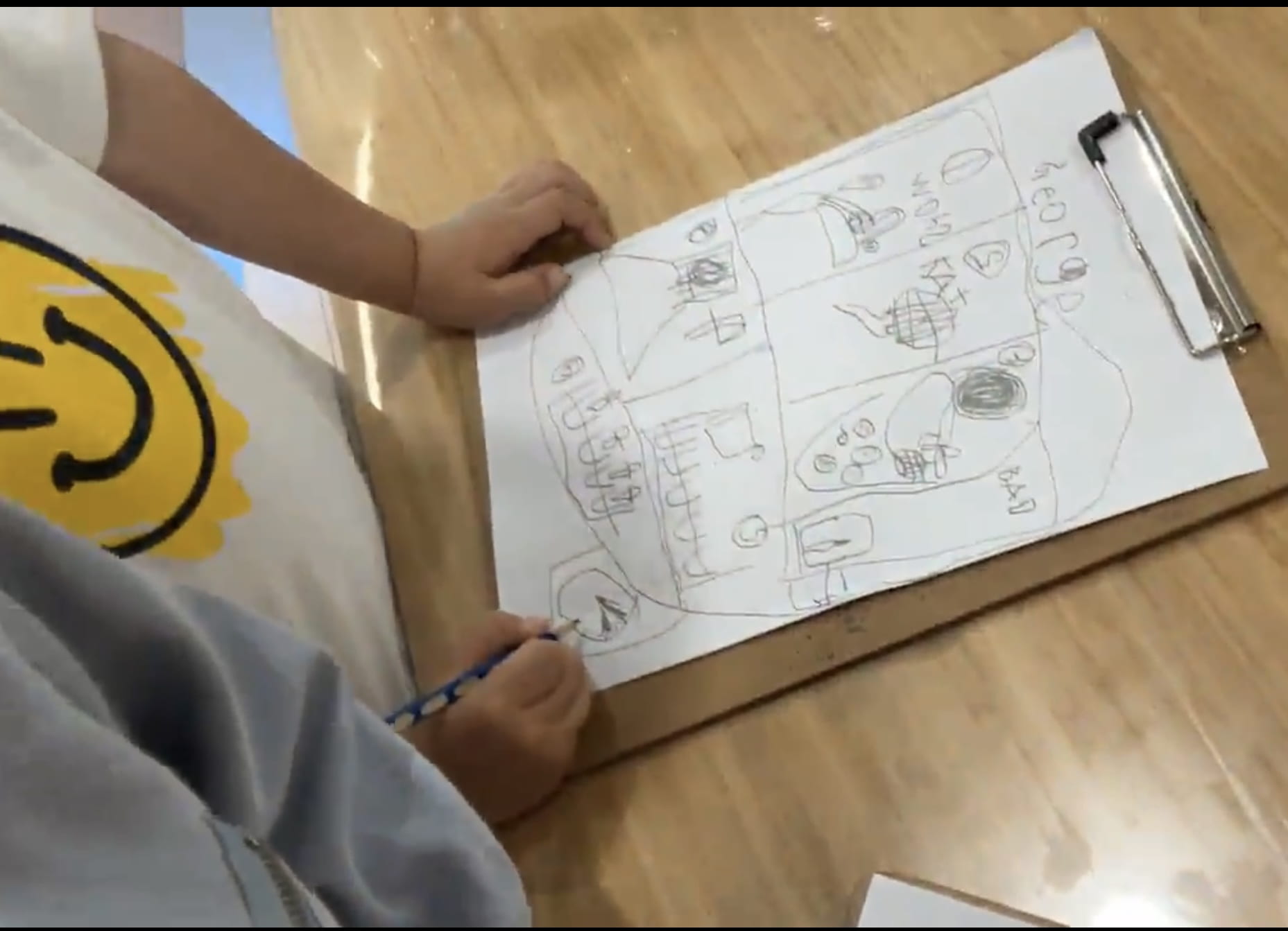
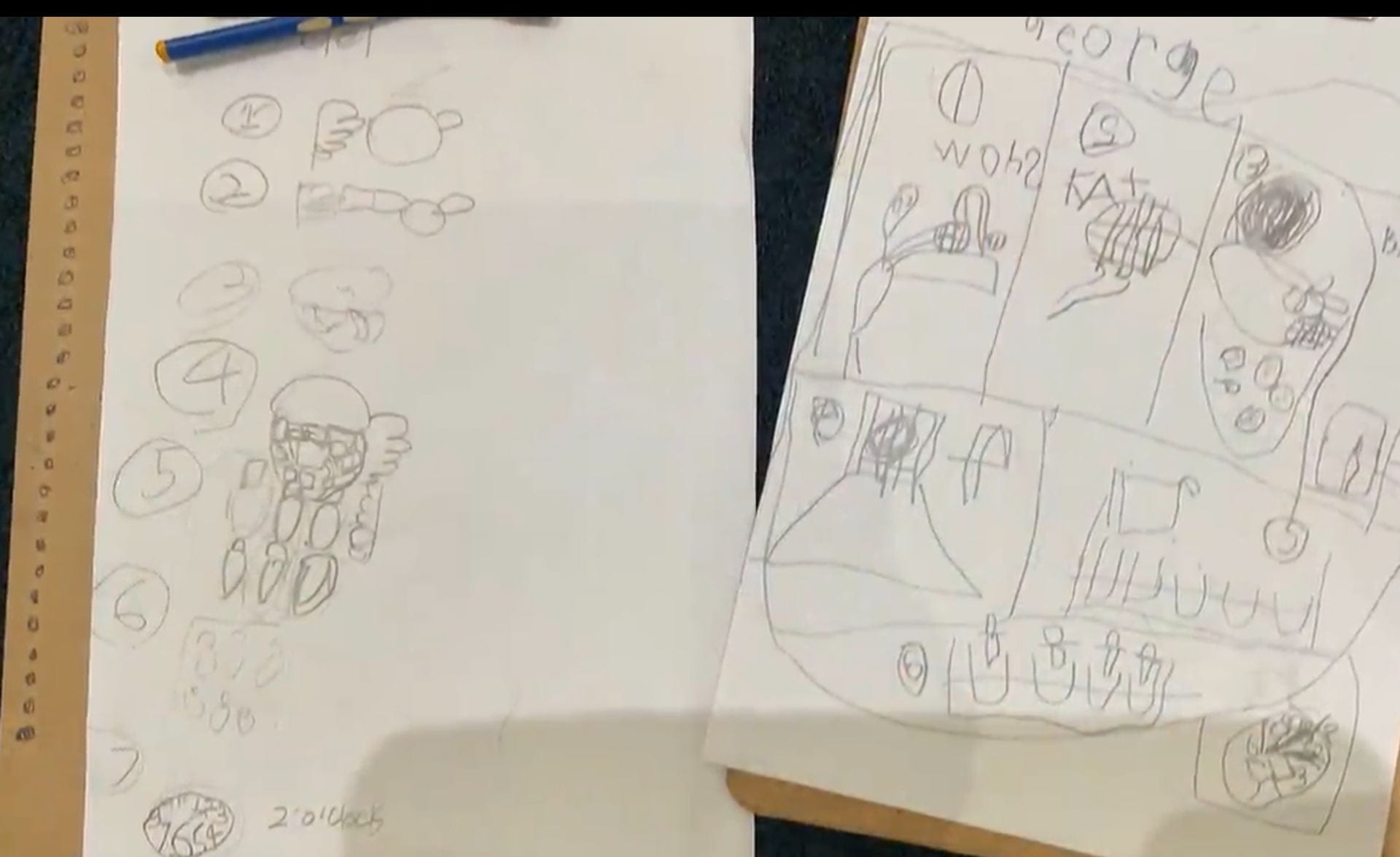
  • Motong “We draw how we make the banana cookies.”
  • Eli “We used numbers and words.”
  • Motong “We used spaces (lines and squares) because we know that is 1 thing.”

We observed the children using several ideas to share their ideas on paper. They used a combination of drawing and writing to narrate and tell about the events in the order in which they occurred.

We paused to talk about the K2 writers’ drawings. The children noted that some writers used numbers to show the steps needed to complete a task while others used spaces or drew around a picture to share the same idea (procedures/steps). Some writers used arrows to show ‘the next steps’ in the process. The children noted that including labels with the drawings helps others ‘read’ the information.

Some children used sentences to share their ideas and others used lots of details in their drawings, all important crafts that good writers use to share messages and information with others.


Math Talk – Tens & Ones

What do you see?

What do you know?

When we look for patterns, we notice what changes and what stays the same from one picture to the next.

Drawing or building the pattern helps us think about what comes next!

The children used mathematical vocabulary to share their observations about the image.

We documented these ideas using symbols, words and numbers.

Then, we played a game of ‘Trash and Treasure’.

This game helps the children learn about place value and how to use the Base10 Blocks to find the biggest and smallest numbers.

Can you make a paper airplane?

The children continued to make paper airplanes using recycled paper. They were experimenting with new designs and different sizes of paper.  

Morning “I am making paper airplanes. Lydia taught me how to make paper airplanes.”

Oliver wanted to measure how far his paper airplane went in the classroom. He used a measuring tape with numbers to check how far it had gone.

  • Eli “He is measuring how far we threw the airplane.”

We posted the documentation about the paper airplanes in the corridor.

  • Howie “We are looking at paper airplanes because we can remember how much time to take to make the paper aeroplane.”
  • Liz “We tell people to make the paper airplane.”
  • Eli “Get a paper from the classroom and they can take and then they can make airplanes. We can come and make some too.”
  • Eunbyul “It’s airplane too far and write your name and what number to see how far the paper airplane went.”

  • Oxford “I am flying the plane.”
  • Eunbyul “We see who is no far and who is too far.”

  • Jeongyoon “Standing the line.”
  • Eunbyul “We have to stand on zero. Zero first and flying paper airplane.”

  • Oxford “I draw the numbers, 100, 200, 300, 400… Everybody can know where is the 300.”

  • Eli “Pin the paper plane on the wall because if we don’t pin it no one will know we made a airplane.”
  • Eunbyul “I made one paper airplane and faster and very far. 300cms.”

The children use what they know about number and measurement to record how far their paper airplanes flew. They are learning that standard units allow us to have a common language to identify, compare, order and sequence objects.

The Shop

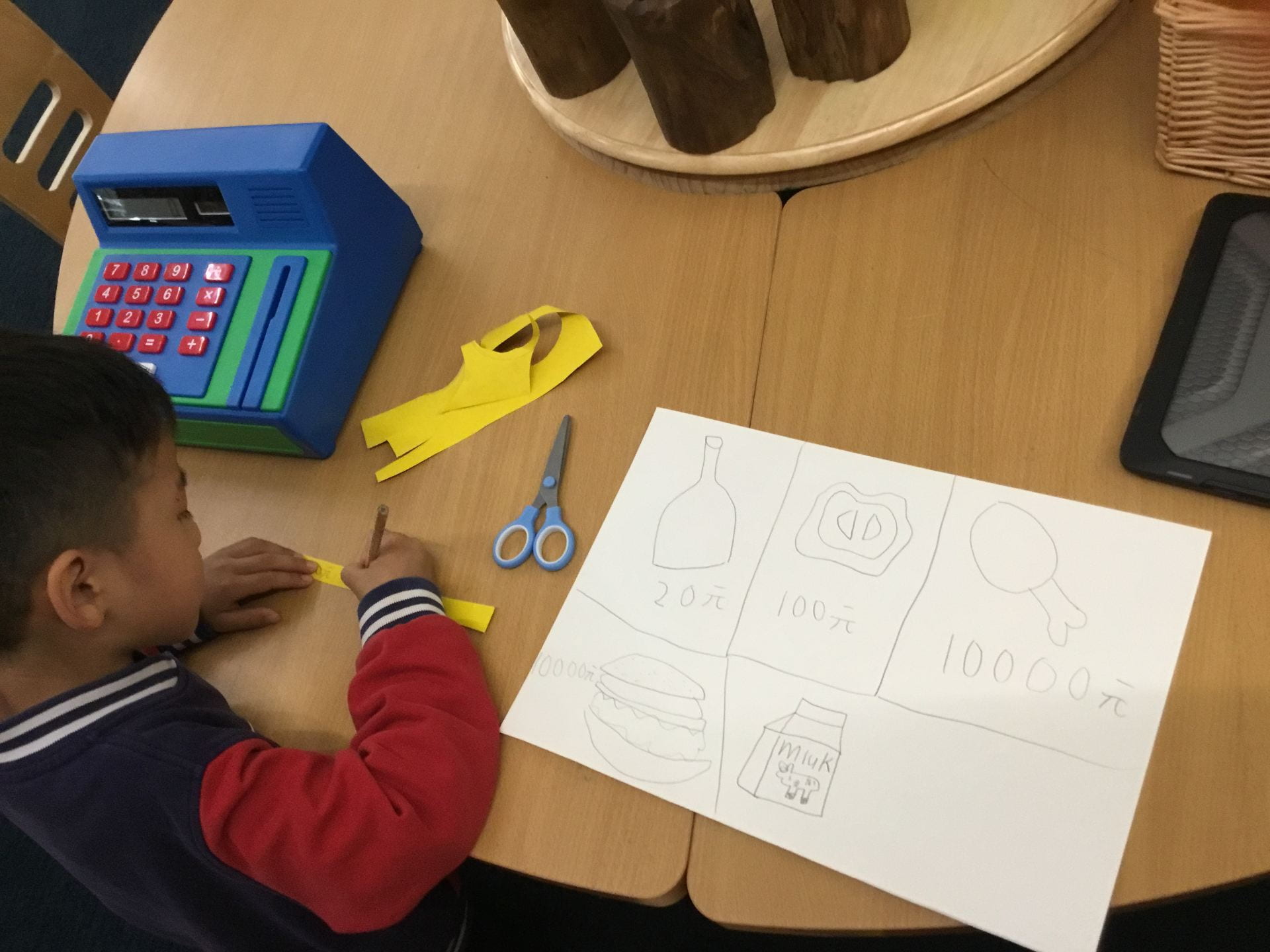
A few children have been making ‘money’ using cardstock.

During a conversation about money, the children shared their experiences and thoughts about money; the difference between money from countries and the ability to pay for things they want to purchase from a shop.

One child decided to explore this idea further while at home and prepared a presentation for the children. He began his presentation by explaining how much money he had earned and saved by doing his ‘jobs’ (chores) at home.

Noticing the child’s interest in using money to purchase items, the teachers decided to share a cash register that was stored away in the classroom.

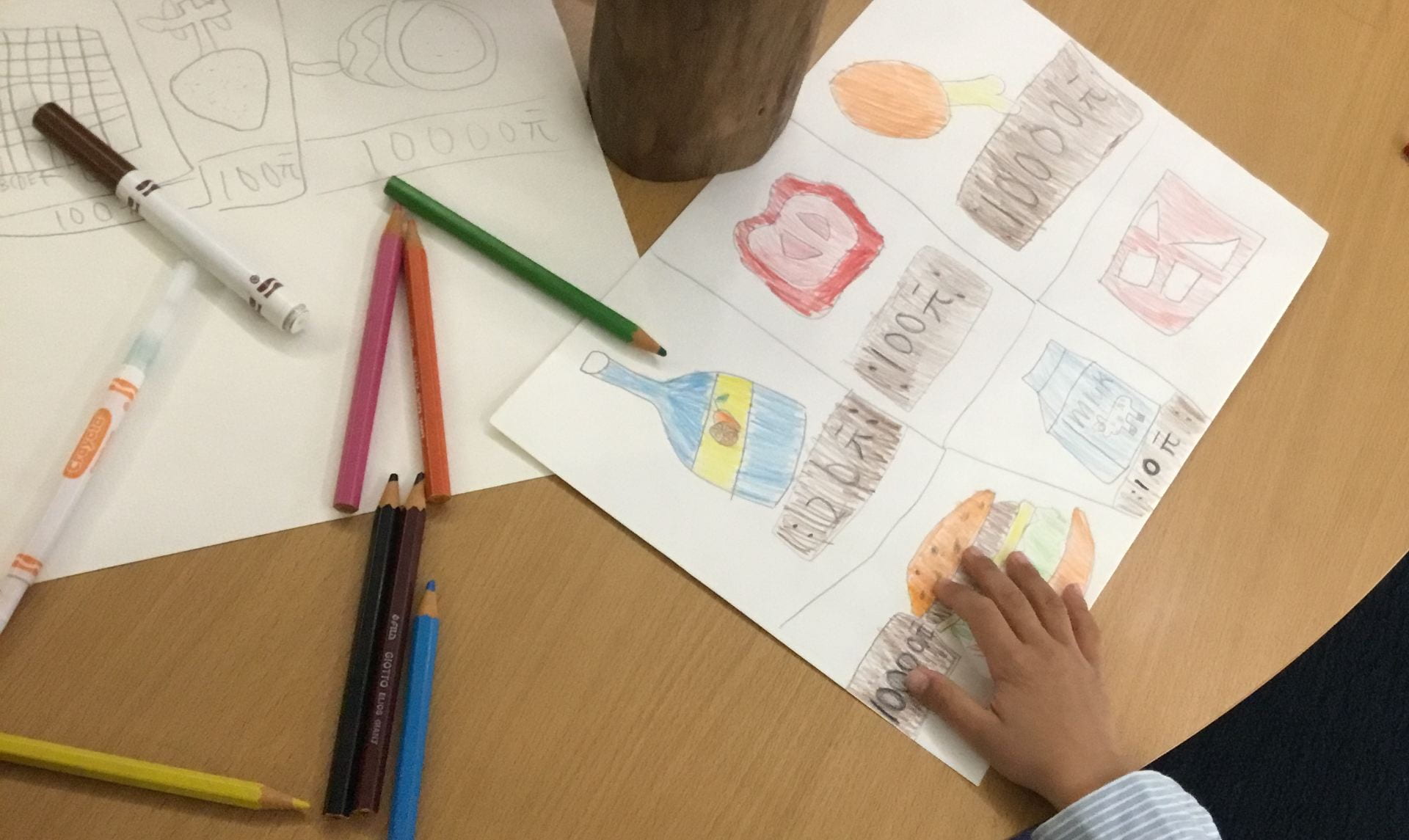
The child was excited to play with the cash register but there wasn’t any money in the till. He decided to create his own money for the till. Then he decided to make different items that he could purchase using the money in the till. He carefully drew items you would find in a store, adding price tags to let others know how much each item costs. 

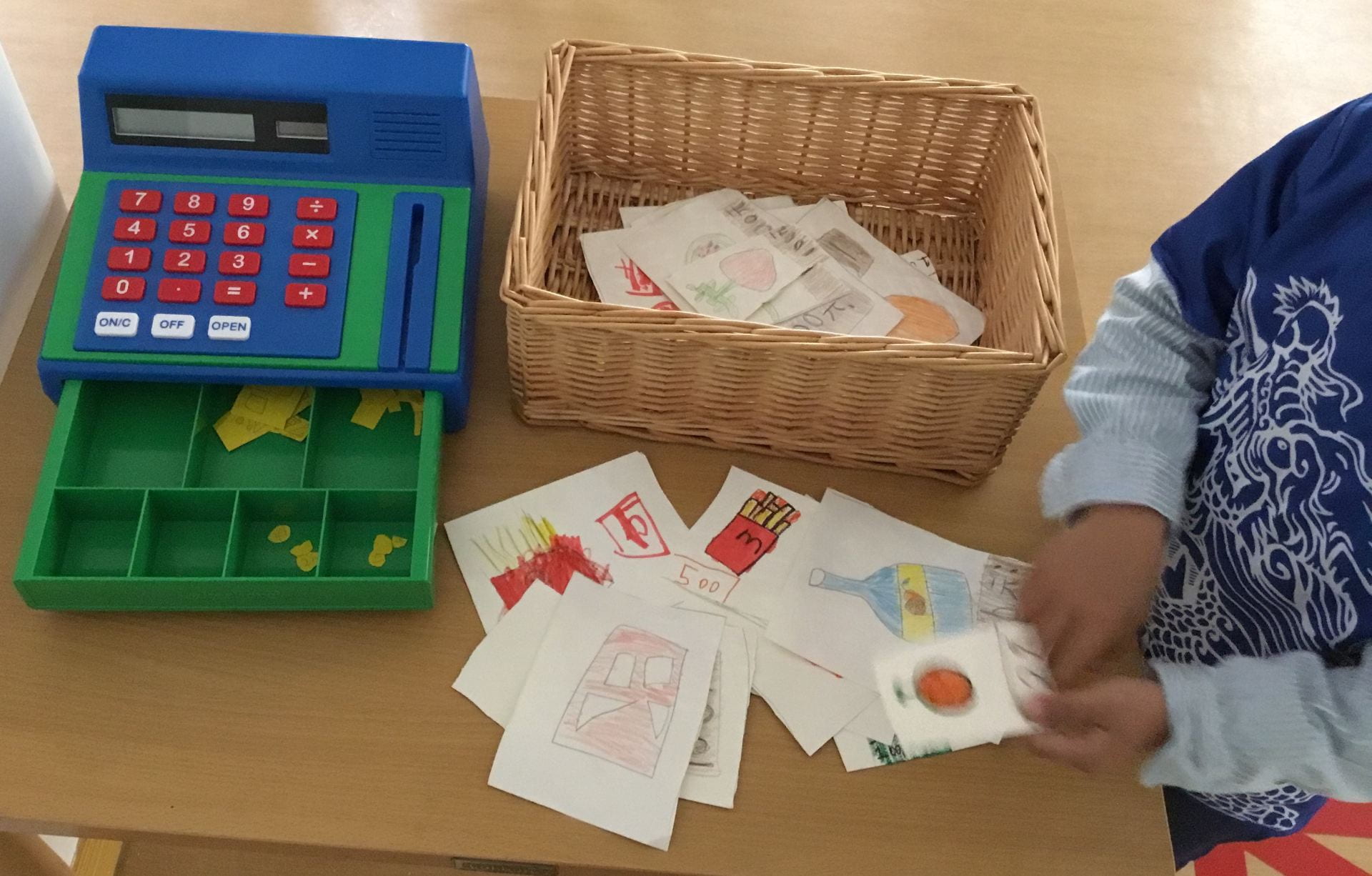
During a class meeting, the teachers shared photographs of this process with the rest of the class. The children began to make suggestions about opportunities to play with the items, the cash register and the money that had been made. The idea of a shop began to grow.

More children joined in creating items that could be sold at the shop.

The children set up the shop, including all the items they had made in a basket next to the cash register.

We wonder how the children may explore this new area in the classroom.

We wonder about the conversations they will have in relation to the concept of purpose and function, resources, needs and wants.

We wonder how the children may use this opportunity to model spending money and trading in role play experiences.

Balance

Two children explored the concept of balance using manipulatives in the construction area. One explained that something was balanced ‘if both sides were the same and the beam remained straight’.

We explored this concept using our knowledge of numbers. The children tapped into what they knew about ‘addition’ to solve the equations to balance the scale.


We wonder how we might explore the concept of balance in other places and situations.

Exploring Numbers

What do you know about the number 3?

The children shared what they noticed about the shape of the Numicon shape.

It looked like a heart, a boot, a letter ‘V’ and it has 3 holes.

What numbers do you see in this shape?

If we wanted to ‘make’ this number, what are the different ways we might try to make it?

  • Oxford shared the first suggestion “2 and 1.”

He was invited to share his suggestion using numbers and symbols. The children began to share other ways to show 3.

Next, we looked for ways to show 5.  

What do you know about the number 12?

Oliver “It has a 1 and a 2.”

Eli “On the bus. So we know where it is going.”

Liz “The clock has 12.”

We used the Cuisenaire Rods and Numicon Shapes to find different combinations that total 12.

Then, the children worked in groups to find combinations that total 15,16 and 20. We noticed how they used their thinking skills to calculate.

They used manipulatives to create models. They used numbers and symbols to share representations of their understandings.

Throughout the task the children worked together in small groups, sharing ideas and taking turns to document their learning.  

Money

We noticed the children making money at the writing table. Soon each of them had a small pile of notes with them.

We decided to share the photographs we took of the money to learn more about their interest in money.

  • Oxford “I am cutting money and cutting paper and drawing money. I want to go home and make some games.”
  • Motong “I am cutting the paper and drawing the money because I want to play with money. Shopping.”
  • Oliver “Money from my country looks different, Germany. I can show you what the money looks like in Germany.”
  • Lydia “I have money in my home.”
  • Liz “I have Hong Kong money in my home. I have one thousand.”
  • Oliver “I have money from China and Germany. My grandma gave me money and then my daddy takes the money that grandma gives me. He took it away and bought some noodles.”
  • Morning “I have money from China at my home. It’s in my bag.”
  • Motong “I have money in my house, Chinese money. Real money.”
  • Oliver “I have to buy something cool with very expensive money.”
  • Eli “I give my mummy the money and she buys something. Nana gives me money. Daddy gives me a thousand money.”
  • Eunbyul “I have in home money, and my daddy gives money and my mummy has no money. I have Korean money.”
  • Howie “I have three thousand, I have to buy toys.”
  • Jeongyoon “I have Chinese money.”

We heard the children talk about the purpose of money. They had emerging theories about the difference between money from different countries.

An inquiry into ‘money’ begins…

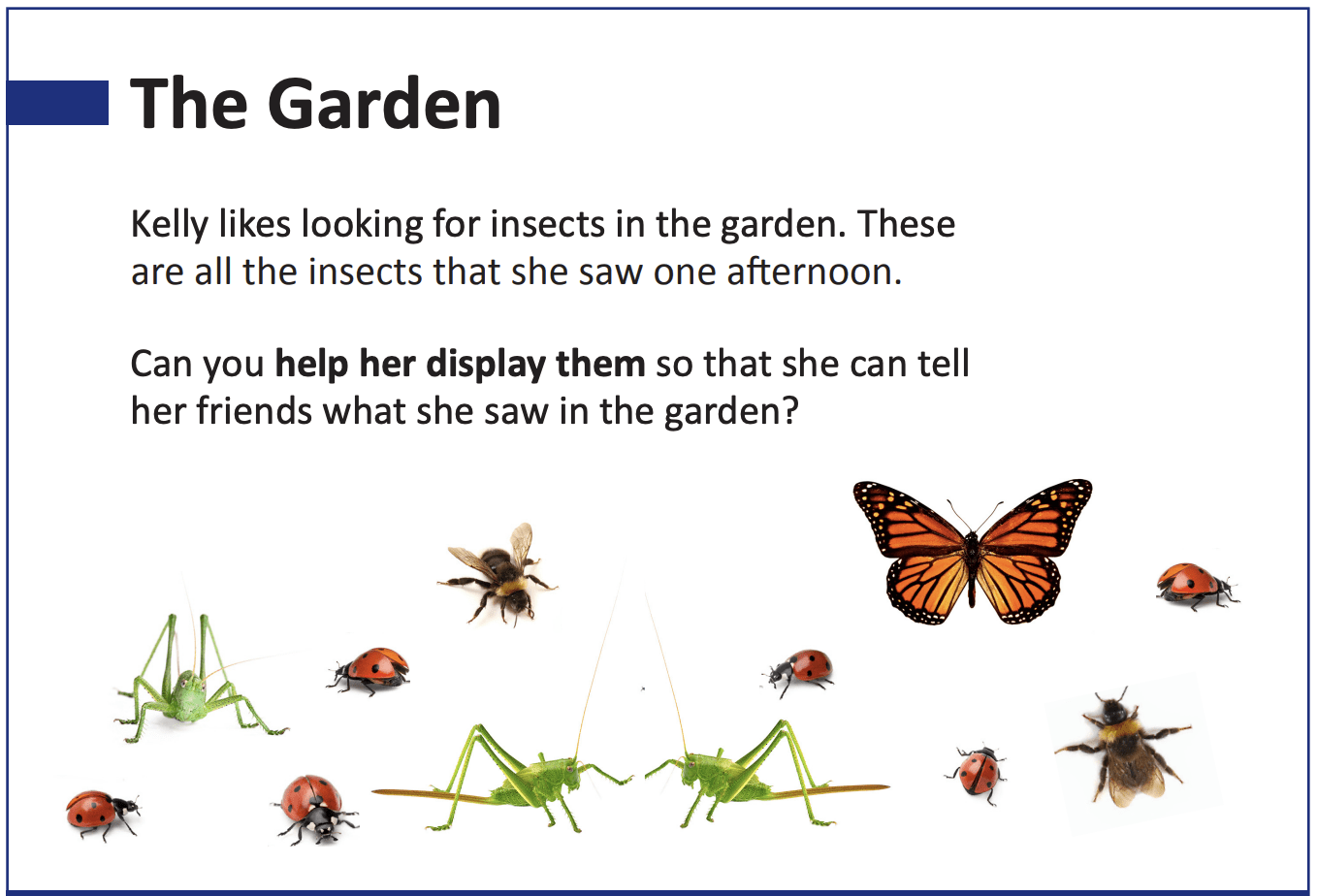
Math Talk – Gathering Data

We gathered to solve a Maths problem. We are learning how to collect information by organising objects in different ways.

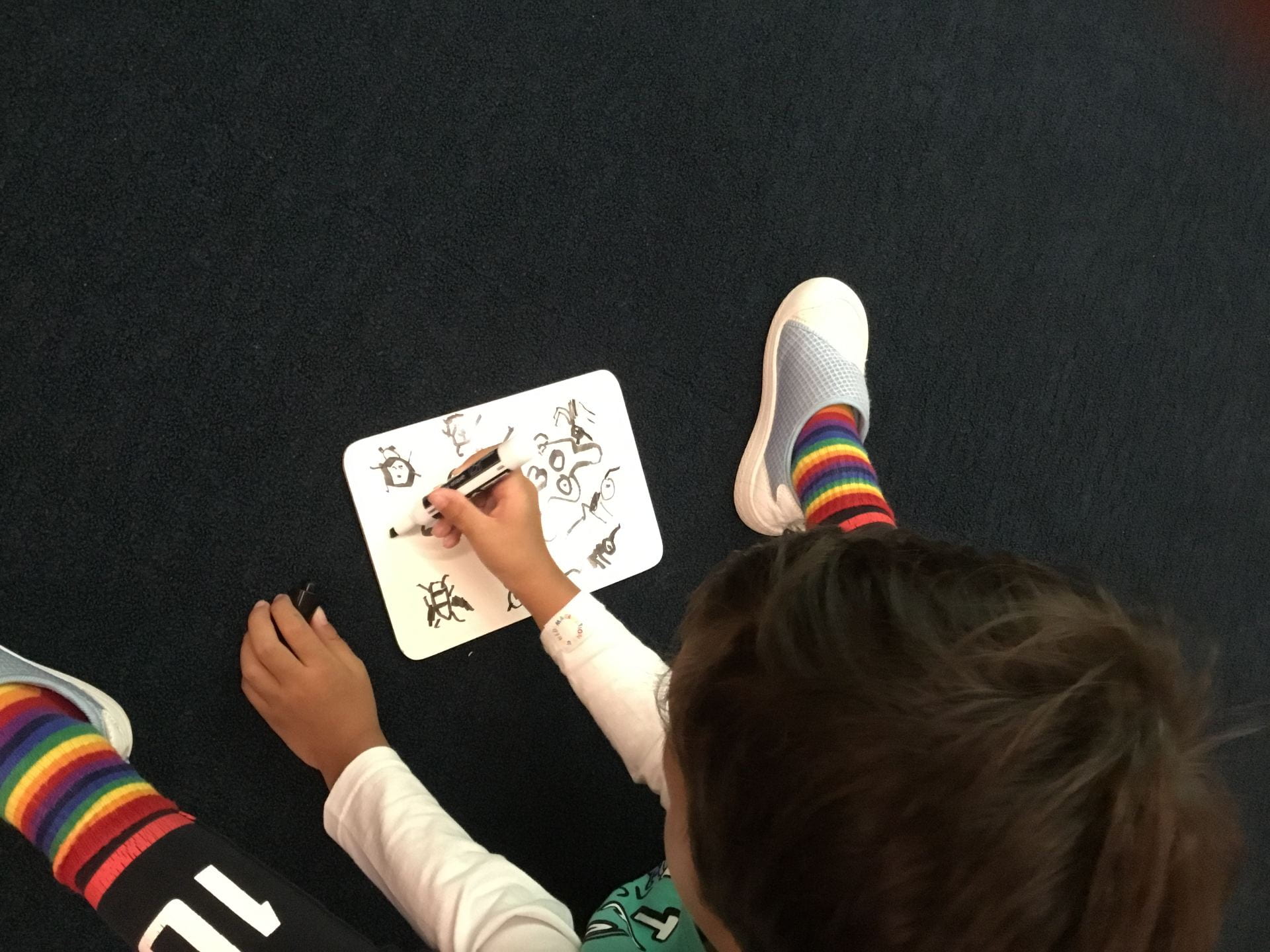
  • Eli “We are looking how much bugs and insects. And we counted how much is the same and how much different insects.”
  • Oliver “You have to look at the board and see the board and count. Its because if you do nothing there is zero insects.”

  • Jeongyoon “Drawing bugs.”
  • Eli “I have to think and look at the picture and look at how much insects there are.”

  • Eunbyul “Sharing ladybugs and drawing on the whiteboard.”
  • Motong “This is a garden. Everybody draw.”
  • Wyatt “It’s drawing pictures.”

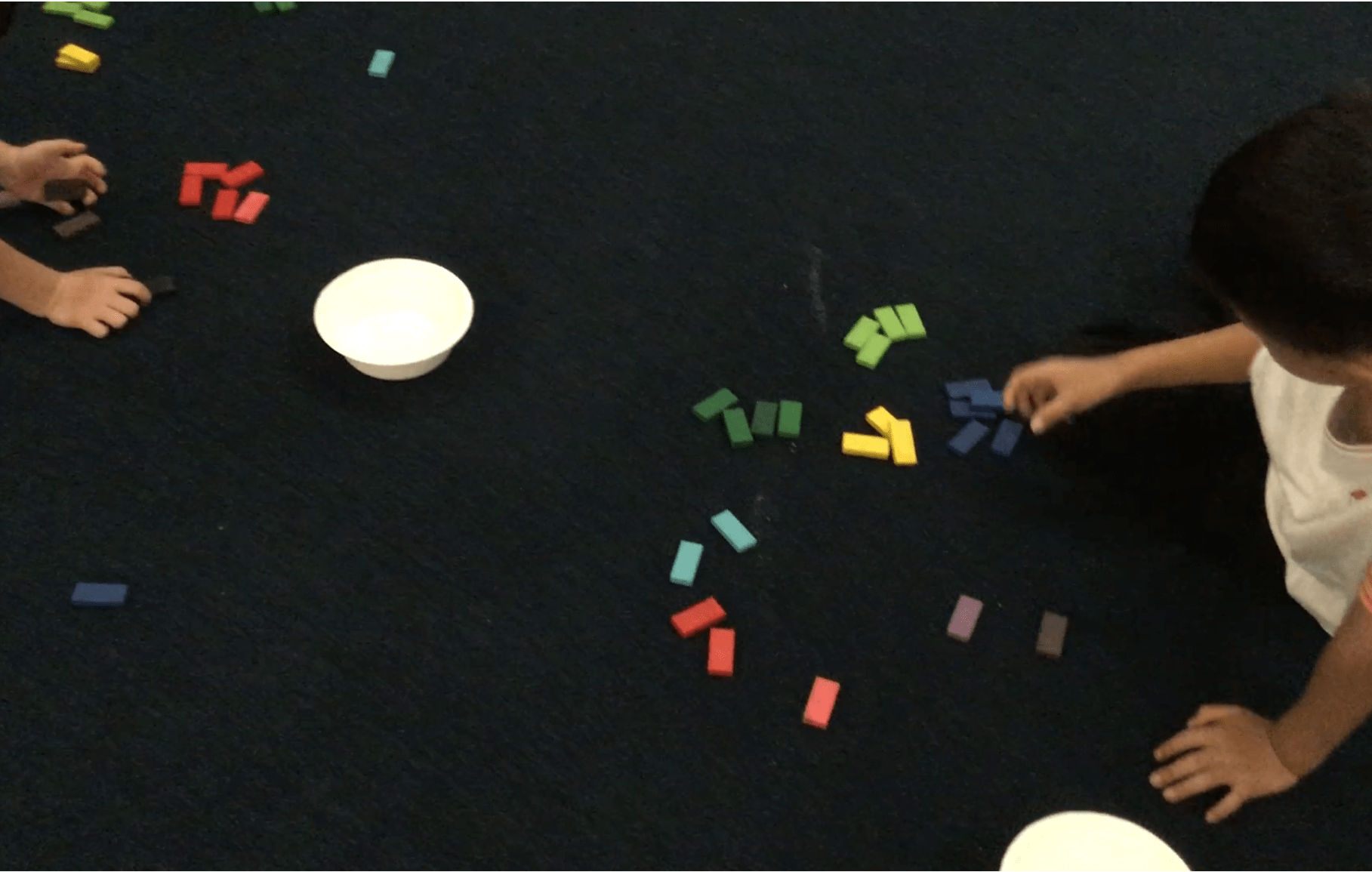
Next, we used colour blocks to explore data collecting.

  • Howie “These are colour blocks. To use same colour blocks to build together. Counting blocks.”
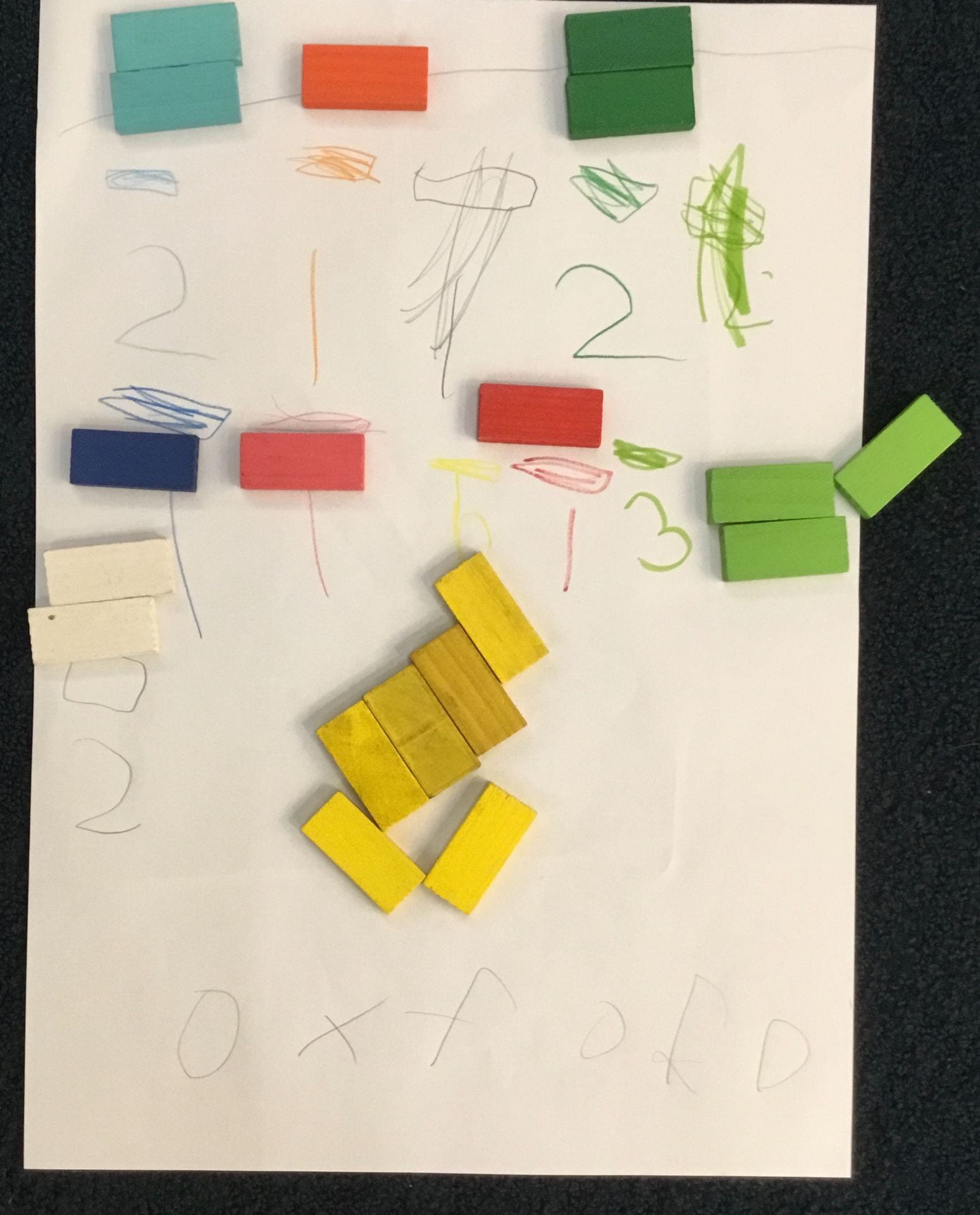
  • Wyatt “Its writing on the paper. Putting blocks on the paper and then draw.”

  • Oxford “I am putting blocks on the paper then we can do drawing.”
  • Motong “I had orange the most, 4. I had only 1 dark green and purple and yellow and red.”
  • Eli “I had green, 8, the most but the green when I put it in the bowl I found lots of green like 8.”
  • Morning “I had blue the most. 7.”
  • Liz “I had 3 blue, I have green is 9 the most. I have 2 red and 2 orange.”
  • Oliver “I have the most is yellow, 4.”
  • Eunbyul “Is from 1 is green.”
  • Howie “I have drawing one white block.”
  • Jeongyoon “I have a green 7, the most.”

The children used colours and numbers to document their information. We noticed that they used comparative language (most, little, lots) to explain their data.

Next, we decided to organise our blocks in columns. This helped us see the different colours and quantities. 

Then, we documented what we saw on paper, creating column graphs to record the data. We noticed how the children represented one real object with one picture/coloured square.

A Math Story – The Sleepover!

We read the story ‘The Sleepover’ by Catherine Twomey Fosnot. In this Maths story, a little girl invites her friends to stay over. Aunt Kate babysits the children and prepares snacks and juice for them. However, the children keep moving between the beds and trick Aunt Kate.


As we read the story, the children noticed the different combinations to make 8 and used their mathematical knowledge to express their thinking.

They recorded their thinking on paper. We used counters to help us problem solve.

We are learning that:

  • Math is in our world!
  • Number operations can be modelled in a variety of ways.
  • We can use pictures, numbers and symbols to share our thinking and problem-solving.
  • We can tell stories using numbers.

Math Talks

Maths Talk is a collaborative process where children’s thinking, ideas and strategies are discussed, shared and or exchanged. The routine reveals children’s understanding and misunderstandings and encourages dialogue about mathematical concepts.

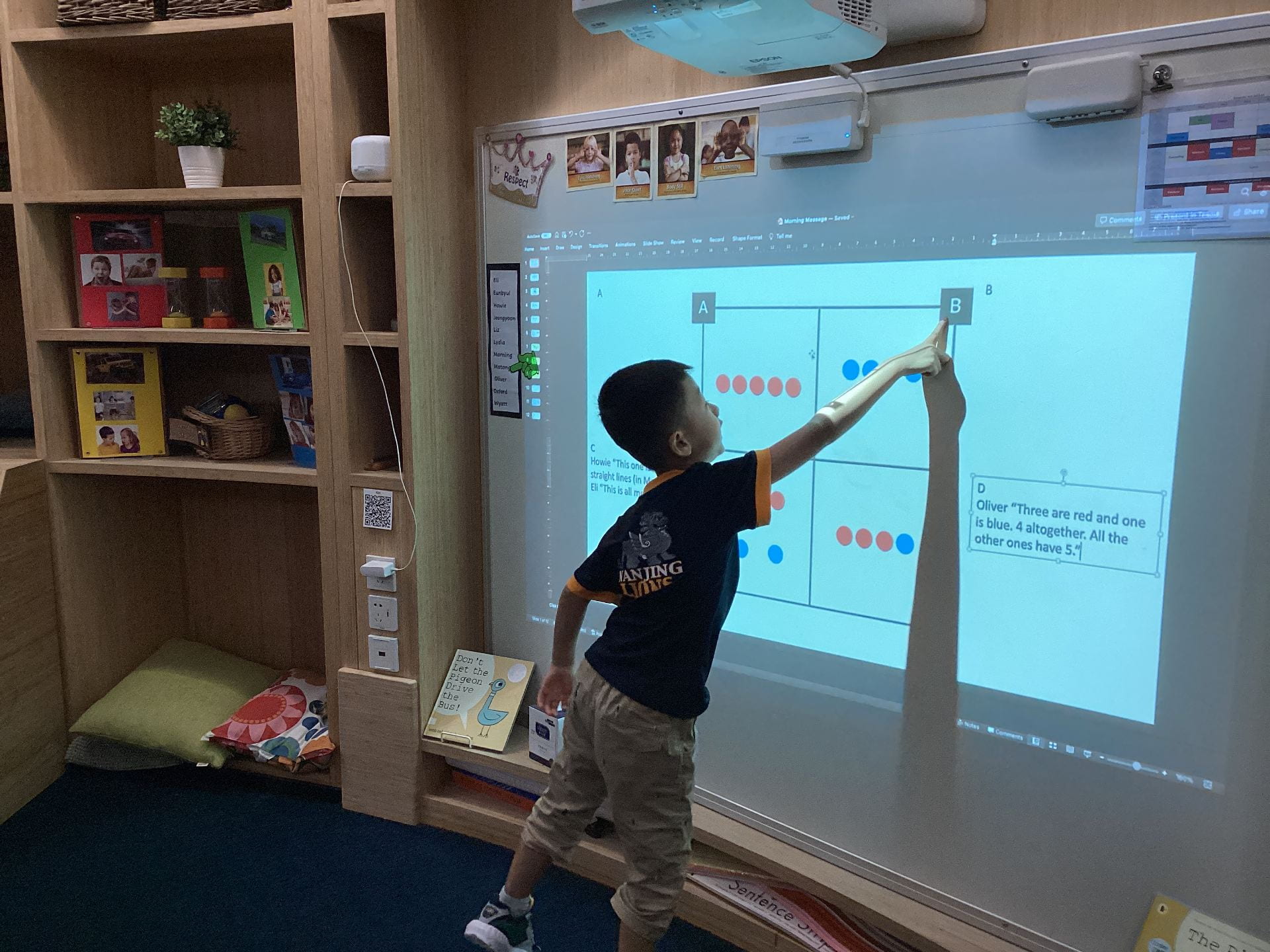
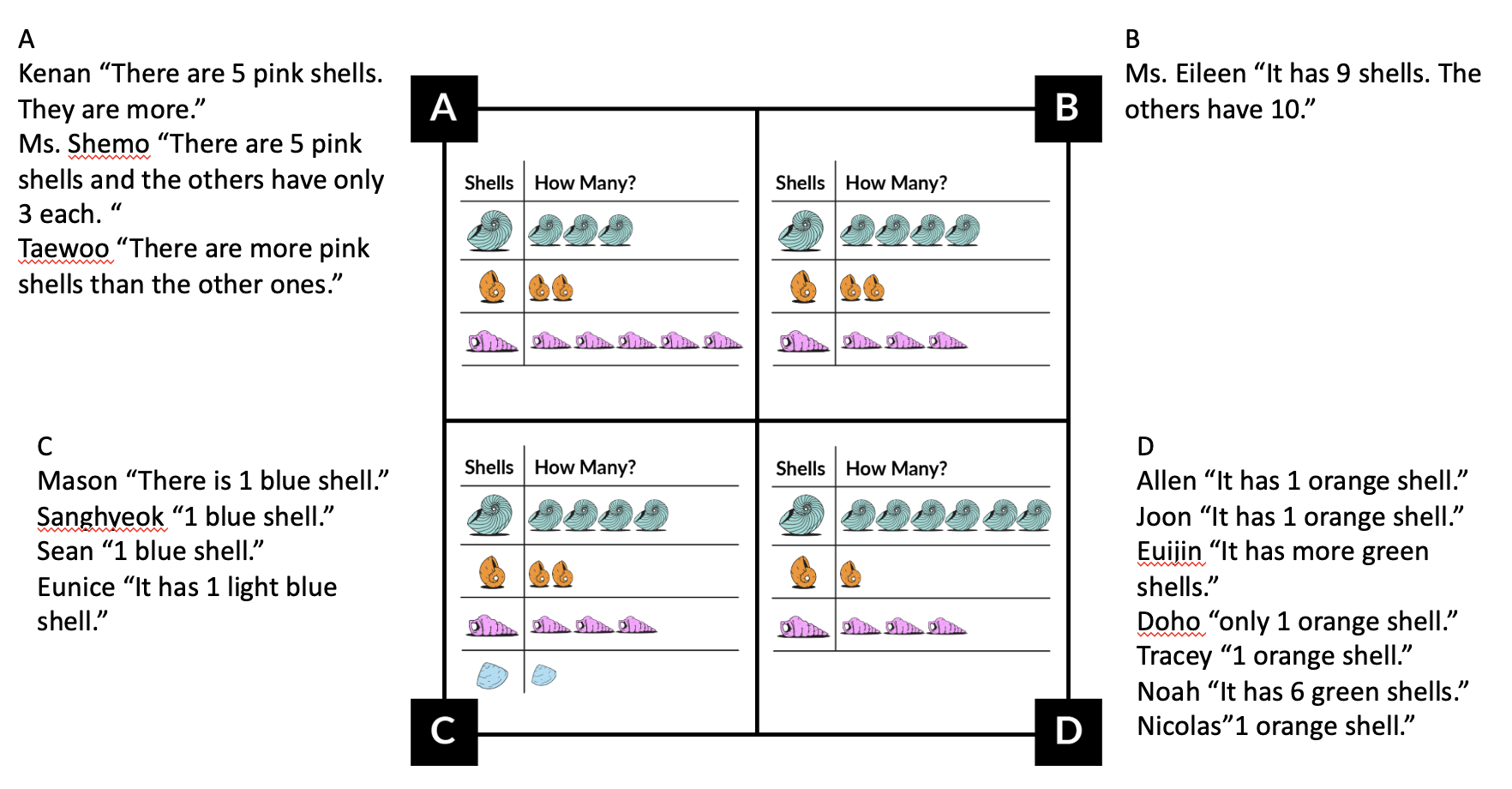
Which One Doesn’t Belong?

Dots in Two Colours

The children were invited to look at the set of four pictures and decide which one doesn’t belong with the other three.

They were encouraged to share their thinking using math words. There are many ways to think about each one!

We noticed that the children tapped into their prior knowledge about quantity and colour to explain their reasoning.


The Number 5!

What do you notice?

What do you wonder?

How many different ways can you show this number?

The children were invited to use manipulatives, numbers and words to share their thinking. We wonder how we might apply what we know about the number 5 to explore bigger numbers!

We wonder how number operations can be modelled in a variety of ways.


Approaches to Learning (ATL’s) 

  • observe carefully
  • analyse and interpret information
  • notice relationships and patterns
  • listen actively and respectfully to others’ ideas and listen to information
  • express oneself using words and sentences
  • understand symbols

100 Hungry Ants

We have been using Place Value Blocks to model numbers and show our thinking.

We read the story ‘One Hundred Ants‘ by Elinor J. Pinczes, illustrated by Bonnie Mackain. 

The story begins with a group of hungry ants that decide to march off single file to a picnic. However, along the way, they realise they are moving too slow and begin to divide themselves in different ways to help them get to the picnic site quickly.

As we read the story, the children worked in pairs to document their thinking using Base 10 Blocks, pictures, words and numbers.

They first went in one line of 100.

2 lines of 50.

4 lines of 25.

5 lines of 20.

And 10 lines of 10.

Next, the students retold the story in their own words, using the images they created to document their thinking.  

Through this activity we:

  • explored how the base 10 values system is used to represent numbers and number relationships
  • used the operations of addition to solve problems

Same and Different: Frogs on a Log

  1. What is mathematically the same about pictures A and B, and what is different?
    • A and B are the same because …
    • A and B are different because …
  2. Make a third picture of some frogs. Explain how your picture is the same as pictures A and B, and how it is different.

Responses

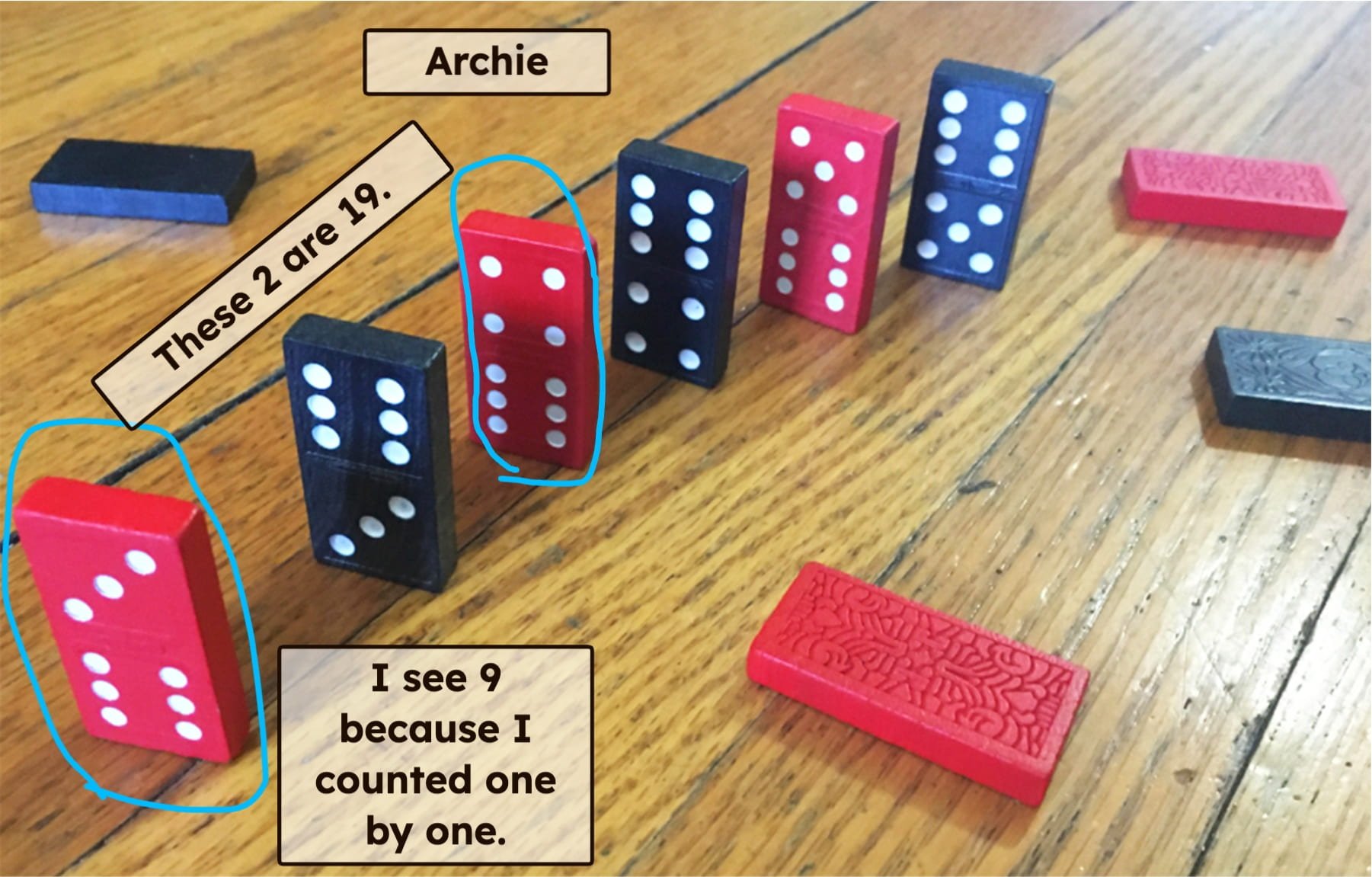
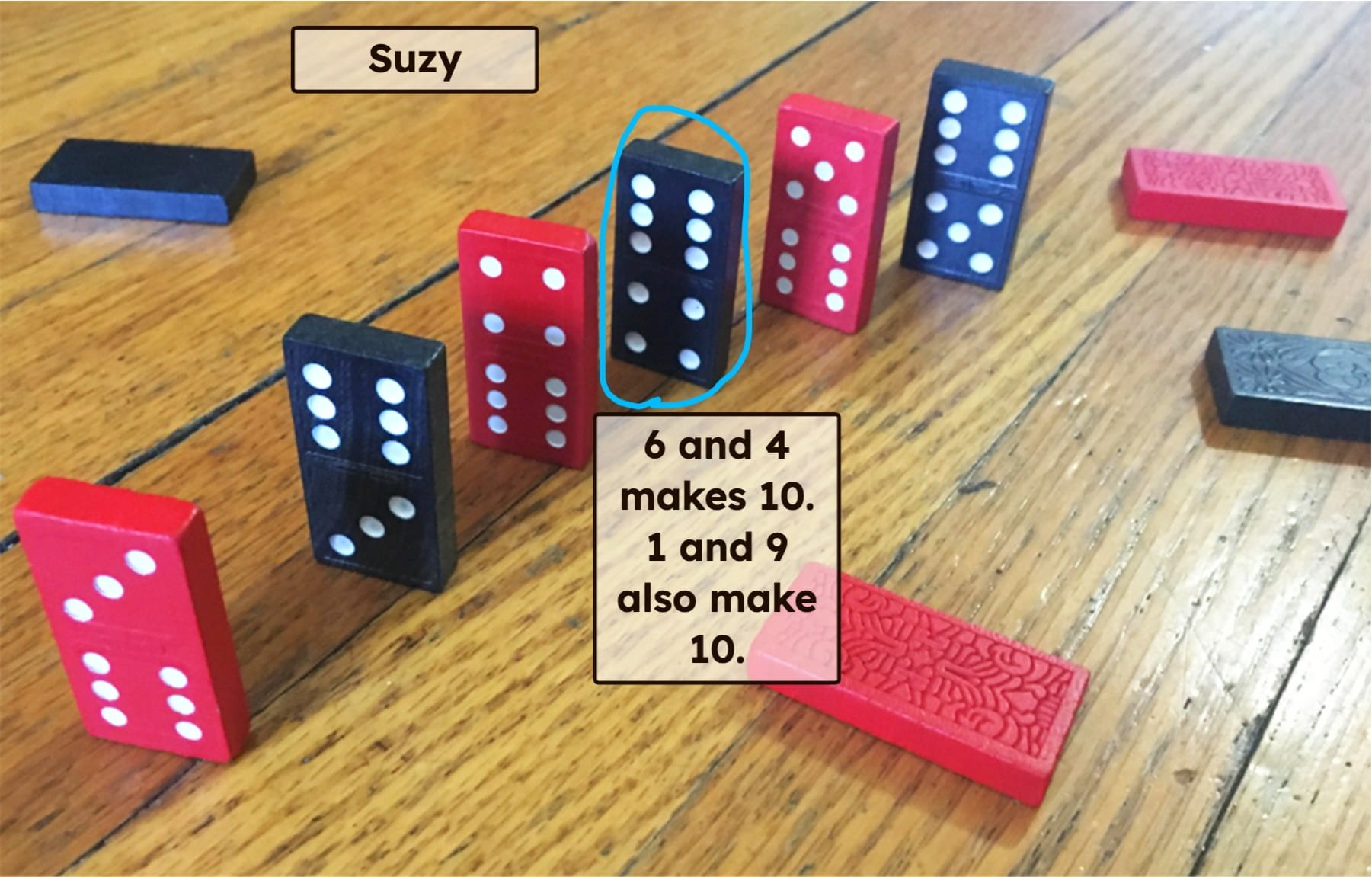
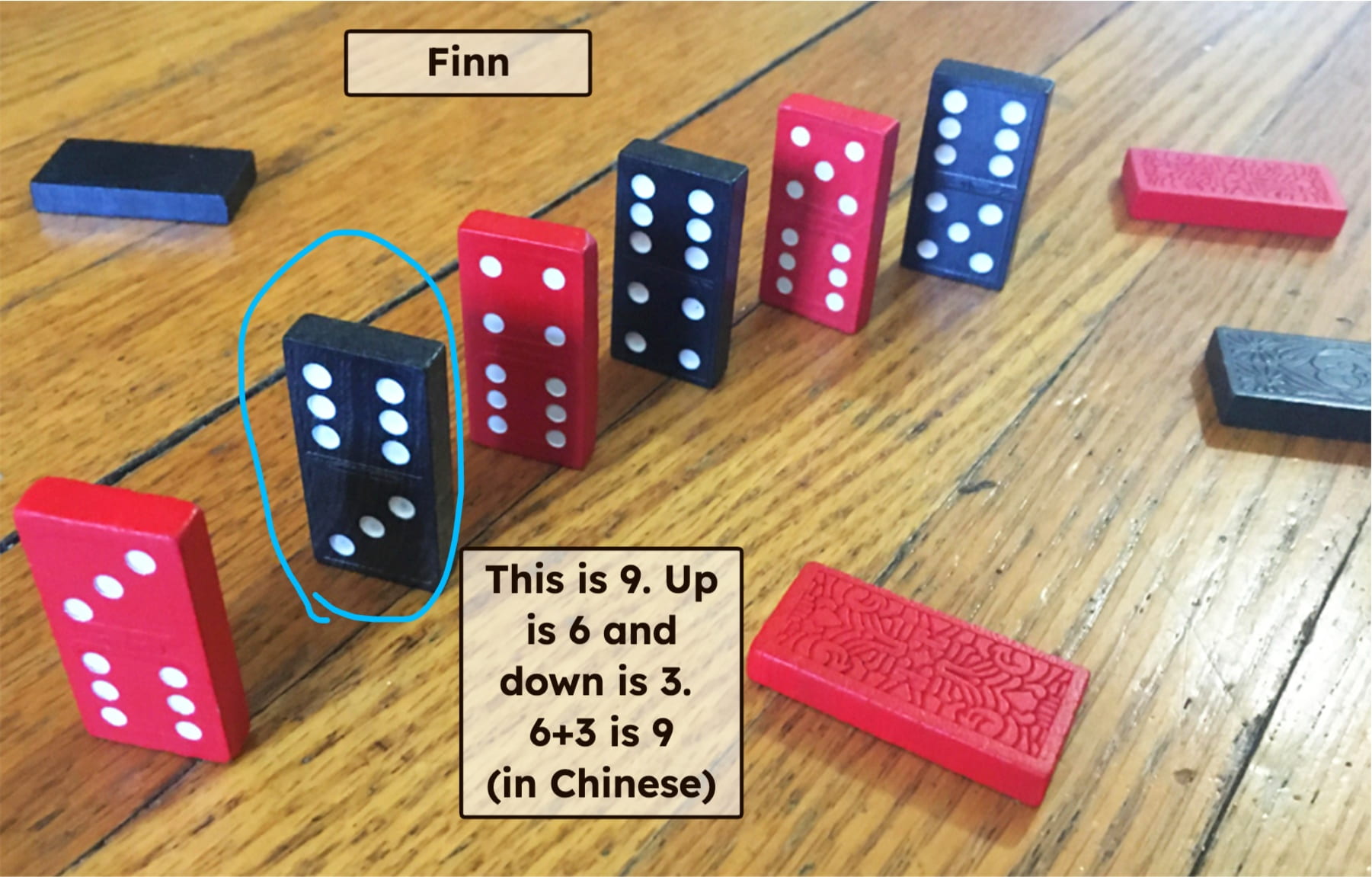
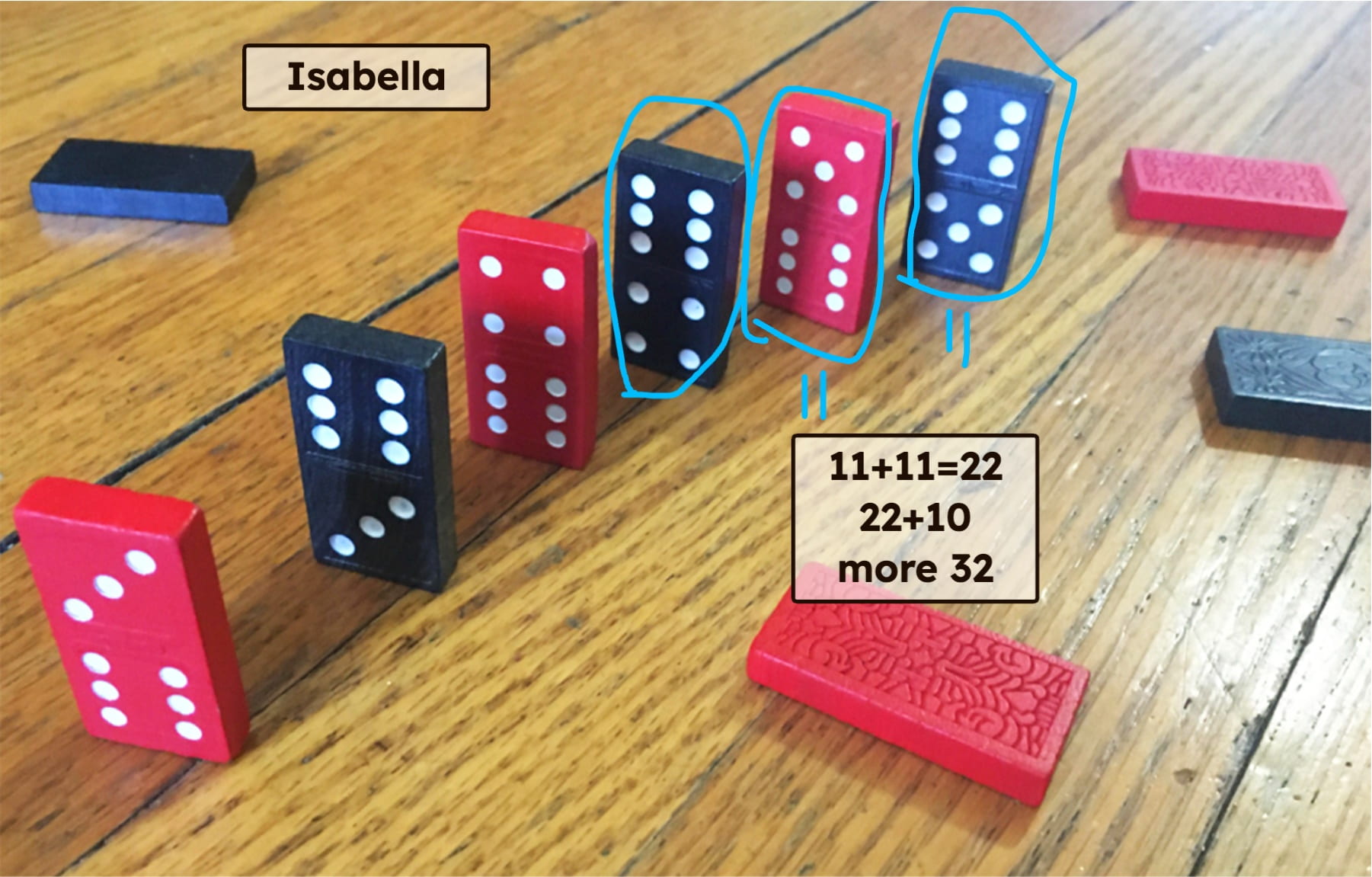
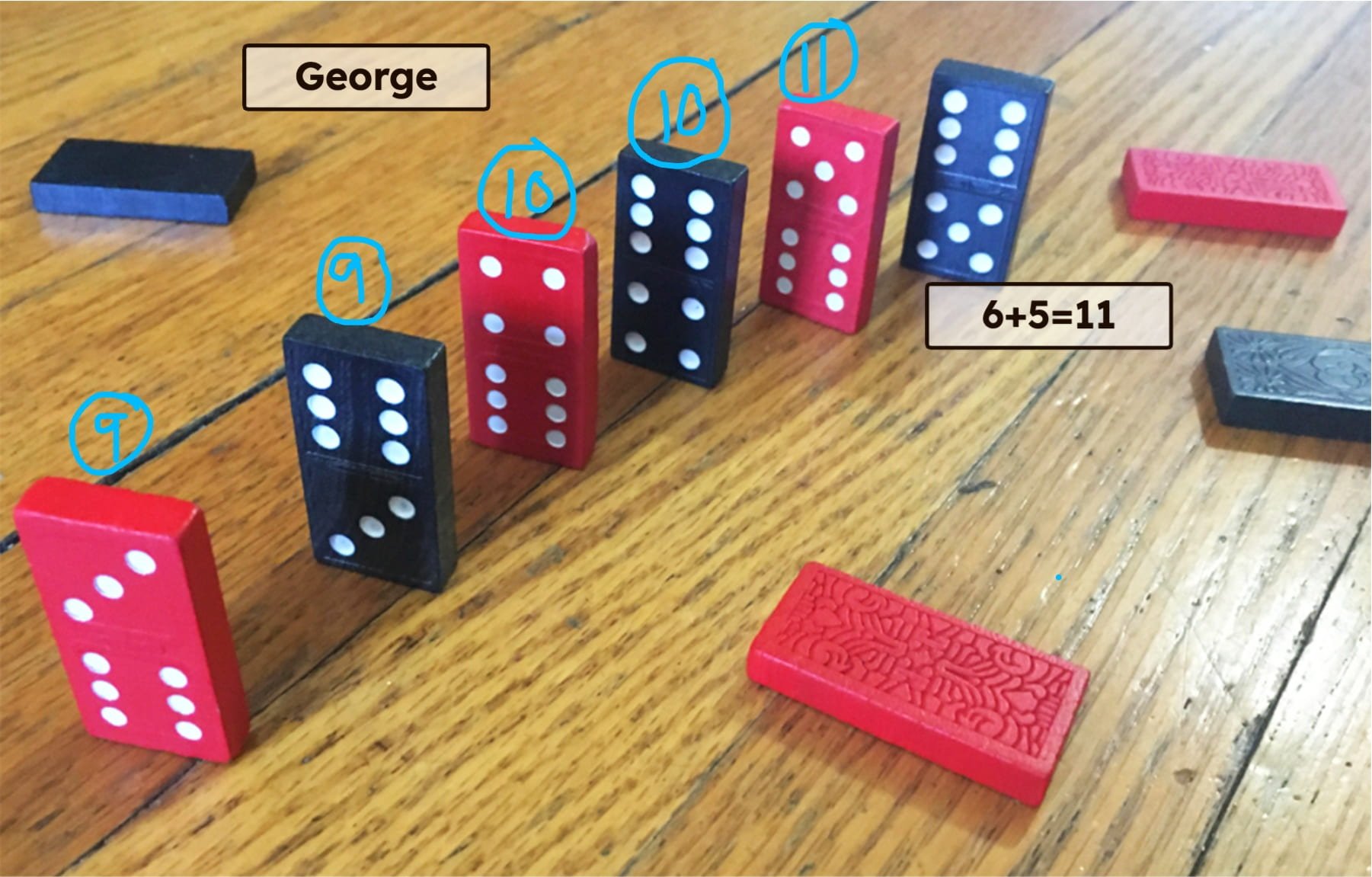
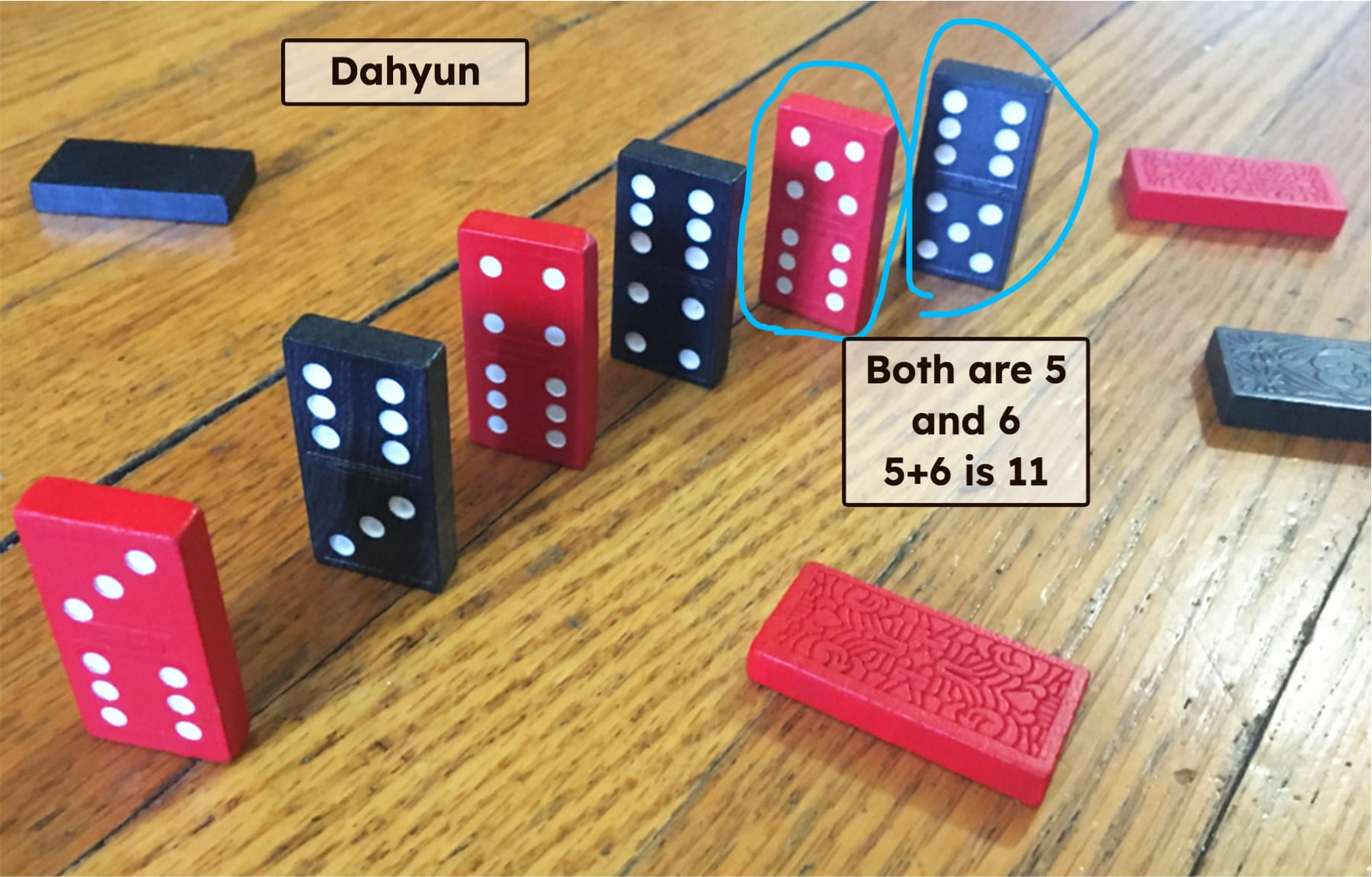
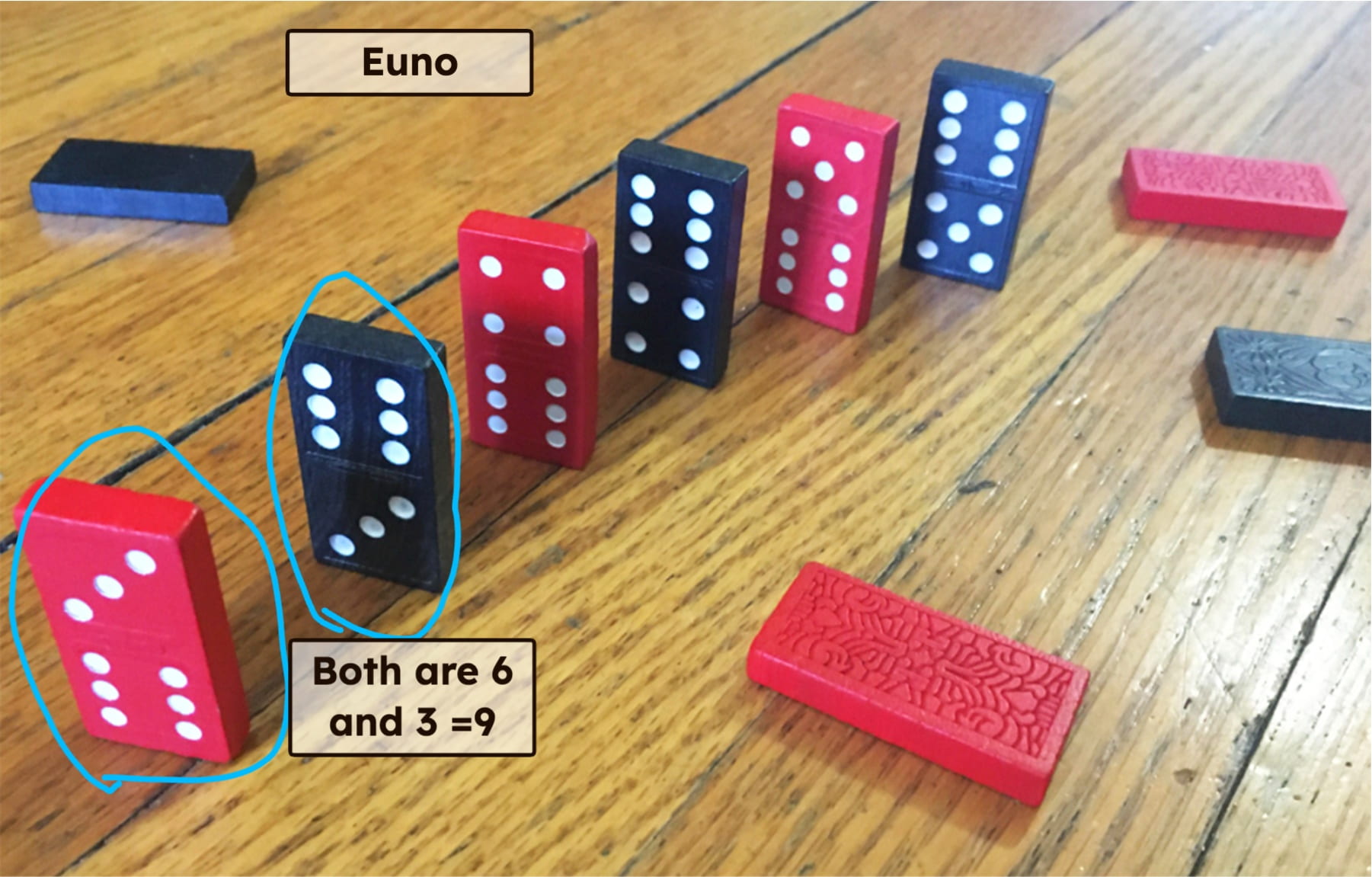
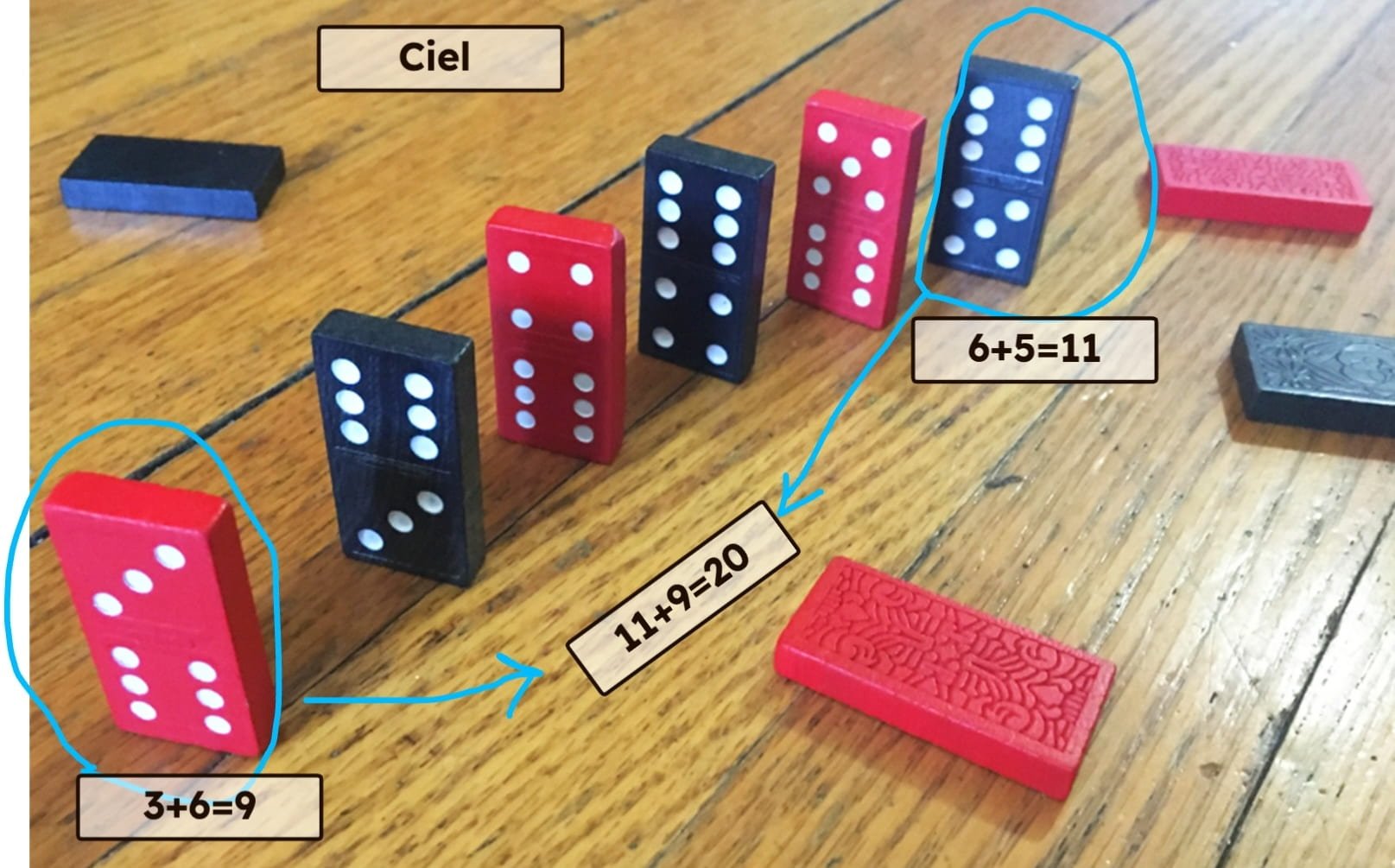
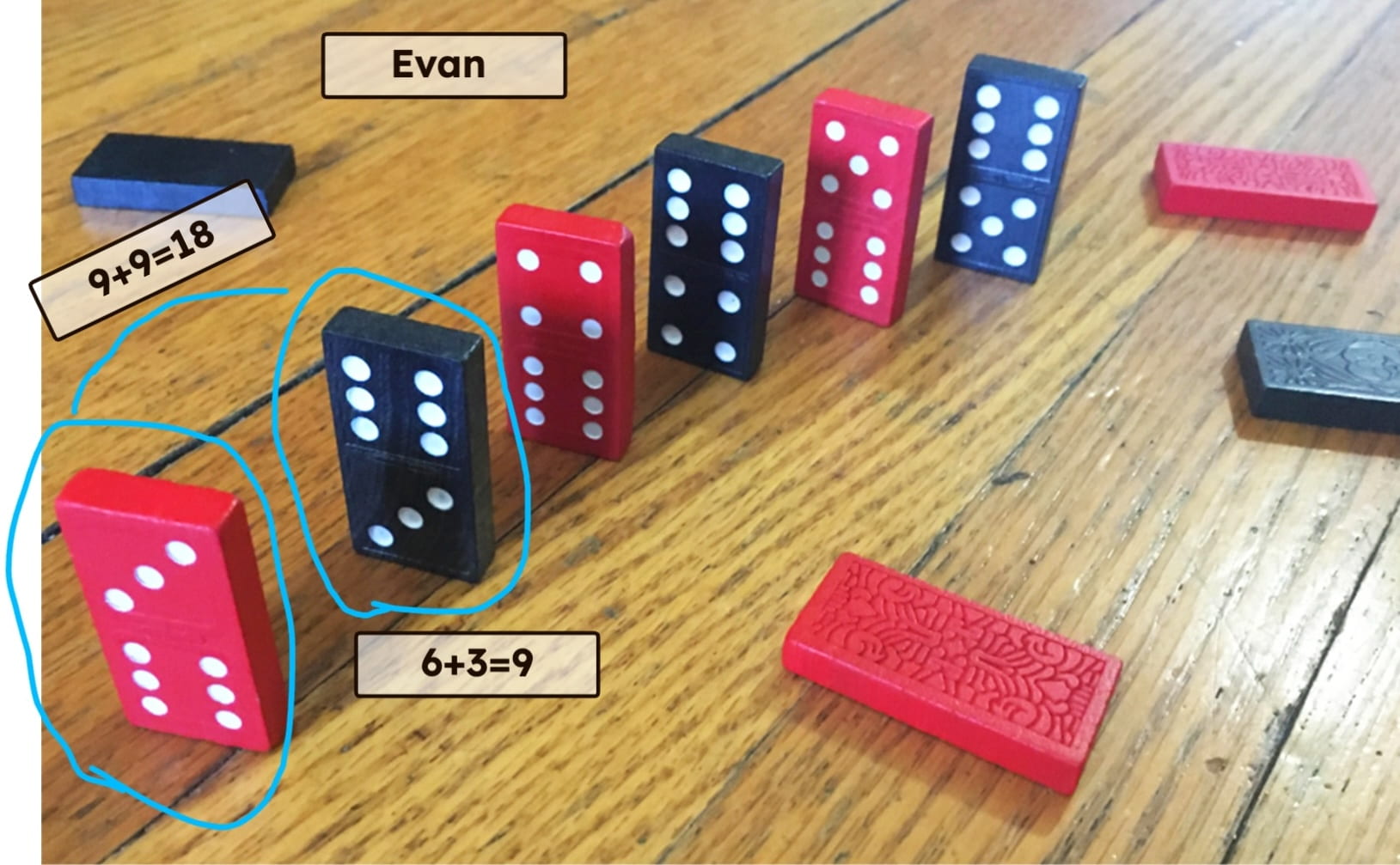
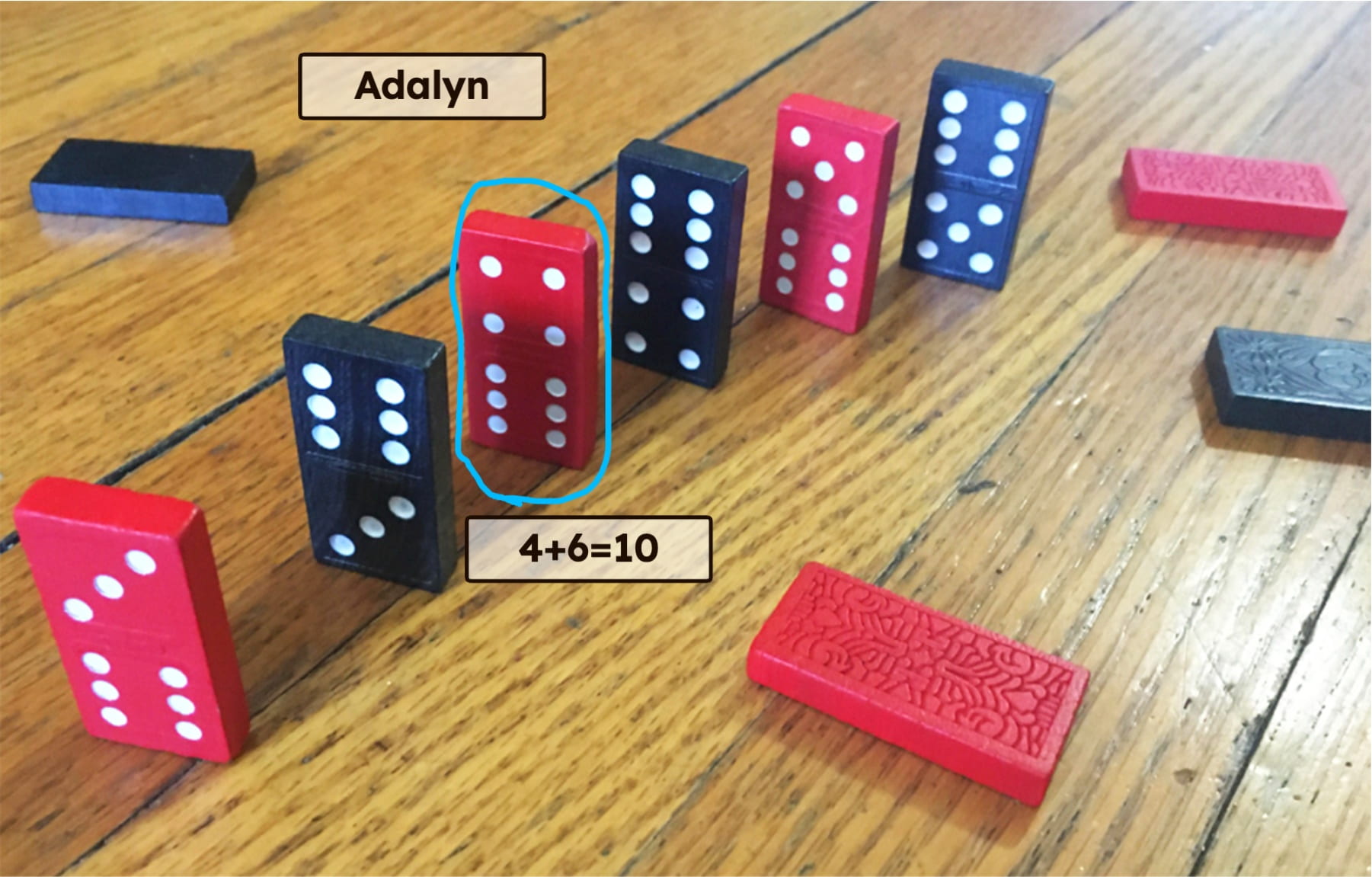
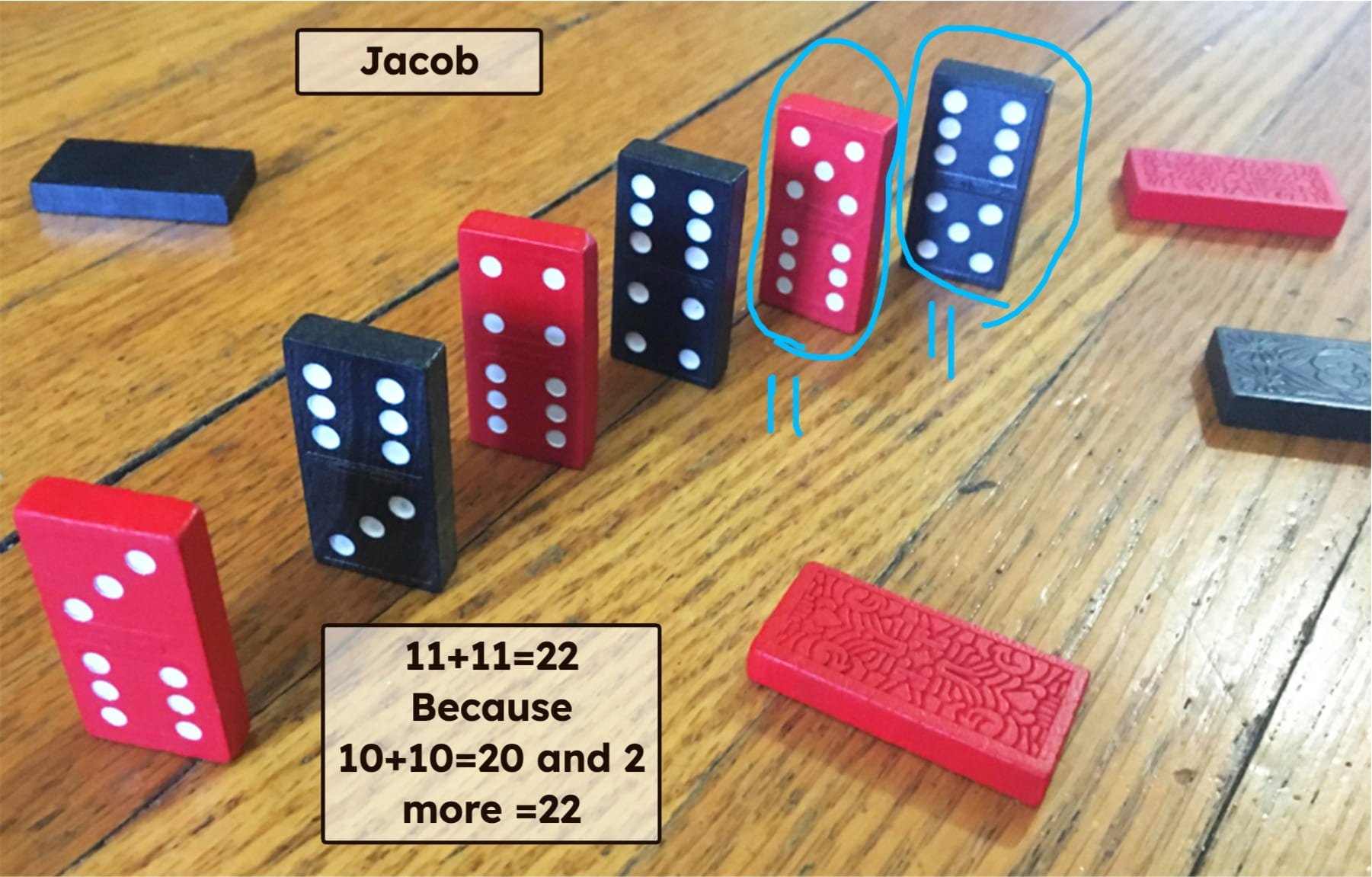
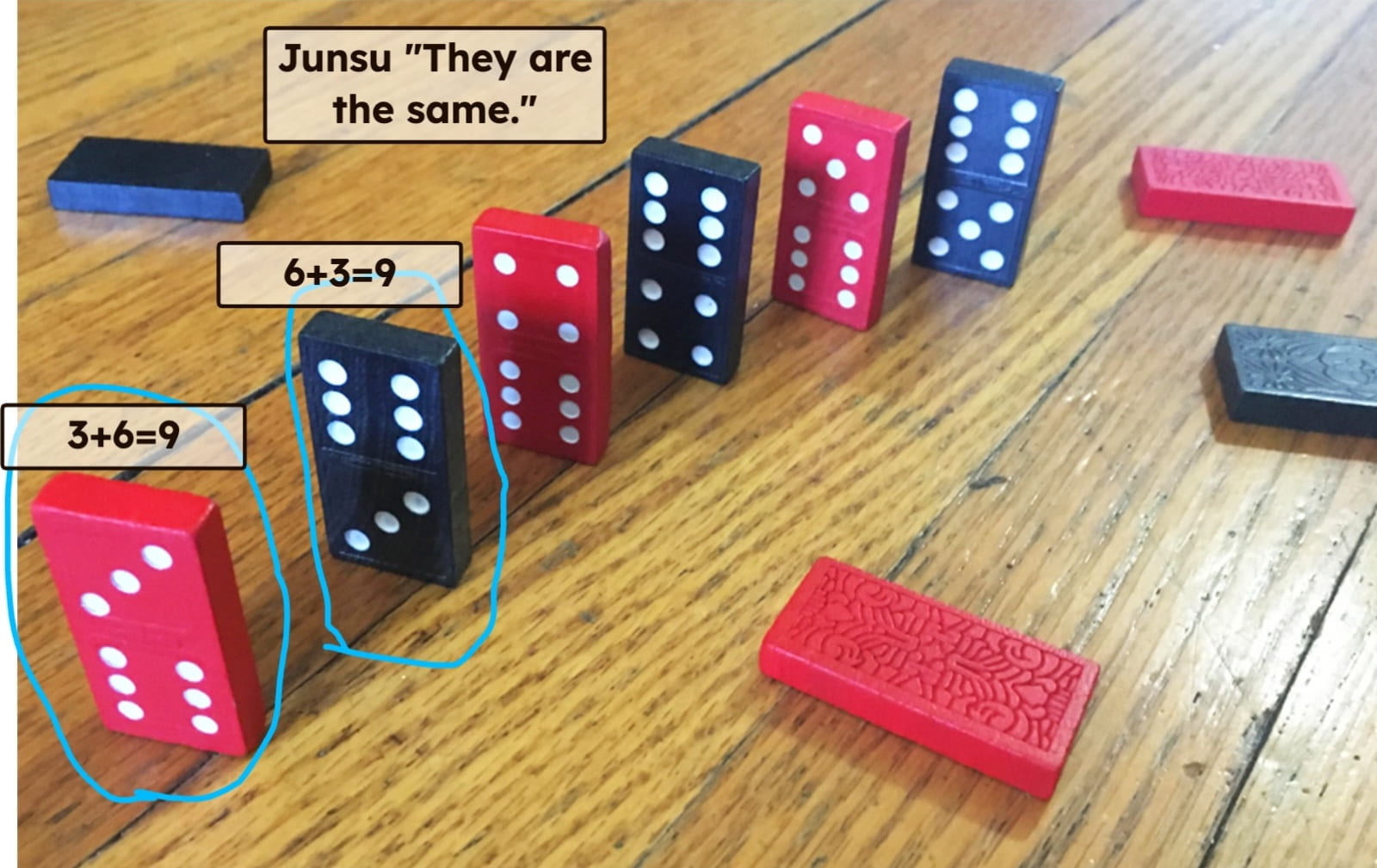
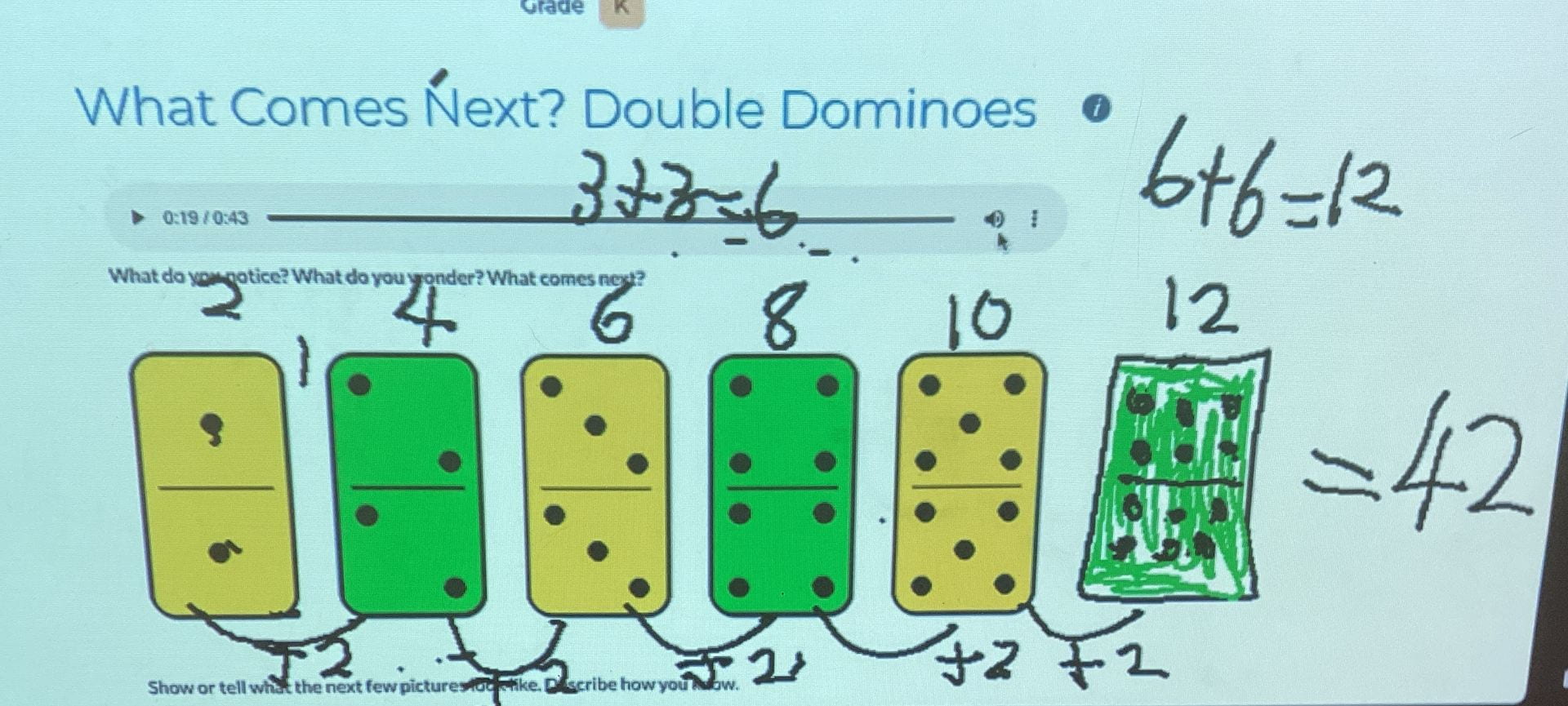
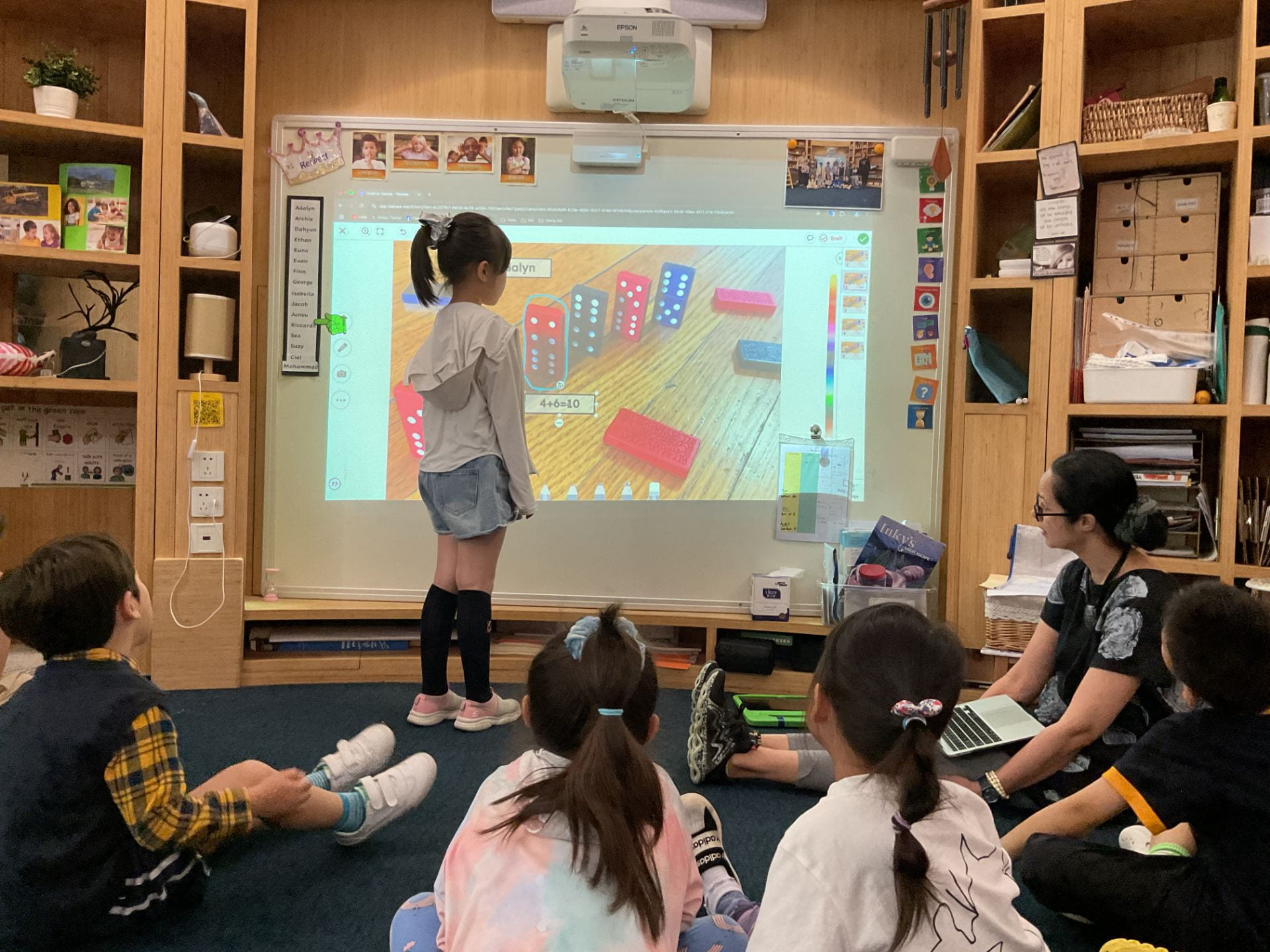
Math Talks – Dominoes

  • What do you notice?
  • What do you wonder?
  • What comes next? 

Show or tell what the next few pictures look like. Describe how you know.


Organising the Shed: Sorting and Data Collection  

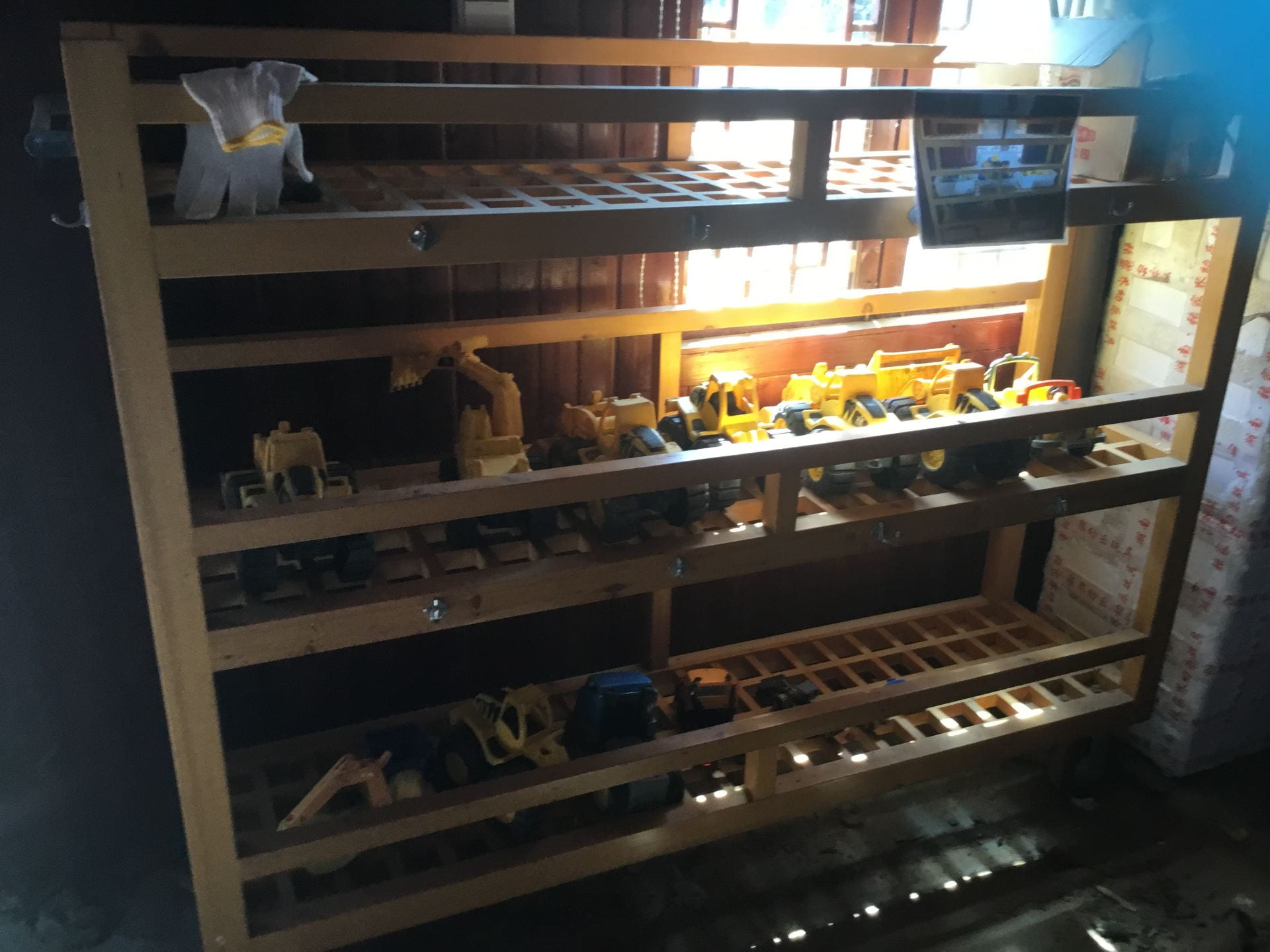
A team of children went to the shed to begin sorting the toys. They placed tubs for the sand toys, put the kitchen and cooking items on one rack and all the trucks and diggers on the shelves.

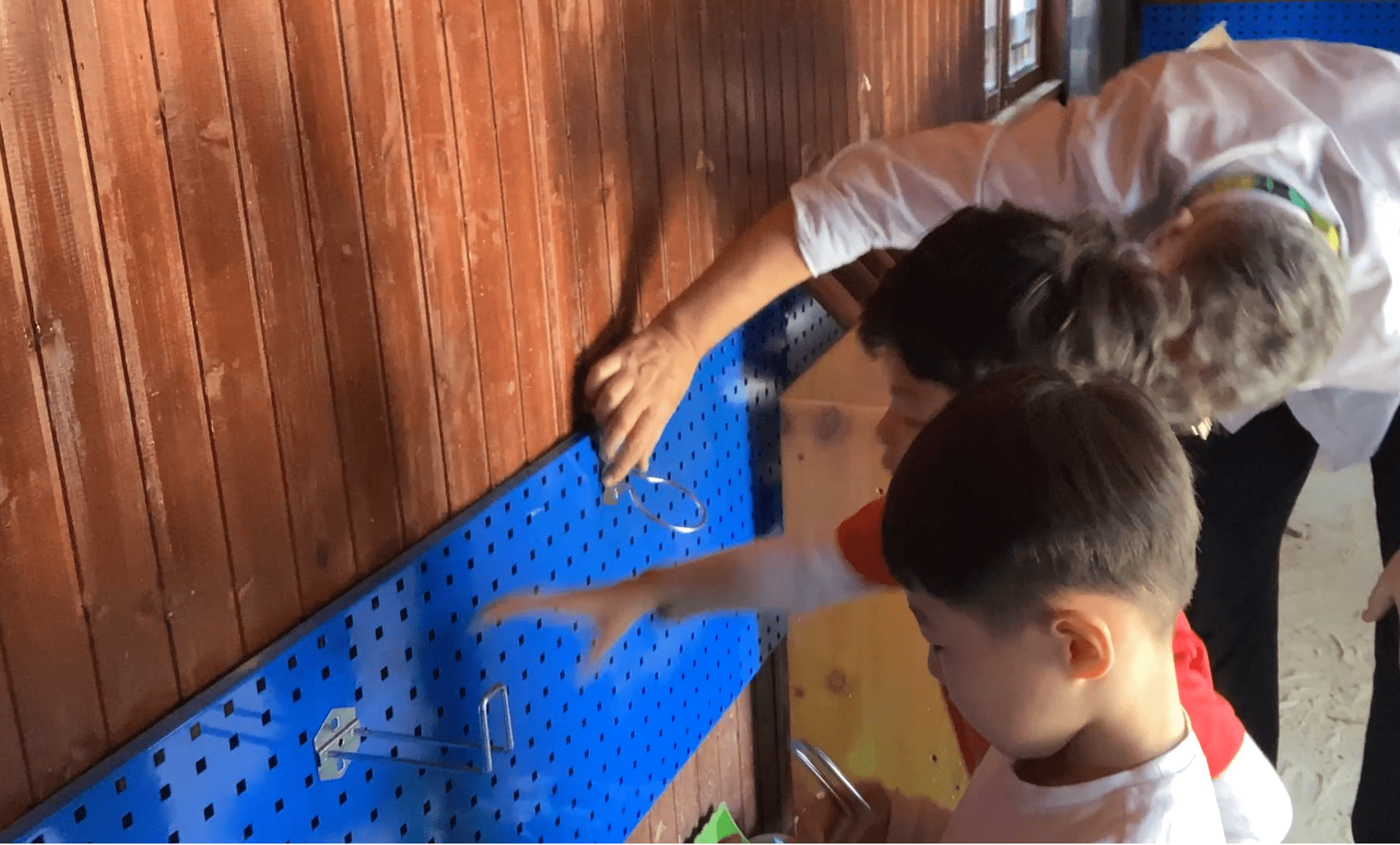
Next, Doho and Sean went to look for Mr. Jamie, to ask him if he could help the team mount the hooks on the pegboards.

Sean and Doho explained the problems they had, and then they went out to the shed with Mr. Jamie. Together, they were able to problem-solve and make a plan to mount the hooks.

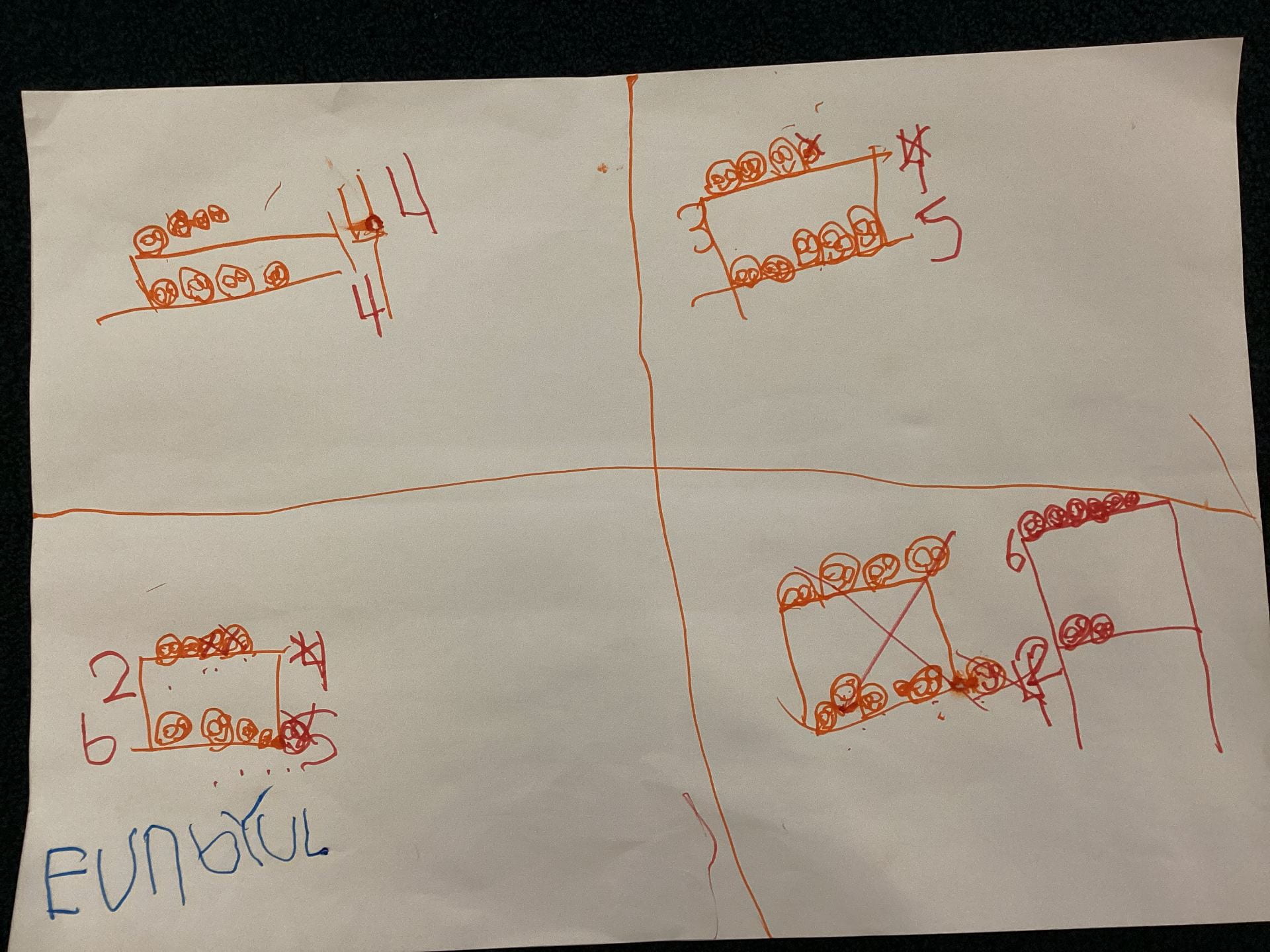
A team of K2 mathematicians went to the shed to gather more information to plan the next step of the project. We needed to find out how many hooks, tubs and racks we will need to sort and organise the different toys in the shed.


The team began to think about the different ways we can record data. We decided to divide the paper into four to record the number of kitchen items wheelbarrows trucks and sand toys.

Then, the data collectors used pictures, words and numbers to record their information. 

We observed the children:

·     gathering, recording and organizing information

·     listening actively and respectfully to others’ ideas and listening to information

·     using mark-marking to convey meaning

·     taking responsibility with tasks

·     using strategies to problem-solve

Measuring with Unit Cubes

We reviewed the measurement activities we did previously. We discussed the language used to describe length, height and different measures.

Then, the children were presented with the image of the spoons.  

Image: Math at Home

What do you notice about the spoons?

How are they the same or different?

The children noticed that:

  • two spoons had holes at the end (3,8)
  • one was like a toothbrush (1)
  • one had a pattern on the handle (8)
  • one was like a toy car (9)
  • some were longer and others were shorter, they had different lengths!


How can we tell how long they are?

What can we use to measure them?

What do we need to remember when we measure objects?

Patrick explained that the spoons should be lined up at the same level to measure them properly. We can also use a ruler to measure the length of the spoons.

Kenan helped Patrick arrange the spoons so that we can measure the length of the spoons accurately. We noticed that the spoons were different lengths, that they were made with different materials and were used for different purposes.
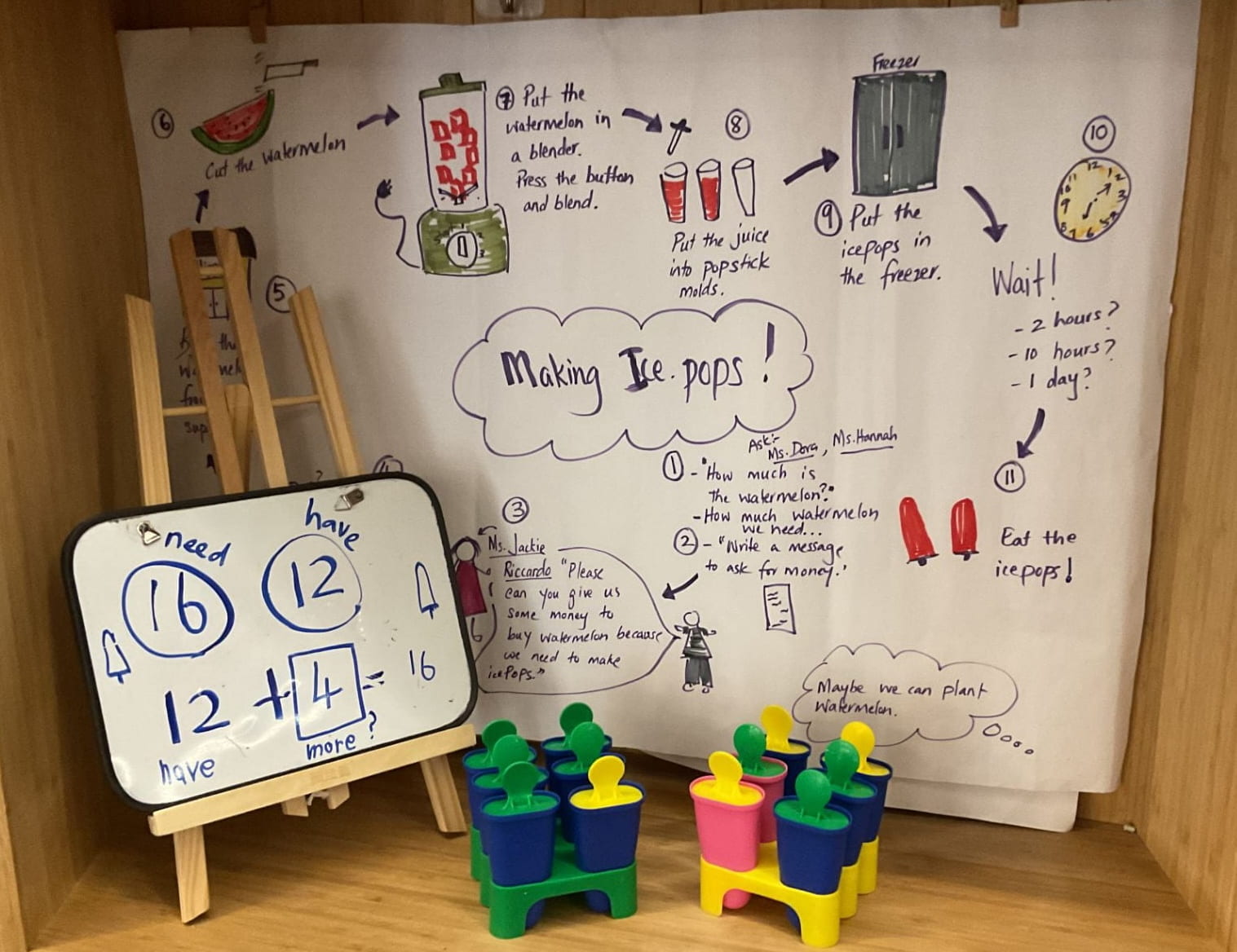
The children were introduced to a Seesaw activity. Then they went on a measurement hunt.

They used the cubes to measure the different items in the classroom to find objects that were approximately (about) 5, 10 and 15 unit cubes long/tall. They documented their research on Seesaw.

Learning Outcomes: Measurement

  • standard units allow us to have a common language to identify, compare, order and sequence objects
  • we use tools to measure the attributes of objects and events
  • estimation allows us to measure with different levels of accuracy

Splat!

What is SPLAT?

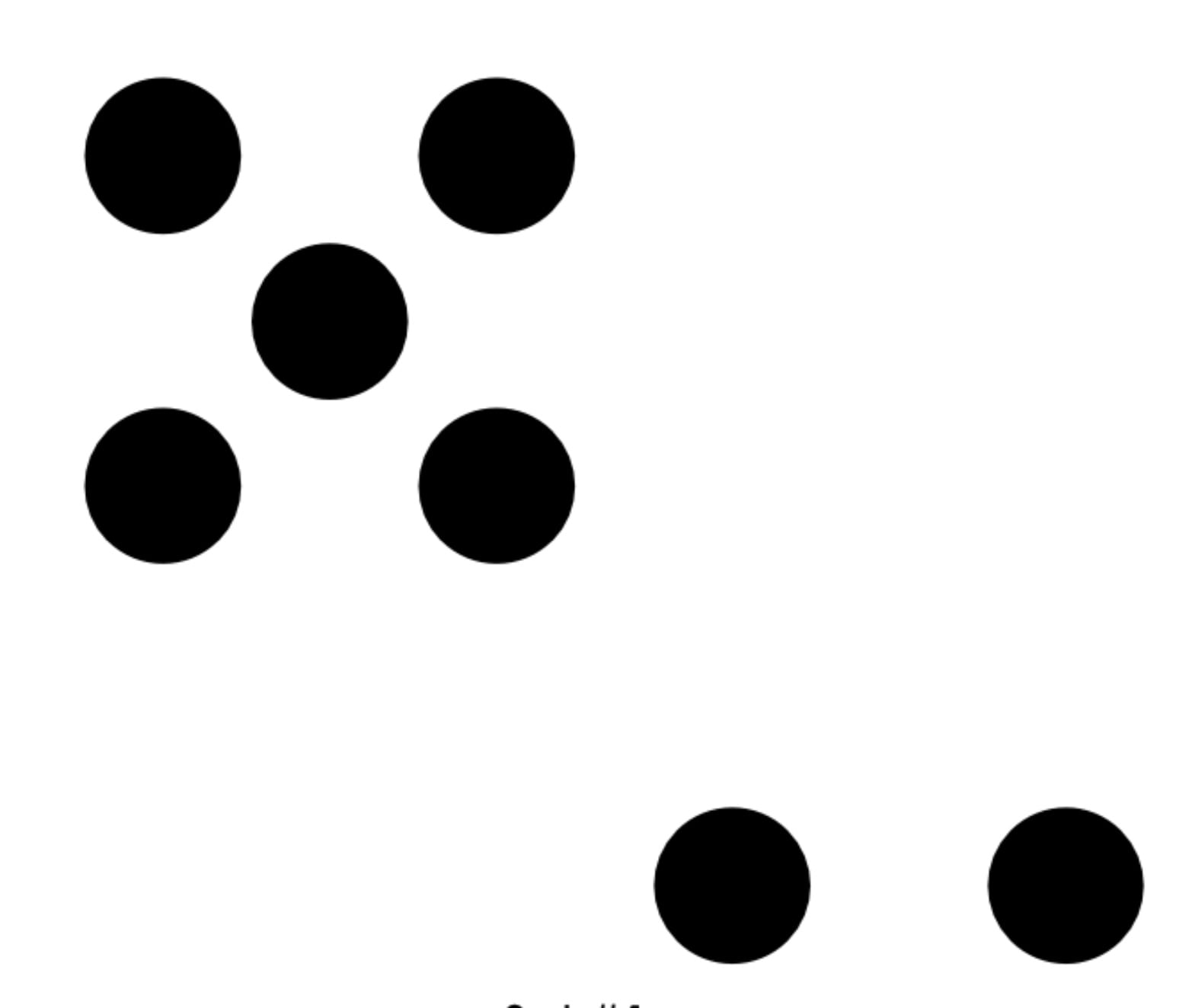
The ‘SPLAT’ math activity is a great way to talk about number. Essentially, a set of dots are shown using manipulatives or a screen. A “splat” or blob covers some of the dots. Then question is:

“How many dots have been covered by the splat?”

The mathematicians used what they know about number relationships to solve the problem. Exploring some of the thinking and reasoning led to creating equations. Finally, the children created their own class ‘SPLAT’ book.

Base 10 Value System

In Kindergarten, we have been exploring numbers in different ways through games and explorations at different centers. We offered the children a provocation to start a conversation about number.

How can we show 16?

Some of the children put their ideas down on the whiteboard. We discussed the ideas and pictures they shared.

Then, we introduced the children to a place value mat. The base 10 value system is used to represent numbers and number relationships.

As we rolled the dice, we began to count and add ones onto the mat. When we reached 10 ones (or units), we regrouped them to make a ten! We continued with the game as we practiced grouping the ones to make tens.

We will continue to use the base 10 value system to represent numbers and explore number relationships.

Fish in the Pond!

Distance Learning

Focus: Mathematics, Thinking Skills

Here is a game you can play with counters and dice.

Watch the video for instructions…

Share your game board!

CHALLENGE: Use more counters and use 2 dice (addition) to decide how many fish should be in the pond.

Counting Squares

The students were presented with a picture that had a heap of red and yellow Unit Tiles.

What do you wonder?

  • Tracey “Why does red and yellow? Why are they not rectangles?”
  • Patrick “Who takes yellow and red to mix it.”
  • Kenan “Why yellow and red is putting in?”
  • Mason “What does it mean?”
  • Olivia “Why don’t they have blue and green?”

 Estimate how many squares are in the pile?  

Next, the children estimated how many Unit Tiles there were in the pile. They noted this down.

How many red?

How many yellow?

How many Unit tiles we used to make the pattern?

Then, we watched a video that gave the children more clues. The video stops midway, showing an incomplete pattern. The children used pictures to draw and share the complete pattern, and to find out how many tiles were used in all.
Finally, they were able to record how many red and yellow tiles were used to make the pattern.

Through this task the children were able to:

-estimate

-share their thinking

-document ideas using drawings and numbers

-problem-solve

-work in collaborative groups


Dot Talks

We have been estimating and subitising groups of objects to help us learn more about number and calculation. Subitising is the ability to look at a small number of objects and instantly recognise how many objects there are, without needing to count. We frequently subitise, estimate and calculate to make decisions and complete tasks, therefore, this is a valuable skill that helps us in our everyday life experiences.

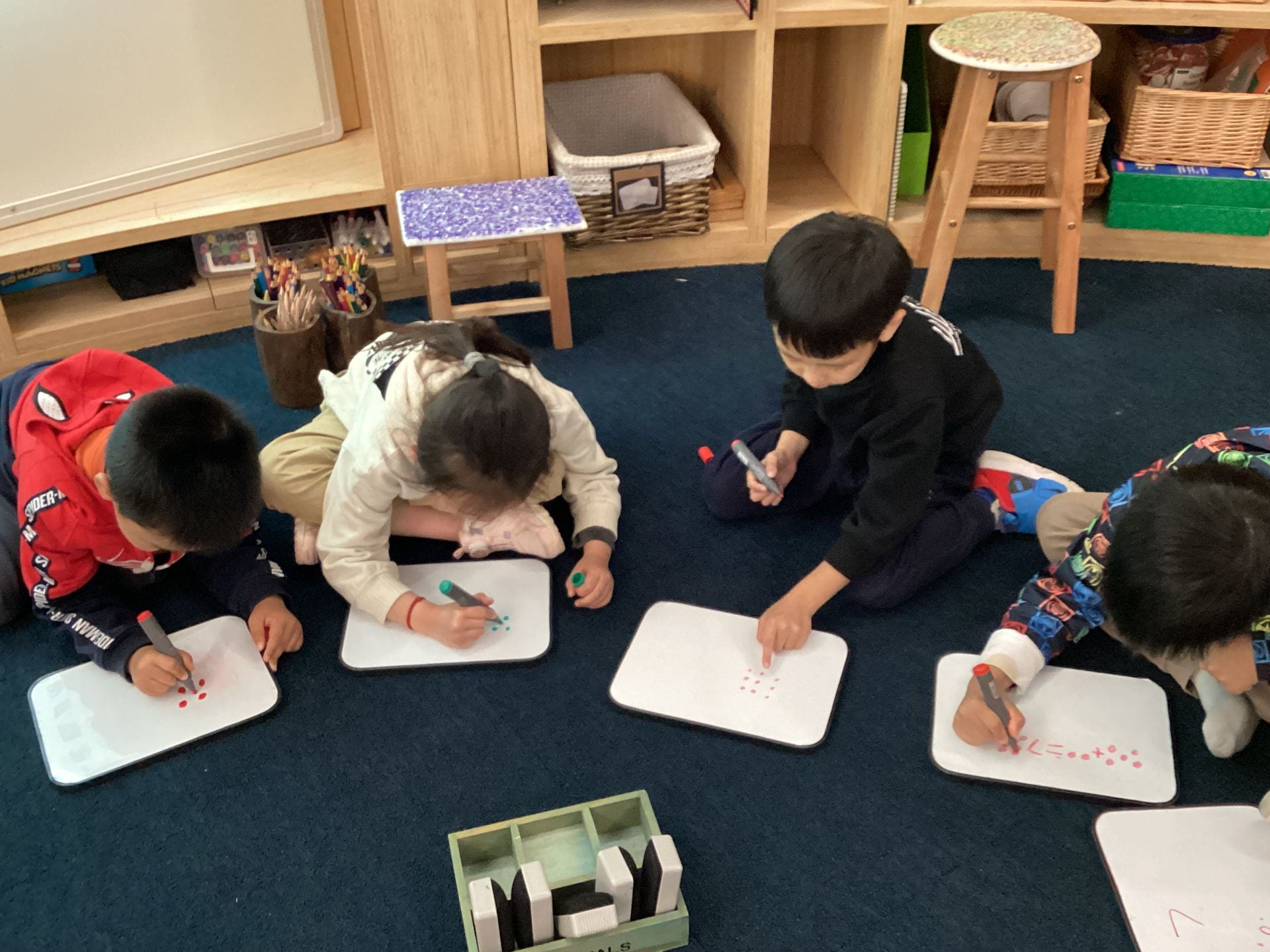
To help us practice this skill, we used a short routine called ‘Dot Talks’.

First, the children were shown a card with a number of dots.

The following questions guide their thinking and problem-solving:

  • How many dots are there?
  • How do you know?
  • How did you count the dots?

Then, they used their whiteboards to document their thinking.

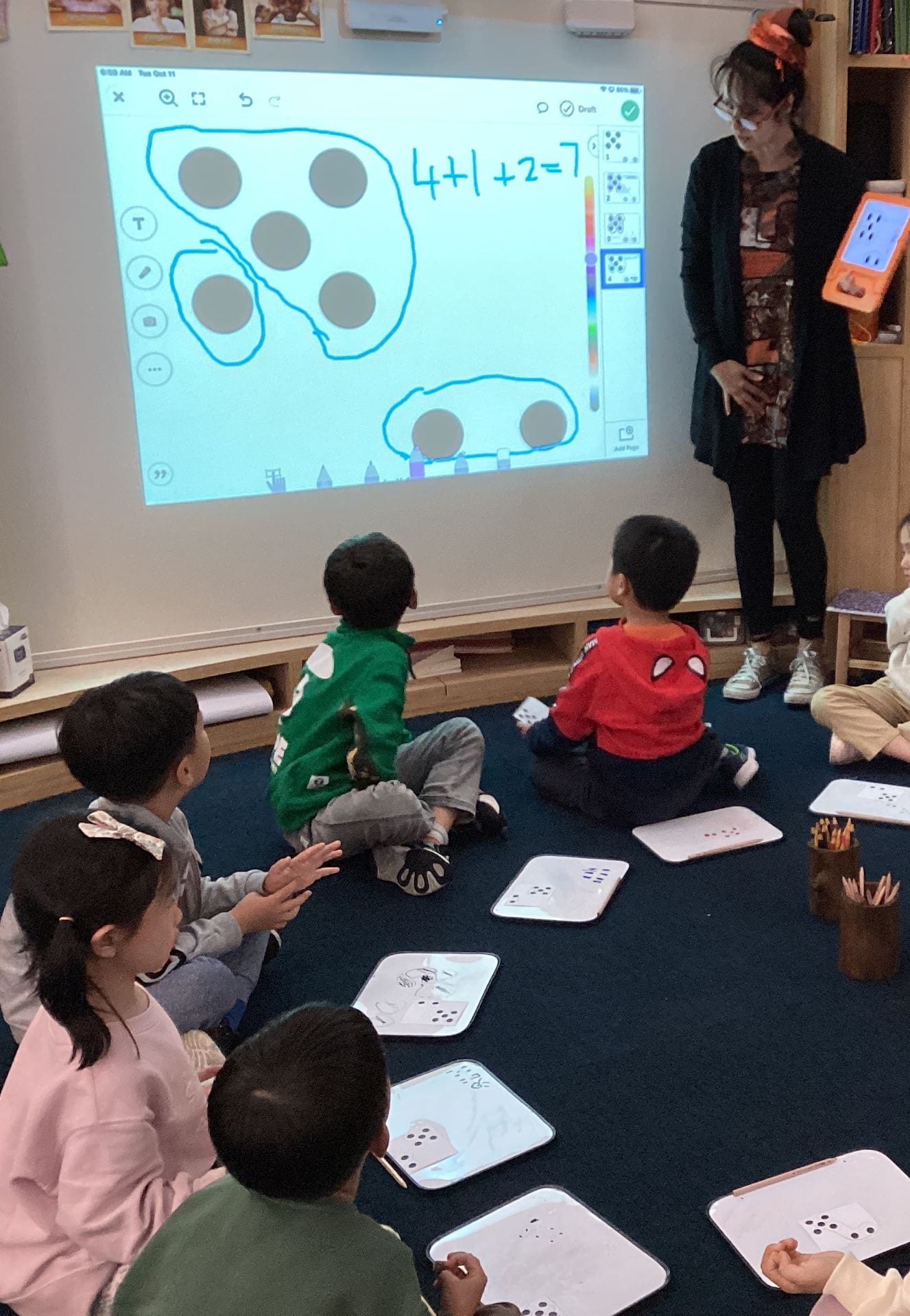
Next, they transferred their thinking onto paper and used coloured pencils to show how they have grouped their dots to make it easier to count.

While documenting the different ways we counted the dots, the children had opportunities to build number sense, articulate their thinking, and appreciate different perspectives.

We created a chart showing all the different ways we counted the dots.

We are learning that number operations can be modelled in a variety of ways.

Other Examples


What does it mean to estimate?

The students were presented with a math task to explore estimation. Estimating means roughly calculating or judging a number or value.

‘Estimation skills provide students with an ability that instils confidence with number. Everyday life requires estimations and approximations such as rounding to the nearest ten, hundred or thousand (Booker, Bond, Sparrow & Swan, 2010).’

A row of dice was placed at the edge of the green rectangle. First, we counted to find out how many we needed on one side of the shape. Then, a question was presented.

How many dice will we need if we were going right around the edge of the rectangle?

The children used their whiteboards to write their estimates (best guess). Then, we recorded these estimates on the board.

Next, we added a few more around the perimeter of the shape.

The children could change their estimate based on the new information presented. Finally, we placed the dice around the edge of the rectangle to check our estimations.

We needed 22 dice to go around the rectangle!

We had a smaller rectangle and so we tried to find out how many dice would go around the edge of the smaller rectangle.

We used an empty number line to find out the estimate that was the closest to the actual number. 

Mouse Count

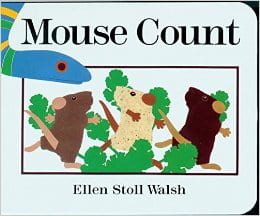
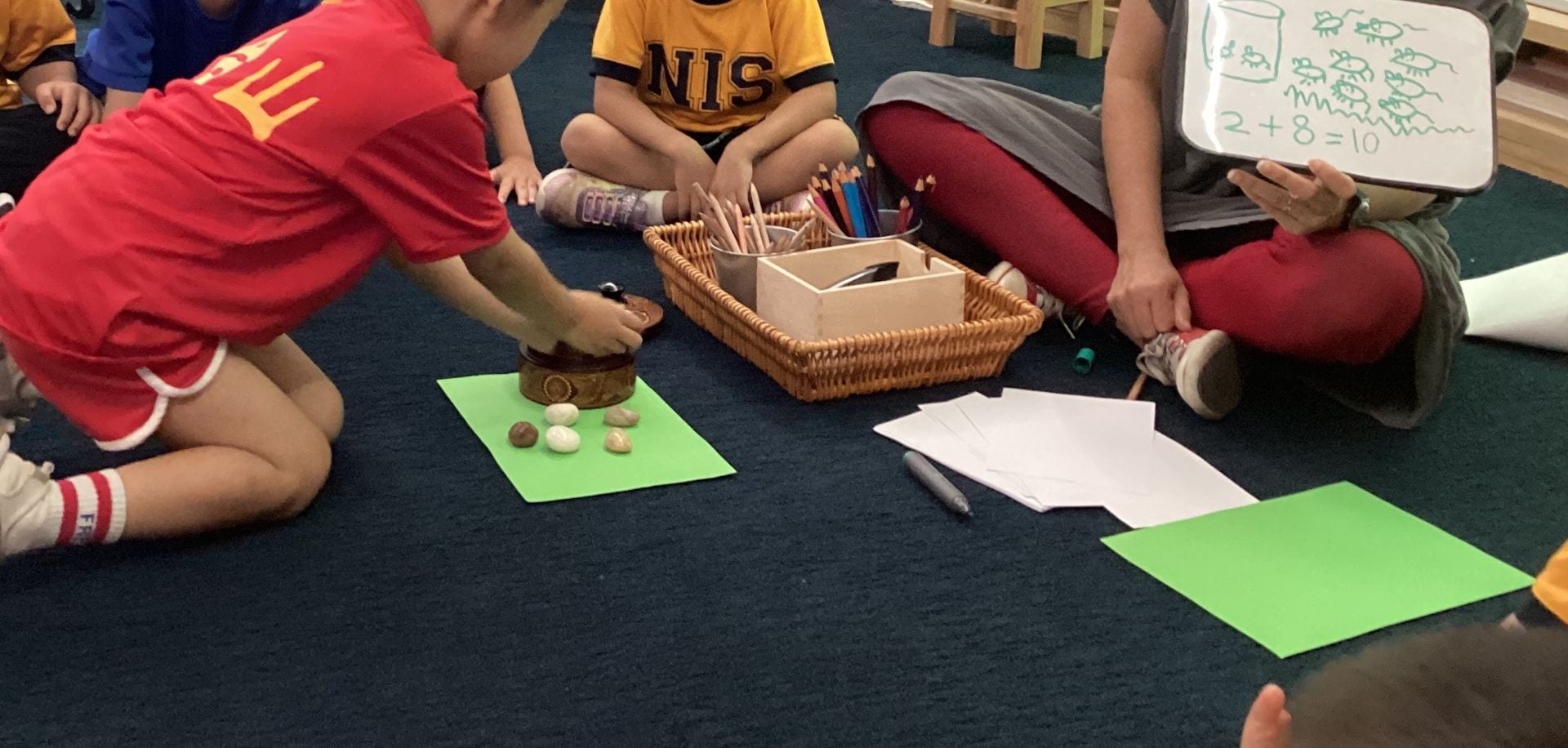
We read the picture book 🐁  Mouse Count by Ellen Stoll Walsh. This is a wonderful picture book that encourages conversations about number, quantity and addition.

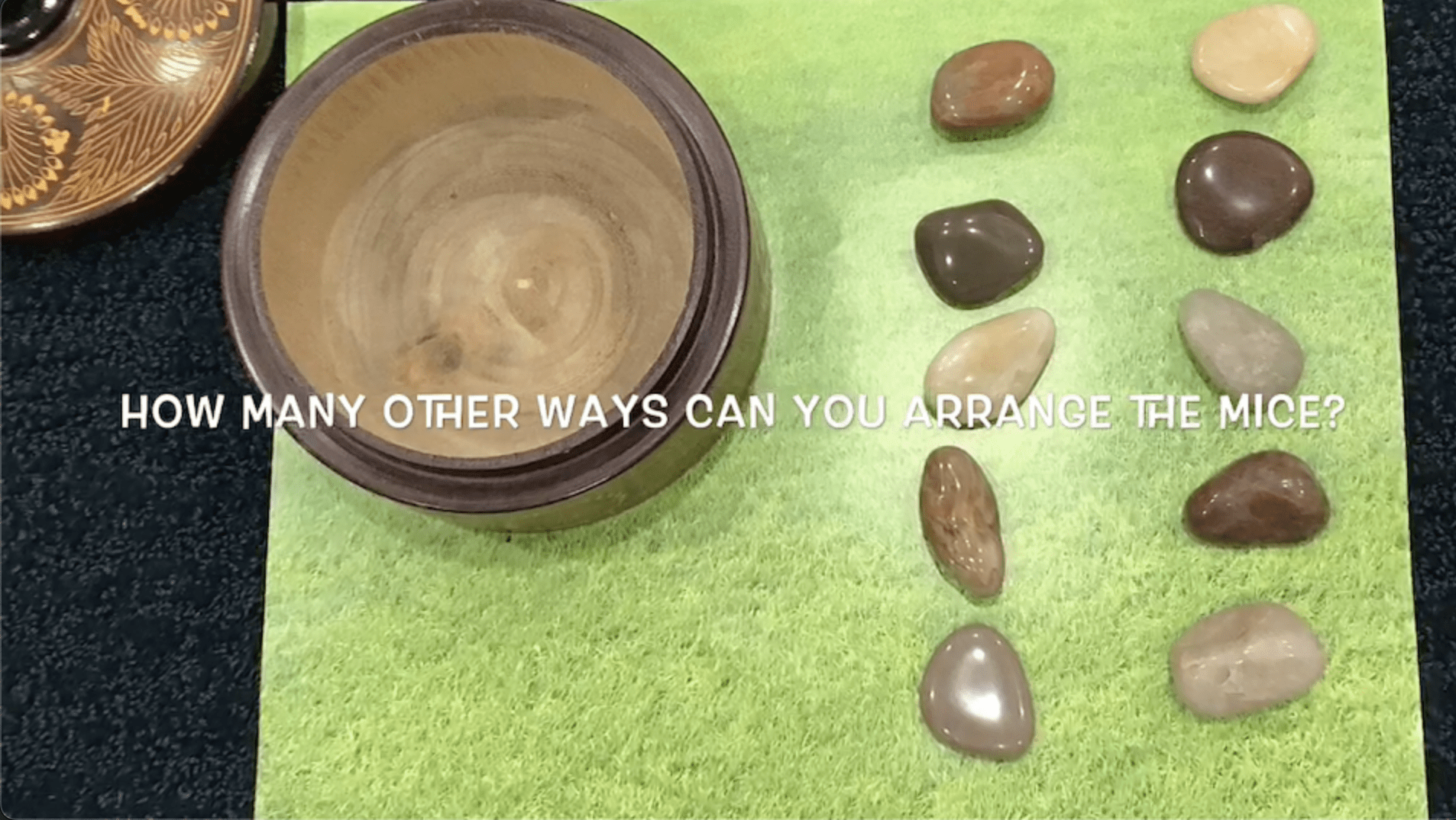
After reading the story, we watched a short video that encouraged the children to think about the multiple combinations that make 10.


We wonder how many different ways 10 mice can be arranged with some in the jar and some in the grass.

Through play and dialogue, we looked a few different combinations using stones to represent mice. 

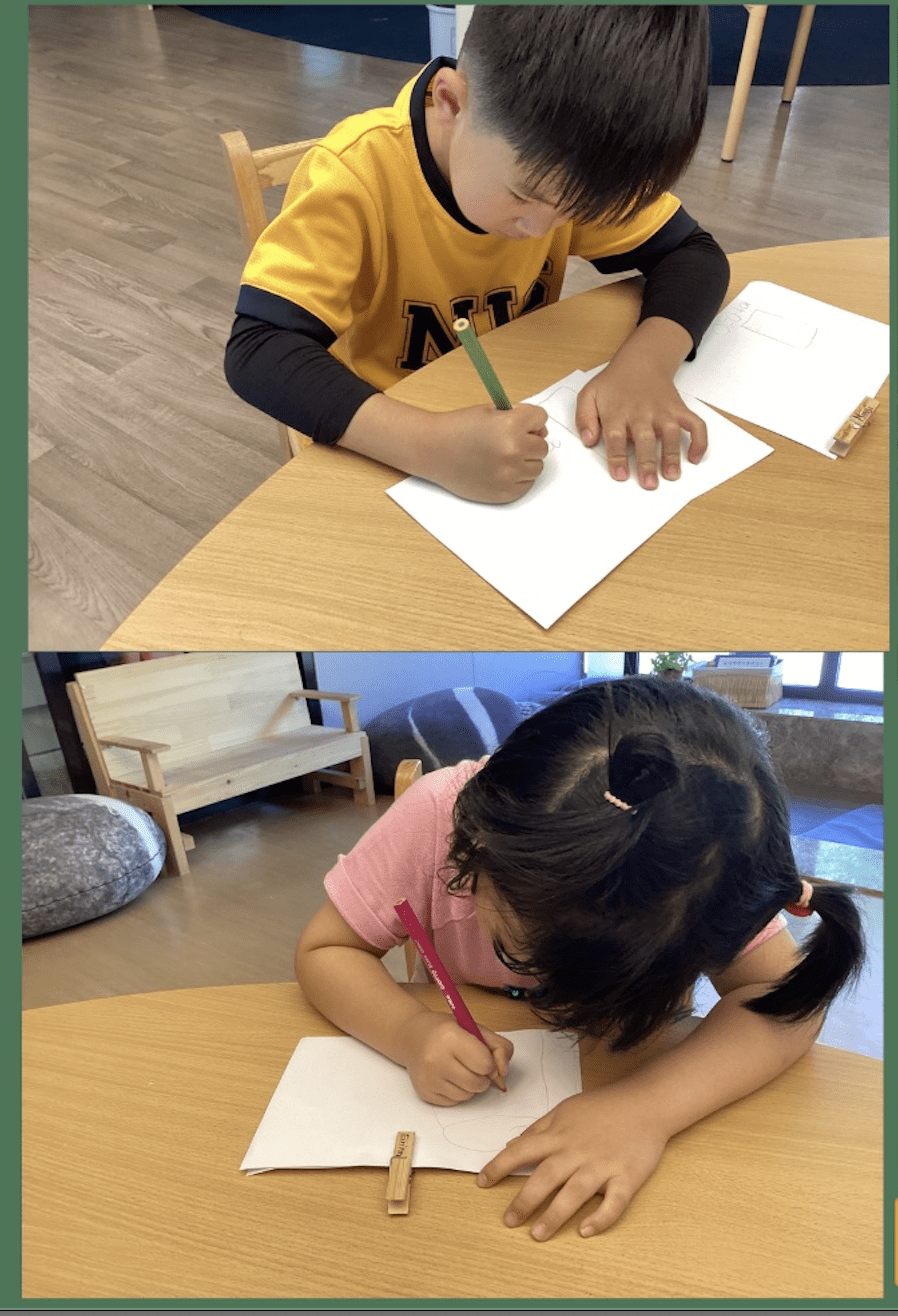
Then, the children were invited to make their own number book.

One student decided to tell his own number story using the different loose parts in the campfire.

We are learning to create number stories by modelling joining and separating concrete objects. We can use language to describe changes to a collection as objects are added or taken away.

The children documented their thinking on paper using pictures, numbers and symbols. These pages will be collated to create a number book.

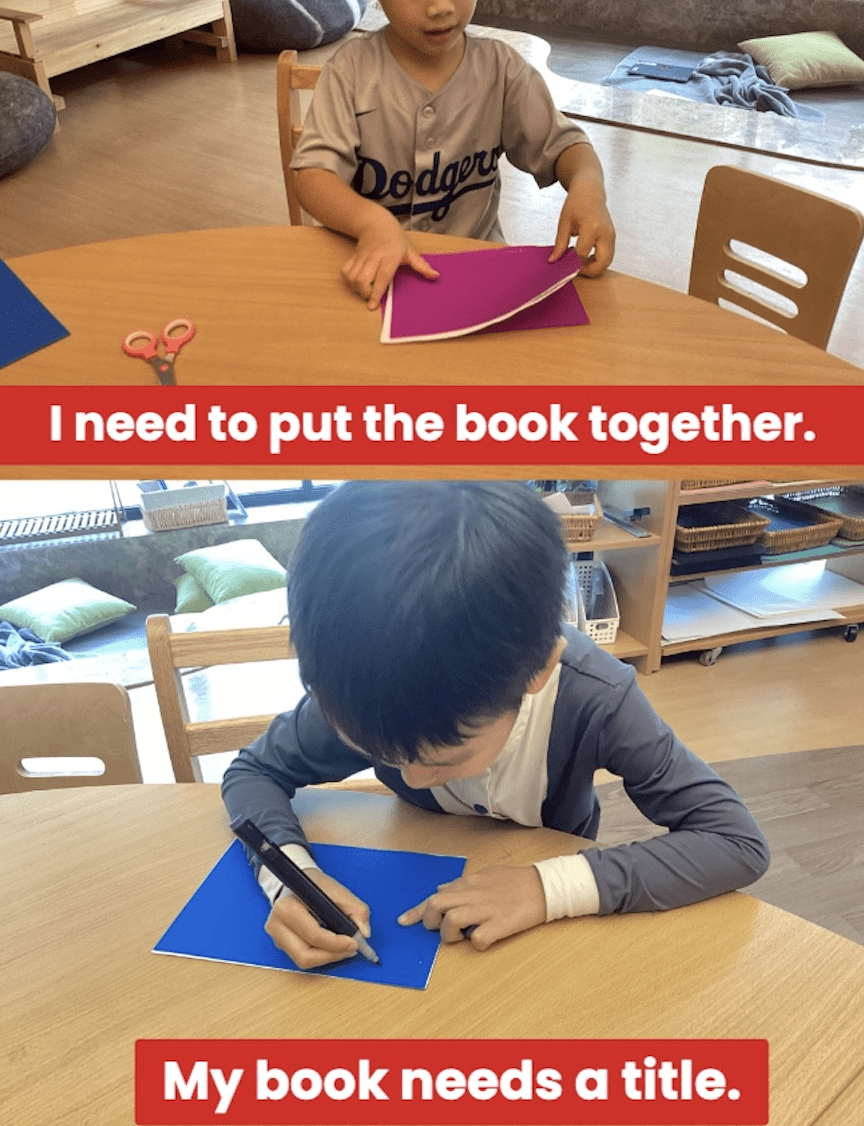
As authors and illustrators, their next task was to decide what the cover of the book should look like.

They had to think of a ‘title’ that gives the reader an idea of what the book might be about.  

Finally, the children included a picture on the front cover along with the authors name.


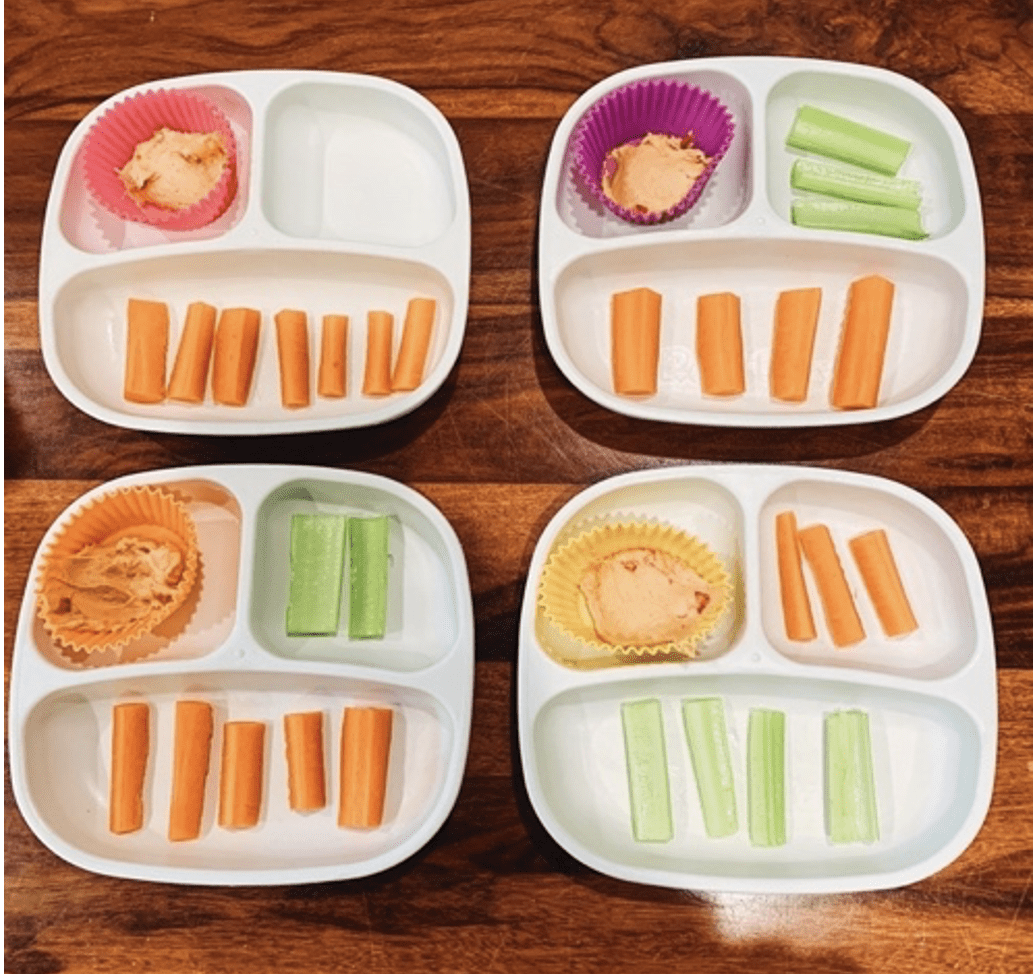
Snack Plate – Math Talk

The children were presented with a photograph of 4 snack plates. The different plates had servings of carrots and celery with hummus.

The children were invited to share their observations.

  • What do you notice?
  • What do you wonder?

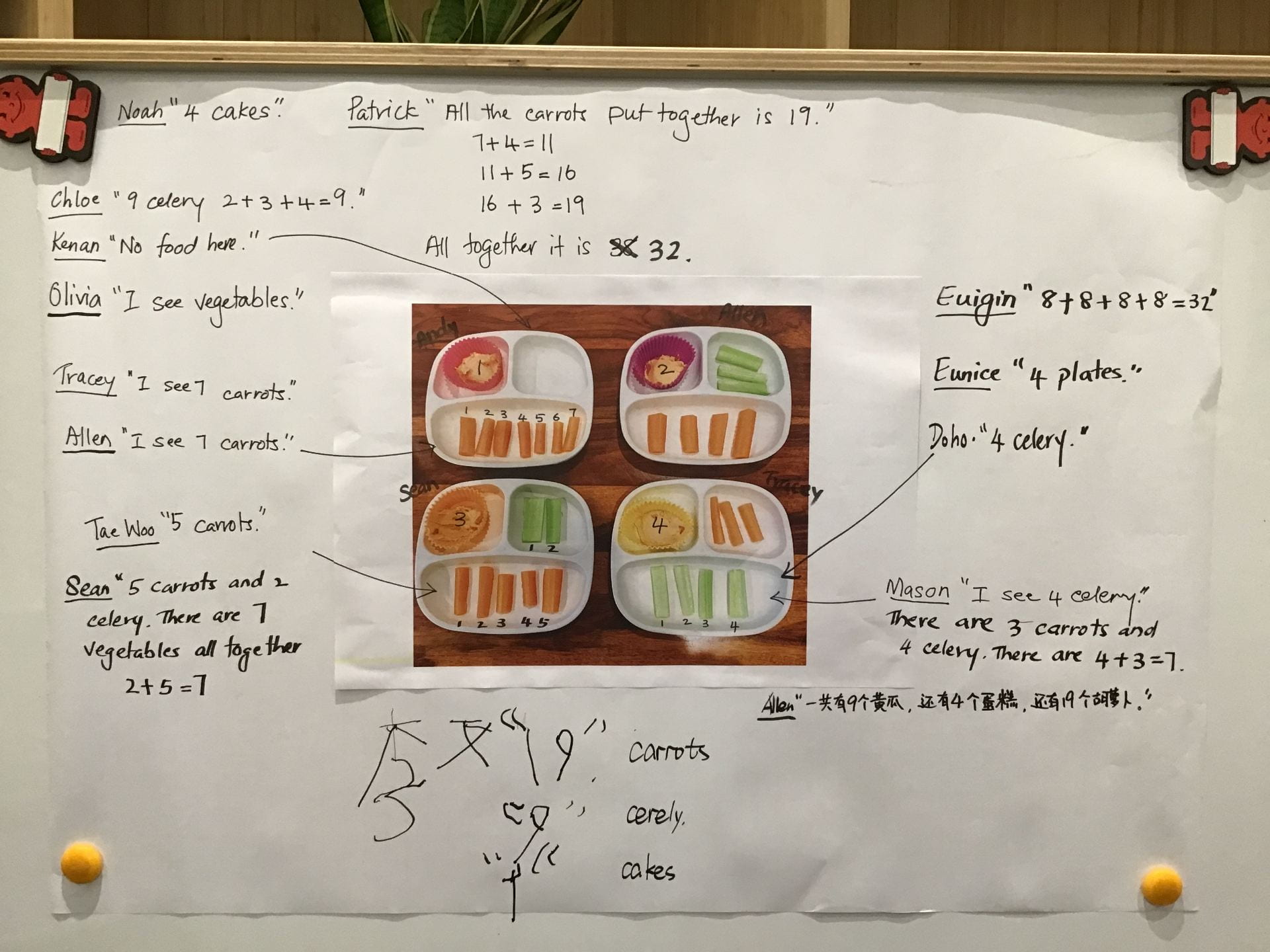
We used numbers, symbols, words and sentences to record their ideas.

We wrote equations to show the combinations of carrots and celery.

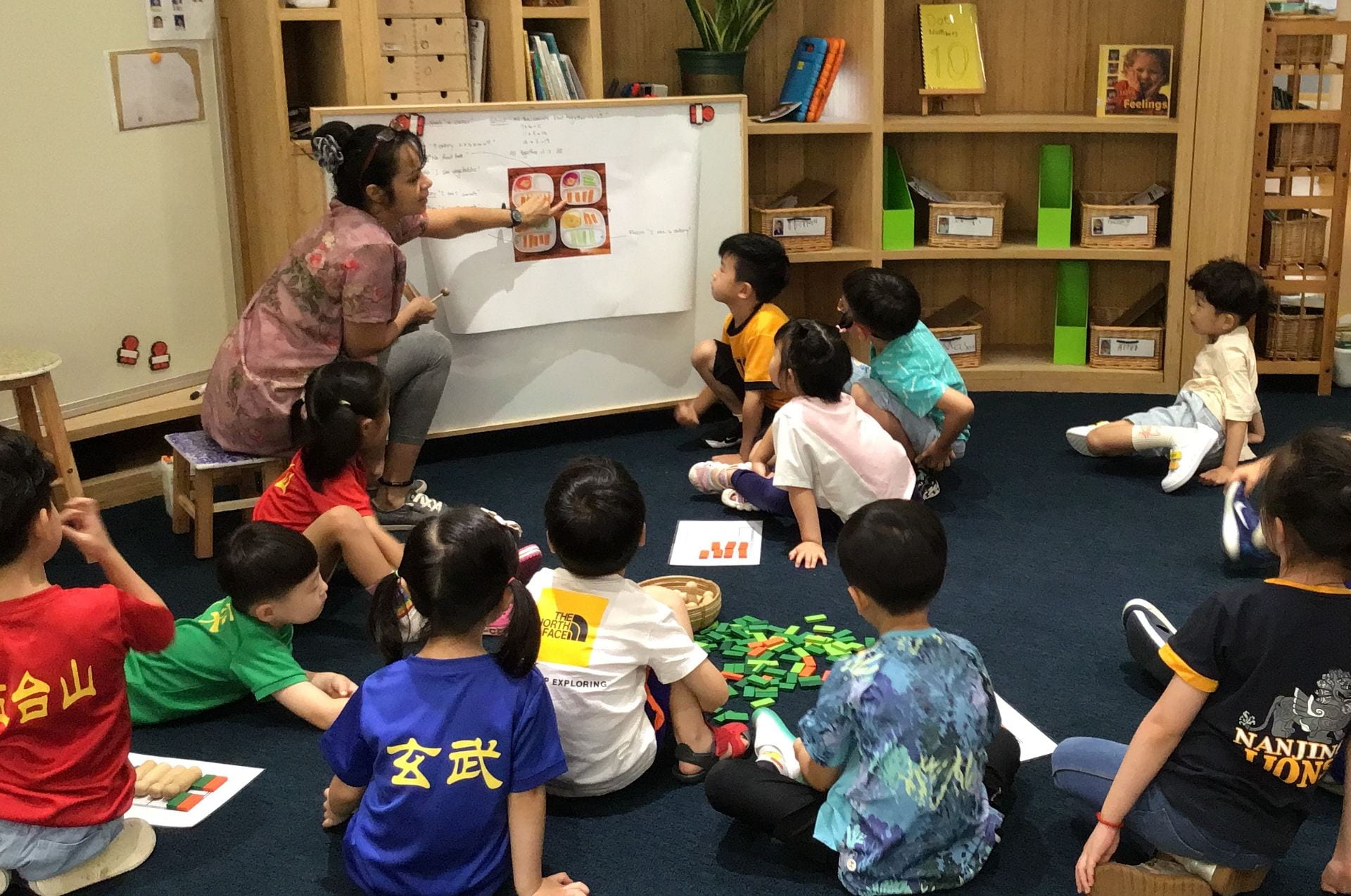
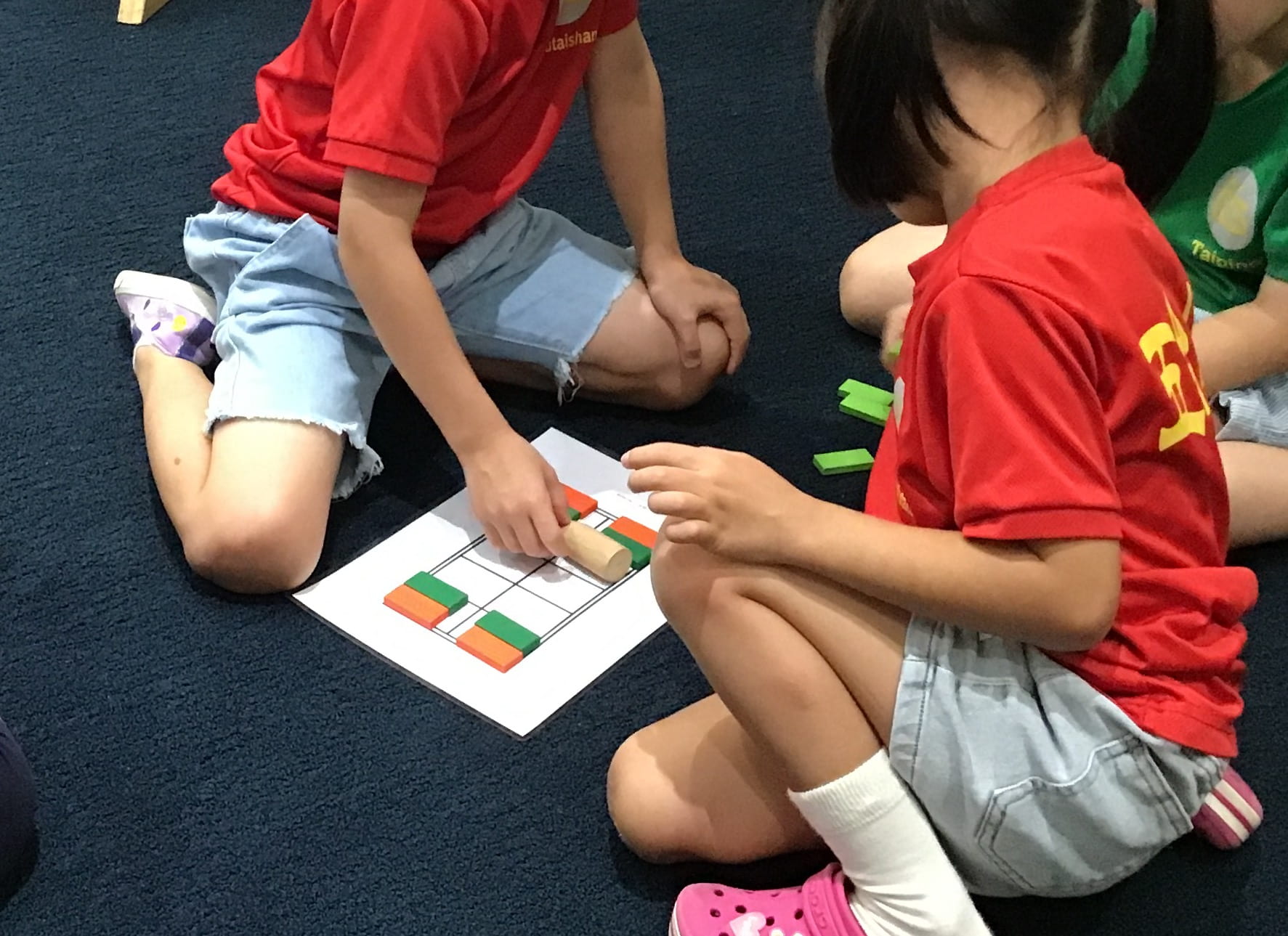
The children were invited to use coloured tiles to recreate the different combinations. 

They worked in 4 teams to share their thinking and problem-solving.

We used coloured tiles to find the different combinations of 7.

We observed the children using number names to share their observations. Many of the students explained their thinking using addition sentences, counting groups/sets of objects to find the total.

 While working together or alongside others, the children found ways to bring their ideas to the group.

Conceptual Understandings:

Number Sense

  • number operations can be modeled in a variety of ways

Approaches to Learning (ATL’s) 

  • observe carefully
  • notice relationships and patterns
  • present information in a variety of modalities
  • listen actively and respectfully to others’ ideas and listen to information
  • participate in conversations

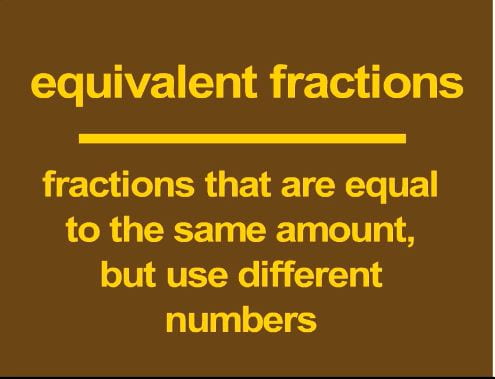
Equivalent Fractions

We continue to use a range of material to make sense of fractions. We wonder how we might: 

  • compare and order 1/2, 1/4, 1/3 and 1/10  of shapes and sets using concrete materials
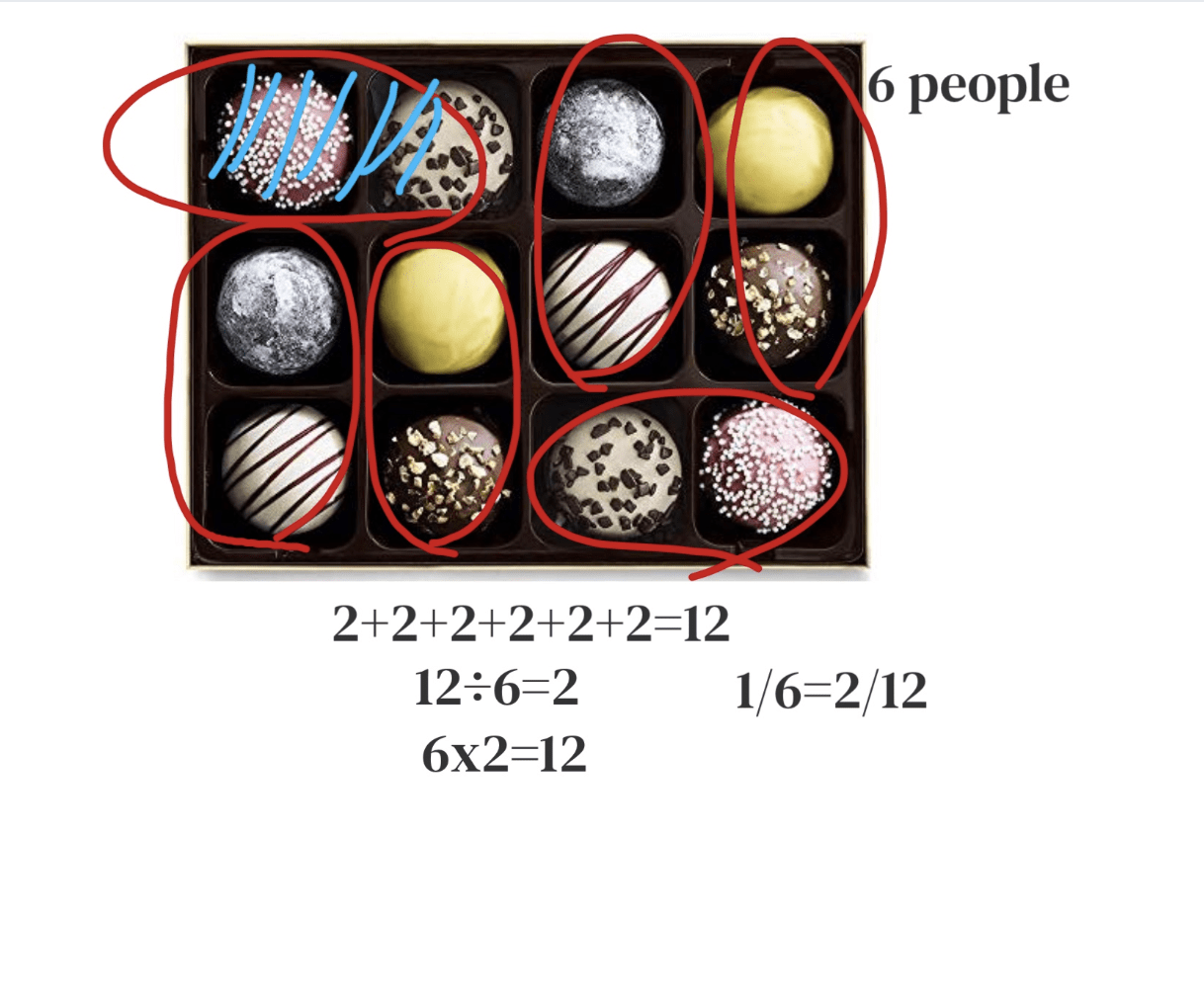
  • model equivalent proper fractions 1/2, 1/4, 1/3 and 1/10

We watched the BrainPop video on Equivalent Fractions.

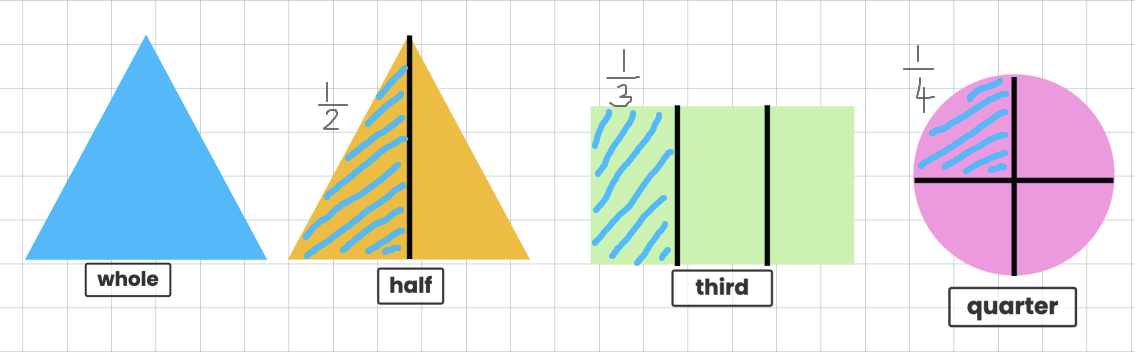
Then, we used manipulatives to model fractions, looking for was to create 1/2, 1/4, 1/3 and 1/10  of shapes. 


Fractions and Measurement

We began by brainstorming ‘What we already know about ‘fractions.

Then, we watched a video on BrainPopJr. to learn more about fractions. 

We noticed that a fraction tells you the number of parts out of a whole.

The students drew pictures to recognise 1⁄4, 1⁄3 and 1⁄2 of shapes.

Then, they worked in teams to create equal sets of objects with a focus on fractions. ​

Our next inquiry was into measurement.

How might we measure different objects?

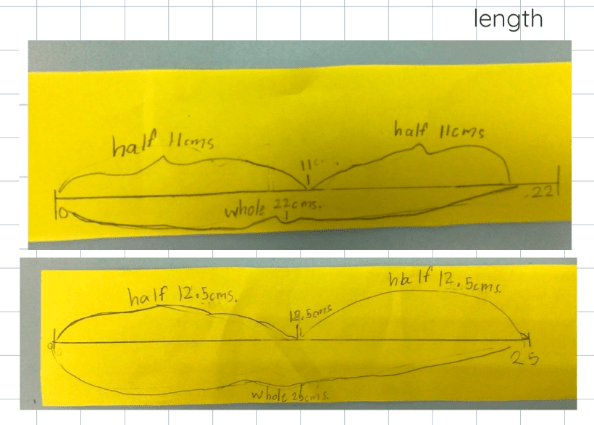
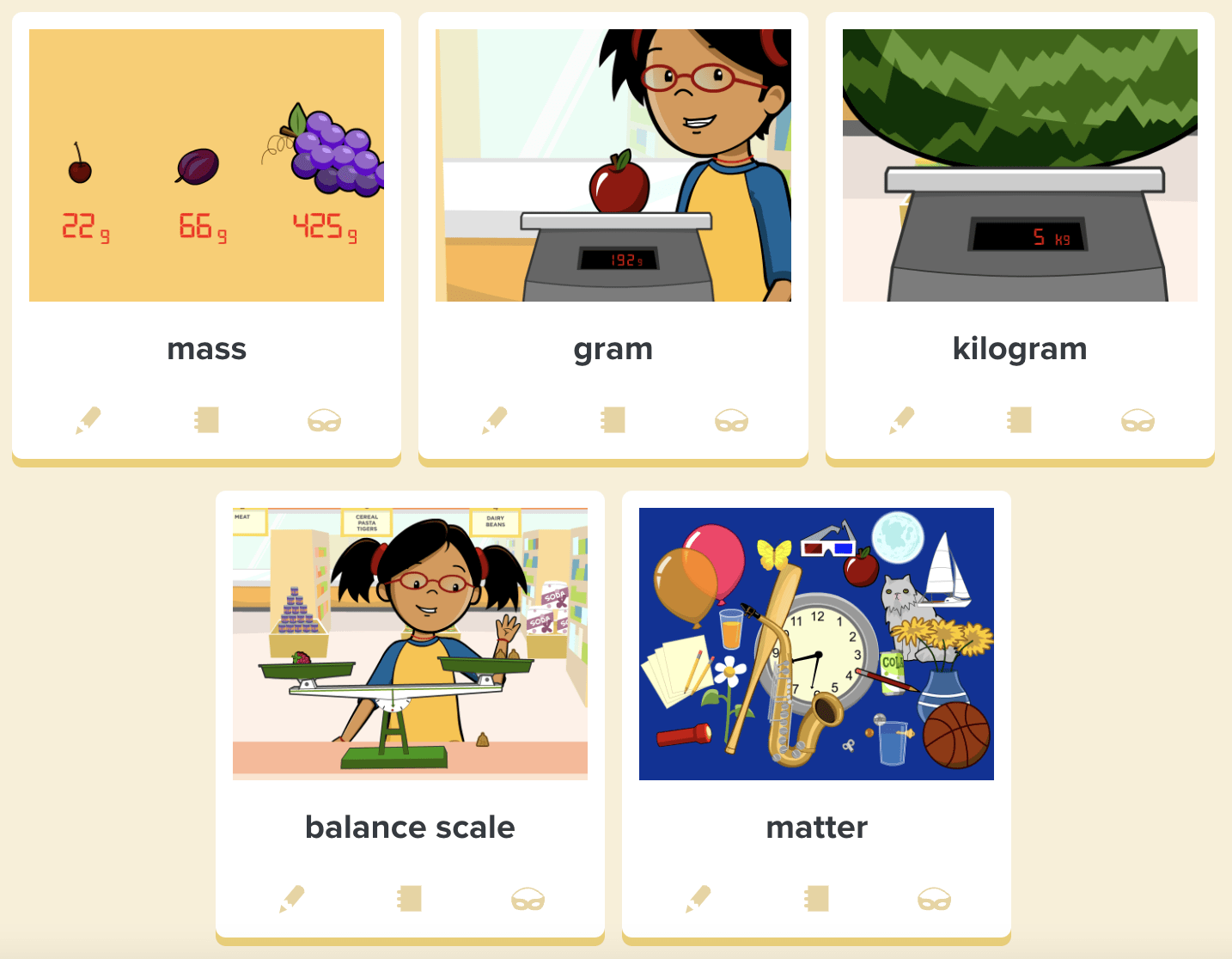
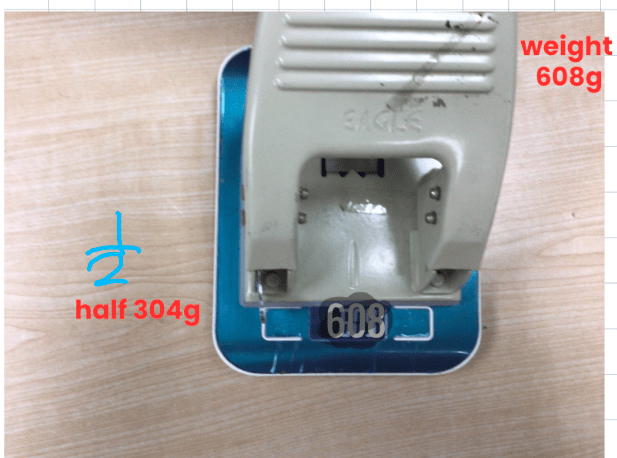
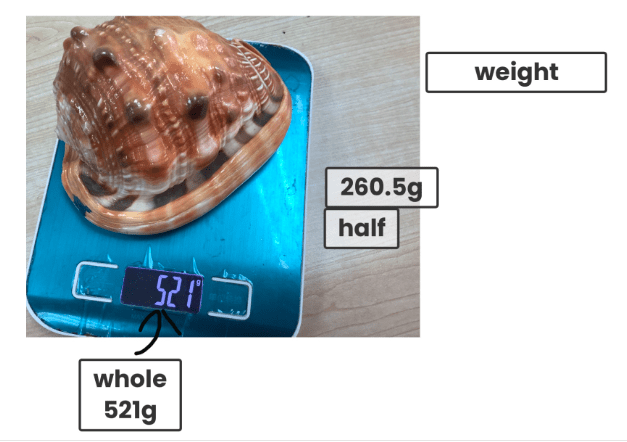
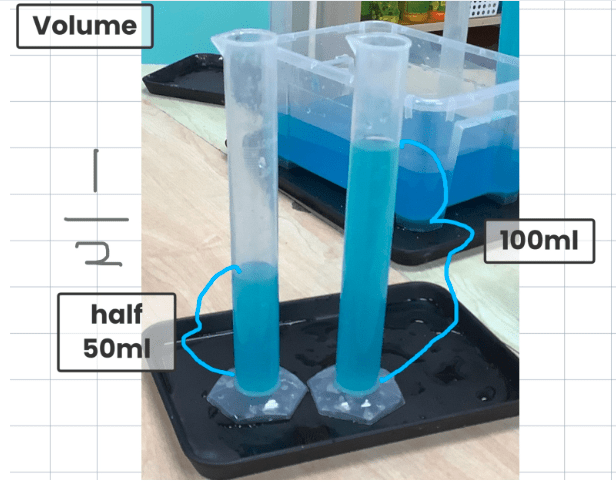
We have watched different videos to learn about length, mass and volume. We explored the connection it has to the Base 10 system.

Length and Height

MASS

VOLUME

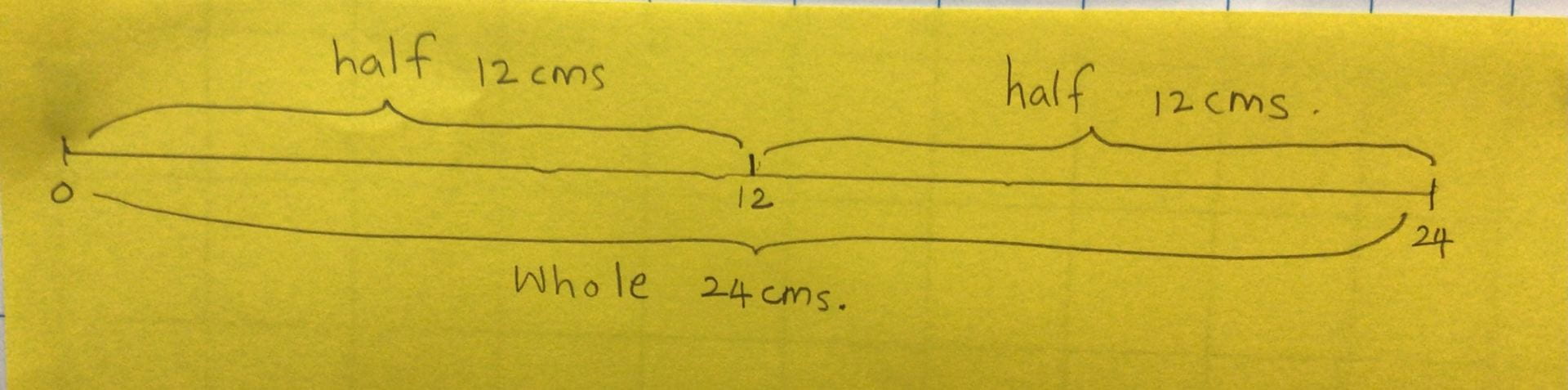
We wondered how we can use the language of fractions to share our measurements.

We are working independently and in teams to solve problems and learn mathematical concepts.

Big Ideas:

Number Sense

  • that fractions are ways of representing whole-part relationships

Measurement

  • that objects and events have attributes that can be measured using appropriate tools
  • that relationships exist between standard units that measure the same attributes
  • that estimation allows us to predict and check our measurements

Area and Perimeter

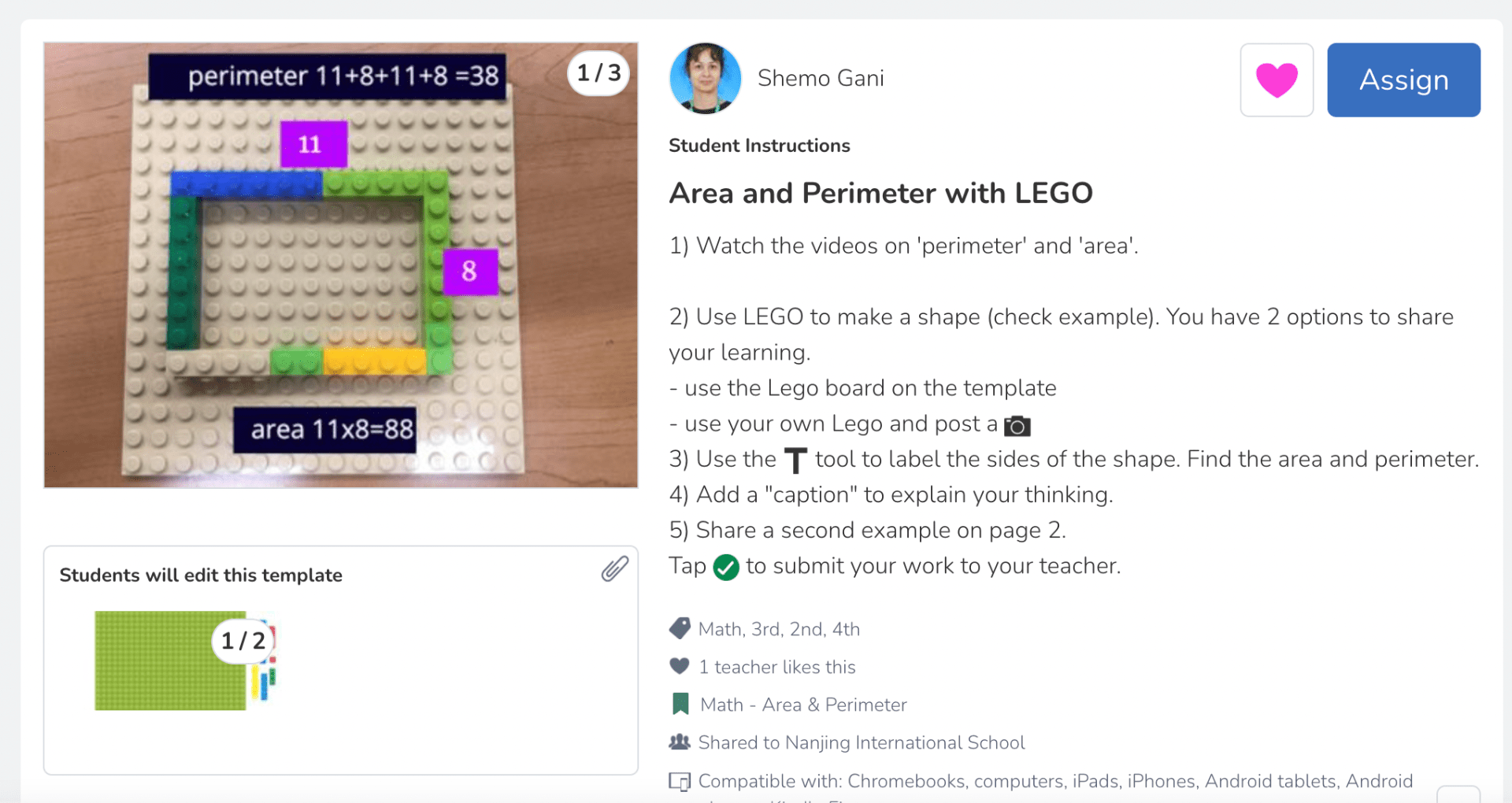
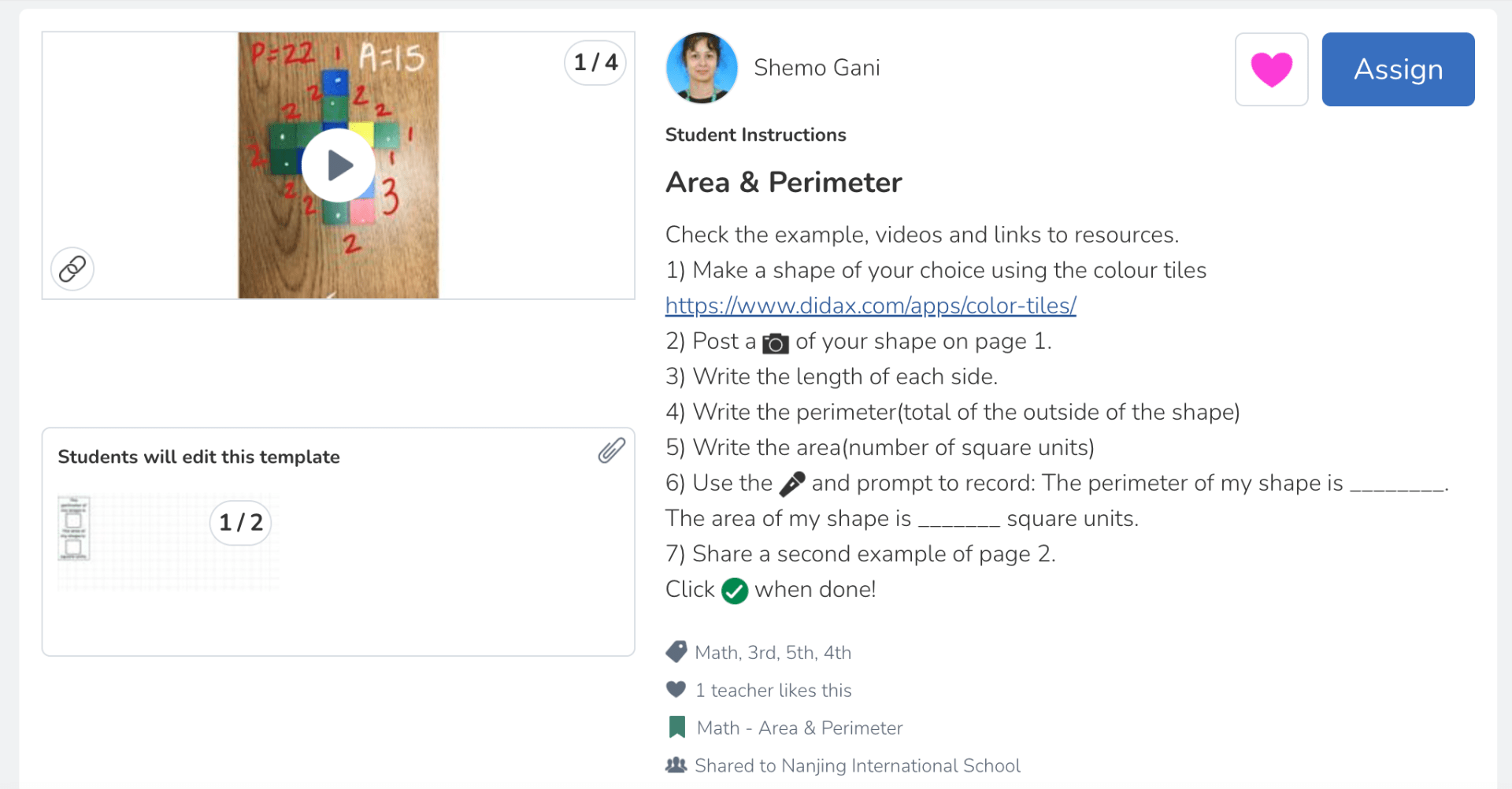
How can we measure the perimeter of different objects? What is area?

We know that objects have attributes that can be measured using appropriate tools.

First, we watched two BrainPop Movies to learn more about Area and Perimeter

https://www.youtube.com/watch?v=JedFHKyp2ro

https://www.youtube.com/watch?v=hzV-tUnqbFM&t=100s

Then, we used Lego to explore this further, sharing different examples of how perimeter and area can be calculated. 

Next, we used virtual colour tiles to calculate the area of a shape.

Creating Structures with Shapes

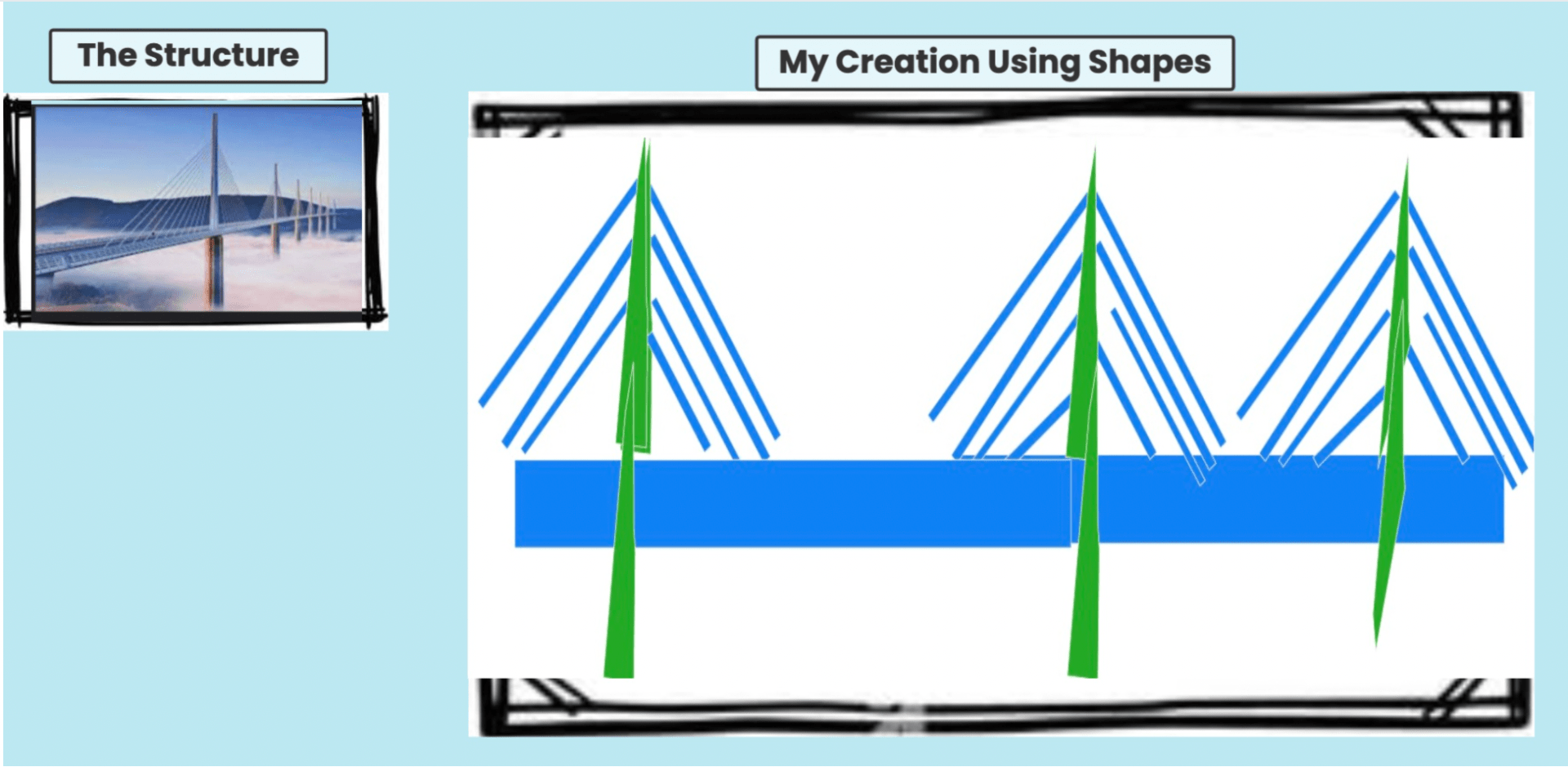
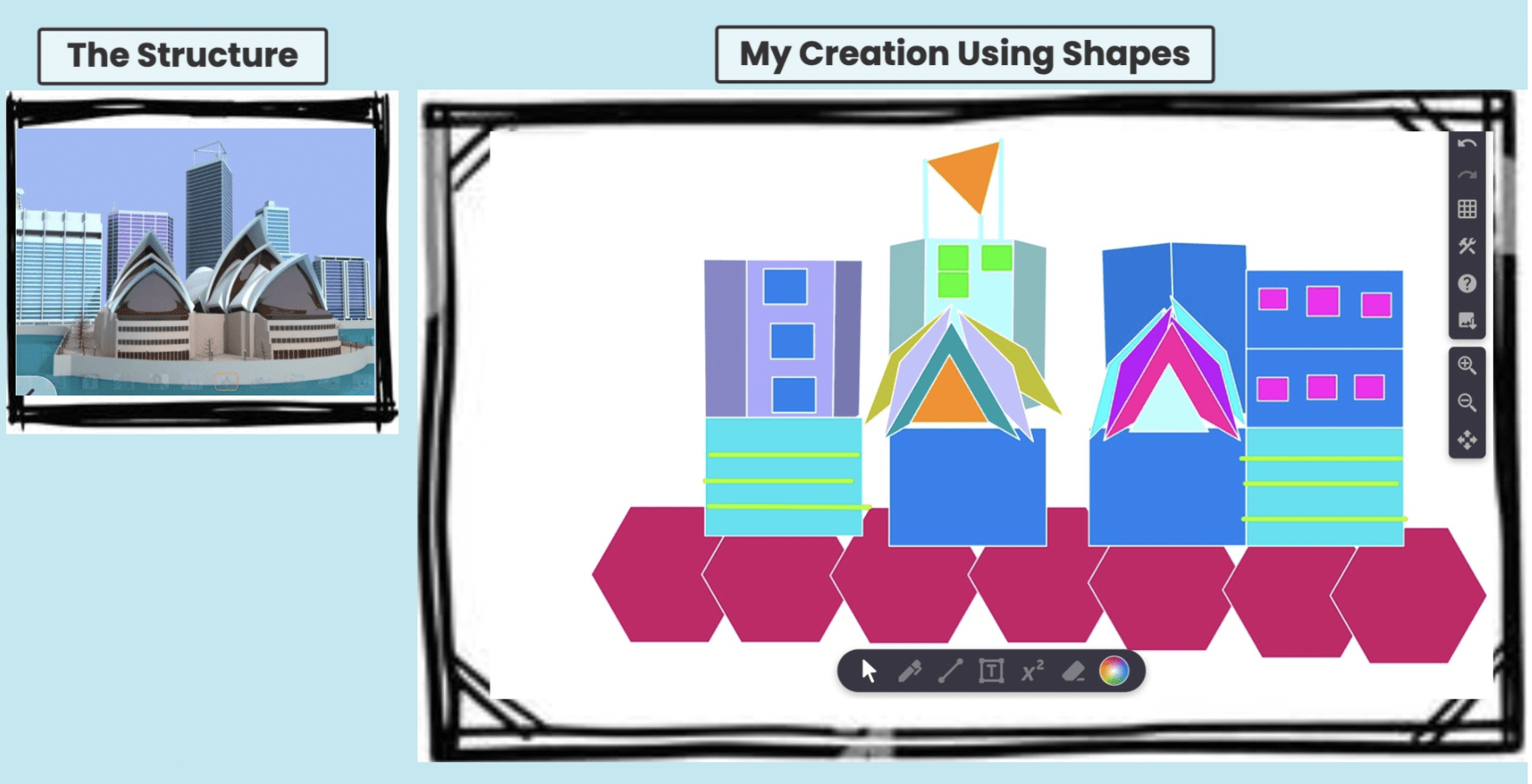
The students were invited to recreate a structure using shapes.

TASK:

  1. Choose a structure that you would like to recreate with shapes. Recreate it

Three Options:

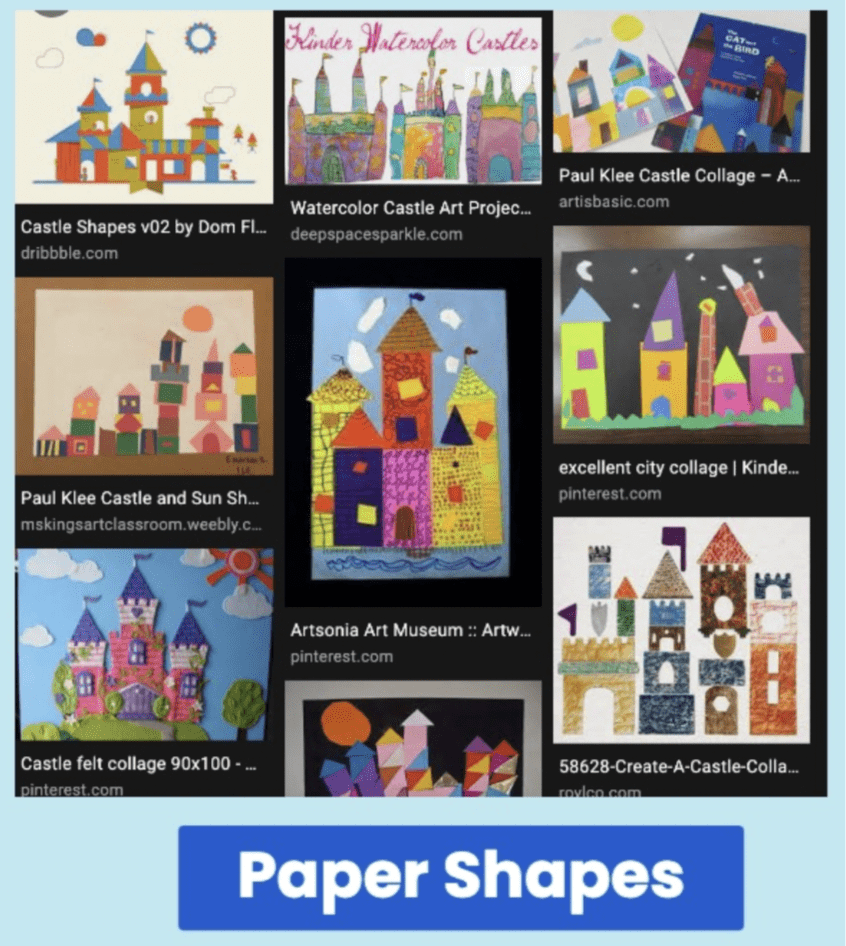
  • Option 2: Use paper shapes to create a collage

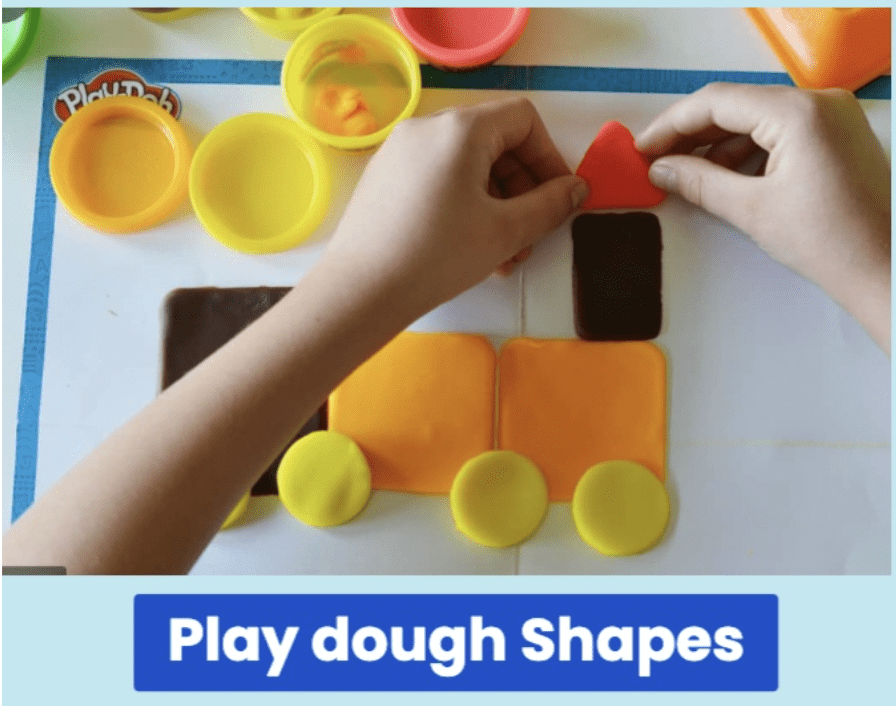
  • Option 3: Use play dough or clay

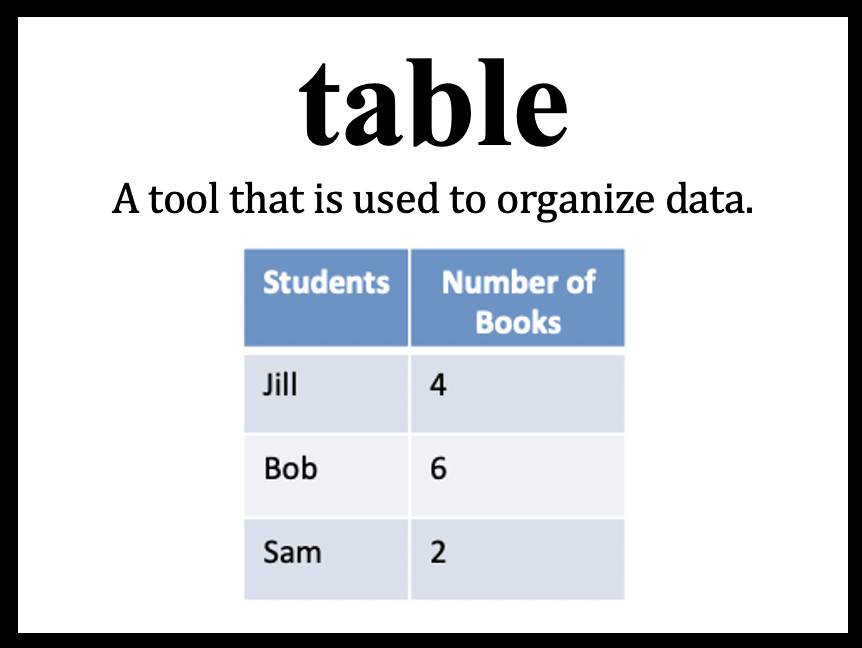
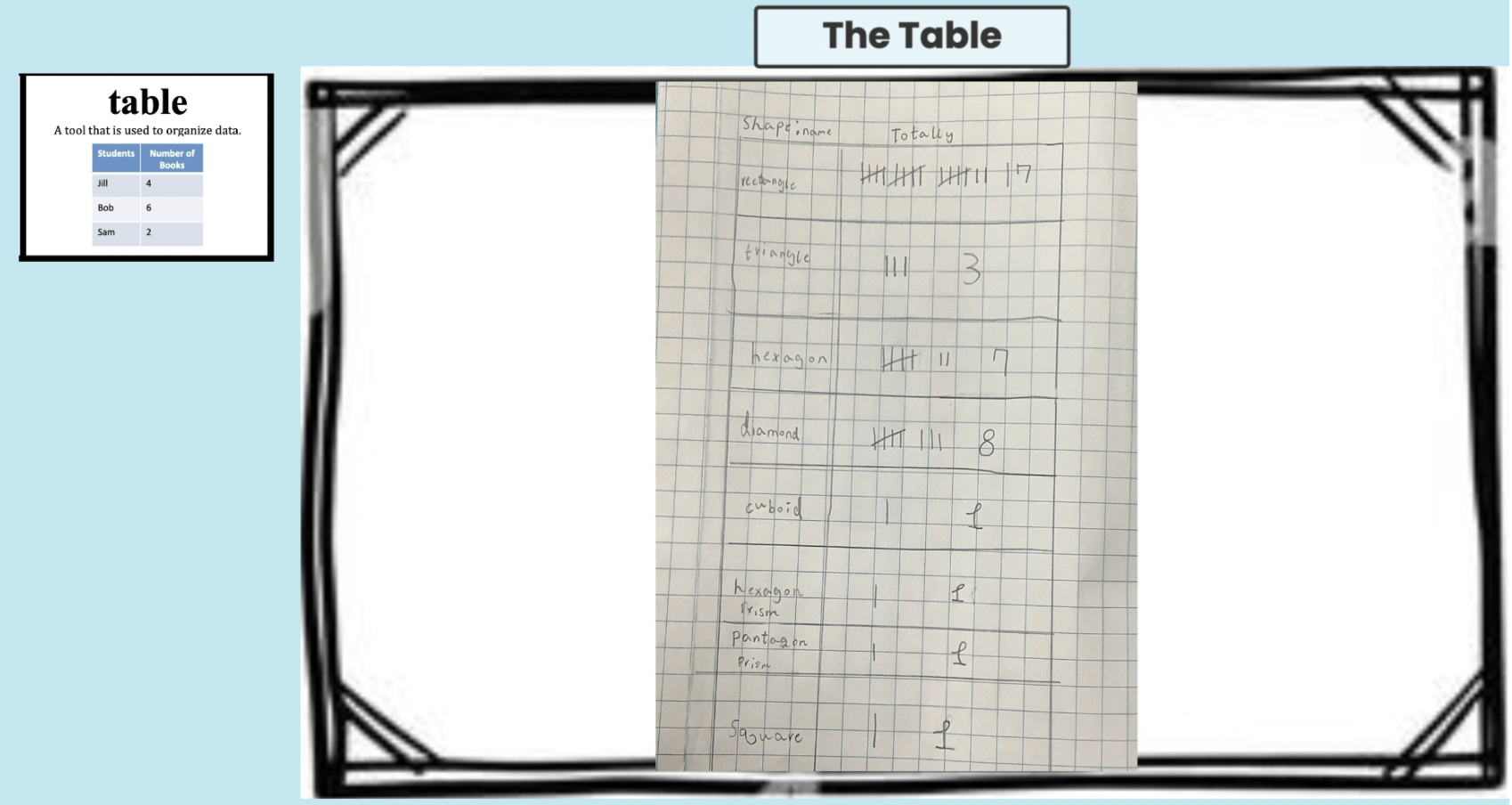
  • 2. Create a table showing all the different shapes you have used.

Student Responses

Through this experience, students were learning that:

  • information can be expressed as organised and structured data 
  • geometric shapes and associated vocabulary are useful for representing and describing objects in real-world situations
  • specific vocabulary can be used to describe an objects position in space
  • shapes can be transformed in different ways
1 2 3 4