
Homes
Living Things in the Early Years Garden
What is happening to the birds in the EY Garden?
Over the past few months, the children have found bird feathers and a few dead birds in the Early Years Garden. The children were puzzled and wondered about the birds, often looking for and sharing ideas about the different living things in the garden.
Noticing their continued interest in living things in the spaces around us, we decided to discuss their observations and wonderings. The different pieces of documentation about birds we had collected sparked our conversation.


We used the question words to help us think about what we wanted to know about the birds.

The questions led us to wonder (Lydia) how the birds died, (Oxford) why the birds didn’t fly away, (Oliver) what happened to the birds after they died and where the birds lived.

We revisited an inquiry project some of the children were engaged in last year (PK1B) to help us think more about the birds that live in the Early Years Garden.
 The children quickly recalled looking for the birds and learning that they come into the garden when fewer people were in the area.

They liked to play in the water (Oliver) and live high in the trees for safety (Howie). Lydia recalled looking for the birds in the big tree, which has since been cut down. “They cut down the tree to make paper” she explained.


Oliver recalled seeing bird’s nests on electric cable poles and said he saw some nests made of sticks in the EY garden.
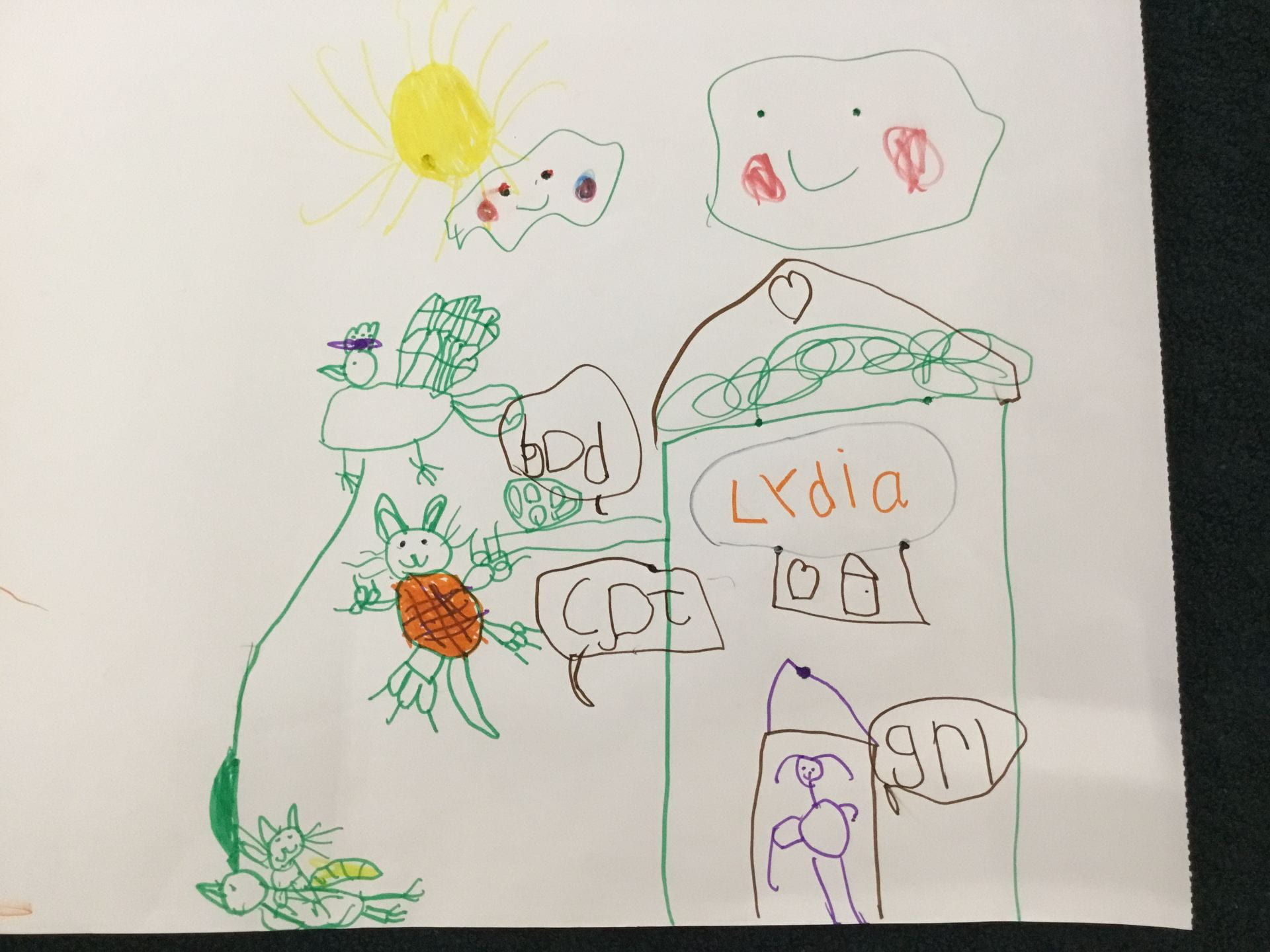
As the children shared many different theories about the dead birds, we gave them paper and writing tools to make their thinking and wonderings visible.


Later during playtime, a group of children found an empty nest on a bush, which had fallen from a tree.

The children were fascinated by the intricate weaving and discussed the materials (cotton, grass, leaves) used to make the nest.
- Liz “Bird house.”
- Motong “It’s a nest. The birds on the tree.”
- Morning “A nest, the nest maybe inside is the bird. Or the birds already died. They use grass because it’s long and the grass is dry, not in the water.”

- Oliver “I see there is a bird’s nest has been fall from a tree. I think a cat pulled the bird’s nest to the bush. It’s because cats don’t like birds nests, I think.
We wonder what others think happened to the birds in the Early Years Garden.

We decided to share the documentation and the provoking question “What happened to the birds?” to help us gather more information.
Nests: How can we help?
We went out to the corridor to look at the documentation about the ‘dead birds’.
The children revisited some of their past observations and theories.
- Lydia “Cats have eat the birds.”
- Liz “Cats eat the birds. I think big birds eat small birds.”
- Eli “I think birds flying and when they are sleeping the cat is down and the cat climbed the tree and then he the ate birds. Birds are in the nest.”
- Jeongyoon “Nests on the tree.”
- Liz “I think bird fell down from the nest. Its dead.”
- Oliver “I think the baby bird fall down and then hits its dead.”
- Morning “Maybe they rolled and fell down the tree.”
What new ideas do we have? What can we do to help?
- Howie “Put the soft things under the tree. If they fall down it will be soft.”
- Oliver “Feathers, cotton.”
- Eli “Maybe something bouncy. Maybe grass.”
- Morning “Paper.”
- Oliver “I see something white that is outside but it is not cotton.”
- Oxford “Take the birds to the doctor. Take them home and look to see what is wrong.”
- Oliver “I think the nest is a little bit not safe for the birds. I think it’s a little bit small. We can build one more.”
- Morning “Use cotton to make the nest. Maybe grass.”
- Oliver “Use sticks. Sometimes we can just put a bowl.”
- Howie “And put inside some soft things.”
- Oliver “I think they make them with water and mud. To make the sticks not fall off the nests. First, we need to find some stick. Then put some water in the sand. Cover the nests with the mud and then the baby birds can live on them. Not mud, we can use clay.”
- Eli “I saw lots of sticks outside. I saw a special place that has lots of sticks.
- Howie “Then we can put them on the tree. We can put them like on the fire trucks, to put the ladder and climb up and put the nests on the tree.”
- Oliver “If we stick the clay to the tree then the nest will never fall off. Then we don’t have to worry about it anymore.”
- Eunbyul “Children feed the birds and one more bird is fly and two more birds fly back. Feed the birds seeds.”
- Motong “We can find some sticks and make a nest. Put paper on the nest because the snow flowing the nest. Put the paper on the top.”
- Wyatt “Put the bird nest on the tree and the bird is going to the house. And the bird is go there and going to the house. If it’s cold, then there is snow. Snow is body is fall down. Help bird, help to put on a jacket to put on the bird.”
The children ran outside to collect the sticks they needed to build the nest. Oliver found some cotton-like material and put it in another tub.


We wonder what we might need to think about when creating nests for the birds.
Designing Birds’ Nests
One of the suggestions the children had made while they were looking for ways to help the birds in the Early Years playground was ‘to make different bird nests that would keep the birds’ eggs safe’. We began to think of different nests that we could build for the birds.
First, the children drew their initial ideas on one side of the paper.

Then, we watched a video to learn more about the different types of bird nests.
The children were excited about the different designs and materials used to create these interesting and complex structures. Next, the children drew a second design.

This time, the children thought about the environments the birds may live in, and the materials the birds might have around them to create the nest.
Their second designs were more complex and included a lot more details.


We wonder how we might move this project further, to create and test some of the different designs the children have been thinking about.
Having revisited their designs, the children were invited to sign up if they wanted to make a nest for the birds.
Homes for the Birds – The Nests
Over the last few weeks, the children have been looking for ways to solve problems and take action to help the community.
We used the design thinking process introduced by Ms. Jo, to explore how we might use the process to solve the problems we see in the Early Years garden, specifically with the dying birds.

Empathise:
who are you trying to help?
- The Birds
What do they need?
- A safe home – nests
 Define:
what is the problem you are trying to solve?
- The nests in the garden are falling down.
- The birds are falling from the nests.
- The birds in the garden are dying.
 Ideate:
How many ideas can you come up with?
- The nest should have walls (Oliver)
- a strong nest on a high tree (Eli)
- make a nest with sticks (Wyatt)
- Put cotton inside the nest to keep the birds warm in the nest when it is cold and snowing (Oliver)
- use a basket because its tall (Motong)
- Make the basket with sticks (Wyatt)
- You stand in water to make nests (Morning)
- use plastic to make the nest the bird won’t get hurt or fall down (Eunbyul)
 Prototype:
which ideas will you try first what will you design to test your idea?
The children decided to use 4 different materials to create their prototypes.
- clay or mud
- sticks
- materials for baskets
- plastic
We noted all these ideas down on chart paper.

Then, the children went back to their first and second design ideas for the nest to see how they could improve on their initial ideas. They used drawings and labels to share their ideas with others. They made improvements to the structure, thinking about the materials they might use and how they could make the nests warm and safe for the birds.


The children created the prototypes of their nests, to help them decide on what works well and the improvements they could make in their final design.

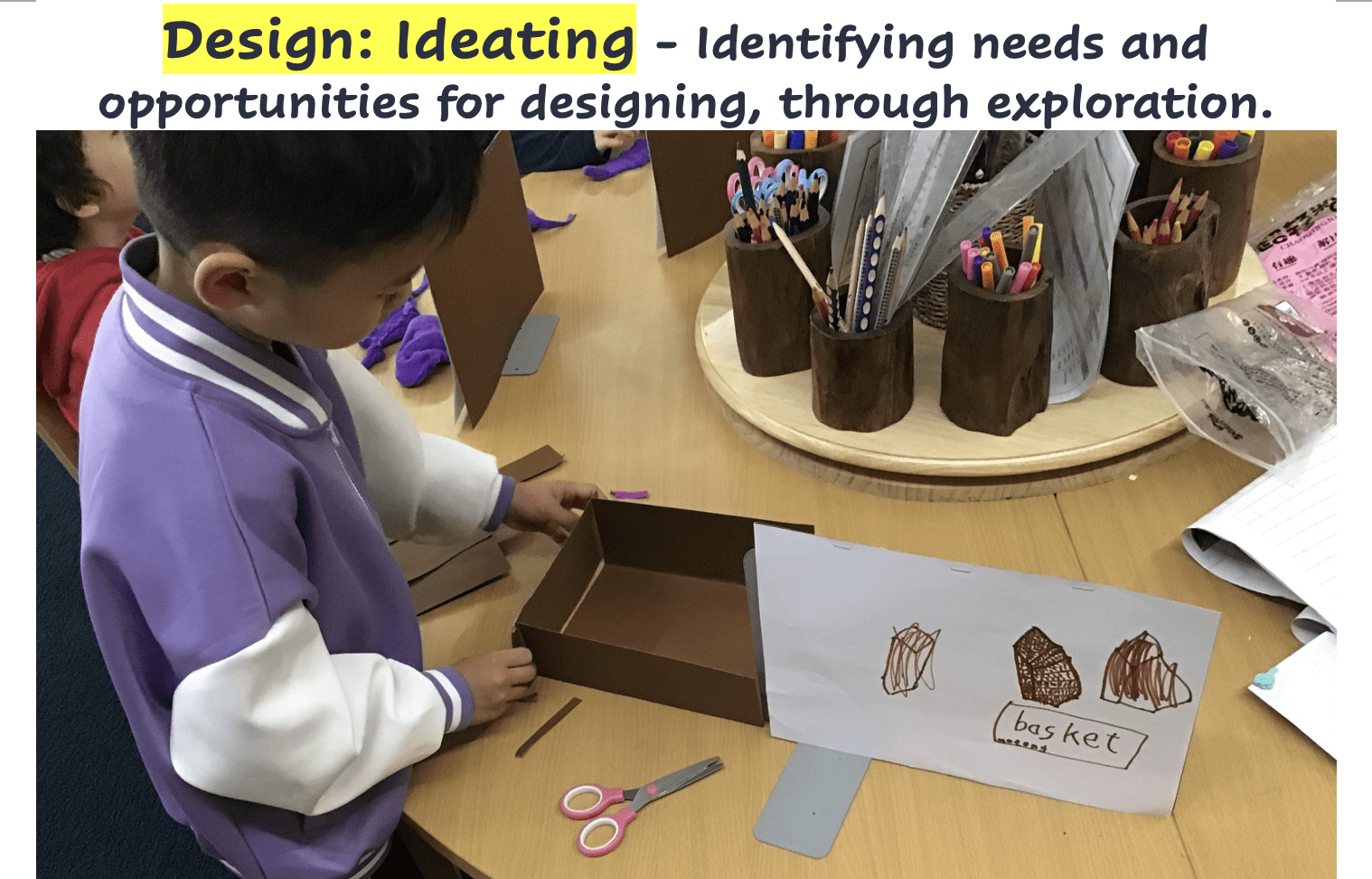


Through this process, they had opportunities to:
- Identify needs and opportunities for designing, through exploration. (Design: Ideating)
- Select tools, materials and processes for specific purposes. (Visual Arts: Creating)
- Use all senses to observe and notice details. (Research Skills: Data Gathering)
- Use trial and error to make changes, solve problems, or incorporate new ideas from self or others. (Design: Making)
A Bird in a Nest

- Wyatt “Oxford tell me a bird is here and we looked at it.”
- Oxford “I wanted them. Eli think it’s not real.”
- Lydia “This bird, her eyes are red. And Ms. Hannah said she is sitting on the nest waiting till the eggs come out.”
- Liz “I see bird, at first it was not on the nest and then the bird is going on the nest.”
- Eli “I see the bird I think he was laying the eggs because he was sitting there for a long, long time on the nest.”
- Wyatt “I see the bird not moving.”
- Oxford “Why no people can not go in there?”

- Liz “I think the bird is see the people and it fly away.”
- Jeongyoon “He is flying away and then eggs will crash to the floor and then break. And then the baby bird will be dead.”
- Oliver “If there is no tape then people will just go in and scare the birds away while making the loud noises, then the baby birds will not have their mummy they will be very scared. The mummy bird might do a battle and might get distracted and the eggs in the nest might hatch and the baby birds might fall down and get hurt. And people might accidentally step on the nest and they might get more hurt.”
- Liz “I think no have the mummy bird then the inside bird gets cold.”
- Lydia “The people are so loud and the bird don’t want to be here and then she will go away. And then egg fall off and then the mummy bird don’t want the bird that falls out.”
- Motong “If we go there and the bird will go crazy and will kick the baby down. If you go in there with a shovel the baby bird will get scared.”
- Oxford “The mum bird he will think we are bad people and he will take his eggs and go away.”
- Jeongyoon “Some people get the shovel and hit the nest then the bird will fall and be dead. The nest will fall and the nest will break.
- Lydia “The tape Ms. Hannah used was broken so the security used the red one.” (in Mandarin)


- Oxford “I think outside there is paper and it is raining and then the paper will break.”
- Wyatt “I think outside the people can help the birds and the baby birds not die.”
- Lydia “It is hatching the eggs.” (in Mandarin)
- Yui “The bird protecting the eggs.” (in Mandarin)
- Oliver “Not letting anything happen to the eggs.”
- Oxford “She has lines on her neck and her beak is so long.”
- Eli “I think protecting means she keeps her eggs safe. She sits by it and keeps the eggs under her bottom. Because she is in the tree the rain will not get through the tree.”

- Liz “I think the bird has red eyes.”
- Lydia “The bird needs to keep the eggs warm to hatch them. Or they will die if it’s cold.” (in Mandarin)
- Oliver “My Chinese grandpa and grandma house they have real birds and one looks like a peacock.”

We wonder how we might observe the bird over time to see how it cares for the eggs and the baby birds (needs).
We wonder what decisions the children will make about their environment because of their developing understanding of the needs of living things in our playground (nature).
The Eggshells
We noticed some changes in the play area and decided to take a look at the slide where the bird was sitting on the nest.

- Oliver “Broken egg.”
- Lydia “And so many people play and have so many noise and the birds nest will fall and the egg is all broken.”
- Eli “I think it’s because when someone goes into that and they take a shovel and it hits the bird egg and it falls on the floor and it broke.”
- Lydia “And the people take the shovel and play and the people don’t know and people throw the shovel and the bird nest is fall off.
- Liz “I think mummy bird think people is so loud and egg can’t listen to the noise and the bird’s mummy thinks throw the egg on the floor.”
- Lydia “I think the bird nest is on the tree and people catch the tree and the bird’s nest fall out and she is so sad and she wanted to go to another space. And she flies away.”
- Oliver “If she fly away she accidentally pushed down one of the eggs.”
- Liz “We cannot use the shovels because the birds mum think shovel will hurt the baby egg. We don’t be loud and mummy is don’t throw the egg down.”
- Wyatt “We use outside words when we are loud the baby fall out of the tree, the bird mum is sad to the bird.”
- Lydia “Birds mummy see the egg is fall down and the mummy is so sad, and the people is too silly with the shovel. Don’t use the shovel silly. We can tell the people not to be silly, it means play and don’t throw on the bird’s nest.”
We wonder what we might do to help the birds in the Early Years garden.
Creating Bird’s Nests
Over the last few weeks, the children have been observing the birds in the Early Years garden (nature). They have been concerned about the mother and baby birds after noticing the broken eggshells scattered on the playground equipment (causation, survival). The children have been discussing ways to help the birds in the playground (safety).
They decided to make nests that they could position around the playground for nesting birds (action). They discussed using a variety of materials including wood, plastic, grass and sticks to create the nests (materials). They began drawing their ideas on paper, using marks, words and pictures to share their ideas with others (organising ideas, making plans).


We wonder how the birds might react to the homes the children create through their project work.
The Final Nests
Following a months-long inquiry into homes for the birds, the children have created their final designs of ‘nests’.


They considered what the birds need to feel warm, safe and comfortable. They had to think carefully about the materials they would use as the nests would be outdoors.
 They have used recycled materials and loose parts from nature to design and build nests for the birds in the Early Years Garden.
Creating prototypes helped them think carefully about their initial ideas and designs, helping them look for ways to improve their product.

After the summer holidays, the children will decide where to place the birds’ nests.


We wonder if the birds would decide to nest in their new homes…