🐁 Mouse Count by Ellen Stoll Walsh is a wonderful picture book that encourages conversations about number and quantity (more and less). This story helps the children explore what happens when we join two sets together; they learn about how quantities change. Through play and dialogue, the children compare amounts and become familiar with thinking about differences between sets. Throughout the story, there are opportunities to count on, count forward and backward.
We can create number stories by modelling joining and separating concrete objects. We can use language to describe changes to a collection as objects are added or taken away.
I wonder how many different ways 10 🐁 mice can be arranged with some in the jar and some in the grass?
You can use any ‘loose parts’ or objects as 🐁 mice. Gather a group of 10 objects. Place some mice inside the jar. Place some mice outside the jar.
Explore as many different ways the 10 🐁could be arranged.
This inquiry challenge will encourage the children to:
Follow the instructions in the video to make your own board game and dice.
You will need a dice, 40-50 counters [buttons, beads, seeds, stones or any other small loose parts]. A game board for each player.
Materials needed to make the dice.
Counters
How to play:
take turns to throw the dice
collect the correct number of counters and cover the spaces on your board until the counters are over.
The person with the most counters wins the game!
Extension:You will need more counters and a game board with numbers over 50.
Use 2 dice.
Add the two numbers and place counters to match the total.
The person with the most counters wins the game!
Jiwon and her brother Jake did not have and seeds or beans or other materials around. 💭 They decided to create their own version of the Dice Game! In their game, the person who circles the most numbers and reaches 80 the fastest wins the game! Can you guess who won the game?
Lemingdecided to create his own Dice Game! He used pistachios as counters!
Focus: Self-management Skills, Communication Skills
Children enjoy and have fun when cooking. Cooking also develops many mathematical concepts such as measurement and volume, while instilling healthy eating habits.
Other benefits include:
strengthening their fine motor skills through cutting, pouring and scooping
learning the concept of sequencing through reading recipes and discussing what comes first, second, and third in the cooking process
expanding their vocabulary as they are exposed to new words and terms
developing a greater sense of discovery with new foods
developing independence and self-management skills
learning about and developing an appreciation for the different resources and produce that are used when cooking
Do you like pancakes? This book is about all the steps needed to make them. Let’s listen to Ms. Anna Mila read ‘Pancake, Pancake!‘ by Eric Carle. Then, let’s make our own pancakes.
Ms. Heidi and her son decide to show their creativity in different ways through Performing Arts.
You can make up your own call and response song linked to cooking. It could be making scrambled eggs, making egg fried rice, baking cookies…. Choose objects to act out and perform your song with. Post a video on Seesaw of yourself singing your own call and response song’ with your chosen objects based on the ‘Pancakes call and response song’.
Curious George loves to cook. This is when he made pancakes!
You can follow along to make your own pancakes. Here is George showing us how to do it!
If you make your own pancakes or other delicious foods, don’t forget to let us know about your experience!
We have had a lot of excitement in the kitchen. We have had opportunities to watch others help out in the kitchen as they cook, clean and prepare healthy meals. Ms. Anna Mila and her daughter worked together to make pancakes. Ms. Heidi and her son were also busy in the kitchen! Here is yet another family preparing a meal together.
Our new campfire has tall curved shelves. They are great for storing our resources and creations. However, we realised that we cannot always reach the top of the shelves. Even the teachers were not tall enough!
We decided to order a step ladder from IKEA. It came in a box. It was in pieces! We had to fix it ourselves.
A few of the children took up the challenge. @S stated that she knows how to do it as her grandpa and grandma always fix the furniture in the house. She knows how it’s done.
@S wanted to be in charge of the screws. @F wanted to read the pictures in the instruction manual. It was decided that he would be the person telling the team where the screws fit, and which wooden pieces were needed.
The children wanted to know the name of the tools we were using. We invited @MrZachG the Design teacher, to come over to the Early Yeas space to help us. He told us the tool was a type of wrench!
The children talked about the pictures they saw in the booklet. They noticed the sequence of steps and the need to follow them.
@F noticed that there are different kinds of screws. He looked closely at the different pieces of wood to see where the screws needed to be inserted. This was a challenge. There were so many different pieces!
He wondered in which direction the screws needed to be turned. After many attempts, @F said…
“Because it’s harder and harder, so I know I’m right.”
Others joined in to see how they can help. The project allowed for opportunities to learn through trial and error.
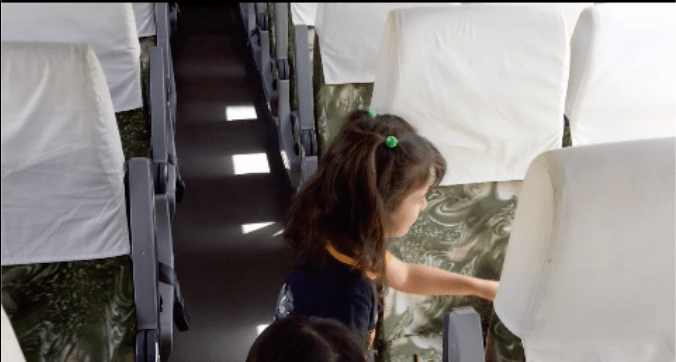
Sarah, Amber and Ruby went to check how many seats the school bus has.
We discussed how can we find out the number of the seats on the bus.
Amber “20个座椅。用你的铅笔来数。1,2,3……20,21。再把数字写下来,来看对不对。” [20 seats. You can use the pencil to count. 1,2,3……20,21. Then write down the numbers and check if it’s right.]
Sarah “有好多位置,我觉得10个,我们进去数就是了。” [There are many seats. I think there are 10 seats. Let’s go in and count.]
Ruby “40. Maybe we can go inside and find out. We could take a picture and we can look at the picture at the iPad.”
We took a picture of the seats on the bus but we found it hard to count the seats using the picture on the iPad.
Ruby “Because it’s far away. I can’t count the back.”
Then we decided that it was better to count the actual seats.
Amber started to use tally marks to record the number of the seats.
When we went back to the classroom, we used different materials to recreate the seats. The students wanted their recreations to look like the actual seats, therefore they used 2 bricks to create one seat.
Amber decided that she wanted to use a softer material because the seats in the school bus were not hard like the bricks.
We put down our name cards to see if we have enough seats.
Amber “后面有空的,很多,我都不知道有这么少人。留给老师,别的小朋, K1A, K1B。有多出来,太多了。” [There are many empty seats. I don’t realise we only have such few people. We can leave these seats to teachers, friends from K1A, K1B. We have more seats. So many.]
Ruby “We make seats for the school bus. Because we have to know how many people can go on the bus. There are so many seats on the school bus. They are available for K1B, K1A, K1C, they are going on the bus.”
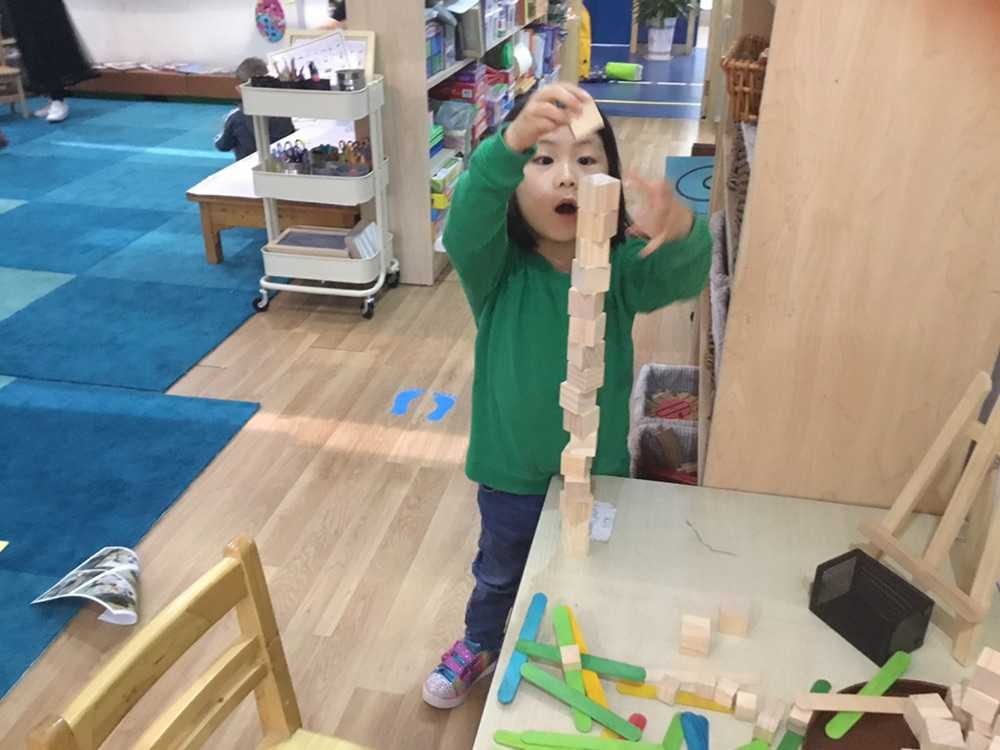
The students have been curious about ‘height’. They have been building tall structures using blocks and other manipulatives and sharing their theories about height, size and length.
Charlotte “我们在搭小魔仙的城堡,这是忍者的家。我们想到很多的好主意,然后我们就可以搭很多的东西” [We are building a castle for the fairy. This is ninja’s home. We had many ideas so we can build many things.]
Si Hyun “I think Amber is like this one, same making. This is a tower. Then other ones go here to the top. And Jiwoo is making small top. And here is diamond. And then everyday get the diamond get go to house and play. And then get to school and diamond is big, big, big.”
Sarah “Amber和 Charlotte在玩blocks。她们需要搭东西。她们能搭得比房子还要高。还没有房子那么高。比恐龙还大。我觉得Amber和 Charlotte搭得挺好的,但是她们搭得很高,肯定会倒的,一下子轰倒了,好好玩。”[Amber and Charlotte are playing blocks. They need to build things. They can build higher than the house. No, not higher than the house yet. Bigger than the dinosaur. I think they are doing good. But the building is very high. It may fall down. It will be very funny if it falls down.]
Amber “这里在搭高高,然后我弄倒的时候我说了‘啊’,我觉得很好玩。”[We are trying to build higher. When it fell down, I said ‘Ah!’. I think it’s very funny.]
Ethan “这个是别人搭的,Amber, Charlotte在一起玩,她们搭得很高。”[Someone else built this one. Amber and Charlotte are building something very high.]
During snack time in the Piazza, a group of students noticed a structure built by the students in the K2 class. They walked over and began to talk about what they noticed.
Alejandra“这是可以爬的,我们可以到天空看月亮。Amber and Charlotte are the same.从那个窗户可以看出去,用电梯,用最快的电梯,上面还可以有发光的星星,很漂亮。还有放两个这种线,三个小的,还有一个三角形就变成真的。”[This one you can climb. We can go to the sky and see the moon. Amber and Charlotte are the same. You could see from that window. We can use the fastest elevator. There are some shinny stars. Very beautiful. You can put two of that strings (referring to the blocks) and a triangle, then it becomes true.]
Charlotte“他们一样在搭高高,但是他们搭得太高了,他们是怎么做到的呢?然后可以搭个更大的。”[They are building something high. But it’s so high, how can they do that? We can make a bigger one.]
Jiwoo “I can see a big one, two small one. Big and small. Here one, one, one, one.” (referring to the blocks and the tower)
Jasmine “I see a tower. And I see Amber build something. Amber build a tower. She want to build high. Amber says ‘不要把它弄倒。’ [Don’t break it down] I see she build a ninja tower. One high, one high, three blocks. She has ‘三角形’[triangle]blocks.”
Ruby “I see Amber building blocks. Charlotte helping. I see a building somebody already built. Somebody wanted to build a giant thing to see when we have snack time. This is bigger than that one. These have two big blocks and they are the same. Three blocks.”
During a conversation, one student wondered if we can reach the ‘moon‘. Ms. Tina found a mirror ball in the storage room. We decided to suspend it from the railings in the classroom and offer the students a challenge.
Ms. Tina began by reminding the students about their questions and wonderings about tall structures.
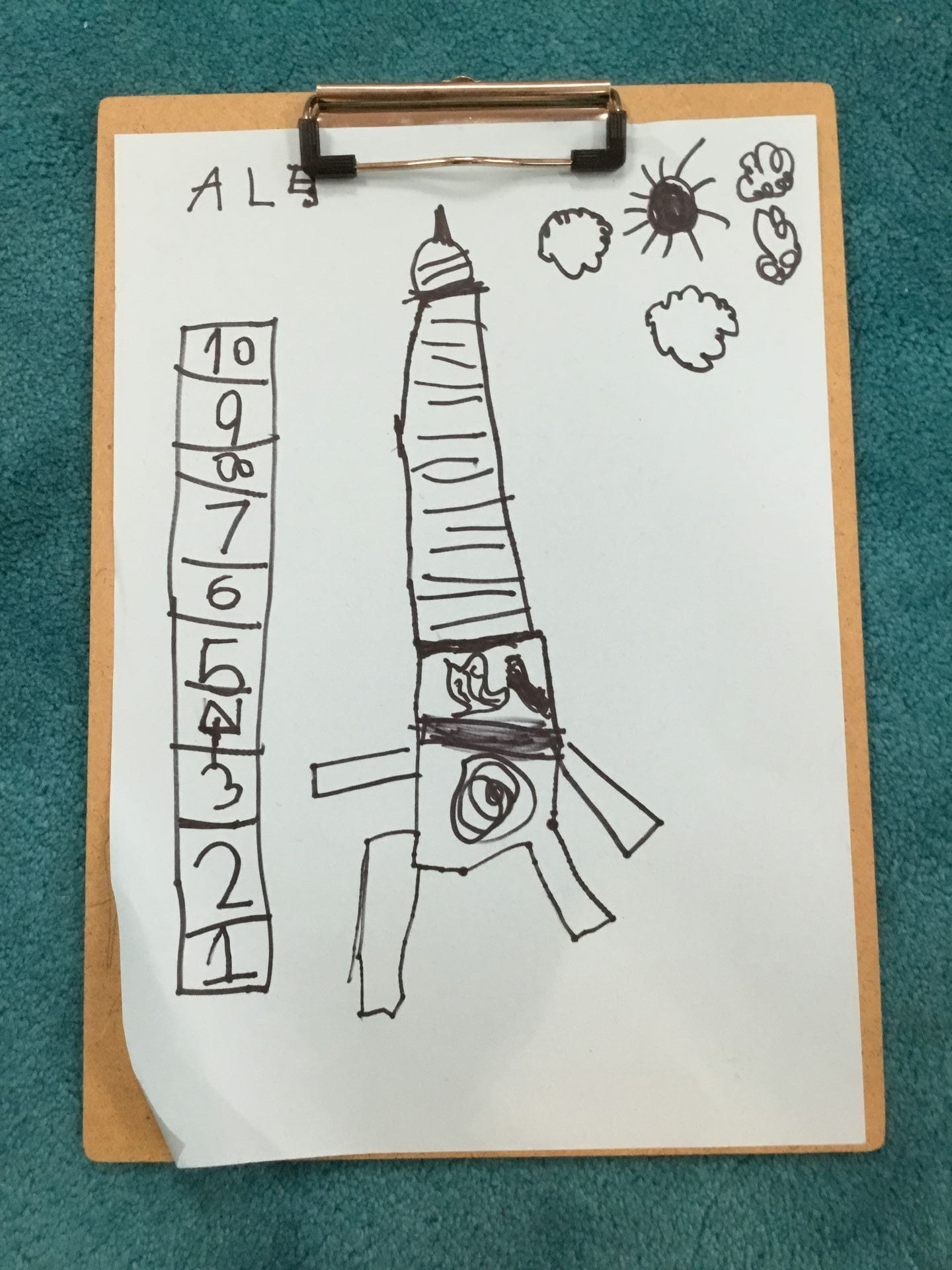
The students were invited to show their thinking using paper before they begin to test their theories.
Here are a few…
Charlotte “我画的这个是地基,用一些blocks围成一个方块的形状,地基就可以很平稳。房子都需要地基,需要围成一个圈。我们可以做一个超高的东西,然后呢就可以用积木碰到球,很高。等我长高了我就可以够到了,等我长大我就是K1,然后就可以够到了。我们可以做一个超大的机器,把它抱住很紧,那它就不会倒。”[I was drawing the foundation. I used some blocks to make a square. Then it’s stable. All the houses need foundation. It needs to be made into a circle. Then we can make something super high. Then we can add blocks to reach the ball. It’s very high. When I grow up, I can reach them because I will be in K1 then. We can make a super big machine. It can hold the house very tight, the house won’t fall down.]
Freida “That’s a circle. Some blocks here. And the disco is hanging here. It was blocks, blocks, blocks up to the disco. Up, up, up, up to the top. I drew it.”
Sarah “如果我们想碰到灯的话,可能会很难。我们要把blocks搭得很高才能碰到。我们用梯子搭搭搭。”[If we want to reach the light, it may be very difficult. We have to build very high by using the blocks. We are using the ladder to help us build.]
Alejandra “这是一个塔。那个塔这里到最上面有电梯。上面有闪亮的东西,它可以很快到终点。”[This is a tower. This is an elevator from here to the top. This is something shinny on the top. We can reach the destination.] “是因为我有一个好办法,用楼梯爬到上面,这样搭才不会掉,没有楼梯就不能够到最上面。从1,2,3……就是终点,最上面的终点。”[Because I had a good idea that we can use the ladder to climb to the top. It will protect us from falling down. You can’t reach to the top without the ladder. From 1,2,3……That is the destination on the top.]
Si Hyun “This is big blocks go to the top. And red, blue and yellow. The ladder. [Si Hyun used his body and expressions to show how the ladder makes the blocks more stable]
Jasmine “Me get one step, two step, three step……And I go to the blocks. Then I climb the chair and climb the puzzle and climb, climb, climb. And then I saw something. I see a ladder and I climb a ladder. NIS stretch my arms. Then I get the moon.”
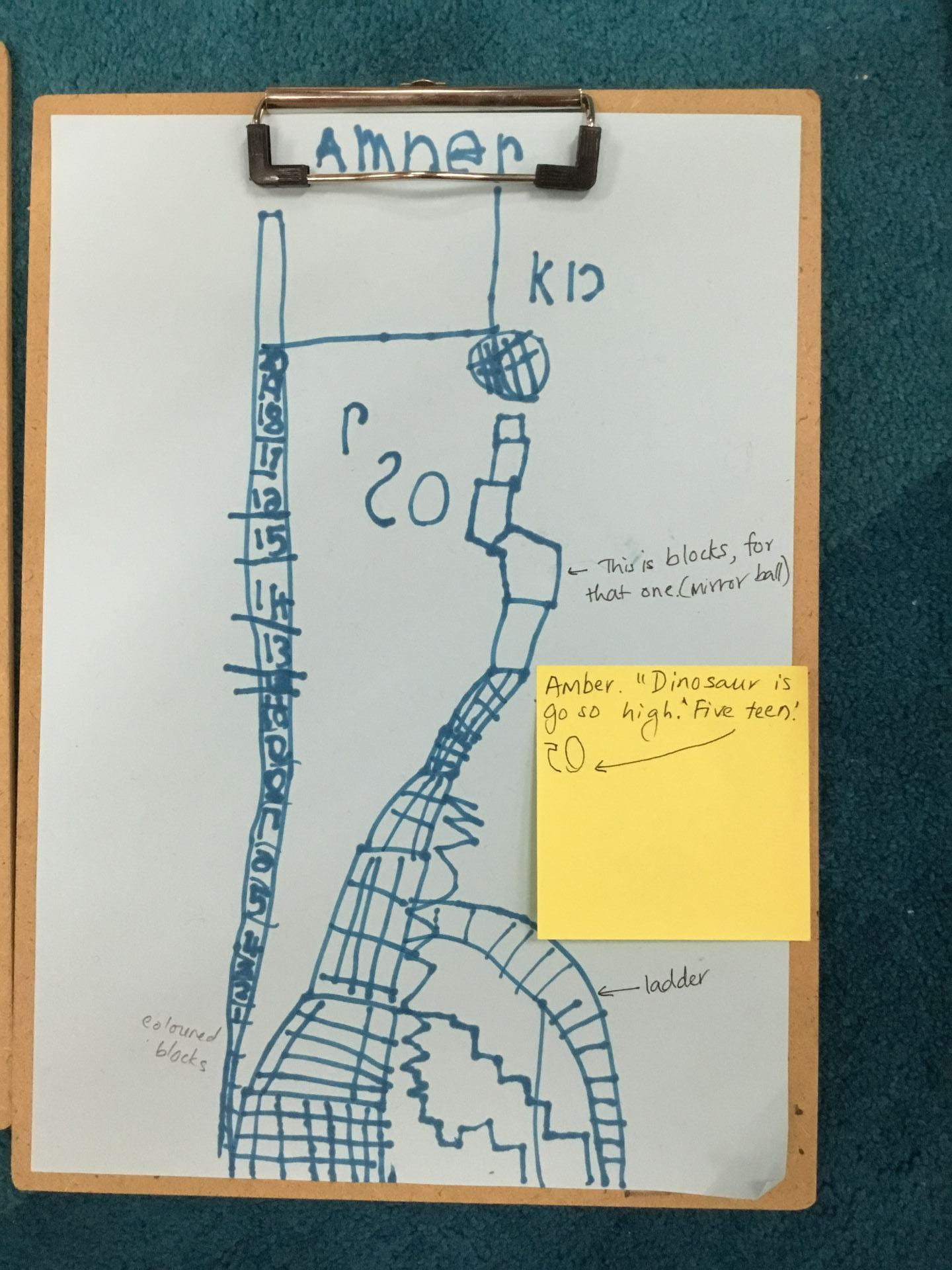
Amber “This is blocks, for that one [The mirror ball]. Dinosaur is go so high. ‘Fifteen’.”
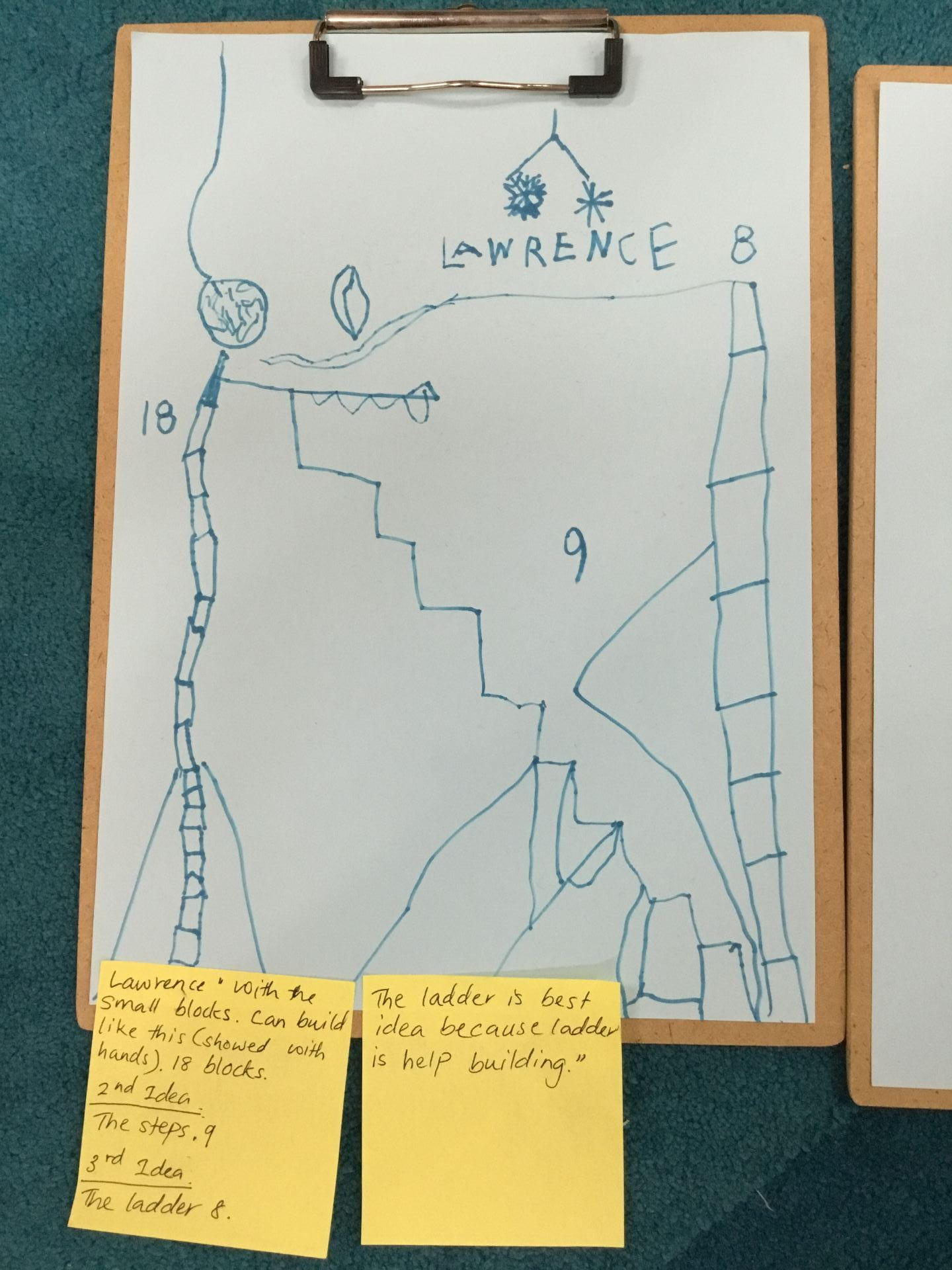
Lawrence “With the small blocks can build like this [showed with hands]. 18 blocks.” 2nd idea “The steps, 9.” 3rd idea “The ladder, 8.” “The ladder is best idea because ladder is help building.”
Nicolas “It’s the tower in the classroom. We are building so high to get to the disco lamp. 5 kilometres high.”
Michelle “这是一个可以攀爬的游乐园,可以够到月亮。用一个梯子,然后可以用很多积木块,把它一层一层叠上去就好了。”[It’s an amusement park that you can climb. Using a ladder and many blocks. You can reach it by piling them one by one.]
Ruby “We are making a tower to make the same height as the disco. We had a little help with the ladder. It’s difficult the blocks keep falling down and then you have to go to the nurse for million times. When you climb on the top of the disco, you got hurt, you can’t climb on top because the rope is not hard enough to lift people then you will fall down then you have to go to the nurse. Building it with our hands.”
The students had many different theories. They suggested a tower of blocks could reach the mirror ball, or even a ladder. Yet another student suggested a stairway to reach the mirror ball. All these theories included references to number, quantity and size. The students recorded their ideas using pictures, symbols, numbers and oral stories. They wondered if their ideas might work. They decided to test their theories.
Another student decided that the blocks were not high enough, we needed a way to reach up high.
Ruby “We are making it taller.”
Freida “To the disco.”
Nicolas “It’s falling!”
Ruby “How about we do each next?”
Nicolas “I’m going to make it. Because it is too high, it’s wiggling. We can’t reach. Every time it falls down.”
Alejandra “We can use the ladder!”
A ladder was suggested and brought over. Everyone wanted to have a turn to climb the ladder to place the blocks.
Everyone wanted to have a turn to climb the ladder to place the blocks. We had to find a way to work together. Ms. Tina called a meeting. The students discussed safety, collaboration and decided on a way to move forward.
One student decided that the numbers on the side of her paper looked like a measuring tape. We decided to use a tape to see how tall the mirror ball was. She worked on creating her own measuring tape.
Amber “这样我就能把它弄得这么高,这样可以够到那里。这样我们就可以够到那样亮亮的东西。我们就可以知道它是多高。65.我需要把它放在上面就可以知道多高了。”[I do this because then I can make it very high. We can reach there to get the shiny thing. We know it’s 65 high. We need put things on then we know how high it is.]
The students finally reached the mirror ball with blocks. They reflected on how they worked together and placed their ‘people blocks’ on the rungs of the ladder.
Later we read the story ‘Papa, Please Get the Moon for Me’ by Eric Carle. The students made many connections between the story and the process they went through to ‘get to the moon’.
SLO’s
Use non-standard units of measurement to solve problems in real-life situations involving height
read, write, say, count, model and order numbers to 10
understand that number names relate to a specific quantity
We discussed the skills we will be using to complete our journey of inquiry.
Observe carefully, noticing details.
Listento others as they share their thinking and ideas.
Being mindfulof our bodies so that we can be ready to learn.
Solving problems using the information we have.
What do you notice?
Ethan “Ms. Shemo pictures. Against the wall.”
Michelle “Blocks.”
Ruby “I think, I see that you have your name card. Maybe because it’s letter T.”
Felix “That’s like how big it is.”
How many blocks do you think Ms. Shemo is?
First, we counted to see how many blocks there were already. It was 4.
Then we began to estimate how many blocks tall Ms. Shemo might be. We recorded our estimates on the board.
After all the students had made their initial ‘best guess’ we went out for a break. On our return, we went back to our estimates to see if anyone wanted to change their first guess. Some of the students changed their estimates.
How can we check to see what the actual number might be?
Nicolas “We can count up to here.” He suggested that we ‘DRAW’ the boxes to see how many we need. We did.
Ruby “We need go up to your head. We need some more.”
Ms. Shemo was ‘12’ blocks tall!
Was that correct? How else can we check the actual number?
Ruby “We could count and see how many blocks.”
We decided as a group to use the actual blocks. The students helped place the blocks.
Ruby explained that ‘you have to balance’ when placing them one on top of the other.
We made sure the blocks went all the way up, right up to where Ms. Shemo’s head ended. We pretended there was an imaginary horizontal line that tells us where to stop.
Every time a block was placed, we tried to guess ‘how many more’ we may need.
The students were given a draw string bag with some objects in it. They used their sense of touch to guess what was in the bag.
Blocks?
Lego?
Worms?
We took the objects out and arranged them in a pile on the floor.
There were different types of rubber ‘bugs’ in the bag.
Freida “I see here spiders.”
Michelle “Spider.”
Felix “Worm. 1.”
Lawrence “Worms don’t have legs. 1, caterpillar.”
Nicolas “2, one red, one purple.”
Ethan “Spider.”
Lawrence explained that they were NOT worms but caterpillars, as worms don’t have legs.
The bag also included dragon flies, beetles and spiders. Ruby explained that spiders were NOT ‘bugs’. She insisted that they were ‘creatures’. Perhaps we should inquire into this a little more…
How many bugs were there in the bag?
The students attempted to guess but it was difficult to count as some of them were hidden.
Michelle had a plan. She lay the bugs out in two rows, making it easier to count.
Nicolas “She is making a line and counting.”
We counted the bugs, there were 16 altogether.
Ruby was thinking about the spiders, “They are not bugs because they have legs. They can make webs on their own. Also, they like eating…”
Freida “They can make webs.”
How can we sort these bugs out? What should we do?
Felix “We can do like that, yellow, yellow, yellow. And then another colour. Orange.” We decided to follow Felix’s idea and sort them by colour.
Then we counted them to see how many were in each colour group.
Lawrence “Counting the yellow, red.”
Is there another way to sort the bugs?
Amber explained that we can put them into groups… “Spiders, caterpillars, butterflies, beetles.”
How can we record our information on paper?
Ms. Shemo drew the different bugs and the students helped keep a tally count where 1 line represented 1 object.
Next, we decided to use the information we had to create a graph.
Then, the students wrote the numbers 1 to 6 on the side of the graph. It helped us count the rows.
Nicolas “Green is tallest.”
Si Hyun “Green top.”
Ruby “Biggest.”
Michelle “Smallest.”
Jasmine “Very big.
Charlotte “So big.”
Michelle pointed to the blue square that represented 1 beetle. “This is lower.”
Felix explained that the green column (6) had “One more than this one [red column (5)].”
Ruby “This is the lowest.”
Charlotte “Super low.”
Nicolas “Teeny weeny”
Amber explained that the graph looked like “A building.”
SLO’s
sort objects
present information on teacher-generated pictographs where one picture equals 1
begin to explain data using simple language such as same and different / more or less
understand that number names relate to a specific quantity
We read the story ‘Balancing Act‘ written byEllen Stoll Walsh. In this story, two mice make a teeter-totter. They are having fun and balancing just fine until a salamander and frog join in their game. We used a scale and cubes while reading the story, and the students discussed the concepts number, balance, weight and measurement.
“3 on one side and only 2 on the other. We need one more on this side. 3+3 will make 6!”
They decided that the bird weighed 6 cubes. We used cubes to explain our thinking.
The students were then invited to play with the scales and manipulatives.
12 on both sides.
Making sets of 2.
“It has to be the same on both sides!”
Through these playful experiences, students developed an understanding of how measurement involves comparing objects, and that objects have attributes that can be measured using non-standard units. They used their developing knowledge to solve problems involving weight.
The students have been exploring four sets of wooden cylinders. The different sets vary in colour and encourage the exploration of height and diameter. Students can grade by size, develop their co-ordination of movement, observe differences in dimensions and recognize difference and similarities (when using more than one set).
I can organize the cylinders and observe their differences.
I like to explore all the different cylinders. I can see the reflection in the mirror!
The students were exploring with weights. They discussed what they observed.
Hally “I see balancing. Because we don’t have anything in both sides.”
Vera “I see nothing is in there and its balancing and if you put yellow and yellow on both sides and then it will balance.
One block was added on to one side of the scale.
Daniel “I see a block in there and it is heavier and the other side is lighter.”
Carolyn “I see 20g on the block.”
Vera “I saw a 20 grams because its got dots on the yellow block.”
Daniel “I can see that one is not strong enough because its not balancing.”
The students decided to put another block on the other side.
Lele “Its balancing because it is heavy enough in this space and this space.”
Oliver “Its balancing because its the same heavy on both sides.”
Gabby “Both of them are the same of the blocks.”
Isabella “2 sides are the same heavy (weight).”
One student put 10g on the other side to balance it. It did not balance. Then they solved the problem by adding another 10. The students recorded the information using a number sentence.
They looked for other ways to make 20. The students recorded the information on the whiteboard.
The students worked in teams to weigh different objects using bears and blocks (grams).
SLO’s
Select appropriate non-standard units of measurement to estimate, measure and record weight
Record addition and subtraction sentences using the appropriate signs
The students brainstormed what they know about ‘measurement‘.
“You can use the long stick with numbers of it!” said one student. “You can see things in the supermarket that help you to buy things” said another.
Here are some of their initial ideas.
Shorter and Longer
The students then looked for 3 items that were shorter than a pop stick and 3 items that were longer than a pop stick. They recorded the information of their journals.
SLO: Order objects according to their attributes. Represent the results of measurement with drawings and concrete materials.
How long is your foot?
The students then measured how long their foot was using cubes.
They first worked with a buddy to draw out their foot.
Then they cut it out and measured it using cubes. They wrote the sentence “My foot is ___ cubes long.”
SLO: Select appropriate non-standard units of measurement to estimate, measure and record length.
The students decided how to order the information and created a graph using their prior knowledge on how to create graphs.
SLO: Order objects according to their attributes.
SLO: Record data on block graphs. Present information using pictographs where one picture equals 1. Explain data using simple comparative language.
Daniel: There are numbers on a side to tell us how many there are.
Hally: 13, The most had feet 9 cubes long.
Ms. Shemo’s foot is the longest because it is 13 cubes long.
Minseong’s foot is the shortest, because it’s 8 cubes long.
2 people have feet that are 10 cubes long.
We estimated and used our feet to measure our lunch table, the design centre and others interesting objects around us.
The students estimated how many pom poms were in the bottle.
SLO: Estimate and subitise groups of up to 20 objects.
After the estimates were made, we needed to count and check how many were in the bottle. What is the best way to count the pom poms? Is there an easier way than counting them out one by one?
One student suggested counting in 5’s. We decided to give it a try. We used cups to make sets of 5. We had 6 cups of 5 and 3 more pom poms. 33 in all.
SLO: Skip count in 2’s and 10’s.
Then another suggested making 10’s as we had done with the base 10 blocks. We had 3 sets of 10 and 3 more pom poms. 33 in all.
The students were then given their own bag of collections to count. They were invited to use the cups, bowls and sorting trays to help them count. They buddied up for this task and recorded their strategy on paper.
Students watched the video ‘The Candyman’ and discussed what they noticed in the video.
They wondered if the Candyman would eat all the candies and how many he had in his hand. They first made an estimate and were then given a clue. They drew pictures to show their thinking.
It is vital that students learn how to make a sensible ‘guess‘ or an ‘estimation‘, as it is something we all do at any time of the day. Imagine if you can easily estimate how much something would cost or how big something is.
The students first ‘estimated’ how many dominoes they thought were in the bag. They recorded this information. Then they counted to check.